

- About Us
- Information
-

The Author ensures that the research has been conducted responsibly and ethically with adherence to all relevant regulations. read more..
- For Authors
- For Reviewer
- Manuscript Guidelines
- Membership
- Publication Ethics
-
- Journals
- Reprints
- e-Books
- Videos
- Policies
- Contact Us
 COVID-19
- Submissions



Abstract
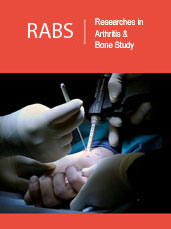
Researches in Arthritis & Bone Study
Shoulder Dislocation & Rotator Cuff Tears a Challenging Combo!!
-
Open or CloseSuresh Kishanrao*
Department of Family Physician & Public Health Consultant, India/p>
*Corresponding author:Suresh Kishanrao, Family Physician & Public Health Consultant, Bengaluru, Karnataka, India
Submission: January 05, 2026;Published: February 11, 2026
Volume2 Issue 3February 11, 2026
Abstract
Introduction: The shoulder is one of the most mobile and unstable joints of the human body. When the
head of the humerus pops out of the shoulder blade’s socket called the glenoid it is called dislocation.
Shoulder Dislocation (SD) is primarily caused by traumatic injuries especially among elderly falling in
bathroom, and among youth by direct blows in sports or vehicle accidents, or extreme rotation, forcing
the humerus head out of the socket, often with the arm raised or twisted. Other causes include underlying
ligament laxity, electric shocks and seizures, which can cause muscles to contract violently and pull the
joint out of place. The powerful force causing a dislocation can easily tear one or more tendons stabilizing
the humerus especially the rotator cuff, making them a frequent combination, particularly in older
individuals.
Materials & methods: This article aims to report in all five cases shoulder dislocation. Two cases of
primary dislocation, one case each of accidental dislocation, chronic dislocation and bilateral dislocation
and their management. It shows that in the elderly shoulder dislocation is often associated with a rotator
cuff tear and becomes a challenge for rehabilitation.
Outcome: The elderly patient had to undergo arthroscopy, for a trivial injury due to a fall, The young
football player needed the labral tear repair arthroscopically followed by mini-open rotator cuff repair
and took almost a year to resume his sports. The chronic shoulder dislocation case had temporary relief
with cortisone injection but had to undergo rotator cuff repair surgery followed by physiotherapy a year
later after three injections, bicycle accident patient had to undergo surgical intervention, physiotherapy
to recover complete range of movements in about 16 weeks. Other elderly with bilateral dislocation were
treated with closed reduction under procedural sedation, put in sling for immobilization for 6 weeks to
allow healing.
Keywords:Shoulder; Head of humerus; Glenoid; Luxation; Sub-luxation; Arthroscopy; Physiotherapy; Xray; MRI; CT scan
Abbreviations: RCT: Rotator Cuff Tear; ROM: Range of Motions
Editor In Chief





.jpg)






























Signup for Newsletter

Quick Links
 Editorial Board Registrations
 Submit your Article
 Best Paper of the Volume
 Reprints
 Refer a Friend
 Advertise With Us
Our Recent Edition
.jpg)



Top Editors



.jpg)
















.bmp)
.jpg)
.png)
.jpg)













.jpg)






.png)

.png)




.png)




Financial Support

Sponsors

Latest e-Books

Latest Video

 a Creative Commons Attribution 4.0 International License. Based on a work at www.crimsonpublishers.com.
Best viewed in
a Creative Commons Attribution 4.0 International License. Based on a work at www.crimsonpublishers.com.
Best viewed in 
 | Above IE 9.0 version