

- About Us
- Information
-

The Author ensures that the research has been conducted responsibly and ethically with adherence to all relevant regulations. read more..
- For Authors
- For Reviewer
- Manuscript Guidelines
- Membership
- Publication Ethics
-
- Journals
- Reprints
- e-Books
- Videos
- Policies
- Contact Us
 COVID-19
- Submissions



Full Text
Peer Review Journal of Solar & Photoenergy Systems
GFN-xTB: A Tight-binding Approach for Structural Determination and Sustainable Energy Applications of Metal-Organic Frameworks
Hasnain Sajid1,2* and Matthew A Addicoat2
1Department of Mechanical and Aerospace Engineering, Carleton University, 1125 Colonel by Drive, Ottawa, ON, K1S 5B6, Canada
2School of Science and Technology, Nottingham Trent University, UK
*Corresponding author: Hasnain Sajid, Department of Mechanical and Aerospace Engineering, Carleton University, 1125 Colonel by Drive, Ottawa, ON, K1S 5B6, Canada and School of Science and Technology, Nottingham Trent University, UK
Submission: October 16, 2025;Published: February 05, 2026

Volume2 Issue5 February 05, 2026
Abstract
The computational performance of GFN-xTB, including CPU time for calculations, accuracy, number of atoms and heavy atom root mean square deviation for the structural determination of Metal-Organic Frameworks (MOFs), is compared with DFT and Force Field methods based on the existing literature. Herein, it is highlighted that the computational time of GFN-xTB is less than 102 seconds for a large MOF containing 5000 atoms in a unit cell and the resultant optimized structure is highly accurate with less than 0.05 Å deviation in structural optimization. Moreover, the photovoltaic properties from GFN-xTB are in satisfactory agreement with DFT and experimental results. The overall performance of GFN-xTB with respect to computational costs and accuracy is far better than DFT and Force Field methods, respectively.
Introduction
Metal-Organic Frameworks (MOFs) are crystalline materials with ultrahigh porosity (up to 90 % free volume) [1] and large surface areas (in excess of 6000m2/g) [2] which makes them a suitable candidate for many applications in catalysis [3] gas sensing [4,5] separation and storage [6]. Since the last two decades, the number of synthesised MOFs has dramatically increased to ca. 70,000 in the Cambridge Structural Database (CSD) [7]. Computational modelling, nowadays, plays an increasingly important role in the pre-synthesis design of hypothetical MOFs with targeted properties, resulting in the rational suggestion of an ideal candidate(s) for attempted synthesis [8].
Density Functional Theory (DFT) Computational modelling, including structure optimisations, frequency calculations and optoelectronic properties of MOFs, is dominated by Density Functional Theory (DFT) calculations [9]. Thousands of research articles have been published to describe the structure-property relationship of both experimental and hypothetical MOFs using DFT calculations; a few examples are described in a review by Cheetham et al. [10] DFT methods including PBE [11] B3LYP [12] HSE06[13] and many more are highly accurate in computing the structures of MOFs with heavy atom root mean square deviation (hRMSD) less than 0.05 Å. However, these methods are computationally costly for large (containing more than 1000 atoms), periodic MOF systems [13]. For instance, the reported CPU time per optimisation cycle is more than 104 seconds for the Rh-MOF (480 atoms) on an Intel Xeon-E5-266.V4@2.00 GHz CPU [14].
Force Fields (FF) Many interesting periodic MOFs with 2000-5000 atoms in a unit cell are not viable for routine DFT optimisations, such investigations are performed by empirical Force-Field (FF) models [15]. Force fields variously parameterise bond lengths, angles, torsions and non-bonded interactions and are consequently up to five to ten orders of magnitude faster than DFT and therefore applicable for larger MOFs (>1000 atoms) [16]. The HRMSD of Universal Force Field (UFF) is greater than 2.00Å for the common MOF-5, as compared to only 0.04Å for the computationally efficient DFT method B97-3c [14]. Initially, this poor and unpredictable accuracy was a serious drawback of FF methods; however, several parameterizations of different Force Fields have variously overcome this limitation [17,18]. Unfortunately, the need for specific parametrizations restricts the applicability of force fields to MOFs where sufficient experimental data is available-most general force fields i.e., AMBER [19] CHARMM [20] UFF [21] MM1 and MM2 [22] are only suitable for specific combinations of (mostly organic) atoms, which limits their usefulness given the wide variety of metal nodes in MOFs. A further limitation on the use of FF methods is the limited range of properties available-while the structure and mechanical properties [23] are readily accessible, electronic properties are not.
Density Functional Tight Binding (DFTB) The high computational cost of DFT, inaccuracy and limited parameterization of FF limit their usage in MOF research. Thus, an intermediate approach, with accuracy and computational cost between DFT and FF, respectively, is highly desirable. This situation sparks renewed interest in semiempirical methods such as Density Functional Tight-Binding (DFTB), which combines the accuracy of Kohn-Sham DFT and the efficiency of minimal atomic orbital basis sets [24]. DFTB is parametrized with precomputed interactions of element pairs, thus it is ca. 2 orders of magnitude faster than conventional DFT [25]. However, similarly to force fields, the lack of availability of parameters, especially for transition metals, where parameters are required for both element pairs and the description of spinpolarisation [26] has limited their applicability to MOFs [27]. To overcome the problem of the non-generality of DFTB, extended tight-binding (xTB) methods have been developed.
GFN-xTB is a computationally robust extended DFTB method developed in 2017 [27] to yield desired geometric, noncovalent interactions with Grimme dispersion (D3) correction and vibrational frequency with ultra-high accuracy, where x stands for the extended atom-centred minimal basis set, augmented with s-function and a d-polarization function, which enable it to describe hydrogen and hyper-valent bonding, respectively. The parametrization of GFNxTB covers s/p/d-block elements up to atomic number 86, which makes it applicable to a wide range of metallic elements, including some lanthanide and actinide elements [28].
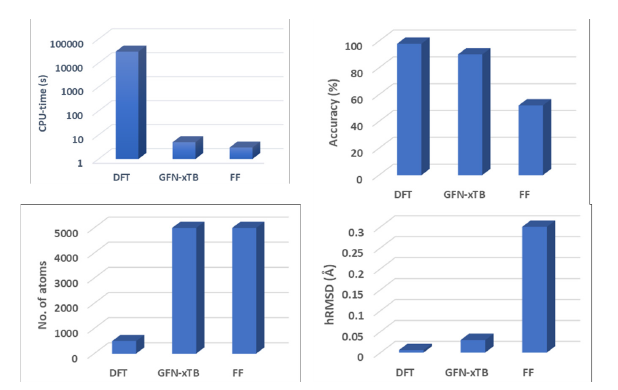
Recent Literature Grimme and co-workers attempted to explore the accuracy of GFN methods in mapping transition metal [14,29] and lanthanide [30] containing MOF structures by comparing the results with high DFT level (PBE0-D4/def2-TZVP) and FF methods. The GFNn-xTB methods not only performed well (with HRMSD less than 0.5 Å) for full geometry optimisation of medium (309 atoms) to large (2784 atoms) non-periodic MOF units but also 6-8 times faster (CPU time per optimisation cycle less than 102s) than highlevel DFT optimisations. The comparative performance of GFNxTB with DFT and FF in terms of computational or CPU-time (s), percentage accuracy, number of atoms and heavy atoms root mean square deviation is graphically represented in Figure 1. GFN-xTB has great potential to rationalize the structure-property relationships of porous materials, including MOFs, COFs, ZIFs and PPNs. The xTB program, as implemented by the Grimme group [https://github. com/grimme-lab/xtb/], has recently been extended to include periodic optimisation. Direct calculation of periodic systems is also available via the GFN1-xTB method implemented in Amsterdam Density Functional (AMS) software developed by Software for Chemistry and Materials (SCM) [31] and the implementation in DFTB+ [32]. Recently, the efficiency of the GFN2-xTB method in alkali-metal-based batteries has been reported by Eilmes et al. [33] and claimed that GFN-xTB is a suitable alternative for studying sustainable energy applications.
Figure 1:GFN-xTB performance for geometry optimization of MOFs compared with DFT and FF methods based on Ref [14,28,29] where the CPU-time and percentage accuracy are compared between the TPSSh/TZ DFT, GFN1-xTB and UFF given in ref [28] while hRMSD values are the average of results presented by Grimme et al. in ref [14].
Conclusion
The article focuses on the computational performance of GFNxTB methods for the structural determination and investigation of sustainable energy applications of MOFs. The efficiency of the GFN-xTB approach enables calculation of large MOF structures containing many thousands of atoms with higher accuracy (90%), which is not practicable by DFT and FF methods due to lower accuracy and high computational cost, respectively.
Author Contributions
Hasnain Sajid: Writing-original draft. Matthew Addicoat: Supervision, review and editing.
Conflicts of Interest
There are no conflicts to declare.
Data Availability Statement
Data sharing is not applicable as no new data were generated or analysed during this study.
References
- Zhou HC, Long JR, Yaghi OM (2012) Introduction to metal-organic frameworks. Chem Rev 112(2): 673-674.
- Omar K Farha, Ibrahim Eryazici, Nak Cheon Jeong, Brad G Hauser, Christopher E Wilmer, et al. (2012) Metal-organic framework materials with ultrahigh surface areas: Is the sky the limit? J Am Chem Soc 134(36): 15016-15021.
- Wen Gang Cui, Guo Ying Zhang, Tong Liang Hu, Xian He Bu (2019) Metal-organic framework-based heterogeneous catalysts for the conversion of C1 chemistry: CO, CO2 and CH4. Coord Chem Rev 387: 79-120.
- Amini A, Kazemi S, Safarifard V (2020) Metal-organic framework-based nanocomposites for sensing applications -A review.
- L Wang (2020) Metal-organic frameworks for QCM-based gas sensors: A review. Sensors and Actuators A: Physical 307: 111984.
- Baumann AE, Burns DA, Liu B, Thoi VS, (2019) Metal-organic framework functionalization and design strategies for advanced electrochemical energy storage devices. Commun Chem 2: 86.
- Peyman Z Moghadam, Timur Islamoglu, Subhadip Goswami, Jason Exley, Marcus Fantham, et al. (2017) Development of a Cambridge Structural Database subset: A collection of metal-organic frameworks for past, present and future Chem. Mater 29: 2618-2625.
- Christopher E Wilmer, Michael Leaf, Chang Yeon Lee, Omar K Farha, Brad G Hauser, et al. (2011) Large-scale screening of hypothetical metal-organic frameworks. Nat Chem 4(2): 83-89.
- Kharissova OV, Kharisov BI, González LT (2020) Recent trends on density functional theory-assisted calculations of structures and properties of metal-organic frameworks and metal-organic frameworks-derived nanocarbons. J Mater Res 35: 1424-1438.
- Jin Chong Tana, Anthony K Cheetham (2011) Mechanical properties of hybrid inorganic-organic framework materials: Establishing fundamental structure-property relationships. Chem Soc Rev 40(2): 1059-1080.
- Mattsson AE, Armiento R, Schultz PA, Mattsson TR (2006) Nonequivalence of the generalized gradient approximations PBE and PW91. Phys Rev B73: 195123.
- Igor Ying Zhang, Jianming Wua, Xin Xu (2010) Extending the reliability and applicability of B3LYP. Chem Commun 46(18): 3057-3070.
- Peter Deák, Bálint Aradi, Thomas Frauenheim, Erik Janzén, Adam Gali, et al. (2010) Accurate defect levels obtained from the HSE06 range-separated hybrid functional. Phys Rev B81: 153203.
- Spicher S, Bursch M, Grimme S (2020) Efficient calculation of small molecule binding in metal-organic frameworks and porous organic cages. J Phys Chem 124(50): 27529-27541.
- Saeed Amirjalayer, Rochus Schmid (2008) Conformational isomerism in the is reticular metal organic framework family: A force field investigation. J Phys Chem 112(38): 14980-14987.
- Chi Chen, Zhi Deng, Richard Tran, Hanmei Tang, Iek Heng Chu, et al. (2017) Accurate force field for molybdenum by machine learning large materials data. Phys Rev Mater 1: 043603.
- Matthew A Addicoat, Nina Vankova, Ismot Farjana Akter, Thomas Heine (2014) Extension of the universal force field to metal-organic frameworks. J Chem Theory and Comput 10(2): 880-891.
- Damien E Coupry, Matthew A Addicoat, Thomas Heine (2016) Extension of the universal force field for metal-organic frameworks. J Chem Theory and Comput 12(10): 5215-5225.
- Junmei Wang, Romain M Wolf, James W Caldwell, Peter A Kollman, David A Case, et al. (2004) Development and testing of a general amber force field. J Comput Chem 25(9): 1157-1174.
- MacKerell AD, Banavali N, Foloppe N, (2000) Development and current status of the CHARMM force field for nucleic acids. Biopolymers 56(4): 257-265.
- Rappe AK, Casewit CJ, Colwell KS, Goddard WA, Skiff WM, et al. (1992) UFF, a full periodic table force field for molecular mechanics and molecular dynamics simulations. Journal of the American Chemical Society 114(25): 10024-10035.
- Philip M Warner, Stephen Peacock (1982) Strain energies of some bridgehead olefins as calculated with the MM2 force field. J Comput Chem 3(3): 417-420.
- Peter G Boyd, Seyed Mohamad Moosavi, Matthew Witman, Berend Smit (2017) Force-field prediction of materials properties in metal organic frameworks. J Phys Chem Lett 8(2): 357-363.
- Bannwarth C, Caldeweyher E, Ehlert S, Hansen A, Pracht P, et al. (2021) Extended tight-binding quantum chemistry methods. WIREs Comput Mol Sci 11(2): e1493.
- Maxime Van den Bossche (2019) DFTB-Assisted global structure optimization of 13- and 55-atom late transition metal clusters. The Journal of Physical Chemistry A 123(13): 3038-3045.
- Guishan Zheng, Henryk A Witek, Petia Bobadova Parvanova, Stephan Irle, Djamaladdin G Musaev, et al. (2007) Parameter calibration of transition-metal elements for the spin-polarized self-consistent-charge Density-Functional Tight-Binding (DFTB) Method: Sc, Ti, Fe, Co, and Ni. J Chem Theory Comput 3(4): 1349-1367.
- Augusto F Oliveira, Pier Philipsen, Thomas Heine (2015) DFTB parameters for the periodic table, part 2: energies and energy gradients from hydrogen to calcium. J Chem Theory and Compt 11(11): 5209-5218.
- Christoph Bannwarth, Sebastian Ehlert, Stefan Grimme (2019) GFN2-xTB-An Accurate and broadly parametrized self-consistent tight-binding quantum chemical method with multipole electrostatics and density-dependent dispersion contributions. J Chem Theory and Compt 15(3): 1652-1671.
- Markus Bursch, Hagen Neugebauer, Stefan Grimme (2019) Structure optimisation of large transition-metal complexes with extended tight-binding methods. Angew Chem Int Ed 58(32): 11078-11087.
- Markus Bursch, Andreas Hansen, Stefan Grimme (2017) Fast and reasonable geometry optimization of lanthanoid complexes with an extended tight binding quantum chemical method. Inorg Chem 56(20): 12485-12491.
- Yannick J Bomble (2006) Amsterdam density functional 2005 scientific computing and modelling NV, Vrije Universiteit, theoretical chemistry, De Boelelaan 1083, 1081 HV Amsterdam, the Netherlands. J Am Chem Soc 128(9): 3103-3103.
- B Hourahine, B Aradi, V Blum, F Bonafé, A Buccheri, et al. (2020) DFTB+, a software package for efficient approximate density functional theory based atomistic simulations. J Chem Phys 152(12): 124101.
- Piotr Wróbel, Andrzej Eilmes (2023) Effects of Me-Solvent Interactions on the Structure and Infrared Spectra of MeTFSI (Me=Li, Na) solutions in carbonate solvents-a test of the gfn2-xtb approach in molecular dynamics simulations. Molecules 28(18): 6736.
© 2026 Hasnain Sajid. This is an open access article distributed under the terms of the Creative Commons Attribution License , which permits unrestricted use, distribution, and build upon your work non-commercially.
Editor In Chief







.jpg)































Signup for Newsletter

Quick Links
 Editorial Board Registrations
 Submit your Article
 Best Paper of the Volume
 Reprints
 Refer a Friend
 Advertise With Us
Our Recent Edition

.jpg)



Top Editors




.jpg)

















.bmp)
.jpg)
.png)
.jpg)













.jpg)






.png)

.png)




.png)




Financial Support

Sponsors

Latest e-Books

Latest Video

 a Creative Commons Attribution 4.0 International License. Based on a work at www.crimsonpublishers.com.
Best viewed in
a Creative Commons Attribution 4.0 International License. Based on a work at www.crimsonpublishers.com.
Best viewed in 
 | Above IE 9.0 version