

- About Us
- Information
-

The Author ensures that the research has been conducted responsibly and ethically with adherence to all relevant regulations. read more..
- For Authors
- For Reviewer
- Manuscript Guidelines
- Membership
- Publication Ethics
-
- Journals
- Reprints
- e-Books
- Videos
- Policies
- Contact Us
 COVID-19
- Submissions



Full Text
Open Access Biostatistics & Bioinformatic
Robust Estimation in Gompertz Diffusion Model of Tumor Growth
Jaya PN Bishwal*
Department of Mathematics and Statistics, University of North Carolina at Charlotte, USA
*Corresponding author: Jaya PN Bishwal, Department of Mathematics and Statistics, University of North Carolina at Charlotte, 376 Fretwell Building, 9201 University City Blvd, Charlotte, NC 28223, USA.
Submission: January 27, 2018;Published: May 10, 2018

ISSN: 2578-0247
Volume1 Issue5
Abstract
Stochastic Gompertz diffusion model describes the in vivo tumor growth. The drift parameter describes the intrinsic growth rate (mitosis rate) of the tumor. The paper introduces some new approximate minimum contrast estimators of the tumor growth acceleration parameter in the Gompertz diffusion model based on discretely sampled data which are robust and studies their asymptotic distributional properties with precise rates of convergence.
Keywords: Itȏ stochastic differential equation; Gompertz diffusion process; Black-Karasinski model; Discrete observations; Approximate minimum contrast estimators; Robustness; efficiency; Berry-Esseen bound
Model and Estimators
The Gompertz diffusion process has been used in tumor growth modeling, Ferrante et al. [1]. Lo [2] considered a Gompertz diffusion model in which the size of the tumor cells is bounded and used Lie-algebraic method to derive the exact analytical solution of the functional Fokker-Planck equation obeyed by the density function of the size of the tumor. Giorno et al. [3] proposed a nonhomogeneous time dependent Gompertz diffusion process with jumps to describe the evolution of a solid tumor subject to an intermittent therapeutic program. Moummou et al. [4] obtained explicit expressions for the maximum likelihood estimators with discrete sampling from the Gompertz diffusion model by using functional optimization orthogonal projections. However, the statistical properties of the model were not studied.
Ferrante et al. [1] studied maximum likelihood estimation of natural growth parameters of tumor for such models. However, they did not study distributional properties of the estimators. The knowledge of the distribution of the estimator may be applied to evaluate the distribution of other important growing parameters used to access tumor treatment modalities. We study distributional properties of approximate minimum contrast estimators of the unknown parameters in the model from discrete data with precise rates of convergence which are robust and efficient.
Let  ,P be a stochastic basis on which is defined
the Gompertz diffusion process
,P be a stochastic basis on which is defined
the Gompertz diffusion process  satisfying the Itȏ stochastic
dierential equation
satisfying the Itȏ stochastic
dierential equation

Where  is a standard Brownian motion with the
filtration
is a standard Brownian motion with the
filtration  and α>0; β>0; σ>0 are the unknown parameters to
be estimated on the basis of discrete observations of the process
{Xt} at times 0=t0< t1 < ....tn=T with ti-ti-1= T
n , i = 1,2....,n. We assume equi-spaced sampling for simplicity. We assume two types of high
frequency data:
and α>0; β>0; σ>0 are the unknown parameters to
be estimated on the basis of discrete observations of the process
{Xt} at times 0=t0< t1 < ....tn=T with ti-ti-1= T
n , i = 1,2....,n. We assume equi-spaced sampling for simplicity. We assume two types of high
frequency data:
Here Xt is the tumor volume which is measured at discrete
time, α is the intrinsic growth rate of the tumor, β is the tumor
growth acceleration factor, and σ is the diffusion coefficient. Other
parameters are the plateau of the model  tumor growth decay, and the first time the growth curve of the model
reaches X∞ . We assume that the growth deceleration factor β
does not change, while the variability of environmental conditions
induces fluctuations in the intrinsic growth rate (mitosis rate) α.
In finance literature, this model is known as Black-Karasinski
model which is a geometric mean reverting Vasicek model used for
modeling term structure of interest rates which preserves positivity
of the interest rates.
tumor growth decay, and the first time the growth curve of the model
reaches X∞ . We assume that the growth deceleration factor β
does not change, while the variability of environmental conditions
induces fluctuations in the intrinsic growth rate (mitosis rate) α.
In finance literature, this model is known as Black-Karasinski
model which is a geometric mean reverting Vasicek model used for
modeling term structure of interest rates which preserves positivity
of the interest rates.
Let the continuous realization be {Xt,0≤t≤T} denoted by
 . Denote Ѳ:=(α,β,σ). Let
 be the measure generated
on the space (CT,BT) of continuous functions on [0,T] with the associated
Borel σ algebra BT generated under the supremum norm by the
process
be the measure generated
on the space (CT,BT) of continuous functions on [0,T] with the associated
Borel σ algebra BT generated under the supremum norm by the
process  and let
 be the standard Wiener measure. It is
well known that when Ѳ is the true value of the parameter
be the standard Wiener measure. It is
well known that when Ѳ is the true value of the parameter
 is
absolutely continuous with respect to
is
absolutely continuous with respect to  and the Radon-Nikodym
derivative (likelihood) of
and the Radon-Nikodym
derivative (likelihood) of  with respect to
 based on the data
 is given by

Consider the log-likelihood function, which is given by

A solution of the estimating equation  provides the
conditional maximum likelihood estimators (MLEs)
provides the
conditional maximum likelihood estimators (MLEs)

As an alternative to maximum likelihood method and to obtain
robust estimators with higher efficiency we use contrast functions.
Suppose α and σ are known, for simplicity let  , σ=1, 1; x0=1
and our aim is to estimate the tumor growth acceleration parameter
β. Using Itȏ formula, the score function can be written as
, σ=1, 1; x0=1
and our aim is to estimate the tumor growth acceleration parameter
β. Using Itȏ formula, the score function can be written as

Using a contrast function which is related to the negative derivative of the log-likelihood function, we consider the estimating function,

Then the minimum contrast estimate (MCE) of β which is the solution of is given by

Where  Hence
Hence 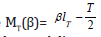 . Sometimes we
will denote this by just MT. We find several discrete approximations
of the MCE. Define a weighted approximation of IT:
. Sometimes we
will denote this by just MT. We find several discrete approximations
of the MCE. Define a weighted approximation of IT:

Where wti≥0 is a weight function. Denote the forward and backward approximations of IT:
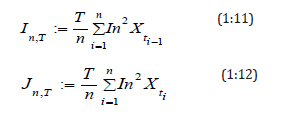
General weighted AMCE is defined as

With wti =1 in (1.10), we obtain the forward AMCE as

With = 0 in (1.10), we obtain the backward AMCE as

With w_(t_i )=0.5 in (1.10), the simple symmetric AMCE is defined as

Define the weighted symmetric estimators: With the weight function
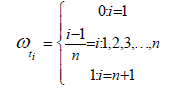
the weighted symmetric AMCE is defined as
 Note that estimator (1.16) is
analogous to the trapezoidal rule in numerical analysis. One
can instead use the midpoint rule to define another estimator
Note that estimator (1.16) is
analogous to the trapezoidal rule in numerical analysis. One
can instead use the midpoint rule to define another estimator
 . One can further use the Simpson’s
rule to define another estimator where the denominator is a
convex combination of the trapezoidal and midpoint estimators,
. One can further use the Simpson’s
rule to define another estimator where the denominator is a
convex combination of the trapezoidal and midpoint estimators,

The AMCE has several good properties. The AMCE is simpler to calculate, in the sense that it does not involve simulation of a stochastic integral unlike AMLE. Hence AMCE is a more practical estimator. This is robust since M-estimator is reduced to the AMCE. The AMCE is efficient, Tanaka [5]. Tanaka [5] calculated the asymptotic relative efficiency of the minimum contrast estimator with respect to least squares estimator (LSE) and showed that MCE is asymptotically efficient while LSE is inefficient. We study the distributional properties of the AMCE. We obtain the rate of weak convergence to normal distribution of the AMCE using different normings. We also obtain stochastic bound on the difference of the AMCE and its continuous counterpart MCE when T is fixed. We need the following lemmas from Bishwal [6] to prove our main results.
Lemma 1.1 Let X, Y and Z be any three random variables on a probability space (Ω,F,P) with P(Z>0)=1. Then, for any Є>0, we have

Lemma 1.2 Let Qn, Rn, Q and R be random variables on the
same probability space (Ω,F,P) with P(Rn>0)=1 and P(Rn>0)=1.
Suppose  where
where

Distributional Properties of Estimators
Let Ø(.) denote the standard normal distribution function. Throughout the paper C denotes a generic constant (perhaps depending on β, but not on anything else). Since ln Xt is an Ornstein- Uhlenbeck process, we can use the following lemmas from Bishwal [6] in the sequel.
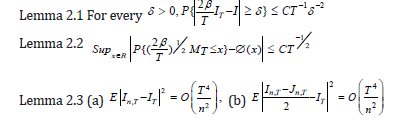
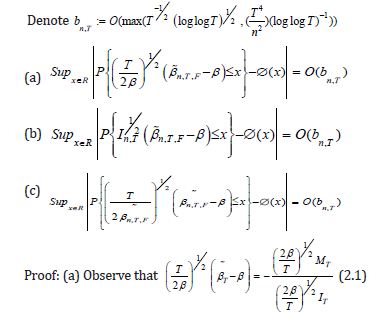
The following theorem gives the bound on the error of approximation of the distributions of the AMCE to normal distribution. Note that part (a) uses parameter dependent nonrandom norming. While this is useful for testing hypotheses about β, it may not necessarily give a confidence interval. The normings in parts (b) and (c) are sample dependent which can be used for obtaining a confidence interval. Following theorem shows that asymptotic normality of the AMCE needs the design condition

Theorem 2.1
Thus, we have I Hence
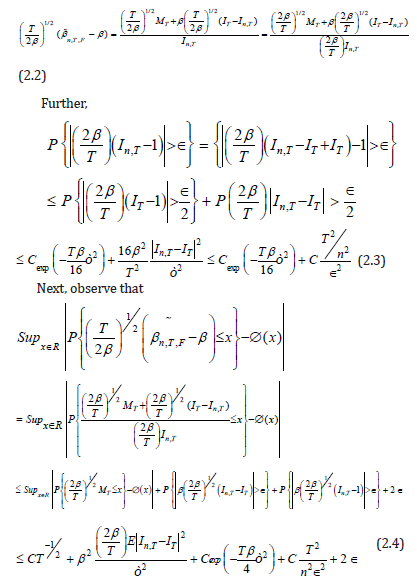
(the bound for the 3rd term in the right hand side of (2.4) is obtained from (2.3))
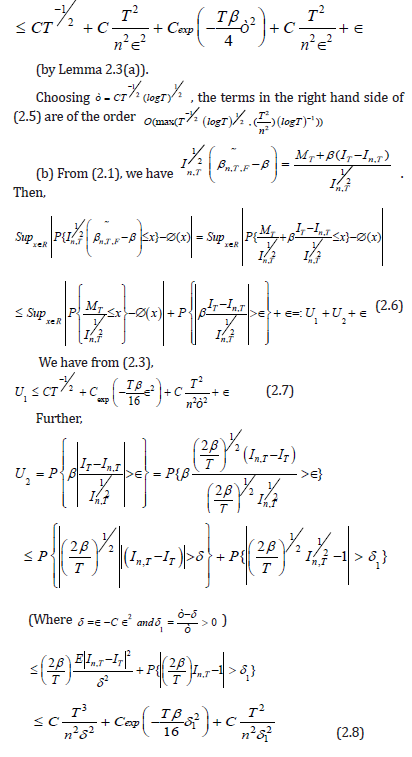
Here, the bound for the first term in the right hand side of (2.7)
comes from Lemma 2.2(c) and that for the second term is obtained
from (2.3) [2]. Now, using the bounds (2.7) and (2.8) in (2.6) with
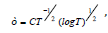 , we obtain that the terms in (2.6) are of the order
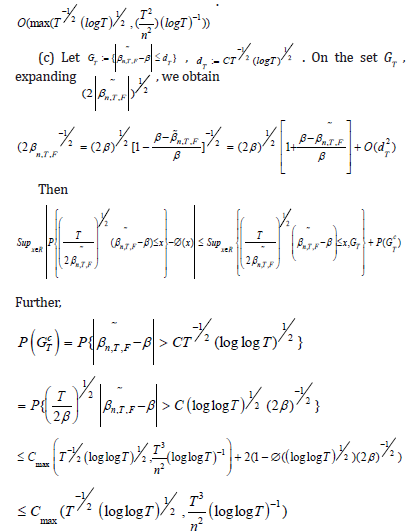
On the set 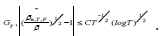 . Hence, upon choosing
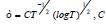 large, using Lemma 1.1(b)) and Theorem 2.1(a)),
we obtain
large, using Lemma 1.1(b)) and Theorem 2.1(a)),
we obtain
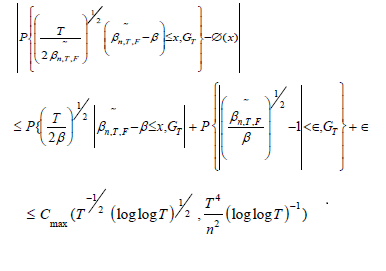
In the following theorem, we improve the bound on the error of
normal approximation using a mixture of random and non-random
normings. Thus asymptotic normality of the AMCEs need T → ∞
and  which are sharper than the bound in Theorem 2.1.
Theorem 2.2

The following theorem gives stochastic bound on the error of approximation of the continuous MCE by AMCEs.
Theorem 2.3
References
- Ferrante L, Bompadre S, Possati L, Leone L (2000) Parameter estimation in a Gompertzian stochastic model of tumor growth. Biometrics 56(4): 1076-1081.
- Lo CF (2010) A modified stochastic Gompertz model for tumor cell growth. Computational and Mathematical Methods in Medicine 11(1): 3-11.
- Giorno V, Roman P, Spina S, Torres RF (2017) Estimating a non-homogeneous Gompertz process with jumps as a model in tumor dynamics. Computational Statistics and Data Analysis 107: 18-31.
- Moummou EK, Gutierrez R, Gutierrez SR (2012) A stochastic Gompertz model with logarithmic therapy functions: Parameter estimation. Applied Mathematics and Computation 219(8): 3729-3739.
- Tanaka K (2013) Distributions of the maximum likelihood and minimum contrast estimators associated with the fractional Ornstein-Uhlenbeck process. Statistical Inference for Stochastic Processes 16(3): 173-192.
- Bishwal JPN (2008) Parameter estimation in stochastic differential equations. Lecture notes in mathematics 1923. Springer-Verlag, Germany.
© 2018 Jaya PN Bishwal. This is an open access article distributed under the terms of the Creative Commons Attribution License , which permits unrestricted use, distribution, and build upon your work non-commercially.
Editor In Chief







.jpg)































Signup for Newsletter

Quick Links
 Editorial Board Registrations
 Submit your Article
 Best Paper of the Volume
 Reprints
 Refer a Friend
 Advertise With Us
Our Recent Edition

.jpg)



Top Editors




.jpg)

















.bmp)
.jpg)
.png)
.jpg)













.jpg)






.png)

.png)




.png)




Financial Support

Sponsors

Latest e-Books

Latest Video

 a Creative Commons Attribution 4.0 International License. Based on a work at www.crimsonpublishers.com.
Best viewed in
a Creative Commons Attribution 4.0 International License. Based on a work at www.crimsonpublishers.com.
Best viewed in 
 | Above IE 9.0 version