

- About Us
- Information
-

The Author ensures that the research has been conducted responsibly and ethically with adherence to all relevant regulations. read more..
- For Authors
- For Reviewer
- Manuscript Guidelines
- Membership
- Publication Ethics
-
- Journals
- Reprints
- e-Books
- Videos
- Policies
- Contact Us
 COVID-19
- Submissions



Full Text
Research in Medical & Engineering Sciences
Advances of Material Structure Formation during High-Voltage Powder Consolidation
EG Grigoriev1*, V Yu Goltsev2, EL Strizhakov3, SV Neskoromny3, OO Kuznechik4, AN Chumakov5 and AV Osintsev2
1A.G. Merzhanov Institute of Structural Macrokinetics and Problems of Materials Science, Russian Academy of Sciences, Russia
2National Research Nuclear University MEPhI, Russia
3Don State Technical University, Russia
4O.V. Roman Institute of Powder Metallurgy, National Academy of Sciences of Belarus, Russia
5B.I. Stepanov Institute of Physics, National Academy of Sciences of Belarus, Russia
*Corresponding author:Evgeny Grigorievich Grigoriev, A.G. Merzhanov Institute of Structural Macrokinetics and Problems of Materials Science, Russian Academy of Sciences, Russia
Submission: August 14, 2026;Published: August 26, 2026

ISSN: 2576-8816Volume12 Issue 3
Opinion
High-voltage powder consolidation forms a complex compact material through the combined action of external mechanical pressure and high-voltage pulsed current on a powder blank. The process of high-voltage powder consolidation is largely determined by the localization of energy release in interparticle contacts during the electric pulse action on the powder blank. The compaction process is decisively influenced by both the shape and size of the powder particles and the properties of the powder material, such as heat resistance and the temperature dependence of the yield strength. Theoretical analysis, computer modeling, and experimental studies of the high-voltage consolidation process have identified the conditions for the formation of various compaction modes for cylindrical powder blanks. Wave compaction modes along the axis of a cylindrical compact under mechanical pressure from punches [1] have been established and studied for materials whose yield strength decreases with increasing temperature. Radial compaction modes for cylindrical powder compacts under the influence of magnetic pressure generated by a high-voltage current pulse have also been established. Radial compaction due to magnetic pressure dominates over axial compaction caused by the mechanical pressure of the punches for two different modes. First, when the amplitude of the magnetic pressure on the compact exceeds the mechanical pressure from the punches; second, when the mechanical pressure is unable to deform the spherical granules of the heat-resistant material during consolidation. The structure of the materials of samples consolidated under wave compaction modes differs from that of materials consolidated under magnetic pressure.
The wave compaction mode in a cylindrical powder compaction is formed by the movement of the punches along the axis of the compaction. The process of compaction of the powder material under constant pressure from the punches occurs due to the collapse of interparticle pores at the front of the compaction wave, which is created in the powder compaction during the movement of the punch. The velocity of the compaction wave front is related to the speed of the punch and depends on the pressure P exerted by the punches on the compaction and the resistance to plastic deformation of the powder material being compacted during high-voltage consolidation [2]. The dynamics of the collapse of interparticle pores at the front of the compaction wave is determined by the dimensionless parameters β and R [2]:
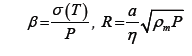
where: σ(T) is the yield strength of the powder material, a is the initial pore radius, η is the dynamic viscosity of the powder material, ρm is the density of the powder material, T is the temperature of the powder material.
In [2], the range of values of the parameters β and R in which pore collapse occurs in cumulative modes was established. Figures 1&2 show examples of the microstructures of powder materials obtained in cumulative high-voltage consolidation modes. The presence of spherical pores of different sizes in compact materials consolidated in cumulative modes is shown in Figure 1 (hard alloy VK20) and Figure 2 (hafnium carbide HfC).
Figure 1:Sample of hard alloy VK20, cumulative mode (×1000).
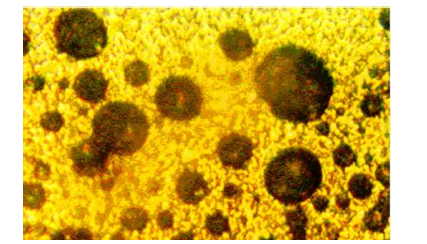
Figure 2:Hafnium carbide sample, cumulative mode.
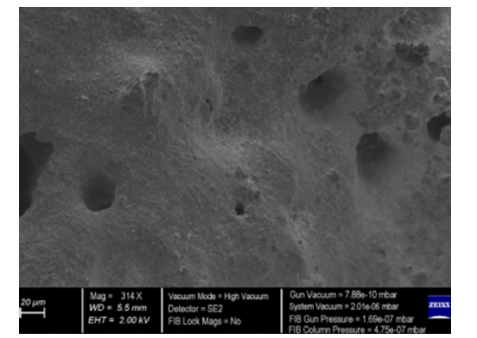
Figure 3:Microstructure of P6M5, mode 1.
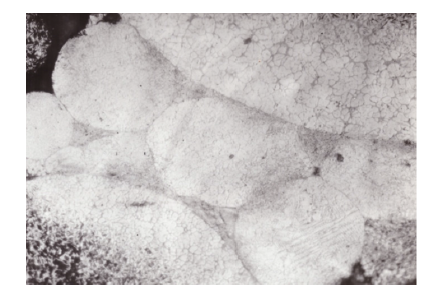
Another type of microstructure of a compact material is formed during radial compaction under the action of magnetic pressure created by a high-voltage current pulse flowing through a consolidated cylindrical sample, which contains heat-resistant granules of P6M5 powder steel and is shown in Figures 3-5.
Figure 4:Microstructure of P6M5, mode 3.
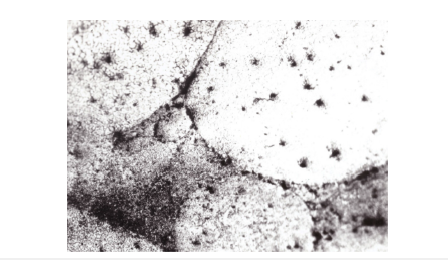
Figure 5:Microstructure of P6M5, mode 4.
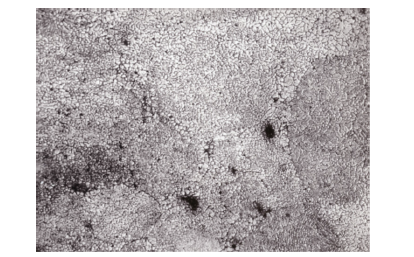
The mechanical pressure from the punches on the powder compacted R6M5 steel granules was constant at 350MPa for all modes. The high-voltage current pulse amplitude was: 226kA/cm2 for mode 1, 276kA/cm2 for mode 3, and 296kA/cm2 for mode 4.
A detailed analysis of the microstructure of samples of highspeed steel P6M5, consolidated under various modes of highvoltage consolidation of heat-resistant granules of powder steel P6M5, as well as an analysis of the microstructure of materials consolidated under wave modes, may be presented in the full text of the paper.
It should be noted that the main difference between the radial compaction modes due to magnetic pressure created by a highvoltage current pulse is the short-term effect of pressure on the entire volume of the consolidated sample compared to the wave compaction mode.
References
- Grigorye EG, Moskovskikh DO (2018) Wave kinetics of powder consolidation by high-voltage electric pulse. In: Proceedings of the 8th International Symposium on Nonequilibrium Processes, Plasma, Combustion, and Atmospheric Phenomenon, Sochi, Nonequilibrium Processes, “Torus Press”, LLC, Moscow, Russia pp: 153-160.
- Grigoryev EG, Olevsky EA, Yudin AV, Yurlova MS (2015) Wave mode high voltage consolidation of powder materials. Computational Materials Science 100, Part A: 8-14.
© 2026 EG Grigoriev. This is an open access article distributed under the terms of the Creative Commons Attribution License , which permits unrestricted use, distribution, and build upon your work non-commercially.
Editor In Chief







.jpg)































Signup for Newsletter

Quick Links
 Editorial Board Registrations
 Submit your Article
 Best Paper of the Volume
 Reprints
 Refer a Friend
 Advertise With Us
Our Recent Edition

.jpg)



Top Editors




.jpg)

















.bmp)
.jpg)
.png)
.jpg)













.jpg)






.png)

.png)




.png)




Financial Support

Sponsors

Latest e-Books

Latest Video



