

- About Us
- Information
-

The Author ensures that the research has been conducted responsibly and ethically with adherence to all relevant regulations. read more..
- For Authors
- For Reviewer
- Manuscript Guidelines
- Membership
- Publication Ethics
-
- Journals
- Reprints
- e-Books
- Videos
- Policies
- Contact Us
 COVID-19
- Submissions



Full Text
Research in Medical & Engineering Sciences
Optical-Mechanical Method for Determining the Hydrodynamics of Impurities in Liquids
Nikolenko IV1* and Movchan SI2
1Vernadsky Crimean Federal University, Russia
2Melitopol State University, Russia
*Corresponding author:Nikolenko IV, Vernadsky Crimean Federal University, Russia
Submission: April 11, 2026;Published: May 11, 2026

ISSN: 2576-8816Volume12 Issue 2
Abstract
The article discusses ways to improve the optical methods for determining the characteristics of pollution particles in water, in order to increase the efficiency of wastewater treatment. The use of measurement systems based on digital processing of Doppler signals from laser systems provides high-precision simultaneous measurement of the velocity and effective diameter of colloidal and dispersed particles. The integration of optical systems for automated measurement and adaptive control of pollution parameters opens up opportunities for significant intensification of wastewater treatment and purification processes.
Keywords:Pollution; Wastewater; Dispersed particle; Measurements; Laser system; Doppler signal
Introduction
The laser Doppler interferometry methods are used in many fields of physics, medicine, telecommunications, biology, and chemistry. They allow for the study of materials and processes that were previously difficult or impossible to investigate using traditional physical and chemical methods.
The use of laser light sources with high coherence, high power in a narrow spectral range, and high directivity has made it possible to develop and implement new interferometry methods for various objects and processes. In addition to traditional measurements of linear movements, including ultra-small movements, measurements of distances, velocities, and vibrations, as well as measurements of sizes and surface shapes, new methods are being developed based on the use of quantum dots in the photodetectors of optical systems for laser Doppler interferometry [1].
Analysis of the physical and chemical processes of colloidal and dispersed particles coagulation during the treatment of electroplating production wastewater has shown that the value of electrokinetic zeta potential (ξ - potential) of the double electric layer (DEL) of particles is of significant importance. At sufficiently large values of zeta potential (ξ > 30mV), colloidal systems are stable, since the repulsive forces arising between particles due to the deformation of diffuse electric layers prevent the enlargement of the dispersed phase as a result of particle coagulation [2,3].
The theoretical justification of the use of the optical method for determining the hydro-mechanical and physical parameters of suspended matter particles in wastewater has created the preconditions for the development and testing of a laboratory-based measuring device for determining the electrophoretic velocity, diameter, and electrokinetic potential during electrophoresis.
Using the Doppler effect and the Dove prism, a combined block diagram (Figure 1) has been developed for determining the electrokinetic zeta potential, effective diameter, electrophoretic velocity, and the number of impurity particles in aqueous solutions, etc.
Figure 1:Combined block diagram of the optical-mechanical system for determining the hydro-mechanical parameters of particles in aqueous solutions, technical fluids, and industrial wastewater: 1-coherent radiation source (helium-neon laser); 2-beam splitter; 3-optical lens; 4-electromechanical modulator; 5-mirror system; 6-world stream divider; 7-Dove prism; 8-electrophoretic cell; 9-photoelectric multiplier; 10-photodetector; 11-oscilloscope; 12-pulse counter; 13-personal computer; I, II, III, IV-measuring channels.
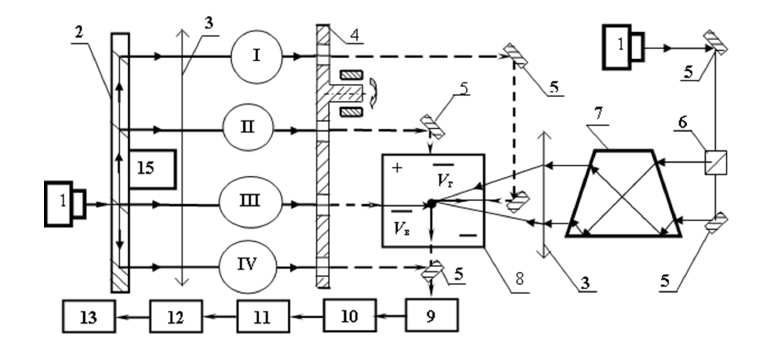
A detailed analysis of the dependence of the Doppler signal magnitude on time is the basis for the developed optical methods of laser interferometry for simultaneous measurement of the velocity and effective diameter of a particle during electrophoresis and/ or another combination of various hydrodynamic parameters of impurity particles in liquid media [4,5].
Conclusion
B. An optical method of laser Doppler interferometry has been developed and proposed in laboratory conditions, which allows remote, high-precision, real-time measurement of the electrophoretic velocity of particles in the processes of electrophoresis and sedimentation in a wide range of velocities of 10-5 ...102m/s and diameters of 1…500 microns.
C. The theoretical justification of the application of the optical method allows us to create the preconditions for the development of an algorithm and a program for mathematical modeling of the Doppler signal shape when measuring the hydrodynamic and physical parameters of particles in a fluid flow using laser Doppler interferometry, which allow us to estimate the relative errors in determining the size of impurity particles in aqueous solutions and the sensitivity of the developed method.
References
- Bajborodin YuV (1988) Fundamentals of laser technology. Russia, p. 308.
- Veselov YuS (1985) Water treatment equipment: Design and use. Yu S, Veselov IK, Lavrov NI, Rukobratsky L (Eds.), Mashinostroenie, Leningrad, Russia, p. 232.
- Goronovsky IT (1975) Physical and chemical justification of automation of technological processes of water treatment. Naukova Dumka, Kiev, Ukraine, p. 215.
- Nikolenko IV, Movchan SI (2023) Intensification of resource-saving technologies in recirculating water supply systems of industrial enterprises: Monograph. Moscow, Russia, p. 196.
- Movchan SI (2026) Control of particle parameters of water solutions in industrial wastewater treatment systems. SI Movchan (Ed.), Water Supply and Sanitary Engineering 3: 19-26.
© 2026 Nikolenko IV. This is an open access article distributed under the terms of the Creative Commons Attribution License , which permits unrestricted use, distribution, and build upon your work non-commercially.
Editor In Chief







.jpg)































Signup for Newsletter

Quick Links
 Editorial Board Registrations
 Submit your Article
 Best Paper of the Volume
 Reprints
 Refer a Friend
 Advertise With Us
Our Recent Edition

.jpg)



Top Editors




.jpg)

















.bmp)
.jpg)
.png)
.jpg)













.jpg)






.png)

.png)




.png)




Financial Support

Sponsors

Latest e-Books

Latest Video

 a Creative Commons Attribution 4.0 International License. Based on a work at www.crimsonpublishers.com.
Best viewed in
a Creative Commons Attribution 4.0 International License. Based on a work at www.crimsonpublishers.com.
Best viewed in 
 | Above IE 9.0 version