

- About Us
- Information
-

The Author ensures that the research has been conducted responsibly and ethically with adherence to all relevant regulations. read more..
- For Authors
- For Reviewer
- Manuscript Guidelines
- Membership
- Publication Ethics
-
- Journals
- Reprints
- e-Books
- Videos
- Policies
- Contact Us
 COVID-19
- Submissions



Full Text
Research & Development in Material Science
Synthetic Seawater Electrolysis: Experimental Validation of Bipolar Plates, Seals and Stack Components
Thorsten Hickmann* and Prasad Venkatesan
Whitecell Eisenhuth GmbH and Co. KG, Osterode, Germany
*Corresponding author:
Thorsten Hickmann, Whitecell Eisenhuth GmbH and Co. KG, Osterode, Germany
Submission: September 10, 2026;Published: October 02, 2026
ISSN: 2576-8840 Volume 23 Issue 2
Abstract
This study investigates the feasibility of operating a laboratory-scale electrolysis cell with synthetic seawater and evaluates whether the integrated bipolar plates and sealing components can withstand saline electrolysis conditions. A single-cell system with a nominal active area of 100cm² was assembled and operated using synthetic seawater based on NaCl solutions. Systematic experiments examined the influence of temperature, salt concentration and KOH addition on current-voltage behaviour. The test system included automated data acquisition and control, and selected components were examined after operation by post-mortem inspection. The experiments demonstrated that synthetic seawater electrolysis is technically feasible and that the bipolar plate and sealing concept remained functional throughout the laboratory test campaign without documented leakage-related or mechanical failure. Increasing temperature and NaCl concentration increased current density, while very small KOH additions produced only limited improvements. More strongly alkaline conditions resulted in significantly better electrochemical performance. At the same time, chlorine formation and corrosion limited the practical operating window, and post-mortem analysis revealed pronounced deposits particularly on the oxygen side of the cell. Overall, the results are encouraging and demonstrate a suitable component platform for further development. Future work should focus on corrosion-resistant bipolar plate coatings, optimization of the anodic side, longer-term durability testing and evaluation under more realistic seawater compositions.
Keywords: Seawater electrolysis; Electrolysis stack; Measurements under temperature and seawater content
Introduction
Green hydrogen produced by water electrolysis has become a key element of global strategies for the decarbonization of industry, mobility and energy systems. Among the available electrolysis technologies, Proton Exchange Membrane Water Electrolysis (PEMWE) has attracted particular attention because of its high current densities, compact system design, high hydrogen purity and good dynamic response when coupled with fluctuating renewable electricity sources such as wind and solar power [1]. At the same time, electrolysis is moving from laboratory and pilot scale towards industrial deployment. According to the International Energy Agency, global installed water-electrolysis capacity reached approximately 2GW in 2024, with additional capacity commissioned during 2025. Individual projects have already entered the several-hundred-megawatt range, while projects at gigawatt scale are under construction or development [2].
This development is no longer restricted to Europe. Regions with excellent renewable-energy resources are increasingly becoming centers for future hydrogen production. Large-scale projects and national hydrogen programmes have been announced in South America, particularly in Chile and Brazil, in Asia, including China and the Middle East, and in Australia. Earlier global project assessments already included projects such as H2 Magallanes in Chile, several multi-gigawatt developments in Australia and major projects in China and Saudi Arabia [3]. More recent developments confirm the continuing scale-up: a 500 MW electrolysis project was commissioned in China in 2025, while the NEOM Green Hydrogen Project in Saudi Arabia is targeting an electrolysis capacity of approximately 2GW [2].
However, the large-scale deployment of water electrolysis also introduces a resource-related challenge that is receiving increasing attention: water availability. From the stoichiometry of electrolysis, approximately 9kg, or roughly 9L, of water are required to produce 1kg of hydrogen. In practical systems, the overall demand is higher because water purification, cooling, system blowdown and other auxiliary processes have to be considered; depending on system design, values of approximately 10-25L of water per kilogram of hydrogen have been reported [4]. While this demand is not necessarily critical on a global scale, the regional situation can be very different. Many locations offering particularly favorable conditions for solar- or wind-based hydrogen production are arid, semi-arid or already affected by freshwater scarcity. In such regions, the use of high-quality freshwater for hydrogen production may compete locally with drinking-water supply, agriculture and other industrial applications [5].
Against this background, the use of seawater represents an obvious and potentially attractive alternative. Approximately 71% of the Earth’s surface is covered by water, and the oceans contain about 96.5% of all water on Earth [6]. The enormous availability of this resource, together with the fact that many future hydrogen production sites are expected to be located close to coastal regions, provides a strong motivation to investigate seawater-based hydrogen production. The conventional technical approach is generally to desalinate and purify seawater before feeding it into an electrolyser. Direct or partially conditioned seawater electrolysis could, in principle, reduce the requirements for upstream water treatment and provide an alternative route for locations where freshwater resources are limited.
Nevertheless, seawater cannot simply be substituted for deionized water in existing electrolysis systems. Natural seawater contains high concentrations of chloride ions as well as numerous other dissolved salts. These species can induce corrosion of metallic components, form deposits and precipitates, affect membranes and electrodes, and promote competing electrochemical reactions. In particular, chlorine evolution at the anode is one of the major challenges of direct seawater electrolysis. Consequently, current research focuses not only on catalysts and membranes but also on the chemical and electrochemical stability of the complete electrolyser, including bipolar plates, coatings, sealing materials and other stack components [7].
The SeaEly - Direct Seawater Electrolysis to produce H₂ and O₂ project was initiated within this context. One objective was to investigate whether electrolysis can be operated with synthetic seawater under technically relevant conditions and to determine the resulting requirements for the stack components. Particular attention was therefore given to electrically conductive and corrosion-resistant bipolar plates, suitable sealing systems and their integration into laboratory-scale electrolysis cells. Compound bipolar plates based on metallic fillers and polymer matrices were developed and characterised, while dedicated stack components, sealing systems and test equipment were prepared for subsequent electrolysis experiments.
The present work describes the development and experimental validation of these components and the subsequent operation of an electrolysis cell with synthetic seawater. Particular emphasis is placed on the behaviour of the bipolar plates and seals under saline operating conditions and on the question of whether these components can provide a sufficiently robust basis for further development of seawater electrolysis systems. In summary, an Introduction should have:
Materials and Methods
Experimental setup
The experimental work was carried out using a laboratoryscale alkaline electrolysis cell developed and operated at Whitecell Eisenhuth within the SeaEly project. The single-cell test device, internally designated as AEL 100, had a nominal active membrane area of 100cm². The effective electrode area was approximately 90cm²; consequently, current densities calculated using the nominal area represent conservative values and the actual electrode-related current densities may be approximately 10% higher. The initial test configuration used an AGFA 500 separator/membrane according to the internal project documentation.
The electrolysis cell consisted of end plates, sealing elements, electrodes, insulating frame components, the membrane unit and the metallic plate components required for current distribution and flow management. The bipolar plates and sealing components were integrated into the complete cell assembly and therefore evaluated under actual electrochemical and saline operating conditions rather than only by ex-situ material testing. This approach was particularly important because chloride-containing electrolytes may affect not only the electrodes but also metallic flow plates, seals, separator materials and interfaces within the complete electrolyser [8-11].
The commercial use of porous diaphragm materials such as AGFA/Zirfon-type separators in alkaline water electrolysis is well established. Such separators are designed to provide ionic transport while maintaining physical separation of the anodic and cathodic gas compartments [12]. However, operation in chloridecontaining electrolytes represents a considerably more demanding environment than conventional alkaline electrolysis and therefore requires evaluation of the entire cell architecture (Figure 1).
Figure 1:AEL 100 laboratory cell and PC-controlled experimental test station.
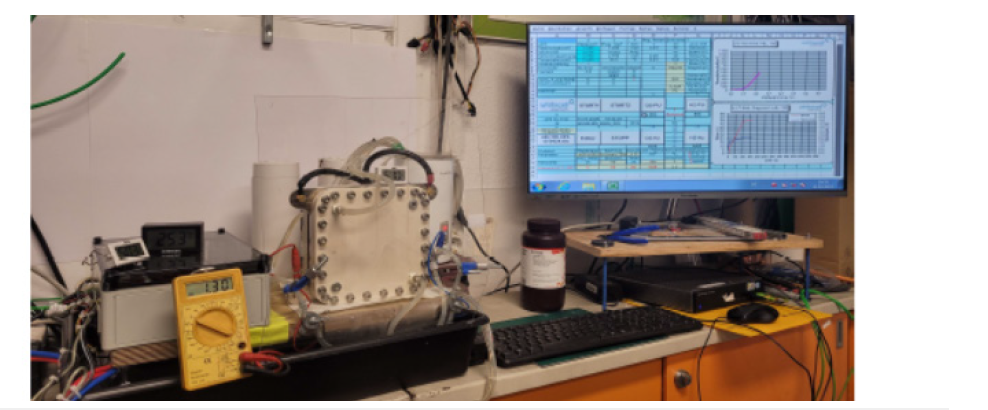
The experimental test station consisted of the electrolysis cell, a power supply capable of delivering currents of up to 100A, measurement electronics with a 16-bit analogue-to-digital resolution, digitally controlled current regulation, two electrolyte circulation loops and a PC-based data acquisition and evaluation system. The online software allowed the relevant operating parameters to be monitored, controlled and recorded continuously.
During the project, the measurement equipment was further upgraded. In particular, the initial U12 measurement unit was replaced by a LabJack UE9 system in order to improve the resolution of the current control and data acquisition. This required modification of the software as well as rewiring of parts of the hardware. The modified system was subsequently commissioned successfully and used for systematic seawater experiments. Approximately 20 seawater-related tests, including repeat measurements and discontinued preliminary tests, were performed during the experimental campaign.
Synthetic seawater and experimental programme
A simplified synthetic seawater electrolyte was prepared from deionized water and sodium chloride. A NaCl concentration of 3.5wt.% was selected as the main reference composition, approximately representing the salt concentration of ocean water. It should be emphasised that this simplified electrolyte did not reproduce the full ionic composition of natural seawater. In particular, naturally occurring Ca²⁺ and Mg²⁺ species, which can cause precipitation and scaling under alkaline conditions, were not systematically reproduced. The present experiments should therefore be regarded primarily as a chloride-dominated screening of stack and component behaviour rather than a complete simulation of natural seawater. Current literature similarly distinguishes clearly between simplified NaCl-based synthetic seawater and natural seawater because multivalent ions, microorganisms and other impurities may significantly influence cell durability and performance [10,11].
Three principal experimental series were initially performed:
1. Variation of temperature at a constant NaCl concentration
of 3.5wt.%;
2. variation of the NaCl concentration at constant
temperature;
3. addition of small quantities of KOH to increase electrolyte
conductivity.
For the temperature study, measurements were performed at 30, 50, 60, 70 and 80 °C using 3.5wt.% NaCl. During preliminary experiments, chlorine formation and anodically induced corrosion were observed at elevated cell voltages. Consequently, the maximum cell voltage was limited to 2.0V for the subsequent experimental programme.
This limitation is consistent with the fundamental challenge of direct seawater electrolysis. At the anode, the desired oxygen evolution reaction competes with chloride oxidation. Depending on pH and operating potential, chloride may be converted into chlorine or hypochlorite species. Under alkaline conditions, an approximately 480mV thermodynamic potential window exists between oxygen evolution and hypochlorite formation, which is one reason why alkaline operation is widely considered advantageous for suppressing chlorine-related side reactions [8,9].
For the second series, the NaCl concentration varied between 1 and 7wt.% at a constant temperature of 40 °C. These measurements were designed to determine the effect of increasing ionic concentration on the current-voltage characteristics. From an application perspective, this is relevant because water is consumed during electrolysis and recirculation without appropriate makeup water could result in progressive salt concentration within the electrolyte loop.
In the third series, small quantities of a 3wt.% KOH solution were added to 250mL of 3.5wt.% NaCl solution. The resulting effective KOH concentrations in the electrolyte were approximately 0.012, 0.025, 0.06 and 0.12wt.%. The tests were conducted at 70 °C. The intention was to determine whether a relatively small alkaline addition could improve electrical conductivity and electrochemical performance without converting the system into conventional alkaline electrolysis.
Based on these initial results, the experimental strategy was subsequently extended to more strongly alkaline seawater/KOH conditions. The later project documentation includes a series of approximately ten tests using seawater in combination with 3% KOH at temperatures of 20, 30, 40 and 50 °C.
Electrochemical characterisation
The electrochemical performance was evaluated primarily using cell-voltage/current-density (U-j) characteristics. The cell voltage was varied within the defined safe operating range, and the resulting current was recorded. Current values were normalized to the nominal active membrane area.
The influence of temperature, electrolyte concentration and alkaline addition could therefore be compared directly. Particular attention was paid to operational behaviour close to 2.0V, since preliminary testing had indicated that higher voltages resulted in increased chlorine formation and corrosion. The use of polarization curves is well established for evaluating alkaline and membranebased water electrolysers, as they provide combined information about activation, ohmic and mass-transfer losses [12]. In seawater electrolysis, interpretation must additionally consider competing chloride oxidation and chloride-induced degradation processes [8- 11].
Functional and post-mortem assessment of stack components
In addition to electrochemical performance, the integrated cell was evaluated with respect to its mechanical and functional stability. Successful operation required stable sealing of the two fluid circuits as well as mechanical integrity of the bipolar plate and end-plate assembly.
After selected experiments, the cell was disassembled and the membrane and electrodes were visually investigated. Particular attention was given to differences between the oxygen and hydrogen sides, local deposits, flow-field impressions and changes at component contact areas. Such post-mortem evaluation is relevant because ageing and deposits can alter separator resistance, electrode activity and local current distribution [13]. The experimental procedure and data discussed in the following section are based on the internal SeaEly documentation, particularly “76 AEL 100 Seawater Electrolysis Part 1” and the Whitecell Eisenhuth SeaEly Final Report / project presentation. should also be outlined in detail, including information on all statistical tests used.
Results and Discussions
Successful operation of the integrated cell
A first important result of the experimental programme was that the complete cell could be operated reproducibly with synthetic seawater. The bipolar plate assembly, sealing components, membrane and electrodes formed a functional electrochemical system and allowed systematic polarization measurements over a broad range of operating conditions.
Within the reported experimental campaign, no leakagerelated failure of the sealing concept and no mechanical failure of the bipolar plate assembly were documented. The two electrolyte circuits remained sufficiently separated to conduct repeated electrochemical measurements. From the component-development perspective, this represents an important result: the bipolar plates and sealing system were not only manufactured successfully but could also be integrated and operated in a chloride-containing electrolysis environment.
This finding should, however, be interpreted as successful laboratory-scale functional validation, not as a lifetime qualification. Direct seawater electrolysis exposes stack components to highly aggressive conditions. Chloride ions and chlorine-containing reaction products may promote localized corrosion, while longterm sealing performance may additionally be influenced by temperature, compression and chemical ageing [10]. Longer durability tests are therefore required before conclusions regarding commercial service life can be drawn.
Effect of temperature
The first systematic test series demonstrated a clear influence of temperature. At a constant NaCl concentration of 3.5wt.%, increasing temperature resulted in increasing current density over the entire investigated voltage range.
Figure 2:Effect of temperature on the U-j characteristics of the seawater cell operated with 3.5 wt.% NaCl.
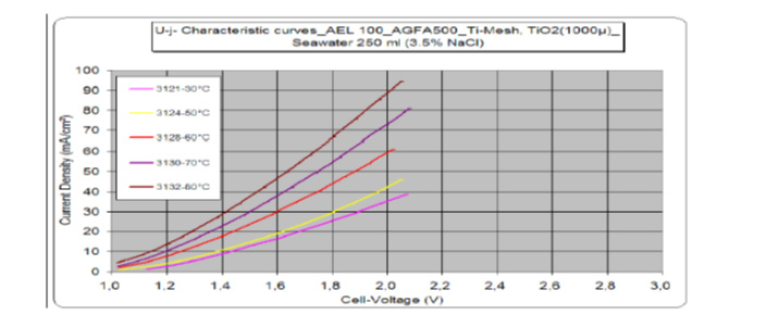
At a cell voltage of approximately 2.0V, the current density increased from roughly 35-40mA cm⁻² at 30 °C to nearly 90mA cm⁻² at 80 °C (Figure 2).
The observed trend is consistent with the expected increase in ionic mobility and reduced electrolyte resistance at elevated temperature. Nevertheless, improved electrical performance cannot be evaluated independently of component durability. Higher temperature can simultaneously accelerate chemical reactions and corrosion processes, particularly in chloride-containing electrolytes. Recent seawater-electrolysis reviews therefore identify the simultaneous optimization of catalytic activity, chloride selectivity and corrosion resistance as one of the central challenges for practical systems [9-11].
An important experimental observation was that operation at increased voltage led to visible chlorine formation and anodically induced corrosion. Restricting the maximum cell voltage to 2.0V was therefore not merely a measurement decision but represented an early system-level optimization arising directly from experimental observation. This behaviour corresponds well with literature reports showing that chloride oxidation can become kinetically competitive with oxygen evolution despite the thermodynamic preference for OER. Chlorine-related reactions involve fewer electron-transfer steps than OER and may therefore become increasingly important at high anodic overpotential [8,9].
Influence of NaCl concentration
The second experimental series investigated salt concentrations between 1 and 7wt.% NaCl at 40 °C. A pronounced increase in current density with increasing salt concentration was observed.
At approximately 2.0V, the current density increased from below 10mA cm⁻² at 1wt.% NaCl to approximately 60mA cm⁻² at 7wt.% NaCl. Within the investigation range, the data indicated that an approximate doubling of salt concentration resulted in an approximately doubled current density (Figure 3).
Figure 3:Influence of NaCl concentration between 1 and 7 wt.% on the current density at 40 °C.
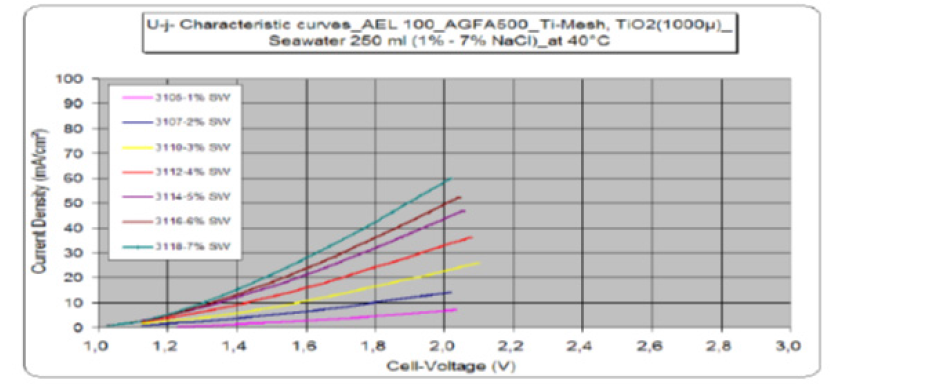
From an electrochemical perspective, the result is readily explained by the increased ionic conductivity of the electrolyte. From a system perspective, however, increasing salt concentration cannot be considered an unrestricted optimization strategy. Higher chloride concentrations simultaneously increase the availability of chloride species at the anode and can intensify chloride-related corrosion and competing oxidation reactions. The experiments therefore reveal a characteristic trade-off of direct seawater electrolysis: increasing ionic conductivity improves electrical performance but may worsen the chemical environment experienced by the stack components. This trade-off is also highlighted in recent literature, where corrosion-resistant materials, protective coatings and selective electrodes are considered key requirements for long-term seawater electrolysis [10,11].
Influence of KOH addition
A further strategy was to modify the electrolyte by adding small quantities of KOH. The initial hypothesis was that even a modest alkaline addition could improve ionic conductivity and at the same time shift the anodic chemistry towards conditions more favorable for oxygen evolution. The initial experiments with effective KOH concentrations between approximately 0.012 and 0.12wt.% resulted only in a small improvement in current density. No substantial increase in electrolysis performance was obtained.
One possible explanation proposed in the project documentation is that the added hydroxide can react with constituents of the saline electrolyte, meaning that the full added KOH concentration is not available to increase electrolyte conductivity. In natural seawater this issue would become even more important because Mg²⁺ and Ca²⁺ can precipitate as hydroxide-containing species under alkaline conditions [11].
Nevertheless, the direction of the approach remained technically relevant. Literature consistently indicates that alkaline conditions increase the potential difference between OER and chloride oxidation. At pH values above approximately 7.5, a theoretical potential window of about 480mV exists between oxygen evolution and hypochlorite formation, giving alkaline conditions an important selectivity advantage [8,9].
For this reason, the subsequent experimental programme investigated considerably stronger alkaline conditions. In the later SeaEly tests with synthetic seawater and 3% KOH, increasing temperature again improved cell performance. The best result of this test series was obtained at 50 °C, reaching approximately 120mA cm⁻² at 1.8V (Figure 4).
Figure 4:U-j characteristics of the optimized synthetic-seawater/KOH test series at different temperatures.
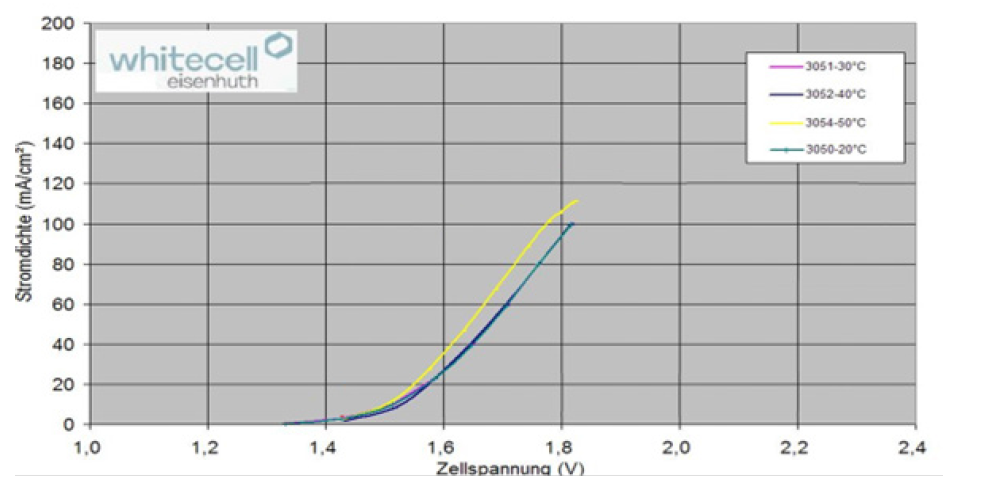
These results demonstrate that alkalization can substantially improve the operating window compared with untreated synthetic seawater. At the same time, they illustrate a fundamental question regarding the definition of “direct seawater electrolysis”. With increasing KOH concentration, the process gradually shifts from direct electrolysis of untreated seawater towards an alkaline electrolysis process using seawater as the water source. This is not necessarily a disadvantage from an engineering perspective. A technically robust solution may ultimately combine moderate seawater conditioning with established alkaline electrolysis principles rather than attempting completely untreated direct seawater electrolysis. Similar hybrid and pretreatment concepts are increasingly discussed in the literature [8,10,11].
Comparison with conventional alkaline electrolysis
The internal test programme also enabled a direct comparison between 3.5wt.% synthetic seawater and conventional 3wt.% KOH electrolysis. At comparable cell voltages and temperatures, the KOH electrolyte produced substantially higher current densities. The project report estimates the hydrogen-production potential of the KOH system to be approximately five times higher under the investigated conditions.
This result clearly demonstrates that the main challenge of direct seawater electrolysis is not whether electrolysis is possible - the experiments demonstrated that it is - but whether sufficient current density, energy efficiency, selectivity and component lifetime can be achieved simultaneously.
The reduced performance in synthetic seawater can be attributed to its lower ionic conductivity as well as to additional electrochemical restrictions associated with chloride. In conventional alkaline electrolysis, concentrated KOH solutions are employed precisely because of their high ionic conductivity. Modern alkaline systems commonly operate with significantly higher KOH concentrations than those used in the present seawater screening experiments [12]. For future seawater systems, this comparison suggests that the potential value of seawater should primarily be evaluated in terms of freshwater substitution, rather than simply expecting untreated seawater to outperform established alkaline electrolytes.
Post-mortem observations
Following electrochemical operation, selected components were visually inspected. The post-mortem examination revealed a pronounced asymmetry between the oxygen and hydrogen sides of the cell. The O₂-side electrode exhibited substantial surface deposits, and the corresponding membrane surface was also strongly covered. In contrast, the H₂-side electrode showed almost no comparable deposit formation. Flow and contact patterns were visible on the membrane and electrode surfaces (Figure 5).
Figure 5:Post-mortem appearance: O₂-side (A/B) & H₂-side (c/D) electrodes after seawater electrolysis.
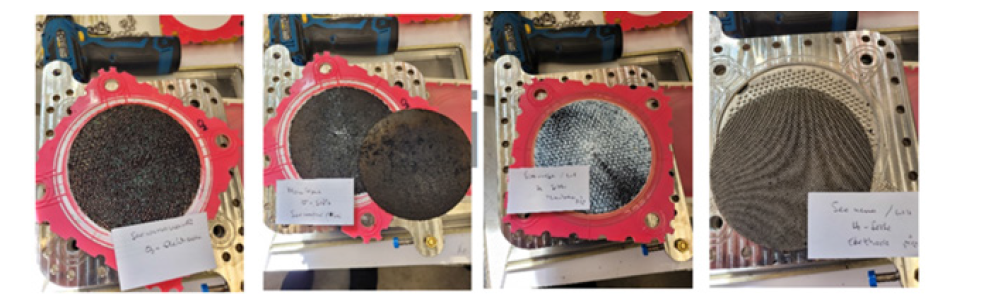
The asymmetric appearance indicates that the anodic side constitutes the more critical environment. This observation is consistent with the electrochemical mechanisms described in the literature: oxygen evolution, chloride oxidation and formation of highly oxidizing chlorine species all occur on the anodic side and may therefore accelerate corrosion and deposition [8-11].
The observations are also relevant for separator durability. Previous alkaline-electrolysis studies have shown that surface deposits and ageing of separator materials may contribute to increasing cell resistance and decreasing long-term electrochemical performance [13].
Importantly, despite the visible deposits on the electrochemically active components, the bipolar plate and sealing concept remained functional during the reported test campaign. No seal-related leakage failure or mechanical plate failure was documented. This is an encouraging result for the component concept and confirms that the selected plate and sealing architecture can withstand shortterm synthetic seawater electrolysis testing.
However, the post-mortem observations also show that successful mechanical operation alone is insufficient. Further development should focus particularly on the interfaces and surfaces exposed to the anodic electrolyte. Corrosion-resistant coatings on metallic bipolar plates, improved electrode surfaces and optimized flow-field design are therefore logical next development steps. Drawing any conclusions. A description of statistical tests as it relates to the results should be included.
Conclusions & Recommendations
The SeaEly investigations demonstrated that electrolysis using synthetic seawater is technically feasible in a laboratoryscale cell. The complete electrolysis system, including bipolar plates, sealing components, electrodes and membrane, could be assembled and operated successfully under saline conditions. Repeated experimental runs were performed without documented leakage-related failure of the sealing system or mechanical failure of the bipolar plate assembly. From a component perspective, this represents an important and encouraging result.
At the same time, the experiments clearly revealed the limitations of direct seawater electrolysis. Untreated synthetic seawater with approximately 3.5wt.% NaCl exhibited considerably lower current densities than a conventional alkaline electrolyte. Increasing the operating temperature and the NaCl concentration improved electrical conductivity and current density; however, these measures did not eliminate the fundamental challenges associated with chloride-containing media. In particular, chlorine formation and corrosion became increasingly relevant at higher anodic potentials. Consequently, the maximum cell voltage had to be limited during the experimental programme.
The addition of very small quantities of KOH resulted only in limited performance improvement, whereas stronger alkalization led to significantly higher current densities and more stable operation. This confirms that the electrochemical environment can be substantially improved by adjusting electrolyte chemistry. However, with increasing alkalinity, the process increasingly approaches conventional alkaline electrolysis using seawater as the water source rather than completely untreated direct seawater electrolysis. Figure 5 post-mortem appearance of O₂-side (a+b) and H₂-side (c+d) electrodes and membrane after synthetic seawater electrolysis
The post-mortem investigations further showed that the electrochemical loading of the components is strongly asymmetric. Considerable deposits and surface changes were observed particularly on the oxygen side, whereas the hydrogen side showed substantially less visible degradation. These findings underline that the anodic side of the electrolyser remains the most critical area with respect to corrosion, deposits and long-term material stability.
Overall, the results are encouraging. They demonstrate that a technically functional cell architecture for synthetic seawater electrolysis can be realised and that the bipolar plates and sealing components successfully withstood the laboratory test campaign. Nevertheless, the present work should be considered a successful functional validation rather than a qualification for long-term operation. Longer operating times and more realistic seawater compositions are required before conclusions regarding industrial lifetime can be drawn.
Based on the present results, the following development priorities are recommended:
- Further development of corrosion-resistant bipolar plate surfaces, particularly through protective coatings such as PVD-based layers, mixed-metal oxides or other electrically conductive barrier systems.
- Long-term durability testing of bipolar plates, seals and complete cells under chloride-containing conditions.
- Evaluation with more realistic synthetic seawater and natural seawater, including Ca²⁺, Mg²⁺ and other species responsible for precipitation and scaling.
- Optimisation of the anodic side, including electrode coatings, flow-field design and operating potential in order to suppress chlorine evolution and reduce local corrosion.
- Further investigation of moderate electrolyte conditioning, including controlled alkalisation or seawater pretreatment.
- Comparison with integrated desalination concepts, for example combinations of reverse osmosis and alkaline or AEM electrolysis, in order to identify the technically and economically most robust system architecture.
This study work therefore provides a promising basis for further development. The next technological step should focus less on proving that seawater electrolysis is possible and more on achieving durable, corrosion-resistant and economically viable operation. In particular, the successful performance of the bipolar plates and sealing concept provides a useful platform for future work on improved coatings and chlorine-resistant stack architectures.
Acknowledgement
The authors gratefully acknowledge the financial support provided by the German Federal Ministry of Education and Research (BMBF) within the project “SeaEly – Direct Seawater Electrolysis to Produce H₂ and O₂” under Grant No. 03SF0663C. The authors also thank all project partners for the fruitful cooperation and scientific exchange throughout the project.
References
- Horri BA, Ozcan H (2024) Green hydrogen production by water electrolysis: Current status and challenges. Current Opinion in Green and Sustainable Chemistry 47: 100932.
- (2025) International Energy Agency (IEA), Global Hydrogen Review, IEA, Paris.
- (2022) International Renewable Energy Agency (IRENA), Geopolitics of the Energy Transformation: The Hydrogen Factor, Abu Dhabi.
- Rafika L, Stefan G, Issam S, Salah L, Abdesslem D (2026) A critical review of green hydrogen production by electrolysis: from technology and modeling to performance and cost. Energies 19.
- Omaima B, Mourad N, Khaoula A, Abdessamad F, Abdelkader B, et al. (2025) Water-energy-hydrogen nexus: Addressing water scarcity in sustainable green hydrogen production. Results in Engineering 28: 108256.
- (2019) U.S. Geological Survey (USGS), The Distribution of Water on, in, and above the Earth, Water Science School.
- Yu L, Ning M, Wang Y, Yuan C, Ren Z (2025) Direct seawater electrolysis for hydrogen production. Nature Reviews Materials 10: 857-873.
- Bahuguna G, Patolsky F (2024) Routes to avoiding chlorine evolution in seawater electrolysis: Recent perspective and future directions. ACS Materials Letters 6: 3202-3217.
- Corbin J, Jones M, Lyu C, Loh A, Zhang Z, et al. (2024) Challenges and progress in oxygen evolution reaction catalyst development for seawater electrolysis for hydrogen production. RSC Advances 14: 6416-6442.
- Yang LJ, Guan HY, Yuan S, Sun T, Jiang AN, et al. (2025) Research progress of chlorine corrosion resistance in seawater electrolysis: Materials and technologies. Chemical Engineering Journal 503: 158458.
- Zhao C, Ding Z, Zhang K, Du Z, Fang H, et al. (2025) Comprehensive chlorine suppression: Advances in materials and system technologies for direct seawater electrolysis. Nano-Micro Letters 17(113).
- Henkensmeier D, Cho WC, Jannasch P, Stojadinovic J, Li Q, et al. (2024) Separators and membranes for advanced alkaline water electrolysis. Chemical Reviews 124(10): 6393-6443.
- Rodríguez J, Palmas S, Sánchez-Molina M, Amores E, Mais L, et al. (2019) Simple and precise approach for determination of ohmic contribution of diaphragms in alkaline water electrolysis. Membranes 9(10): 129.
© 2026 © Thorsten Hickmann. This is an open access article distributed under the terms of the Creative Commons Attribution License , which permits unrestricted use, distribution, and build upon your work non-commercially.
Editor In Chief






.jpg)





























Signup for Newsletter

Quick Links
 Editorial Board Registrations
 Submit your Article
 Best Paper of the Volume
 Reprints
 Refer a Friend
 Advertise With Us
Our Recent Edition





Top Editors




.jpg)

















.bmp)
.jpg)
.png)
.jpg)













.jpg)






.png)

.png)




.png)




Financial Support
Sponsors

Latest e-Books

Latest Video

 a Creative Commons Attribution 4.0 International License. Based on a work at www.crimsonpublishers.com.
Best viewed in

 | Above IE 9.0 version