

- About Us
- Information
-

The Author ensures that the research has been conducted responsibly and ethically with adherence to all relevant regulations. read more..
- For Authors
- For Reviewer
- Manuscript Guidelines
- Membership
- Publication Ethics
-
- Journals
- Reprints
- e-Books
- Videos
- Policies
- Contact Us
 COVID-19
- Submissions



Full Text
Peer Review Journal of Solar & Photoenergy Systems
Heat Shielding Performance of Two Infrared- Reflective Polymer Dispersed Liquid Crystal Films
Hakemi H*
Plastic Liquid Crystal Technology Consultant, Italy
*Corresponding author: Hakemi H, Plastic Liquid Crystal Technology Consultant, Italy
Submission: May 12, 2026;Published: June 23, 2026
Volume 3 Issue 1 June 23, 2026
Abstract
The heat-shielding performance of Polymer Dispersed Liquid Crystal (PDLC) films incorporating OPV8 and PV10 metallized Infrared (IR)-reflective coatings was investigated. The thermal behavior of OPV8– PDLC and PV10–PDLC films was compared with conventional ITO–PDLC structures by measuring the temperature difference (ΔT) between front and back film surfaces under controlled infrared lamp exposure at distances of 50-10cm. Significant reductions in transmitted infrared heat were observed in OPV8- and PV10-based PDLC films due to their enhanced Near-Infrared (NIR) reflectivity. Doublelayer OPV8–OPV8 and PV10–PV10 configurations exhibited the highest ΔT values, confirming their effectiveness in suppressing heat transfer. These results demonstrate that integrating IR-reflective metallized coatings into PDLC architectures significantly improves thermal shielding performance, supporting their application in energy-efficient switchable glazing systems..
Keywords: PDLC; Liquid crystal; Infrared reflection; OPV8; PV10; NIR; Heat shielding; IR lamp exposure
Introduction
The global demand for solar-control window technologies has been increasing in the past decade due to ever growing requirement for energy efficiency and thermal comfort in modern buildings. Approximately half of the incoming solar energy lies in the near infrared region (800-1100nm) accounts for 46-50% of the total solar spectrum. The control of NIR reflection is the main strategy to reduce incoming heat through glazing. In addition to NIR blocking materials, the reflection coatings are preferable types as the heat dissipation of absorption materials is not very effective and allows the heat to penetrate into the indoor spaces [1-3]. A number of organic materials are available for controlling NIR light passing through windows in the review articles on infrared regulation of smart glass [4-6].
Polymer Dispersed Liquid Crystal (PDLC) films are widely utilized in switchable windows, where their electro-optical properties make them attractive for privacy and daylight regulation. Several studies have reported their UV-blocking capabilities and modest NIR modulation; however, conventional PDLC structures typically exhibit low IR reflection, limiting their thermal performance [7-11].
The studied visible spectral transmissions of indoor PDLC glazing are shown to be around 71% at on-state and 27% at off-state, while their Solar Heat Gain Coefficient (SHGC) were similar at on-state (0.4) and off-state (0.5) [12]. Also there has been attempt to utilize PDLC using Chiral Liquid Crystal (CLC) reflector by electrical switching of a reflection band to generate visible coloration, but they are restricted to 50% reflection in a limited single layer bandwidth [13].
In general, the SHGC of a conventional PDLC glazing were studied under indoor conditions by utilizing a small scale test cell equipped with temperature sensors to measure the solar energy entering the PDLC cell, where the optical evaluation showed that the off-state PDLC glazing showed low UV (8%) and NIR (44%) transmissions, respectively [14]. Also, it was observed that, due to the SHGC was basically similar in both on-state (0.68) and off-state (0.63). In a similar report, variation of temperature difference (ΔT) between the internal PDLC cell temperature and external ambient at various radiation intensities were investigated, where the average ΔT increase were 18.8 °C in the transparent state and 20.1 °C in the translucent state. The result was that the overall heat flow through the PDLC glazing was relatively higher in the translucent state [15]. Despite extensive literature on PDLC optical properties, there remains limited quantitative evaluation of thermal performance under direct IR exposure.
This work is continuation of our previous patent literature on solar control of PDLC film by combining static IR-reflection with dynamic CLC mechanisms [16], as well as recent study on heat screening of a silver-based IR-reflective PDLC film utilizing a metallized silver-based PET coating AgTH8 [17]. Here, we utilized two transparent conductive IR-reflective OPV8 and PV10 coated PET films with low electrical resistance and substantially high NIR reflectivity and investigated the heat shielding capability of translucent OPV8-PDLC and PV10-PDLC in comparison to conventional ITO-PDLC films by measuring the temperature differences between the front and back of the films as a function of an IR lamp exposure distance. The results of these experiments are described in the following sections.
Materials and Methods
The PDLC formulation was prepared using a commercial Qingdao liquid crystal mixture (QY142); Norland Optical Adhesive pre-polymer (NOA65); Ciba Ir819 and Ir184 Irgacure photoinitiators; BASF Tinuvin TV400 UV absorber; 25μm NM Suzhou micro-spacers and Kaitai Acrylic Acid (AA). The Eastman 175μm ITO-PET film and 125μm silver-based multilayer FLEXVUE IRrejection OPV8-PET and PV10-PET films used as conductive transparent and infrared (heat) light rejection components in solar-control devices. They achieve high-level heat rejection, specific Visible Light Transmission (VLT) and low SHGC in optical laminates, premium automotive and architectural glazing. The thickness differences between ITO and OPV8/PV10 films should be considered in their comparative PDLC films heat shielding. The material composition (%weight) in the utilized PDLC formulation were as follows:
QY142=40%, NOA65=51%, TV400=4%, Ir819=0.5%, Ir184=0.5%, AA=3.4% and NM=0.6%.
The uncured PDLC formulations were pre-heated at 45 °C for 10 minutes and then were poured between the vertical gap of ITO-PET, OPV8-PET and PV10-PET film rolls on a Sigma-Sivo custom-made coater/laminator system. Under the coating rolls, the uncured coated films were passed through a pressure roll to insure the uniformity of PDLC films. The uncured PDLC films were then cured at UV intensity of 165mW/cm2 and line speed of 0.15 meter/ minute. The thickness homogeneity of PDLC layers were insured by micro-spacers.
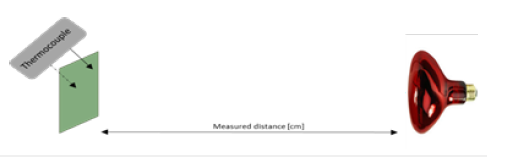
The thermal testing of PDLC films was carried by direct exposure of the off-state PDLC films to a Philips 150W IR lamp placed at distances of d=50, 40, 30, 20, and 10cm. The front- side and back- side temperatures of the films were recorded using LOGGER Log-Master thermocouples, where the temperature difference (ΔT=Tfront−Tback) was used as an indicator of IR heat shielding. The experimental setup of the heat measurements is presented in (Figure 1).
Figure 1:The experimental set up of IR lamp and PDLC film temperature measurement.
Results and Discussion
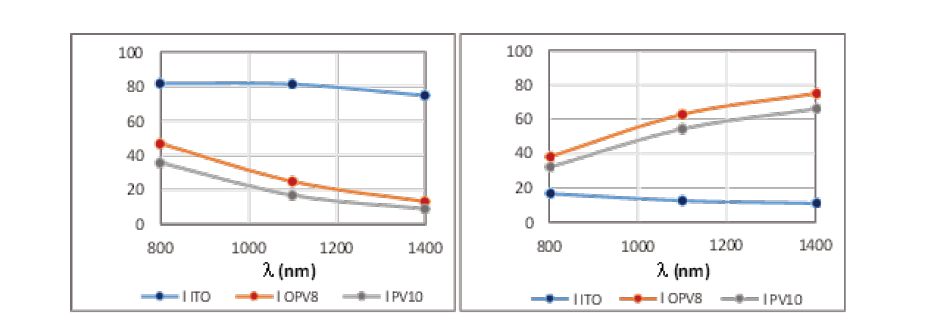
In (Figure 2) we provide the differences of NIR transmission and reflection values of translucent PDLC films with double ITO, OPV8 and PV10 coatings at 800, 1100 and 1400nm wavelengths. The results clearly indicate the significant transmission and reflection differences between double-coated OPV8-PDLC and PV10-PDLC with respect to those of ITO-PDLC film, even by considering that the coating thickness of ITO (175m) is also larger than the other IR-reflective films (125m). The heat shielding behavior of PDLC films with ITO, OPV8 and PV10 configurations under controlled infrared lamp exposure demonstrates clear distinctions in thermal response that strongly correlate with the optical properties of their respective metallized coatings. For example, according to Figure 2 at NIR 1400nm, the NIR transmissions of OPV8-OPV8 (13%) and PV10-PV10 (17%) are much smaller than in ITO-ITO (75%) PDLC films, whereas the NIR reflections of OPV8-OPV8 (75%) and PV10-PV10 (66%) exhibit significantly higher values than in ITOITO (11%) PDLC films. In other words, the ITO-based films allow deeper IR penetration, increasing internal absorption and thermal saturation. In contrast, OPV8 and PV10 coatings reflect a large portion of incident NIR radiation, reducing internal heat buildup and maintaining a stable thermal gradient. These differences will be even more at equal PET thicknesses of ITO, OPV8 and PV10, which confirm significantly the enhanced NIR reflection in silverbased metallized films.
Figure 2:Transmissions & reflections of PDLC films with ITO, OPV8 and PV10 coatings within NIR wavelengths.
The heat shielding behavior of three translucent PDLC films configurations: a) double ITO-ITO; b) hybrid ITO-OPV8 and ITOPV10 and c) double OPV8-OPV8 and PV10-PV10, were studied by measuring the temperature differences between their front and back (ΔT=Tfront−Tback) of the films at exposure distances of d=50- 10cm from an IR lamp (see Figure 1). The results as presented in Figure 3 graphs demonstrate clear distinctions in thermal response that correlate strongly with the optical properties of their respective metallized coatings. According to Figure 3, the ΔT temperature differences due to heat shielding effect in the three types of PDLC films within 50→10cm distance range are described as follows:
Figure 3:ΔT values of ITO, OPV8 and PV10 coated PDLC films as a function of IR lamp distance.
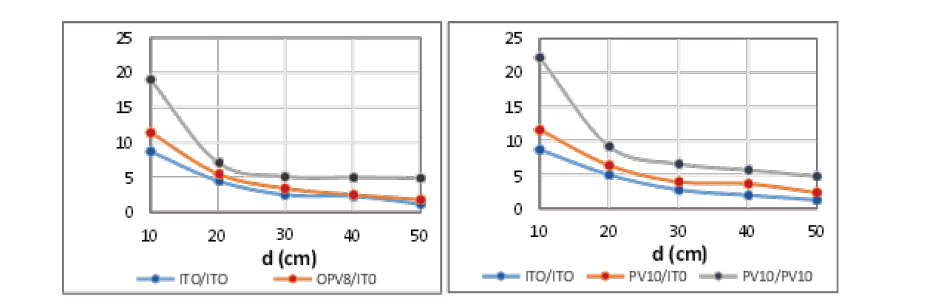
a) Double ITO-ITO: The ΔT=1.3→8.7 °C trend provides
minimum heat shielding of only 7.4 °C, at closest distance
(d=10cm).
b) Hybrid ITO-OPV8 & ITO-PV10: The ΔT trends in hybrid
ITO–OPV8 (1.8→11.4 °C) and ITO–PV10 (2.4→11.6 °C) provide
heat shielding effect of around <9.4 °C> at d=10cm distance.
c) Double OPV8-OPV8 & PV10-PV10: The ΔT trends of
OPV8-OPV8 (4.9→19.0 °C) and PV10-PV10 (4.8→22.2 °C) drop
14.1 and 17.4 °C, respectively at d=10cm distance, indicating
the effectiveness of heat screening of both coatings.
The low NIR reflectance in conventional ITO-ITO PDLC film permits deeper IR penetration. This increases internal absorption, raises back-surface temperature and causes the ΔT reduction. Regarding the hybrid ITO–OPV8 and ITO-PV10 PDLC films, the ΔT reductions at 50–10cm range are nearly identical to ITO-ITO, mainly due to lower PET thicknesses of the formers (125m) in comparison to that of the latter (175m). This heat screening has been more in our previous study on AgHT8-PDLC, the PET thickness in both ITO and AgHT8 coatings where 175mm [11], where ΔT in double AgHT8-AgHT8 PDLC film had been reduced more significantly within the 50-10cm range.
A key parameter influencing thermal behavior is substrate thickness. The ITO-PET films (175μm) are ~40% thicker than OPV8/PV10-PET films (125μm). Thicker substrates contribute to increased thermal mass and partial IR attenuation through absorption. To normalize performance, a thickness-adjusted ΔT efficiency factor (ΔT/thickness) can be estimated ITO–ITO (~0.050 °C/μm); OPV8–OPV8 (~0.152 °C/μm) and PV10–PV10 (~0.178 °C/μm), respectively. This demonstrates that even after accounting for thickness differences, OPV8 and PV10 coatings deliver approximately 3 times higher thermal shielding efficiency per unit thickness than ITO. A further comparison of heat screening efficiency of PDLC films in this study with our previous work on AgHT8 [11], although ΔT values of all three PDLC films at d=10cm distance are around 20 °C, but the lower thickness of OPV8/PV10- PDLC films (125m) makes them more heat efficient than that of AgHT8-PDLC film (175m). This indicates a higher intrinsic infrared reflection efficiency per unit thickness, representing a significant advancement in PDLC-based thermal management.
The nearly linear ΔT reduction of OPV8 and PV10 PDLC films within 50-20cm lamp distances indicates minimal internal heat saturation, dominance of reflective rather than absorptive thermal processes and stable thermal behavior under increasing IR flux. The high ΔT reduction below 20cm range arises because much of the incident NIR energy is reflected at the OPV8-PDLC and PV10- PDLC film surfaces, indicating their distinct IR reflection potential and preventing thermal buildup inside the PDLC layer. This is in contrast to ITO-PDLC film, where ΔT shows the lowest T reduction at 20-10cm range due to thermal saturation of the PDLC interior. The superior performance of OPV8 and PV10 arises from dominant reflective heat rejection rather than absorptive heating. Overall, the results demonstrate that when integrated into PDLC switchable films, silver-based transparent OPV8 and PV10 conductors provide desirable thermal improvements over conventional ITO conductor, which reinforce several design advantages of IR-reflective PDLC films:
a) Larger IR rejection efficiency that reduces heat transfer to
indoor space.
b) Lower internal heating which preserves PDLC optical
stability.
c) Better performance under strong solar irradiance for
external glazing.
d) Promising energy-efficient smart glass where thermal
shielding and optical switching coexist.
In order to assess measurement reliability, temperature readings were repeated across multiple exposure cycles under identical conditions. The observed variation in ΔT values remained within ±0.5 °C for all configurations, indicating good experimental repeatability. Sources of uncertainty include thermocouple positioning, ambient convection fluctuations, and slight nonuniformity in IR lamp intensity. Despite these factors, the relative performance ranking between ITO, OPV8, and PV10 configurations remained consistent, confirming the robustness of the observed trends. Furthermore, a simplified estimation of Solar Heat Gain Coefficient (SHGC) can be inferred from relative IR transmission reduction. Assuming NIR accounts for ~50% of solar load, the effective SHGC reduction (ΔSHGC) scales with reduced transmission and suggests a potential ~40–50% reduction in solar heat gain of OPV8/PV10-PDLC compared to conventional ITO-PDLC glazing.
Conclusion
The silver-based NIR-reflective OPV8-PDLC and PV10- PDLC films exhibit superior heat shielding in comparison with conventional ITO-PDLC film. Under the closest IR exposure distance (d=10cm), the measured ΔT values of OPV8-OPV8 and PV10-PV10 PDLC films were 19 °C and 22 °C, respectively, in comparison to 8.5 °C of ITO-ITO PDLC film. These results position OPV8 and PV10 coatings as a promising candidates for energy-efficient switchable smart PDLC windows with improved solar heat rejection. The OPV8 and PV10 systems position among the highest-performing IR-reflective PDLC architectures reported, particularly considering their transparency and electrical functionality.
The opportunities for future investigations could include multi-layer silver/dielectric stacks in order to broaden the reflection spectra, integration with broadband tunable cholesteric liquid crystal reflectors for IR selective-band reflection, Largescale thermal modeling for architectural-scale simulations and optimization of layer thickness and film symmetry to balance transparency, haze, and IR blocking. These materials provide a viable pathway toward high-performance smart windows by combining electro-optical switching with efficient solar heat rejection.
Acknowledgement
This study has been internally funded by Gauzy Ltd, Tel Aviv, Israel, and has been carried out with R&D team at the company’s laboratories during 2015-2016 period as part of industrial PDLC research and development program.
References
- Jelle BP, Hynd A, Gustavsen A, Arasteh D, Goudey H, et al. (2020) Fenestration of today and tomorrow: A state-of-the-art review and future research opportunities. Solar Energy Materials & Solar Cells 96: 1-28.
- Li X, Gao Y, Luo H (2022) Nanostructured coatings for IR reflection and energy-saving glazing. Nano Energy 92: 106709.
- Zhang S, Wang Y, Yang H (2023) Multilayer thin films for spectral selectivity in energy-efficient windows. Progress in Materials Science 131: 101017.
- Khandelwal H, Schenning AP, Debije MG (2017) Infrared regulating smart window based on organic materials. Advanced Energy Materials 7(14): 1602209.
- Sentjens H, Augustinus JJ, Kragt A, Schenning PH, Debije MG (2023) Responsive Materials 1(1): 1-17.
- Ke Y, Zhou C, Zhou Y, Wang S, Chan SH, et al. (2018) Emerging thermal-responsive materials and Integrated techniques targeting the energy-efficient smart window application. Advanced Functional Materials 28(22): 1800113.
- Casini M (2015) Smart windows for energy efficiency of buildings. International Journal of Civil and Structural Engineering– IJCSE 2(1): 273-281.
- Casini M (2018) Active dynamic windows for buildings - A review. Renewable Energy 119: 923-934.
- Oh M, Lee C, ark JP, Lee K, Tae S (2019) Evaluation of energy and daylight performance of old office buildings in South Korea with curtain walls remodeled using Polymer Dispersed Liquid Crystal (PDLC) Films. Energies 12(19): 3679.
- Li W, Liu Y, He W (2021) Thermal and optical performance of polymer dispersed liquid crystal smart windows. Energy and Buildings 231: 110598.
- Kim J, Lee K, Jeong H, (2022) Performance evaluation of PDLC smart windows under real environmental conditions. Applied Energy 306: 118086.
- Ghosh A, Mallick TK (2017) Evaluation of color properties due to switching behavior of a PDLC glazing for adaptive building integration. Renewable Energy 120: 126-133.
- Zhang H, Liu J, Zhao X, Gao J, Ma C, et al. (2022) Electrically induced coloration of polymer-stabilized cholesteric liquid crystal films with broadband reflection capability for smart windows. Dyes and Pigments 203: 110316.
- Hemaida A, Ghosh A, Sundaram S, Mallick TK (2020) Evaluation of thermal performance for a smart switchable adaptive polymer dispersed liquid crystal (PDLC) glazing. Solar Energy 195: 185-193.
- Hemaida A, Ghosh A, Sundaram S, Mallick TK (2021) Simulation study for a switchable adaptive polymer dispersed liquid crystal smart window for two climate zones. Energy & Buildings 251: 111381.
- Hakemi H, Loffer A, Peso E, Gal-Fuss D (2018) Solar-controlled reflective & absorbing electrically-switchable Film & Glazing. US.
- Hakemi H (2026) On heat screening performance of infrared reflective polymer dispersed liquid crystal films. Biomed J Sci & Tech Res 64(3): 56452-56455.
© 2026 Hakemi H. This is an open access article distributed under the terms of the Creative Commons Attribution License , which permits unrestricted use, distribution, and build upon your work non-commercially.
Editor In Chief







.jpg)































Signup for Newsletter

Quick Links
 Editorial Board Registrations
 Submit your Article
 Best Paper of the Volume
 Reprints
 Refer a Friend
 Advertise With Us
Our Recent Edition

.jpg)



Top Editors




.jpg)

















.bmp)
.jpg)
.png)
.jpg)













.jpg)






.png)

.png)




.png)




Financial Support

Sponsors

Latest e-Books

Latest Video

 a Creative Commons Attribution 4.0 International License. Based on a work at www.crimsonpublishers.com.
Best viewed in
a Creative Commons Attribution 4.0 International License. Based on a work at www.crimsonpublishers.com.
Best viewed in 
 | Above IE 9.0 version