

- About Us
- Information
-

The Author ensures that the research has been conducted responsibly and ethically with adherence to all relevant regulations. read more..
- For Authors
- For Reviewer
- Manuscript Guidelines
- Membership
- Publication Ethics
-
- Journals
- Reprints
- e-Books
- Videos
- Policies
- Contact Us
 COVID-19
- Submissions



Full Text
Examines in Marine Biology & Oceanography
Rediscovery of a Single Specimen of the Critically Endangered Spiny Butterfly Ray (Gymnura Altavela Linnaeus, 1758) on the Mediterranean Coast of the Gaza Strip, Palestine, Following A 30-Year Absence
Abdel Fattah N Abd Rabou*1, Mazen T Abualtayef2, Khalid A Qahman3, Eman A Amodi4, Faten A Al-Hamidi5, Jehad Y Salah6, Norman A Khalaf7, Ola A Abd Rabou8, Asmaa A Abd Rabou9, Eman S El-Sharatha10, Doaa F Abd Rabou11, Mariam Abu Rayya11, Shoroug Abu Rayya12 and Mohammed R Al-Agha13
1Department of Biology & Biotechnology, Faculty of Science, Islamic University of Gaza, Gaza Strip, Palestine
2Department of Civil & Environmental Engineering, Faculty of Engineering, Islamic University of Gaza, Gaza Strip, Palestine
3Environment Quality Authority, Gaza Strip, Palestine
4Department of Biodiversity, Environment Quality Authority, Ramallah, Palestine
5Department of Media & Communication Technology, University College of Applied Sciences, Gaza Strip, Palestine
6General Directorate of Fisheries, Ministry of Agriculture, Gaza Strip, Palestine
7Department of Environmental Research & Media, National Research Center, University of Palestine, Gaza Strip, Palestine
8Department of Smart Systems Engineering, Faculty of Engineering, Islamic University of Gaza, Gaza Strip, Palestine
9Department of Civil Engineering, Faculty of Engineering, Islamic University of Gaza, Gaza Strip, Palestine
10Public Administration Program, Postgraduate Studies College, Gaza University, Gaza Strip, Palestine
11Department of Curricula and Teaching Methods, Faculty of Education, Islamic University of Gaza, Gaza Strip, Palestine
12Department of Primary Education, Faculty of Education, Islamic University of Gaza, Gaza Strip, Palestine
13Department of Marine Sciences, Faculty of Science, Islamic University of Gaza, Gaza Strip, Palestine
*Corresponding author: Abdel Fattah N Abd Rabou, Department of Biology and Biotechnology, Faculty of Science, Islamic University of Gaza, PO. Box 108, Gaza Strip, Palestine
Submission: January 21, 2026;Published: February 12, 2026
ISSN 2578-031X Volume 8 Issue 1
Abstract
Cartilaginous fishes are highly threatened due to slow growth, late maturity, and low reproductive rates. The Spiny Butterfly Ray (Gymnura altavela Linnaeus, 1758) is Endangered globally and Critically Endangered in the Mediterranean, with severe population declines and local extirpations. This study reports the first confirmed record of a single specimen of the Spiny Butterfly Ray along the Mediterranean coast of the Gaza Strip, Palestine, after a 30-year absence. A single specimen, measuring 115cm in disc width and weighing 13kg, was incidentally captured by local fishermen using a bottom longline on 28 August 2023. Although not targeted, the specimen was sold and consumed locally. This single record confirms the very rare presence of the Spiny Butterfly Ray in the southeastern Mediterranean and underscores the need for monitoring, bycatch mitigation, and public awareness to support its conservation.
Keywords:PlatevindexElasmobranchs; Spiny butterfly ray; Gymnura altavela; Bycatch; Bottom longline; Human consumption; Southeastern mediterranean sea; Gaza strip; Palestine
Introduction
Cartilaginous fishes, belonging to class Chondrichthyes, are fishes whose skeletons are made of cartilage instead of bone. These fish are characterized by their long lifespans, delayed maturity, low fecundity, and slow growth [1]. They are particularly vulnerable to fishing in many parts of the world [2]. The spiny butterfly ray or giant butterfly ray (Gymnura altavela Linnaeus, 1758), belonging to the family Gymnuridae and the order Myliobatiformes, is of particular concern in the region due to its rarity and conservation status [3]. It is a Mediterranean and Atlantic elasmobranch species with a patchy and rare distribution in the Mediterranean Sea [4] (Figure 1). The species has been recorded across the Mediterranean Sea and the Black Sea, occurring in shallow coastal waters with sandy or muddy bottoms [5]. Its historical range extended widely throughout the basin, including western, central, and eastern Mediterranean areas [3,6]. The Spiny Butterfly Ray has been classified as Endangered globally by the International Union for Conservation of Nature (IUCN) and Critically Endangered in the Mediterranean, owing to severe population declines primarily driven by intense fishing pressure and habitat degradation, together with its extremely low encounter rates across much of its former regional range [7]. The Spiny Butterfly Ray is a benthic carnivorous predator with feeding habits typical of large coastal rays in the Mediterranean and eastern Atlantic. It feeds on small fishes, crustaceans, mollusks and other benthic prey [8,9]. The Spiny Butterfly Ray exists throughout the Mediterranean, from western to eastern parts of the sea, but populations are now very low and fragmented [10]. It has been recorded historically in countries such as Spain [11,12], France [13], Italy [14], Tunisia [15,16], Libya [17], Cyprus [18], Türkiye [9,19-24], Syria [25-27], Lebanon [28], and Albania and Croatia [6,29].
Figure 1:The Spiny Butterfly Ray (Gymnura altavela Linnaeus, 1758) has a patchy and rare distribution in the Mediterranean Sea. (Source : https://www.fishbase.se/summary/SpeciesSummary.php?ID=2577&AT=Rrai)
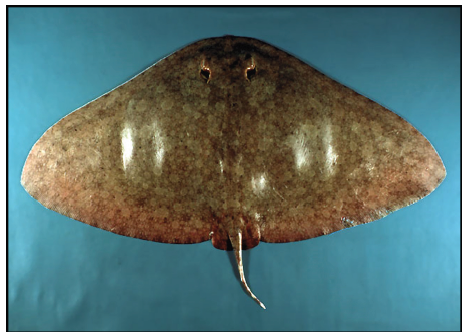
Although there are no specific published records of its occurrence off the coast of Palestine, its presence in the Levantine waters adjacent to Syria [27] and on a large scale in the eastern basin [6,20,22,29], suggests that it may occur in this region, albeit rarely and intermittently. However, new records -including gravid females and juveniles - have recently emerged in parts of the northern and eastern Mediterranean, particularly the Adriatic Sea off Albania, indicating that small remaining populations may persist in some coastal areas [29]. On Monday, August 28, 2023, in a very rare occurrence, Gazan fishermen caught a specimen of the Spiny Butterfly Ray using a longline. Accordingly, this study marks the rediscovery of a single specimen of the endangered spiny butterfly ray (Gymnura altavela Linnaeus, 1758) on the Mediterranean coast of the Gaza Strip, Palestine, after a 30-year absence. The importance of this study lies in it being the first Palestinian study to confirm the presence of this species in the Mediterranean Sea off the coast of the Gaza Strip after a period of not recording it locally for 30 years.
Methodology
This descriptive study was based on the collection of data and photographs documenting the very rare occurrence of the spiny butterfly ray (Gymnura altavela Linnaeus, 1758) in the Mediterranean waters off the Gaza Strip. Information was obtained through communication with the General Directorate of Fisheries at the Ministry of Agriculture and local fishermen, who also provided rare photographs of the species. Although this species was rarely captured in the waters of the Gaza Strip several decades ago, some researchers and experienced fishermen conducted preliminary measurements immediately after the specimen was landed. The Gaza Strip, located in the southeastern Mediterranean, extends 42km along the coast, covers 365km², and supports over 2.4 million inhabitants. The fishing sector includes more than 4,500 fishermen operating over 1,800 vessels using diverse fishing gears.
Result
The latest and most impressive catch of spiny butterfly ray in the Gaza Strip
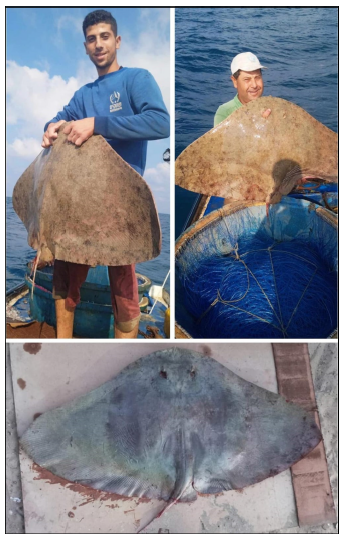
On Monday, August 28, 2023, fishermen from the Gaza Strip caught a specimen of spiny butterfly ray using a longline (Figure 2). According to the general directorate of fisheries at the ministry of agriculture, this species had not been caught there for 30 years. In fact, the spiny butterfly ray is among the largest rays in the Mediterranean, and its size is usually reported using disc width rather than total length. According to the only measurements taken on the specimen, the disc of the locally caught specimen was 115cm wide and weighed about 13kg.
Figure 2:The solitary specimen of the spiny butterfly ray (Gymnura altavela Linnaeus, 1758) was captured by local Gazan fishermen using a bottom longline on 28 August 2023.
Description of the spiny butterfly ray
The spiny butterfly ray is characterized by a dorsoventrally flattened body and an exceptionally broad pectoral disc, which is considerably wider than long, giving the species a distinctive butterfly-like appearance. The head is short and poorly differentiated from the disc. The snout is blunt, and the eyes are small and positioned dorsally, with large spiracles located immediately posterior to them. The dorsal surface is generally brown, occasionally marked with scattered darker or paler spots, while the ventral surface is white. The skin is mostly smooth and the mouth is ventrally positioned. The tail is short and slender, lacks a caudal fin and typically bears one or two stinging spines on its dorsal surface. Finally, the dorsal fin is completely absent.
Main local bycatch methods and conservation concerns of the spiny butterfly ray
In the coastal waters of the Gaza Strip, several bottom fishing methods may contribute to the bycatch of cartilaginous fishes inhabiting benthic and demersal habitats. The Spiny Butterfly Ray is not a target species but is occasionally recorded as bycatch in small-scale fisheries. Over thirty years ago, few cases of bycatch of the spiny butterfly ray in the Gaza Strip were reported, mainly in bottom trawls, gillnets, trammel trawls, and bottom longlines operating in shallow coastal waters and over the continental shelf. The species’ benthic behavior, extremely broad pectoral disc, and frequent use of nearshore habitats increase its susceptibility to entanglement and capture. In the Gaza Strip, the high concentration of fishing effort within a narrow coastal zone, together with the long soak times of static nets, likely contributed to elevated post-capture mortality of cartilaginous fishes. Given the critically endangered status of the spiny butterfly ray in the Mediterranean Sea, bycatch in the Eastern Mediterranean, including the Gaza Strip’s coastal waters, represents a significant conservation concern, even when encounter rates are low.
Local consumption of the spiny butterfly ray
In the past, thirty years ago or more, the spiny butterfly ray was not a major target species in the Gaza Strip due to its scarcity, but it was occasionally consumed by Gazans like any other cartilaginous fish caught in the Gaza Strip, despite its low commercial value and rapidly declining numbers. Even the most recent specimen, captured by bottom longlines in 2023, was sold indiscriminately alongside other cartilaginous fishes at the Gaza City fish market at a local price equivalent to approximately five US dollars per kilogram. The specimen was subsequently purchased and consumed locally. According to local old fishermen, this species is often treated in a manner similar to the Common Guitarfish (Rhinobatos rhinobatos Linnaeus, 1758) in Palestinian cuisine. It is typically fried or grilled, while some Gazans prepare it in the locally well-known Sayadieh dish, which consists of rice cooked with fish meat. It should be noted that this fish, despite its extreme rarity, is not considered a distinctive species in the Gaza Strip, unlike some sharks, rays, and large bony fishes. However, the part that is locally edible is the pectoral disc (wings), which is distinguished by its white flesh and firm texture.
Awareness of the spiny butterfly ray’s conservation status
The spiny butterfly ray is an extremely rare demersal species in the marine ecosystem of the Gaza Strip, as in the eastern Mediterranean basin. Although the General Directorate of Fisheries at the Ministry of Agriculture is aware of the species and its global conservation status, most local fishermen remain unfamiliar with it. Only a very small number of fishermen reported learning about this globally endangered cartilaginous fish through internet sources and, occasionally, publications issued by the General Directorate of Fisheries in the Gaza Strip.
Discussion
In the Mediterranean Sea, a high proportion of elasmobranch species are in threatened categories (Critically Endangered, Endangered, and Vulnerable) under IUCN criteria. The 42-kilometer coastline of the Gaza Strip on the Mediterranean Sea supports approximately 30-40 species of cartilaginous fish (Personal Communications), which represents a significant proportion of the shark and ray diversity in the Mediterranean. Some published scientific studies have provided information on certain species of cartilaginous fish (sharks and rays) that are caught or accidentally caught in the marine ecosystem of the Gaza Strip [30], noting that a few of them have been found preserved in the biology museums of Palestinian universities in the Gaza Strip [31,32].
Some sharks, both identified and unidentified, have injured or killed fishermen along the Palestinian coast stretching from Lebanon to the Arab Republic of Egypt [33]. Recently, extremely rare and Critically Endangered shark species have been recorded along the Gaza Strip coast, including the Angular Roughshark (Oxynotus centrina Linnaeus, 1758) [34] and the Whale Shark (Rhincodon typus A. Smith, 1828) which reached a length of 7-8 meters and entered the Mediterranean waters of Palestine from the Red Sea via the Suez Canal, a phenomenon known as Lessepsian migration [35]. One of the giant cartilaginous fishes caught in large quantities along the Gaza Strip during late winters and early springs (February-April) is the Spine tail devil ray (Mobula mobular Bonnaterre, 1788), a unique phenomenon that has been documented in the Gaza Strip over the years in numerous local and international studies [30,36-39]. With regard to the spiny butterfly ray (Gymnura altavela Linnaeus, 1758), the subject of the present study, it has undergone massive declines in the Mediterranean Sea over recent decades, with few to no records in major trawl surveys and historical catch data showing disappearance from areas where it was once common. Consequently, the species is now considered Critically Endangered in the Mediterranean and rare or absent throughout much of its former range, reflecting its severe population reduction and highly fragmented distribution across the basin [2,6,29,40,41].
The spiny butterfly ray is known as one of the largest butterfly rays. Adults can have a disc width of up to approximately 2 meters and a total length (including the tail) of about 2.5 meters [12]. The specimen caught in the Gaza Strip had a disc width of 115cm, as reported. This size indicates a subadult or medium sized adult specimen, roughly half the maximum reported disc width of two meters or more. Nutritionally, the spiny butterfly ray, despite its extreme rarity as previously discussed, was consumed in the distant past, and the specimen caught in 2023 was even eaten by Gazans. Most cartilaginous fish, such as sharks and rays, caught locally are eaten without objection from the Gazan population. An exception is the Angular Rough shark (Oxynotus centrina Linnaeus, 1758), another rare deep-sea cartilaginous fish recorded from the Gaza Strip. This species is never consumed locally because of its pig-like appearance and flesh, as well as its local names (Alfar or Aleursa), which translate to “mouse” or “rat,” as recently explained by Abd Rabou et al. [34]. In fact, the consumption of this extremely rare Mediterranean fish by Gazans is not unprecedented, as several studies have shown that other communities around the world also consume it and its relatives [2,42,43]. Despite the General Directorate of Fisheries at the Ministry of Agriculture being aware of the spiny butterfly ray and its global conservation status, most local fishermen, and even the general public in the Gaza Strip, remain largely unaware of this species. Conversely, many Gazans, including fishermen, are generally aware-primarily through media and social media-that cartilaginous fishes are globally threatened for various reasons. However, this awareness has not translated into changes in fishing practices. In fact, all species of cartilaginous fishes caught or by-caught in local nets are ultimately sold or consumed, as documented in recent local studies [30,32].
Again, in the case of the spiny butterfly ray, its extreme rarity in local waters has further obscured recognition of its status as a globally endangered species. As previously pointed out, the spiny butterfly ray is assessed as Critically Endangered in the Mediterranean Sea, having become rare or absent in many areas once historically occupied. Indeed, the current conservation situation the spiny butterfly ray highlights the need for ongoing scientific studies, such as that of Gajić & Karalić [6] and Espino-Ruano et al. [12]. Such studies are essential for enhancing understanding of the species’ ecology, which in turn supports effective management and conservation planning. Despite its simplicity, this study aims to clarify key issues and raise awareness among local fishermen-and potentially the broader Palestinian public-about the importance of protecting globally threatened marine species. Preserving marine biodiversity is a fundamental pillar for the sustainability of marine ecosystems and the maintenance of their biological resources. As for the species in question, it is benthic predator that helps maintain marine ecosystem balance and needs protection efforts [44,45]. There is no doubt that the General Directorate of Fisheries at the Ministry of Agriculture has previously provided information, supported by explanatory materials, on endangered cartilaginous species; however, such communication remains intermittent and limited. In conclusion, this study documents the first confirmed record of the species after a prolonged period without observations, thereby confirming its continued presence in the area. Should the political and security situation in the Gaza Strip stabilize, it will be essential to utilize a range of official and unofficial media outlets to raise public awareness of endangered cartilaginous fishes, including the spiny butterfly ray, in order to promote their conservation and sustainable management.
References
- Ebert DA, Dando M (2020) Field guide to sharks, rays & chimaeras of Europe and the mediterranean. Princeton University Press, New Jersey, USA, p. 384.
- Dulvy NK, Charvet P, Carlson JK, Badji L, Parra MPB, et al. (2021) Gymnura altavela. In The IUCN red list of threatened species 2021 (e.T63153A3123409). International Union for Conservation of Nature, Switzerland.
- Serena F (2005) Field identification guide to the sharks and rays of the mediterranean and Black Sea. FAO Species Identification Guide for Fishery Purposes FAO, Rome, Italy, p. 97.
- Milazzo M, Cattano C, Mabruk SAA, Giovos I (2021) Mediterranean sharks and rays need action. Science 371(6527): 355-356.
- Psomadakis PN, Dalù M, Scacco U, Vacchi M (2008) A rare batoid fish Gymnura altavela (Chondrichthyes, Gymnuridae) captured in the Tyrrhenian Sea. Marine Biodiversity Records 1: e6.
- Gajić AA, Karalić E (2024) Rediscovery and urgent conservation needs of the critically endangered Spiny Butterfly Ray (Gymnura altavela) in the Adriatic Sea. Animal Conservation 27(5): 581-584.
- (2025) Proposal for amendment to Annex II and Annex III of the SPA/BD Protocol: Gymnura altavela (Linnaeus, 1758). United nations environment program/mediterranean action plan regional activity center for specially protected areas. Mediterranean: Critically endangered (IUCN red list regional status), with evidence of massive decline and rare encounter rates in the Mediterranean Sea p. 260.
- Silva FG, Vianna M (2018) Diet and reproductive aspects of the endangered Butterfly Ray Gymnura altavela raising the discussion of a possible nursery area in a highly impacted environment. Brazilian Journal of Oceanography 66(3): 315-324.
- Yemışken E, Forero MG, Megalofonou P, Eryilmaz L, Navarro J (2018) Feeding habits of three batoids in the Levantine Sea (north-eastern Mediterranean Sea) based on stomach content and isotopic data. Journal of the Marine Biological Association of the United Kingdom 98(1): 89-96.
- Dulcic J, Jardas I, Onofri V, Bolotin J (2003) The rough tail stingray Dasyatis centroura (Pisces: Dasyatidae) and Spiny Butterfly Ray Gymnura altavela (Pisces: Gymnuridae) from the southern Adriatic. Journal of the Marine Biology Association of the United Kingdom 83(4): 871-872.
- Narváez K, Osaer F (2016) Morphological and functional abnormality in the Spiny Butterfly Ray Gymnura altavela. Marine Biodiversity Records 9(1): 95.
- Ruano AE, Castro JJ, Marrero AG, Montero LC, Meyers EK, et al. (2023) Aggregative behavior of spiny butterfly rays (Gymnura altavela, Linnaeus, 1758) in the shallow coastal zones of Gran Canaria in the Eastern Central Atlantic. Animals 13(9): 1455.
- Béarez P, Pruvost P, Feunteun E, Iglesias SP, Francour P, et al. (2017) Checklist of the marine fishes from metropolitan France. Cybium: Revue Internationale D’Ichtyologie 41(4): 351-371.
- Grech D, Aciutto E, Bakiu R, Battaglia P, Grira CB, et al. (2023) New records of rarely reported species in the Mediterranean Sea (July 2023). Mediterranean Marine Science 24(2): 392-418.
- Capapé C, Zaouali J, Tomasini JA, Bouchereau JL (1992) Reproductive biology of the Spiny Butterfly Ray, Gymnura altavela (Linnaeus, 1758) (Pisces: Gymnuridae) from off the Tunisian coasts. Scientia Marina 56(4): 347-355.
- Neifar L, Euzet L, Hassine OKB (2002) Anthobothrium altavelae n. (Cestoda: Tetraphyllidea) from the Spiny Butterfly Ray Gymnura altavela (Elasmobranchii: Gymnuridae) in Tunisia. Folia Parasitologica 49(4): 295-298.
- Etayeb KS (2021) Libya conservation of mediterranean marine and coastal biodiversity by 2030 and beyond UN environment Programme, p. 78.
- O’Keefe M, Bengil EG, Palmer JL, Beton D, Çağlar Ç, et al. (2023) Diversity and distribution of elasmobranchs in the coastal waters of Cyprus: Using bycatch data to inform management and conservation. Frontiers in Marine Science 10: 1181437.
- Özbek EÖ, Çardak M, Kebapçioğlu T (2016) Spatio-temporal patterns of abundance, biomass and length-weight relationships of Gymnura altavela (Linnaeus, 1758) (Pisces: Gymnuridae) in the Gulf of Antalya, Turkey (Levantine Sea). Journal of the Black Sea/Mediterranean Environment 22(1): 16-34.
- Yeldan H (2018) Estimating some population parameters and stock assessment of spiny butterfly ray, Gymnura altavela (Linnaeus, 1758) the Levant Basin coast (Northeastern Mediterranean). Indian Journal of Animal Research 52(12):
- Türker D, Zengin K, Tünay ÖK (2019) Length-weight relationships for nine Chondrichthyes fish species from Edremit Bay (North Aegean Sea). Turkish Journal of Fisheries and Aquatic Sciences 19(1): 71-79.
- Taylan B, Bayhan B, Saglam C, Kara A (2019) First observation of the embryos of Spiny Butterfly Ray, Gymnura altavela (Linnaeus, 1758) (Chondrichthyes: Gymnuridae) from Eastern Mediterranean, a species critically endangered. Fresenius Environmental Bulletin 28: 3147-3152.
- Taylan B, Bayhan B, Sağlam C, Babaoğlu AÖ, Kara A (2022) The length-weight characteristics of five elasmobranch species (Pisces: Chondrichthyes) from Izmir Bay (Aegean Sea coast of Turkey): Spring 2018. Turkish Journal of Agriculture-Food Science and Technology 10(2): 368-373.
- Ergüden D, Uyğur N, Ayas D (2023) The presence of Pontobdella muricata (Hirudinea: Piscicolidae), on the new host Gymnura altavela (Linnaeus, 1758) in the Eastern Mediterranean, Turkey. Advanced Underwater Sciences 3(2): 26-30.
- Alkusairy HH (2013) The study of the life cycle, fecundity, and feed habitat of the cartilaginous species: Gymnura altavela (Linnaeus, 1758) in Syrian marine waters.
- Alkusairy HH (2013) The life cycle of cartilaginous species: Gymnura altavela (Linnaeus® 1758) (Gymnuridae) in Syrian marine water. Iraqi Journal of Aquaculture 10(2): 123-140.
- Alkusairy HH, Ali M, Saad A, Reynaud C, Capapé C (2014) Maturity, reproductive cycle, and fecundity of spiny butterfly ray, Gymnura altavela (Elasmobranchii: Rajiformes: Gymnuridae), from the coast of Syria (Eastern Mediterranean). Acta Ichthyologica et Piscatoria 44: 229-240.
- (2014) Ecological characterization of sites of interest for conservation in Lebanon, p. 146.
- Gajić AA, Karalić E, Beširović H, Sulikowski J (2023) The first record of gravid spiny butterfly ray (Gymnura altavela) in the northern Mediterranean Sea, with description of near‐term fetuses. Journal of Fish Biology 102(6): 1506-1509.
- Abd Rabou AN, Elkahlout KE, Elnabris KJ, Attallah AJ, Salah JY, et al. (2023) An inventory of some relatively large marine mammals, reptiles and fishes sighted, caught, by-caught or stranded in the Mediterranean coast of the Gaza Strip-Palestine. Open Journal of Ecology 13(2): 119-153.
- Abd Rabou AN (2020) The Palestinian marine and terrestrial vertebrate fauna preserved at the Biology Exhibition, Islamic University of Gaza, bombarded by the Israeli Army in December, 2008. Israa University Journal of Applied Science (IUGAS) 4(1): 9-51.
- Abd Rabou AN, Gafar MF, Mohanna AM, Rafeea AA, Jadallah RI, et al. (2025) A look at the deadly shark attack on an Israeli diver off the Mediterranean coast of Hadera, Palestine. Uttar Pradesh Journal of Zoology 46(12): 124-142.
- Abd Rabou AN, Kichaoui AYE, Bashitin TAE, Aziz IIA, Elnabris KJ, et al. (2025) On the mummified marine and terrestrial vertebrate fauna adorning the Biology Department Museum at the Islamic University of Gaza, Gaza Strip, Palestine, before the Israeli war on October 7, 2023. Open Journal of Ecology 15(9): 528-568.
- Abd Rabou AN, Hamidi FAA, Samara SA, Aitah EKA, Alajrami MS, et al. (2026) Rare records of the critically endangered angular roughshark (Oxynotus centrina Linnaeus, 1758) from the marine ecosystem of the Gaza Strip, Palestine. Journal of Entomology and Zoology Studies 14(1): 6-13.
- Abd Rabou AN, Aitah EKA, Samara SK, Alajrami MS, Jebril MA, et al. (2026) First record of the globally endangered Whale Shark (Rhincodon typus Smith, 1828) in the Mediterranean waters of the Gaza Strip, Palestine, and its consumption shortly after the ceasefire following the two-year Israeli war of genocide (2023-2025): Examines in Marine Biology & Oceanography 8(1): 1-13.
- Abd Rabou AN (2013) Priorities of scientific research in the fields of marine environment and fishery resources in the Gaza Strip-Palestine. Priorities of Scientific Research in Palestine: Towards a National Directory of Scientific Research March 25-26, 2013, Scientific Research Affairs, Islamic University of Gaza, Gaza Strip, Palestine, 481-522.
- Abudaya M, Ulman A, Salah J, Fernando D, Wor C, et al. (2018) Speak of the devil ray (Mobula mobular) fishery in Gaza. Reviews in Fish Biology and Fisheries 28(1): 229-239.
- Couturier LI, Bennett MB, Richardson AJ (2013) Mystery of giant rays off the Gaza Strip solved. Oryx 47(4): 480-480.
- Sciara GND, Abudaya M, Milisenda G, Canese S, Panigada V, et al. (2025) Insights into Spinetail devil ray spatial ecology in the Mediterranean Sea through satellite telemetry. Scientific Reports 15(1): 2405.
- Ciriaco S, Segarich M, Franzosini C, Konstas S (2020) A record of rare spiny butterfly ray, Gymnura altavela (Linnaeus, 1758), in the Amvrakikos Gulf (Greece). In Annales: Series Historia Naturalis Scientific and Research Center of the Republic of Slovenia 30(1): 39-42.
- Serena F, Abella A, Bargnesi F, Barone M, Ferretti F, et al. (2020) Elasmobranch abundance declines in the Mediterranean Sea: Long-term absence from standardized surveys. Marine Policy 115: 103868.
- Kyne PM, Carlson JK, Ebert DA, Fordham SV, Bizzarro JJ, et al. (2012) The Conservation Status of North American, Central American, and Caribbean Chondrichthyans. IUCN Species Survival Commission Shark Specialist Group, Vancouver, Canada, p.148.
- Sherman CS, Akhilesh KV, Ali AB, Bineesh KK, Derrick D, et al. (2021) Gymnura poecilura longtail butterfly ray. The IUCN Red List of Threatened Species.
- Leite CVT, Santana FM, Valle RF, Takasuka V, Góes MF, et al. (2024) Life‐history of the spiny butterfly ray, Gymnura altavela (Chondrichthyes: Myliobatiformes) kept under human care in a marine aquarium. Journal of Fish Biology 105(4): 1060-1073.
- Turan C, Soldo A, Dogdu SA, Turan F, Ergenler A, et al. (2025) Identification of a potential nursery ground of the spiny butterfly ray, Gymnura altavela, in the northeastern Mediterranean Sea, Tü In Annales: Series Historia Naturalis. Scientific and Research Center of the Republic of Slovenia 35(2): 205-212.
© 2026 Abdel Fattah N Abd Rabou. This is an open access article distributed under the terms of the Creative Commons Attribution License , which permits unrestricted use, distribution, and build upon your work non-commercially.
Editor In Chief







.jpg)































Signup for Newsletter

Quick Links
 Editorial Board Registrations
 Submit your Article
 Best Paper of the Volume
 Reprints
 Refer a Friend
 Advertise With Us
Our Recent Edition

.jpg)



Top Editors




.jpg)

















.bmp)
.jpg)
.png)
.jpg)













.jpg)






.png)

.png)




.png)




Financial Support

Sponsors

Latest e-Books

Latest Video

 a Creative Commons Attribution 4.0 International License. Based on a work at www.crimsonpublishers.com.
Best viewed in
a Creative Commons Attribution 4.0 International License. Based on a work at www.crimsonpublishers.com.
Best viewed in 
 | Above IE 9.0 version