

- About Us
- Information
-

The Author ensures that the research has been conducted responsibly and ethically with adherence to all relevant regulations. read more..
- For Authors
- For Reviewer
- Manuscript Guidelines
- Membership
- Publication Ethics
-
- Journals
- Reprints
- e-Books
- Videos
- Policies
- Contact Us
 COVID-19
- Submissions



Full Text
Environmental Analysis & Ecology Studies
Vegetated Wire Mesh Mattress with Sand Filling, a Technique of Posidonia Oceanica Re-Planting in the Coastal Waters of Elba’s Island (Italy)
Nicola Cantasano1* and Federico Boccalaro2
1National Research Council, Institute for Agricultural and Forest Systems in the Mediterranean, Rende Research Unit, Italy
2AIPIN Lazio, Member of EFIB, European Federation of Soils Bioengineering, Section of Italian Association for Soil Bioengineering, Italy
*Corresponding author:Nicola Cantasano, National Research Council, Institute for Agricultural and Forest Systems in the Mediterranean, Rende Research Unit, Italy
Submission: February 27, 2026; Published: May 22, 2026

ISSN 2578-0336 Volume13 Issue 4
Abstract
Restoration processes, through transplanting operations, represent a reliable approach to enhance the recovery of Posidonia oceanica meadows in the Mediterranean Sea. The environmental issue, regarding the need of this study is to summarize some kinds of Soil Bioengeneering, commonly used in terrestrial landscape, also in marine environments. Amongst the main techniques, it has been realized, on October 2006, an experimental test regarding the transplantation of Posidonia oceanica (L.) Delile shoots on the marine depths of Elba’s Island (Italy). These kinds of coatings, are formed by vegetated wire mesh mattresses with sand filling. The first results of this trial show the positive outcomes of the experiments but, at the same time, the slowness of recovery actions, suggesting the potential to extend such methodologies, typical of terrestrial defense, to marine environment.
Keywords:Posidonia oceanica; Soil Bioengineering; Mattresses; Elba’s Island
Introduction
Seagrasses are marine angiosperms able to support healthy coastal ecosystems maintaining the ecological, physical and geological processes in marine biosphere [1-4]. Amongst seagrass species, Posidonia oceanica (Linnaeus) Delile, is one of the most important endemic species of Mediterranean Sea. In good and pristine conditions of coastal seawaters, this marine plant, can form large and extensive meadows, covering a global surface area estimated as 23,000km2 [5]. Posidonia beds represent the typical “climax” ecosystem of the basin [6,7] in the infralittoral bottoms of Mediterranean Sea on mobile and hard substrata from surface waters to 40-45 meters depth, according to light conditions. So, valuing the important ecological roles performed by the meadows, Posidonia beds are protected by European legislation through the Habitat Directive (92/43/UE), classified as “Priority Habitat” and inserted as “Best Concern” ecosystem within the Red List released by the International Union for Conservation of Nature (IUCN) [8]. However, despite all these legislative efforts, the meadows are, actually, affected by a widespread regression with a declining trend variable from 13% to 50% [9,10]. This negative trend is caused by conditions of marine pollution induced by human impacts [11-13], by mechanical erosion [14,15] and by burial processes [16-18]. Therefore, the protection of the meadows has become one of the main targets within a sound management of Mediterranean seawaters. In this way, Posidonia oceanica seagrass, is one of the main Nature-Based Solution (NbS) for coastal protection, since it may reduce wave action and sediment transport in coastal areas, so to mitigate erosion risk [19]. Active restoration, through transplanting techniques, becomes a reliable approach to enhance the natural recovery of Posidonia meadows. In these last decades, many efforts have been realized in Mediterranean Sea [20,21] but experimental evidences highlight the failure of some trials
[22]. The transplanting techniques are distinguished by scientific
literature [10,23,20] in the following ones:
A. cement with holes;
B. cement frames around wire meshes retaining cuttings;
C. metallic, plastic or biodegradable wire grid laid flat on the
bottom, retaining cuttings;
D. fixing the cuttings to the bottom by means of stakes or
staples;
E. digging of holes in which blocks are placed;
F. planting of seedlings germinated in laboratory;
G. planting of seeds collected at sea or on beaches.
Amongst these experimental measures, the C techniques have been performed in some Mediterranean regions as in Provence, French riviera, Corsica, Tuscany and Sicily [24-31]. Such measures are distinguished in mattresses, biological and/ or geotextile mats being part of Soil Bioengineering, a specific discipline of environmental engineering. It pursues technological, ecological and economic as well as design goals. In this way, it seeks to achieve these results primarily by making use of living materials, i.e. seeds, plants, parts of plants and plant communities, employing them in near-natural constructions and exploiting the manifold abilities inherent in plants. Soil Bioengineering may be a substitute for classical engineering works and, in most cases, it is a meaningful and necessary method of complementing the latter. The application of Soil Bioengineering tools is suggested in all fields of soil and hydraulic engineering, especially for slope, embankment stabilization and erosion control.
This study analyses a similar kind of technique normally used by Soil Bioengineering on terrestrial environments but applicable also in marine ones. The experimental trial consists in laying down, on marine depths, wire mesh mattresses with sand filling coated with geotextile membranes, where cuttings of Posidonia oceanica are fixed.
Materials & Methods
The experimental trial, conducted for the re-vegetation and the consolidation of marine depths, through the transplanting of Posidonia oceanica plantlets, with intact leafs and rhizomes, was realized along the coastline of Elba’s Island just in front of the sandy beach of Cavo bay. This research, realized in three years from October 2006 to March 2009, was tested to evaluate the resistance of these materials, normally used by Soil Bioengineering in terrestrial environments.
Study area
The island of Elba, the main islet of Tuscan Archipelago, is located in the Western Mediterranean basin, along the Northern Tyrrhenian Sea of Italian seaboard. Elba is the third Italian island for its extension. It shows a global surface area of 224 square kilometres and a length of its coastline of 147 kilometres. The island shows a triangular shape, appearing irregular in its coastal outline, interrupted by many gulfs, bays and headlands. The geological formations of the sandy beaches are variable from sands to gravels and pebbles. The submerged beach of Cavo bay, characterized by Posidonia oceanica meadows, on a depth of about 5 meters, represents the study area of the research (Figure 1). It is composed by fine sands and pebbles with a lot of plate fractures filled with quartz highly deformed by veins within the typical “Cavo Formation” [32]. Finally, on the marine depths Cavo bay it was shown a regression of Posidonia meadows caused by human activities, as confirmed, also, by the presence of some dead “mattes” widespread on soft marine bottoms.
Figure 1:Geographic map of Elba’s Island and detail of the study area with geographical coordinates 42°51’,729 N, 10°25’,221 E located in the bay of Cavo and marked with a red circle.

Materials
The experimental trial, for the re-vegetation of marine depths, was realized through the use of mattresses and Posidonia oceanica cuttings. During the field trial pre-assembled modules, known as mattresses, were used. These kinds of mats were coupled with double twisted wire meshes, covered with geotextile materials and filled with sands and/or pebbles. The geotexile materials, as “Macmat R” square tables, were dissected in plots by 1m x 1m dimensions and the mattresses were lined with geo-texture coverings. Finally, cuttings of Posidonia oceanica species were fixed singly on the mats (Figure 2).
Figure 2:Mattress for re-vegetation of marine depths with transplanted cuttings of Posidonia oceanica.
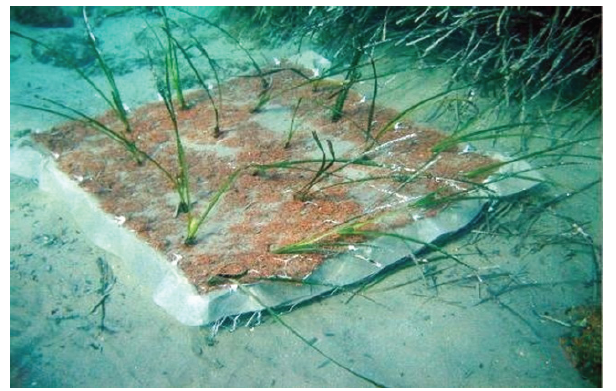
Sustainable engineering: Amongst the different kind of mattresses, combining sustainability and performance, it was tested the PoliMac® mattress. This specific kind of coating, composed by biodegradable materials, ensures exceptional durability, reducing maintenance and extending the product’s life cycle. Rigorously tested, it does not release harmful substances into water. By using natural stone, these solutions integrate seamlessly into aquatic environments, enhancing biodiversity. With over 70% less material usage compared to rip-rap, they deliver the same performance with a lower environmental footprint.
Verification of the mattress stability on marine depth: Before the planting operations, it was tested the resistance of the mattress against the pulling and the raising forces of hydrodynamics existing in the transplanting site, on the base of weather and climatic conditions prevailing in the bay of Cavo (Table 1).
Table 1:Verification of mattress stability in the marine depth of transplanting site (from Matteo Zanella Coastal Protection System, Maccaferri S.p.A., Bologna, Italy).

Methodologies
The actions made during the field campaign were firstly
realized on the ground to characterize the biotic and abiotic
conditions existing in the marine depths of the study area. Then,
it was prepared, in laboratory, the main kind of mattresses used
for transplanting experiments. In the third stage of the planning
activities, it was realized, directly on the marine depths of Cavo’s
bay, the sinking of the mats and the following transplanting of
Posidonia oceanica cuttings. The planting was realized following
some steps, as suggested by scientific literature [33], as are:
A. Preliminary assessment of a planning scheme to evaluate
the effectiveness of planting operations.
B. Characterization of experimental sites and evaluation
of Posidonia oceanica meadows in the donor sites and in the
receiving ones.
C. Identification of the most suitable transplanting
techniques.
D. Sorting of Posidonia oceanica plants for planting activities.
E. Control of transplanting cuttings in time.
F. Monitoring of the main positive and negative outputs of
the interventions.
Work phases
In particular, the planting activities are distinguished in the
following steps:
a. assessment of the installation plan through earthmoving
works;
b. setting of mattresses on beaches or on supporting vessels
and connection of different modules using wire meshes;
c. on marine depths, subjected to high hydrodynamic forces,
it is suggested to anchorage the mats to the bottoms with
metallic grids and/or with ballast waters to guarantee a better
stability of the whole structure;
d. filling voids with sands, peebles and/or with organic
fibres;
e. use of surface coatings on the upper floor of mattresses
with biological or synthetic mats;
f. closing the mattresses in the upper sections;
g. transplanting of Posidonia oceanica cuttings;
h. sinking the whole structure on the selected marine depth.
The operative stages of the project were based firstly on a global withdrawal of 45 orthotropic rhizomes and fifteen plagiotropic ones from donor meadows of Posidonia oceanica. In the second stage of the project, the 60 detached cuttings were transplanted in three plots, by dimensions of 1m x 1m, represented by three “Reno” mattresses, all located on the marine depths of Cavo’s bay. In this marine experimental station, located, at a depth of about 5 metres, were located two underwater drills measuring continually light and temperature values. The experimental trial, beginning in October 2006, went on for about three years until March 2009.
Monitoring
To test the outcomes of transplanting experiments, it has been
prepared a structured monitoring plan, yearly from 2010 to 2019,
with the use of specific collecting forms to verify, after the planting
of Posidonia shoots, the following parameters:
a) the surviving rates of transplanted rhizomes;
b) the growing rate of the transplanted leaves;
c) the formation of new apical rhizomes;
d) the vegetative recovery of transplanted cuttings.
All these steps, representing the core of the experimental design, show that transplanting is a complex procedure that must be realized through a series of stages in a consecutive order for the successful output of the process.
The delay in communicating the resulting data is due to the need to wait the final results of a project nicknamed Life SEPOSSO [34], conducted in the bay of Cavo of Elba’s Island from 2019 to 2020 within an experimental plan realized by the International School for Scientific Diving (ISSD). The aim of the project is to realize a reforestation plan with Posidonia oceanica plantlets using wire mesh mattresses, as already tested in previous experiments within techniques of Soil Bioengineering. The monitoring plan realized in the period 2020-2024 show that all the structures are stable with surviving rates of Posidonia shoots as 55% and rhizomes as 58%.
Results
The installation on marine depths of “Reno” mattresses and “Macmat R” coverings was proceeded by a complex stage realized on the ground for a correct preparation of the materials (Figure 3). Afterwards, in October 2006, the mattresses were carried away directly at sea where the square tables were fixed both on sands and on dead “mattes” of Posidonia oceanica meadows by using steele stakes (Figure 4).
Figure 3:Setting on the ground of “Reno” mattress.
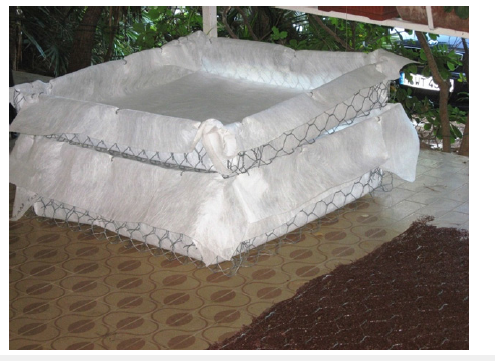
Figure 4:Planting mattress on the marine sandy bottoms at the transplanting site.
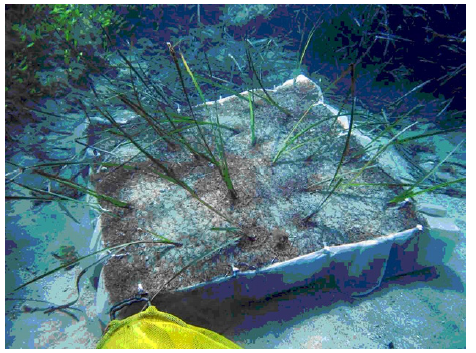
Since from the beginning, the plant cuttings, sustained by soft and spongy materials, without further fixing systems, appeared well established and began to radicate, extending roots from their rhizomes. In next months were performed a series of controls to point out the conservation status of the materials used in seawaters. At the same time, it was checked the stability of the cuttings in a general context of high hydrodynamics. In the first of these surveys, realized one month after the former installation, it was observed a good conservation status the “Macmat R” square covering, located on the dead “matte”, showing a total integration in the benthonic marine environment. As a matter of fact, it was observed the growing of the seaweed aulerpa prolifera (Forsskål) Lamouroux, already present in the study area (Figure 5). In the next surveys, realized in 2007 summer season, after strong sea storms, all the planted structures, showed a good conservation status and, also, the anchorages of the materials appeared stable and effective. So, after two years from the beginning of the experiment, it was observed a total integration of the mattresses in marine environment, as confirmed by the full infiltration of marine macroalgae in the tridimensional structure of the mats (Figure 5).
Figure 5:Integration of the mattress with the seaweed Caulerpa prolifera.

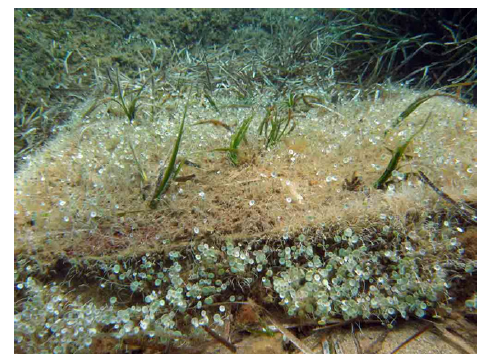
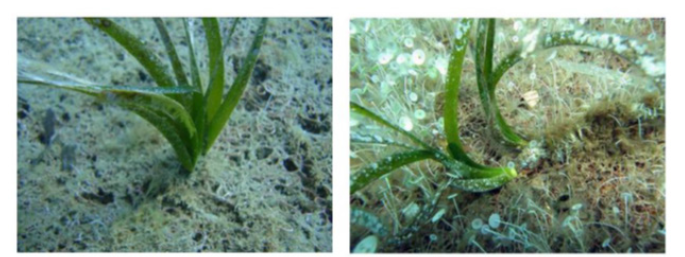
In the following survey, after two years from the beginning of the transplanting experiment, the mattresses were fully integrated with marine depths allowing the gradual growing of marine vegetation, as Acetabularia acetabulum (Linnaeus) P.C. Silva, completely covering the planting plots (Figure 6).
Figure 6:Transplanted cuttings of Posidonia oceanica surrounded by the seaweed Acetabularia acetabulum.
The last field survey, conducted in March 2009, confirmed the solidity of the whole structure and the high capacity of “Macmat R” mattresses fully integrated in the dead “matte” of Posidonia oceanica meadows, Finally the transplanted cuttings of Posidonia oceanica showed a good state of conservation and a fair elongation of their radical systems (Figure 7) with a slow growth rate variable from 1 to 7cm for orthotropic rhizomes and 2-4cm for plagiotropic ones with a surviving rate of about 70%. These results confirm the right choice of marine depth and the good performance of transplanting technique.
Figure 7:Successful stage in transplanted cuttings of Posidonia oceanica.
Discussion
This study was based on field observations and the measurements done on the transplanting cuttings were recorded especially regarding the variables related to growth performance of Posidonia oceanica species. The first results of the field survey suggest that “Reno” mattresses and “Macmat R” squares are stable and, therefore, could be usefully applied for reforestation projects realized with Posidonia oceanica or with other species of seagrasses. This option is becoming possible because mattresses are characterized by a marked stability on marine depths and by a high resistance against hydrodynamics. Indeed, these kinds of measures are easy to prepare directly on the ground and can be realized at low-cost. In particular, from the resulting data, it appears especially useful the application of “Macmat R” coverings fixed on “dead mattes” of Posidonia oceanica meadows and coupled with the presence of natural seaweeds.
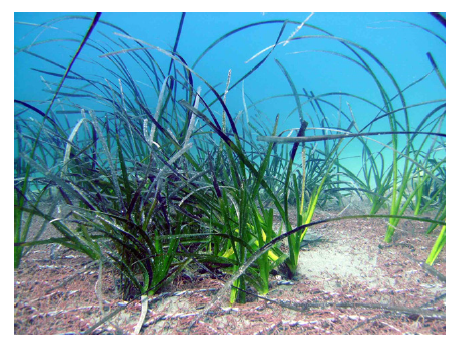
The experimental trial highlights the need to insert Posidonia cuttings directly in the cover of the mattress before its final assessment on marine depth. In this way, it is possible to integrate the radical systems of transplanted cuttings in the sediments, fixing the whole structure on marine depth. The resulting data, based on field observations, show the resilience of transplanted shoots with a slow recovery in time (Figure 8), suggesting that a fair plant recovery is appreciable just after three years, as confirmed, also, by scientific literature [29,22,35].
Figure 8:Cuttings of Posidonia oceanica stably fixed and deeply rooted in the sediments.
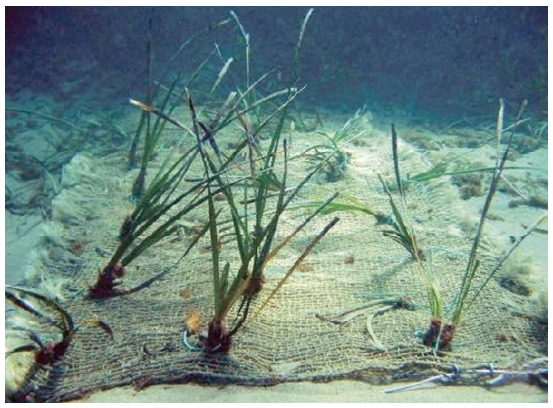
From the resulting data it is possible to confirm that the use of mattresses, fixed with wire stakes on hard substrata and on patchiness marine depths, is better than biological and/or geotextile mats. In fact, the transplanting of Posidonia oceanica cuttings on rocky surfaces needs ballast means while bio-mats are more suitable on large and regular sandy seabed, as observed in the described experiment (Figure 9) [36]. Anyway, in both cases, the cuttings are able to firmly take root because the coverings of the mattresses are made with the same materials [37]. In transplanting operations, it is always suggested to use cuttings of Posidonia oceanica already detached form the meadows by wave motions and/or by human pressures such as anchoring or trawling activities. In this way, it is possible to limit the withdrawal effects from donor meadows, so reducing the environmental impact on coastal habitats [38].
Figure 9:Biological mats, in agave fibres, re-vegetated with Posidonia oceanica cuttings and fixed with wire stakes on marine depths.
Finally, some experiments, conducted on the marine depths of Balearic Islands in the Western Mediterranean Sea, tested the use of Posidonia oceanica seedlings produced by beach-cast fruits collected on the beach. The planting of seedlings was realized on a dead matte of Posidonia meadow. The trial showed a global survivorship of about 50% of the transplanted seeds where each seedling was able to produce from one to four shoots after three years from the beginning of the experiment [39].
Conclusion
The resulting data show that the materials tested in transplanting experiments, especially Macmat R” mattresses fixed on dead “mattes”, can be successfully used for the re-vegetation of marine depths with Posidonia oceanica plantlets. This study provides useful data helping coastal managers to really understand the transitions between local areas of transplanting cuttings and well-established reforestation planning. However, the main issue regarding these kinds of programs in the Mediterranean Sea deals with experiences conducted in short terms [40-43] and rarely in long times [29]. These constraints are caused by the short duration of many projects, by short-term fundings and/or by the need to publish quickly the resulting data. Indeed, policy makers, media coverage and public opinion are more interested in larger operations at high profile, while the projects, aimed to the improvement of environmental conditions, are limited by financial means.
Anyway, the gradual regression of Posidonia oceanica meadows in the Mediterranean Sea is becoming a real environmental emergency. At the same time, it is necessary to remove possible stressors in marine environment allowing ideal conditions for a full natural recovery of coastal ecosystems [44,45]. In this way, to pursue an effective protection of Posidonia meadows, long-term restoration processes should be tested at individual and ecological levels.
In conclusions, the main goal of these experimental trials it is not only to recover the original meadows but also to replace damaged areas, as dead “mattes” of Posidonia oceanica, with stable meadows.
Acknowledgement
The authors thank Matteo Zanella, by Macaferri S.p.A., for its verification of mattress stability in the marine depth of transplanting site.
References
- Hemminga M, Duarte CM (2004) Seagrass ecology. Cambridge University Press, Cambridge, UK.
- Short FT, Carruthers TJB, Dennison WC, Waycott M (2007) Global seagrass distribution and diversity: A bioregional model. Journal of Experimental Marine Biology and Ecology 350: 3-20.
- Barbier EB, Hacker SD, Kennexdy C, Koch EW, Stier AC, et al. (2011) The value of estuarine and coastal ecosystem services. Ecol Monogr 81(2): 169-193.
- Orth RJ, Carruthers TJ, Dennison WC, Duarte CM, Fourqurean JW, et al. (2006) A global crisis for seagrass ecosystems. Bioscience 56(12): 987-996.
- Agulles M, Marbà N, Duarte CM, Jorda G (2024) Mediterranean seagrasses provide essential coastal protection under climate change. Scientific Reports 14(30269): 1-12.
- Ghirardelli E (1981) Life in the waters. UTET Publishers, Torino, Italy, p. 402.
- Duarte CM (2002) The future of seagrass meadows. Environmental Conservation 29(2): 192-206.
- Pergent G, Semroud R, Djellouli A, Langar H, Duarte C (2010) Posidonia oceanica. IUCN Red List 2010.
- Marbà N, Díaz-Almela E, Duarte CM (2014) Mediterranean seagrass (Posidonia oceanica) loss between 1842 and 2009. Biological Conservation 176: 183-190.
- Boudouresque CF, Bernard G, Bonhomme P Charbonnel E, Diviacco G, et al. (2012) Protection and conservation of Posidonia oceanica RAMOGE and RAC/SPA Publishers, Tunisa, p. 202.
- Delgado O, Ruiz J, Pérez M, Romero J, Ballesteros E (1999) Effects of fish farming on seagrass (Posidonia oceanica) in a Mediterranean bay: Seagrass decline after organic loading cessation. Oceanologica Acta 22(1): 109-117.
- Dimech M, Borg JA, Schembri PJ (2000) Structural changes in a Posidonia oceanica meadow exposed to a pollution gradient from a marine fish-farm in Malta (Central Mediterranean). Biologia Marina Mediterranea 7(2): 361-364.
- Ruiz JM, Pérez M, Romero J (2001) Effects of fish farm loadings on seagrass (Posidonia oceanica) distribution, growth and photosynthesis. Marine Pollution Bulletin 42(9): 749-760.
- Francour P, Ganteaume A, Poulain M (1999) Effects of boat anchoring in Posidonia oceanica seagrass beds in the Port-Cros National Park (north-western Mediterranean Sea). Aquatic Conservation Marine and Freshwater Ecosystems 9(4): 391-400.
- Milazzo M, Badalamenti F, Ceccherelli G, Chemello R (2004) Boat anchoring on Posidonia oceanica beds in a marine protected area (Italy, western Mediterranean): Effect of anchor types in different anchoring stages. Journal of Experimental Marine Biology and Ecology 299(1): 51-62.
- Manzanera M, Perez M, Romero J (1998) Seagrass mortality due to oversedimentation: An experimental approach. Journal of Coastal Conservation 4: 67-70.
- González-Correa JM, Sempere JTB, Sánchez-Jerez P, Valle C (2007) Posidonia oceanica meadows are not declining globally. Analysis of population dynamics in marine protected areas of the Mediterranean Sea. Marine Ecology Progress Series 336: 111-119.
- González-Correa JM, Fernández-Torquemada Y, Sánchez-Lizaso JL (2009) Short-term effect of beach replenishment on a shallow Posidonia oceanica Marine Environmental Research 68(3): 143-150.
- Canals Ventín P, Lázaro Marín L (2019) Towards nature-based solutions in the mediterranean. IUCN Centre for Mediterranean Cooperation, Spain.
- Boudouresque CF, Blanfuné A, Pergent G, Thibaut T (2021) Restoration of seagrass meadows in the mediterranean sea: A Critical review of effectiveness and ethical issues. Water 13: 1034.
- La Porta B, Bacci T (2022) Manual for planning, implementing, and monitoring Posidonia oceanica LIFE SEPOSSO (LIFE16 GIE/IT/000761), SEPOSSO, Roma, Italy, p. 114.
- Pansini A, Bosch-Belmar M, Berlino M, Sara G, Ceccherelli G (2022) Collating evidence on the restoration efforts of the seagrass Posidonia oceanica: Current knowledge and gaps. Sci Total Environ 851: 158320.
- Astruch P, Boudouresque CF, Bonhomme D, Goujard A, Antonioli PA, et al. (2012) Mapping and state of conservation of benthic marine habitats and assemblages of Port-Cros National Park (Provence, France, Northwestern Mediterranean Sea). Sci Rep Port-Cros Natl Park 26: 45-90.
- Molenaar H, Meinesz A, Caye G (1993) Vegetative reproduction in Posidonia oceanica. Survival and development in different morphological types of transplanted cuttings. Bot Mar 36: 481-488.
- Piazzi L, Cinelli F (1995) Restoration of the littoral sea bottom by means of transplantation of cuttings and sprouts. In: Cinelli F, Fres, E, Lorenzi C, Mucedola A (Eds.), Posidonia oceanica, A Contribution to the Preservation of a Major Mediterranean Marine Ecosystem; Revista Marittima, Rome, Italy, pp: 69-71.
- Bovina G (2009) Conservation and restoration of Posidonia oceanica In: Onori L (Ed.), Restoring marine-coastal ecosystems and protecting sandy shores in protected areas. ISPRA, Roma, pp: 309-339.
- Vangeluwe D (2006) Effects of transplantation on biometrics and on the dynamics of nutrients, carbon and chlorophyll in Posidonia oceanica (L.) Delile. PhD Thesis, University of Liège, Liège, Belgium, p. 196.
- Pirrotta M, Tomasello A, Scannavino A, Di Maida G, Luzzu F, et al. (2015) Transplantation assessment of degraded Posidonia oceanica habitats: Site selection and long-term monitoring. Mediterr Mar Sci 16(3): 591-604.
- Acunto S, Piazzi L, Cinelli FL, Biasi AM, Pacciardi L, (2015) Transplantation of the Mediterraneanseagrass Posidonia oceanica through naturalistic engineering techniques: Value, weakness and further improvements. Peer J Prepr 3: e1051v1.
- Alagna A, D’Anna G, Musco L, Fernandez TV, Gresta M, et al. (2019) Taking advantage of seagrass recovery potential to develop novel and effective meadow rehabilitation methods. Mar Pollut Bull 149: 1-12.
- ISPRA (2014) Conservation and management of naturalness in marine-coastal ecosystems. Transplanting Posidonia oceanica ISPRA Manuals and guidelines, ISPRA, Roma, Italy, p. 97.
- Bortolotti V, Fazzuoli M, Pandeli E, Principi G, Babbini A, et al. (2001) Geology of central and eastern Elba Island, Italy. Ofioliti 26(2a): 97-150.
- Calumpong HP, Fonseca MS (2001) Seagrass transplantation and other seagrass restoration methods. In: Short FT, Coles RG (Eds.), Global Seagrass Research Methods. Elsevier Science, pp: 425-442.
- LIFE Project SEPOSSO (2019) Supporting environmental governance for the Posidonia oceanica sustainable transplanting Operations. The project Life SEPOSSO (LIFE16 GIE/IT/000761), ACTION A3 Final report on Posidonia oceanica transplanting case studies analysis.
- Pansini A, Deroma M, Guala I, Monnier B, Pergent-Martini C, et al. (2024) The resilience of transplanted seagrass traits encourages detection of restoration success. Journal of Environmental Management 357: 120744.
- Boccalaro F, Rende F, Burgassi M, Cinelli F, Zanella M (2008) A sea of plants. ACER 6: 57-61.
- Cinelli F, Boccalaro F, Burgassi M, Rende F, Piazzi L, et al. (2007) Experimental use at sea of technical systems already employed by terrestrial naturalistic engineering. Biologia Marina Mediterranea 14(2): 342-343.
- Boccalaro F (2012) Coastal defense and bioengineering: A manual for restoring lagoon, dune, coastal, and marine habitats. Dario Flaccovio, Palermo, Italy, p. 577.
- Terrados JMA, Celdrán D (2013) Use of Posidonia oceanica seedlings from beach-cast fruits for seagrass planting. Botanica Marina 56(2): 185-195.
- Vangeluwe D, Lepoint G, Bouquegneau JM, Gobert S (2004) Effect of transplantation on Posidonia oceanica Life Environ 54: 223-230.
- Lepoint G, Vangeluwe D, Eisinger M, Paster M, van Treeck P, et al. (2004) Nitrogen dynamics in Posidonia oceanica cuttings: Implications for transplantation experiments. Marine Pollution Bulletin 48(5-6): 465-470.
- Cunha AH, Assis JF, Serrão EA (2013) Seagrasses in Portugal: A most endangered marine habitat. Aquat Bot 104: 193-203.
- Ward EA, Meek SK, Gordon DM, Cameron TC, Steer MD, et al. (2020) The use of storm fragments and biodegradable replanting methods allows for a low-impact habitat restoration method of sragrass meadows, in the eastern Aegean Sea. Conserv Evid 17: 1-6.
- Elliott M, Burdon D, Hemingway KL, Apitz SE (2007) Estuarine, coastal and marine ecosystem restoration: Confusing management and science-A revision of concepts. Estuar Coast Shelf Sci 74: 349-366.
- Sánchez-Lizaso JL, Fernández-Torquemada Y, González-Correa JM (2009) Evaluation of the viability of Posidonia oceanica transplants associated with a marina expansion. Bot Mar 52: 471-476.
© 2026 © MNicola Cantasano. This is an open access article distributed under the terms of the Creative Commons Attribution License , which permits unrestricted use, distribution, and build upon your work non-commercially.
Editor In Chief







.jpg)































Signup for Newsletter

Quick Links
 Editorial Board Registrations
 Submit your Article
 Best Paper of the Volume
 Reprints
 Refer a Friend
 Advertise With Us
Our Recent Edition

.jpg)



Top Editors




.jpg)

















.bmp)
.jpg)
.png)
.jpg)













.jpg)






.png)

.png)




.png)




Financial Support

Sponsors

Latest e-Books

Latest Video

 a Creative Commons Attribution 4.0 International License. Based on a work at www.crimsonpublishers.com.
Best viewed in
a Creative Commons Attribution 4.0 International License. Based on a work at www.crimsonpublishers.com.
Best viewed in 
 | Above IE 9.0 version