

- About Us
- Information
-

The Author ensures that the research has been conducted responsibly and ethically with adherence to all relevant regulations. read more..
- For Authors
- For Reviewer
- Manuscript Guidelines
- Membership
- Publication Ethics
-
- Journals
- Reprints
- e-Books
- Videos
- Policies
- Contact Us
 COVID-19
- Submissions



Full Text
Environmental Analysis & Ecology Studies
Disintegration of Zebra Mussels in a Life Force Energy-Supported Ecosystem
W John Martin*
Institute of Progressive Medicine, South Pasadena, USA
*Corresponding author:W John Martin, Institute of Progressive Medicine, South Pasadena, USA
Submission: August 28, 2024; Published: September 23, 2024

ISSN 2578-0336 Volume12 Issue3
Abstract
Many aquatic ecosystems have been destabilized by the release into the water of excessive agricultural and industrial chemicals, pharmaceuticals, and animal and human waste. Adverse ecological responses commonly include the overgrowth of filamentous algae, and toxic cyanobacteria (also known as blue-green algae). Ecosystems can potentially adapt to disruptions of the customarily utilized functional pathways by resorting to less energy-efficient pathways (Nature’s allostasis). Adaptability is limited, however, when the required additional energy is unavailable. Ecological disruptions can, however, be potentially overcome by increasing the water’s levels of a proposed life force termed KELEA, an synonym for Kinetic Energy Limiting Electrostatic Attraction. Kiko technology comprises pulverized volcanic material formed into pellets, which are repeatedly heated to near melting point temperatures and slowly cooled over several consecutive days. Kiko pellets were successfully used with biochar and a mineral water conditioner to suppress the growth of cyanobacteria in Spirit Lake, Iowa. With other indications of a more complete restoration of the lake’s ecosystem, many of the lake’s zebra mussels have disintegrated. Prior efforts at eradication of invasive zebra mussels from the upper Midwest regions of the United States have been unsuccessful. Kiko and related life force-enhancing technologies warrant testing in other cyanobacteria and zebra mussel-contaminated waterways.
Keywords:Invasive species; Nature’s allostasis; KELEA; Kiko; cyanobacteria; Blue-green algae; Pollution; Biochar; lowa; Spirit Lake; Great Lakes; Bechamp-Pasteur
Introduction
Zebra mussels (Dreissena polymorpha) are native to the Caspian Sea and Black Sea south of Russia and Ukraine [1]. They had spread to other parts of Europe in the 19th century as an invasive species. Zebra mussels were first identified in the United States in 1988, presumably being carried in the ballast water of international shipping [1]. Zebra mussels are now prevalent in most of the inland lakes and rivers in the upper Midwest region of the United States. Indeed, in 2023, it was estimated that the Great Lakes alone had 750 trillion zebra mussels, with further continuing spread well beyond the Midwest [2-3]. Zebra mussels cause ecological damage primarily as secondary consequences of i) their consuming large numbers of phytoplankton and certain micro-invertebrates [4], ii) physically obstructing the inlets and outlets of metal pipes [5], and iii) structurally weakening support structures [6]. Unless abated, the estimated annual cost to the US economy due to Zebra mussels will exceed a billion dollars.
There have been multiple approaches to reducing the number of zebra mussels. These include using a commercially available ionic copper-generating compound called EarthTec QZ, comprising copper sulfate pentahydrate [7]. Other chemical algaecides include hydrogen peroxide, sodium hypochlorite (bleach), and niclosamide [8]. Biological control has been attempted using Pseudomonas fluorescens strain CL145A bacteria (Zequanox), which are toxic for Zebra mussels [9-10]. Certain crabs and crayfish can devour zebra mussels [11-12]. Genetic control methods to suppress zebra mussels are also under investigation [13]. The physical removal of attached mussels and placing oxygen-impermeable mats onto the contaminated lakebeds (benthic zone) have been used to keep limited areas of lakes and rivers free of zebra mussels [14]. Spirit Lake in Iowa extends to several adjacent backwater areas called sloughs (pronounced slews). Most of the lake’s sloughs, including the approximately 120 acre Sand Bar Slough, have been unfit for swimming, fishing, and even boating for many years because of their offensive odor and widespread growth of filamentous algae and toxin-producing cyanobacteria, commonly called blue-green algae [15].
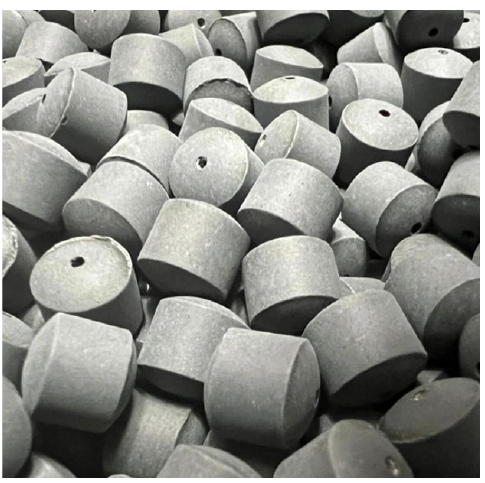
A foul-smelling, heavily algae-contaminated narrow tributary connecting the Sand Bar Slough to Spirit Lake was treated by Mr. Steve Gruhn in late July 2023. Steve, who lives close to the Sand Bar Slough, employed a protocol comprising two water-permeable burlap bags, each containing six pellets of specially treated volcanic rock material mixed into approximately 15lb. of biochar (supplied by 42-Biochar, Iowa). The pellets are manufactured by Kiko Technologies, headquartered in Hong Kong, SAR. They are formed by pulverizing a selected source of volcanic rock from Japan. The pulverized material is formed into small pellets, which are repeatedly heated to near melting point temperatures and slowly cooled over several consecutive days. The cylindrical-shaped pellets measure approximately 8mm in height and width (Figure 1).
Figure 1:Cylindrical-shaped pellets obtained from the processing of volcanic rock material and marketed as Kiko Technology. The water-insoluble pellets weigh 0.8gm and measure 8x8mm with a 1mm central hole.
The algae in the tributary and the foul odor were eliminated within three days of adding biochar-containing Kiko pellets [16]. Upon revisiting the area 10 weeks later, there was no easily visible algae throughout most of the slough. More impressive, a beaver had built a dam near the tributary where the biochar and pellets had been placed. Indeed, one of the burlap bags had been dragged onto the beaver’s dam. This observation was remarkable since Steve had not seen such beaver activity within the region for several decades. Additional novel observations at the time were recently constructed muskrat mounds, sounds of bullfrogs, and ducks on the water [16]. Based on this success, Steve proceeded to treat other areas of Spirit Lake and later the adjoining Okoboji Lake. Smaller amounts of biochar (1-5lb.) containing only 5 Kiko pellets have generally been used. Eight ounces of a mineral and amino acidrich water conditioner, abbreviated MWC, have also been added to each treated water region. As reported elsewhere, there have been remarkable improvements in aquatic, land, and flying wildlife around the entire Spirit Lake [16-21]. These improvements have now extended to recently treated areas of Okoboji Lake.
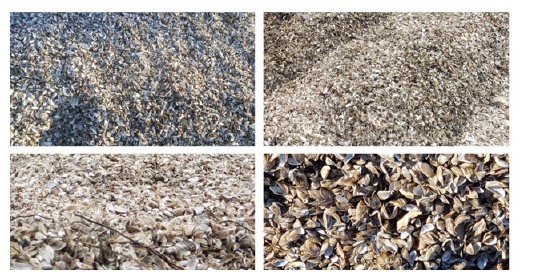
As first noticed in December 2023, substantial amounts of zebra mussel shells were present along some of Spirit Lake’s shoreline near a treated area (Figure 2A). In addition to intact shells, a surprisingly large amount of coarse granulated material was present along with broken shells (Figure 2B). This appearance differed significantly from that of predominantly intact zebra mussel shells that have washed onto the shoreline of Spirit Lake in prior years. Examples of predominantly intact shells are seen in archived photos posted in prior years on the Internet by the Spirit Lake Protective Association (Figure 3). The relative infrequency of intact shells in the December 2003 photographs is consistent with shell disintegration.
Figure 2:A. Washed-up zebra mussel shells and accompanying shell-derived materials on a region of the shoreline
of Spirit Lake, Iowa. The photo was taken on 12/23/2023. The landowner noted the substantial amount of washedup
material for this time of year; May is when maximum accumulation of zebra mussel shells typically occurs.
Another striking feature was the huge amounts of shell-derived material, rather than intact shells, that exceeded
quantities occurring in prior years.
B. A further illustration of the relative lack of intact zebra mussel shells in washed-up material from a region of
Spirit Lake. The material was photographed on 12/23/2023 at a different onshore location than shown in Figure 2.
Again, most of the material comprised broken shells seemingly shattered before or after being washed onshore. The
upper left side of the photo shows more intact shells.
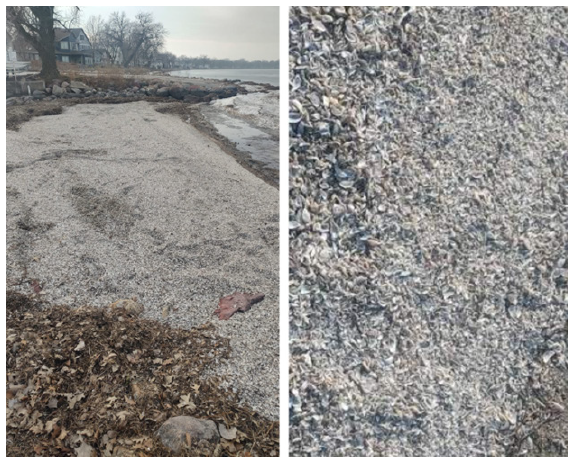
Figure 3:Four examples of photographs posted online by the Spirit Lake Protective Society from 2020 to 2022. The photos show accumulations of essentially intact zebra mussel shells, commonly with the warning of the risk of cuts if walking barefoot.
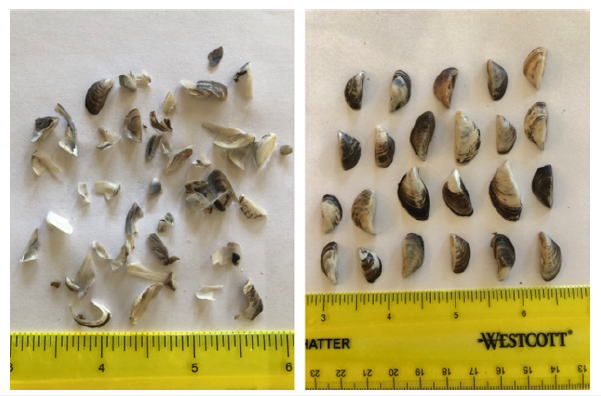
This conclusion was supported during a recent visit by the author to Spirit Lake. Multiple examples of predominantly broken shells submerged near the shoreline were readily seen. Samples were collected by hand, and the larger shell fragments were later photographed (Figure 4A). There were many additional, much smaller shell pieces. Moreover, the larger fragments could be easily crushed into a powdered form. By contrast, Figure 4B shows intact zebra mussel shells collected by Mr. Gruhn from the shoreline of Spirit Lake over a year earlier. These shells are not compressible by hand into powder or easily fragmented. Zebra mussel shells also retained their overall shape even a year after being included in gardening soil.
Figure 4:A. Photo of some of the larger fragments of zebra mussel shell material lifted out of the water by the
author from shallow water on the shore of Spirit Lake in June 2024. Relatively few intact, fully sized shells were
collected compared to the numerous shells, both large and small, with irregularly shaped perimeters or
existing simply as shell fragments. The larger shell fragments could be easily broken, and some shells could be
crushed by finger pressure into powder.
B. Photo of intact zebra mussel shells previously collected from Spirit Lake and provided to the author. The shells
had been maintained in a glass jar for over a year. None of the shells show signs of fragmentation, nor could they be
damaged using finger pressure.
When submerged in water, Kiko pellets increase the water’s level of KELEA, an synonym for Kinetic Energy Limiting Electrostatic Attraction. KELEA is viewed as the life force that preceded and led to the subsequent development of photosynthesis and food metabolism [22-27]. Providing sufficient KELEA is available, an ecosystem can forego using an impaired functional pathway by adapting to a more energy-requiring functional pathway, a process referred to as Nature’s Allostasis [17-21]. Ecosystems go beyond their tipping points and become disordered when there is insufficient KELEA for allostasis. The effectiveness of increasing KELEA levels in reducing the levels of contaminating algae is possibly due to the resurgence of competing beneficial microbes. Biochar and MWC are likely contributing to the proposed preferential growth of the beneficial microbes. The beneficial microbes are thought to create improved conditions for the further stepwise progressive resurgence of the higher life forms typical of the Spirit Lake ecosystem. Fishermen have informally reported higher than usual catching of yellow perch fish and the more frequent appearance of crayfish in Spirit Lake, both predatory to zebra mussels [28-29].
Although no direct measurements exist for the inferred reduction in zebra mussels in Spirit Lake, the KELEA-restored Spirit Lake is now seemingly a less-than-ideal terrain for their survival. Reminiscent of the Bechamp-Pasteur debate [30], zebra mussel invasion may not solely depend on the mussels’ presence but on altered ecological conditions. This is an easily testable hypothesis using various means of increasing KELEA in contaminated waterways.
Acknowledgment
Mr. James Osugi, Chairman of Kiko Technology Limited, registered in Hong Kong SAR, provided the Kiko pellets. Mr. Steve Gruhn is the Chief Executive Officer of 42-(XVII) Bio Char Inc. He placed the products into the Sand Bar slough and other locations at Big Spirit Lake. Mr. Dave Sybesma of D&K Investments supplied the mineral water conditioner as the third component in the current protocol. MI Hope Inc., a non-profit public charity, supports research on KELEA and its many applications. Information on KELEA is available in the cited references.
References
- Karatayev AY, Burlakova LE (2022) What we know and don't know about the invasive zebra (Dreissena polymorpha) and quagga (Dreissena rostriformis bugensis) Hydrobiologia 13: 1-74.
- Lavey K (2017) How do you get rid of 750 trillion mussels? Lansing State Journal.
- Morningstar CR, Kočovský PM, Colvin ME, Counihan TD, Wesley M, et al. (2024) Zebra and Quagga mussels in the United States-Dreissenid mussel research by the US Geological Survey. Report fs20243009, USGS Publications Warehouse, California, USA.
- Wilson AE (2003) Effects of zebra mussels on phytoplankton and ciliates: A field mesocosm experiment. Journal of Plankton Research 25(8): 905-915.
- Larson JH, Bailey SW, Evans MA (2022) Biofouling of a unionid mussel by dreissenid mussels in nearshore zones of the great lakes. Ecol Evol 12(12): e9557.
- Benson AJ, Raikow D, Larson J, Fusaro A, Bogdanoff AK (2013) Dreissena polymorpha. USGS nonindigenous aquatic species database, Gainesville, Florida, USA.
- Claudi R, Hammond D, Mastitsky S (2023) Dose-mortality relationship for quagga and zebra mussels exposed to EarthTec QZ ionic copper: Preliminary findings. Management of Biological Invasions 14(4): 695-708.
- Barbour MT, Schueller JR, Severson TJ, Wise JK, Meulemans MJ, et al. (2021) Concentration addition and independent action assessments of the binary mixtures of four toxicants on zebra mussel (Dreissena polymorpha) Aquatic Toxicology 238: 105935.
- Molloy DP, Mayer DA, Gaylo MJ, Morse JT, Presti KT, et al. (2013) Pseudomonas fluorescens strain CL145A-a biopesticide for the control of zebra and quagga mussels (Bivalvia: Dreissenidae). J Invertebr Pathol 113(1): 104-114.
- Meehan S, Gruber B, Lucy F (2014) Zebra mussel control using Zequanox® in an Irish waterway. Manag Biol Invasion 5: 279-286.
- Kusku H (2021) Biological control of invasive zebra mussel (Dreissena polymorpha) in a freshwater ecosystem through Potamon ibericum. Aquat Res 5(1): 11-19.
- Goote P, Bergman D (2011) Using crayfish to control zebra mussel populations. Grand Valley State University, Students Summer Scholars Manuscripts 82, Michigan, USA.
- Hernández Elizárraga VH, Ballantyne S, O'Brien LG, Americo JA, et al. (2023) Toward invasive mussel genetic biocontrol: Approaches, challenges, and perspectives. iScience 26(10): 108027.
- Wittmann ME, Candra S, Reuter JE, Schladow GS, Allen BC, et al. (2012) The control of an invasive bivalve, Corbicula fluminea, using gas impermeable benthic barriers in a large natural lake. Environmental Management 49(6): 1163-1173.
- Singh PK, Kumar, A, Singh VK, Shrivastava AK (2020) Advances in cyanobacterial biology. Elsevier, Amsterdam, p. 403.
- Martin WJ (2024) KELEA (kinetic energy limiting electrostatic attraction) stimulated alternative cellular energy (ACE) pathway can restore allostasis in heavily polluted collections of water with secondary benefits to birds and land animals. MOJ Eco Environ Sci 9(1): 18-22.
- Martin WJ (2024) Reinvigorating polluted water ecosystems with KELEA (kinetic energy limiting electrostatic attraction) in combination with biochar and water supplement. Environ Anal Ecol Stud 11(5): 1353-1356.
- Martin WJ (2024) KELEA assisted restoration of Nature’s Allostasis (KARNA). Environ Anal Eco Stud 11(5): 1357-1361.
- Martin WJ (2024) KELEA restoring of nature’s allostasis as a low-cost alternative to using chemicals in agriculture. Mod Tech Agri Horti Sci 3(1): 1-5.
- Martin WJ (2024) Restoring Nature's allostasis to disordered water ecosystems with KELEA-kinetic energy limiting electrostatic attraction. Authorea.
- Martin WJ (2024) Progressive improvements of water ecosystems by assisting nature's allostasis with KELEA-Kinetic Energy Limiting Electrostatic Attraction. Abstract 1503877, Poster 217-145, Presented at Water Sci Con24, St Paul, Minnesota, USA.
- Martin WJ (2014) Stealth Adapted Viruses; Alternative Cellular Energy (ACE) & KELEA Activated Water. Author House, Bloomington, Indiana, USA, p. 321.
- Martin WJ (2015) KELEA activation of water and other fluids for health, agriculture and industry. J Water Resources and Protection 7(16): 1331-1344.
- Martin WJ (2015) KELEA: A natural energy that seemingly reduces intermolecular hydrogen bonding in water and other liquids. Open Journal of Biophysics 5(3): 69.
- Martin WJ (2017) The many biological functions of the Alternative Cellular Energy (ACE) pathway. Int J Complement Alt Med 7(5): 00237.
- Martin WJ (2017) Is KELEA (kinetic energy limiting electrostatic attraction) a source of chemical energy? MOJ Biorg Org Chem 1(2): 54-
- Martin WJ (2020) Enhancing the Alternative Cellular Energy (ACE) pathway with KELEA activated water as therapy for infectious diseases. Infectious Disorders-Drug Targets 21(3): 214-219.
- Martin GW, Corkum LD (1994) Predation of Zebra mussels by crayfish. Canadian J Zoology 72(11): 1876-1871.
- Morrison TW, Lynch WE, Dabrowski K (1997) Predation on Zebra mussels by freshwater drum and yellow perch in Western Lake Erie. J Great Lakes Research 23(2): 177-189.
- Hume ED (1923) Bechamp or Pasteur? A lost chapter in the history of biology. CreateSpace Independent Publishing Platform, California, USA, p. 296.
© 2024 © W John Martin. This is an open access article distributed under the terms of the Creative Commons Attribution License , which permits unrestricted use, distribution, and build upon your work non-commercially.
Editor In Chief




.jpg)


























Signup for Newsletter

Quick Links
 Editorial Board Registrations
 Submit your Article
 Best Paper of the Volume
 Reprints
 Refer a Friend
 Advertise With Us
Our Recent Edition

.jpg)


Top Editors



.jpg)
















.bmp)
.jpg)
.png)
.jpg)









.jpg)





.png)

.png)



.png)


Financial Support

Sponsors

Latest e-Books

Latest Video

 a Creative Commons Attribution 4.0 International License. Based on a work at www.crimsonpublishers.com.
Best viewed in
a Creative Commons Attribution 4.0 International License. Based on a work at www.crimsonpublishers.com.
Best viewed in 
 | Above IE 9.0 version