

- About Us
- Information
-

The Author ensures that the research has been conducted responsibly and ethically with adherence to all relevant regulations. read more..
- For Authors
- For Reviewer
- Manuscript Guidelines
- Membership
- Publication Ethics
-
- Journals
- Reprints
- e-Books
- Videos
- Policies
- Contact Us
 COVID-19
- Submissions



Full Text
Aspects in Mining & Mineral Science
From Waste to Resource: A Characterization-Based Framework for Sustainable Mine Tailings Management
Frances Chikanda1*, Ebelia Manda2 and Tsubasa Otake1
1 Faculty of Engineering, Hokkaido University, Japan
2 School of Mines, University of Zambia, Zambia
*Corresponding author:Frances Chikanda, Faculty of Engineering, Hokkaido University, Japan
Submission: May 27, 2026: Published: June 11, 2026
ISSN 2578-0255Volume15 Issue 2
Abstract
Mine tailings are among the most persistent environmental legacies of mineral extraction. Traditionally, they have been treated as waste materials requiring containment, monitoring, and rehabilitation. However, increasing demand for critical minerals, advances in processing technologies, and growing interest in circular economy approaches are changing this view. Tailings are no longer only end-products of mining; they may also represent secondary resources, environmental liabilities, and reactive materials for remediation and carbon removal. This mini-review proposes a characterization-based framework for sustainable tailings management. The first and most important step is detailed characterization of mineralogy, chemistry, acid-generating potential, metal mobility, physical stability, and carbonation potential. These data can then guide appropriate management pathways, including recovery of valuable metals, acid mine drainage prevention, revegetation, land reclamation, safe reuse, carbon mineralization, and long-term monitoring. The paper also highlights the emerging role of artificial intelligence, machine learning, remote sensing, automated mineralogy, and geochemical modeling in improving prediction, monitoring, and decision-making. A shift from passive storage to integrated, data-driven tailings management could support environmental protection, resource recovery, climate action, and sustainable mine closure.
Keywords:Mine tailings; Characterization; Resource recovery; Reclamation; Carbon mineralization; Artificial intelligence; Sustainable mining
Introduction
The global demand for minerals is increasing due to urbanization, renewable energy technologies, electric vehicles, digital infrastructure, and the transition toward low-carbon economies. Copper, cobalt, nickel, lithium, rare earth elements, and other critical minerals are now central to modern development. However, their extraction and processing generate large volumes of tailings, which are commonly stored in tailings storage facilities and may remain environmentally reactive for decades or centuries [1]. If poorly managed, tailings can contribute to acid mine drainage, metal leaching, dust generation, land degradation, groundwater contamination, and physical instability. These risks are particularly important in mining regions where legacy tailings remain close to communities, rivers, agricultural land, and urban infrastructure. At the same time, tailings should not be viewed only as waste. Their fine particle size, large surface area, and residual mineral content make them geochemically active materials. Some tailings may still contain recoverable metals, while others may contain reactive minerals capable of neutralizing acidity, immobilizing metals, supporting revegetation, or reacting with carbon dioxide to form stable carbonate minerals.
This evolving perspective aligns with the concept of mine waste as a potential secondary resource rather than a fixed disposal endpoint. Previous studies have emphasized that mine waste classification is influenced by changing commodity prices, technologies, regulations, and sustainability priorities [2,3]. Therefore, tailings management should begin with a simple but important question: what are these tailings capable of becoming?
Characterization as the Foundation for Decision- Making
A sustainable tailings management strategy must begin with detailed characterization. Total metal concentration alone is not enough because environmental behavior depends strongly on mineral hosts, particle size, pH, redox conditions, water movement, and secondary mineral formation. Mineralogical techniques such as X-ray diffraction, scanning electron microscopy, automated mineralogy, and electron microprobe analysis can identify the minerals controlling reactivity and metal mobility. Bulk chemical analysis using XRF, ICP-AES, or ICP-MS can then determine major, minor, trace, and potentially valuable elements.
Characterization should also include acid-base accounting, kinetic leaching tests, and assessment of neutralizing capacity. This is especially important for sulfide-rich tailings, where minerals such as pyrite can oxidize and generate acidity. Leaching tests under different pH and redox conditions are needed to evaluate the mobility of potentially toxic elements such as As, Cd, Pb, Ni, Cr, Cu, Co, and Zn. Physical properties, including particle size, moisture content, permeability, density, and shear strength, are equally important because they influence dust generation, erosion, water infiltration, and slope stability.
For tailings rich in Mg-, Ca-, or Fe-bearing minerals, characterization should also assess carbonation potential. Such minerals may react with CO₂ to form stable carbonate minerals, offering an additional pathway for long-term carbon storage [4]. However, carbonation potential should not be assumed. It must be supported by mineralogical evidence, geochemical testing, and carbon accounting.
Integrated Pathways for Tailings Management
Once tailings are characterized, they can be directed toward the most appropriate management pathway. One important option is the recovery of residual valuable and critical materials. Many historical tailings were produced using older processing technologies and may still contain recoverable metals such as Cu, Co, Ni, Au, rare earth elements, or battery-related metals. In regions such as the African Copperbelt, reprocessing tailings could support both economic development and environmental rehabilitation. However, recovery must be evaluated alongside water use, energy demand, reagent consumption, waste generation, and post-processing closure requirements [5,6]. For tailings with acid-generating potential, stabilization and acid mine drainage prevention are priorities. Management options include covers to reduce oxygen and water entry, improved drainage control, separation of highly reactive material, addition of alkaline amendments, and geochemical modeling to predict long-term behavior. Reactive materials such as limestone, basalt, or other alkaline silicates may help neutralize acidity, release Ca and Mg, and promote secondary minerals that immobilize metals through adsorption or co-precipitation [7].
Revegetation and ecological rehabilitation are also essential components of sustainable mine closure. Establishing vegetation can reduce dust, improve slope stability, control erosion, and support ecological recovery. However, tailings are often poor growth media due to low organic matter, limited nutrients, poor water retention, extreme pH, and metal toxicity. Successful revegetation may require amendments such as compost, biochar, limestone, clay-rich materials, or microbial inoculants, together with tolerant native plant species. In many cases, phytostabilization may be more suitable than phytoextraction because the goal is to immobilize contaminants rather than transfer them into plant biomass.
Land reclamation and safe reuse should follow a risk-based approach. Tailings with low contaminant mobility and suitable physical properties may be considered for controlled reuse as construction materials, backfill, geopolymer products, bricks, cement additives, or industrial landforms. However, such reuse requires careful leaching tests and mechanical performance assessments to avoid transferring contamination from one site to another. Carbon removal through mineral carbonation is another promising but site-specific pathway. Tailings are attractive for carbonation because they are already mined, crushed, and finegrained, which increases their reactive surface area. Mafic and ultramafic tailings may contain minerals such as olivine, pyroxene, serpentine, brucite, and other Mg- or Ca-bearing phases that can react with dissolved inorganic carbon to form stable carbonates [4,8]. Nevertheless, carbon removal should be treated as an additional benefit within broader tailings management, not as a stand-alone solution. Monitoring, reporting, and verification are needed to confirm actual CO₂ removal, carbonate formation, metal safety, and long-term storage [4].
Role of AI, Machine Learning, and Advanced Technologies
The future of tailings management will increasingly rely on digital and data-driven tools. Tailings facilities are complex systems influenced by mineralogy, hydrology, climate, chemistry, biology, and engineering design. Artificial intelligence and machine learning can help identify patterns, predict risk, and guide decision-making. For example, machine learning models can combine mineralogical, chemical, leaching, and field-monitoring data to predict acid mine drainage risk or metal mobility. Remote sensing, drone surveys, hyperspectral imaging, satellite interferometry, and sensor networks can support the mapping of mineralogical variation, moisture distribution, oxidation zones, vegetation stress, erosion, and physical deformation. Automated mineralogy and geochemical modeling can also support the selection of suitable recovery, stabilization, reclamation, and carbonation strategies. These tools should not replace field and laboratory work, but they can make tailings management more predictive, transparent, and adaptive.
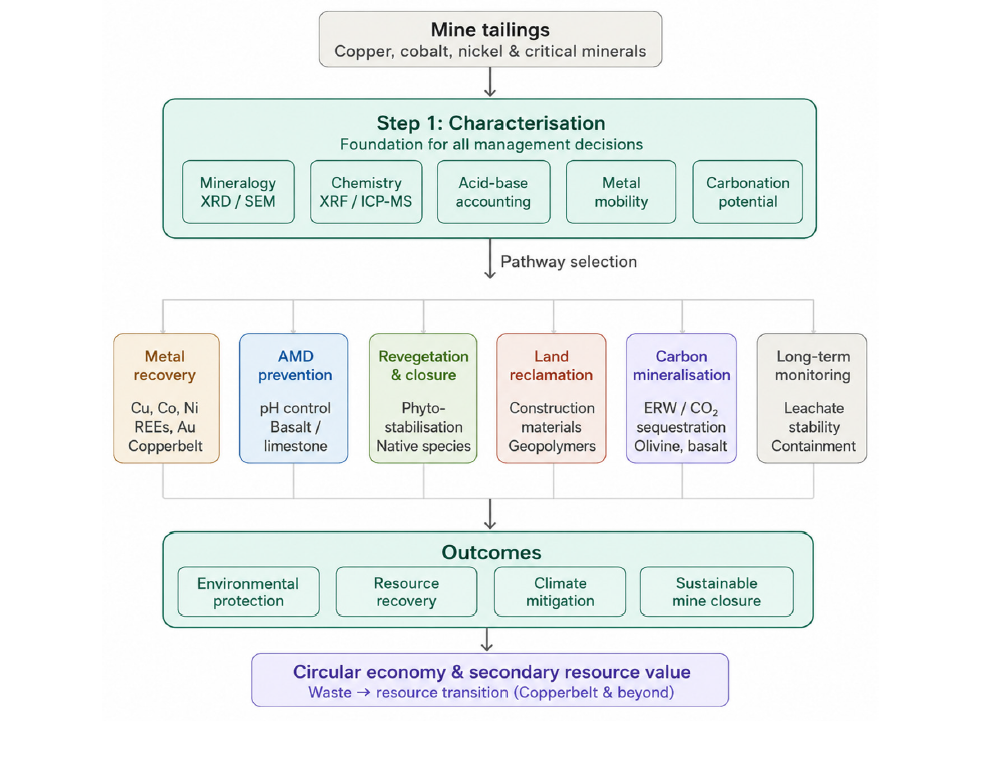
Conceptual Framework
(Figure 1)
Figure 1:Characterization-based framework for sustainable tailings management.
Conclusion
Mine tailings should no longer be viewed only as waste materials requiring disposal. They are complex geochemical systems that may contain both environmental risks and future opportunities. The first step toward sustainable tailings management is detailed characterization. Once their mineralogical, chemical, physical, and environmental properties are understood, tailings can be directed toward appropriate pathways such as metal recovery, acid mine drainage prevention, revegetation, land reclamation, safe reuse, carbon mineralization, or long-term containment.
Artificial intelligence, machine learning, remote sensing, automated mineralogy, and geochemical modeling can further improve how tailings are assessed and managed. For mining regions in Africa and beyond, a characterization-based approach can link environmental protection, resource recovery, climate mitigation, and sustainable development. The future of tailings management should therefore move from passive storage to active transformation.
References
- Tayebi-Khorami M, Edraki M, Corder G, Golev A (2019) Re-thinking mining waste through an integrative approach led by circular economy aspirations. Minerals 9(5): 286.
- Younger PL, Banwart SA, Hedin RS (2002) Mine Water. Environmental Pollution, Dordrecht: Springer, Netherlands.
- Aaron Y, Rogers PW, Constance S (2026) Secondary mining deposits? The need for a conceptual framework for reclassifying mine waste. Aspects in Mining & Mineral Science 14(5):
- Wilson S (2014) Offsetting of CO2 emissions by air capture in mine tailings at the Mount Keith Nickel Mine, Western Australia: Rates, controls and prospects for carbon neutral mining. International Journal of Greenhouse Gas Control 25: 121-140.
- Nwaila GT, Ghorbani Y, Zhang SE, Tolmay LCK, Rose DH, et al. (2021) Valorisation of mine waste - Part II: Resource evaluation for consolidated and mineralised mine waste using the Central African Copperbelt as an example. J Environ Manage 299: 113553.
- Adrianto LR, Pfister S (2022) Prospective environmental assessment of reprocessing and valorization alternatives for sulfidic copper tailings. Resour Conserv Recycl 186:
- Gillmor AM (2011) Attenuation of acid mine drainage enhanced by organic carbon and limestone addition: a process characterization. Dissertations & Theses, p. 116.
- Beerling DJ, Kantzas EP, Lomas MR, Wade P, Eufrasio RM, et al. (2020) Potential for large-scale CO2 removal via enhanced rock weathering with croplands. Nature 583(7815): 242-248.
© 2026 Frances Chikanda. This is an open access article distributed under the terms of the Creative Commons Attribution License , which permits unrestricted use, distribution, and build upon your work non-commercially.
Editor In Chief






.jpg)






























Signup for Newsletter

Quick Links
 Editorial Board Registrations
 Submit your Article
 Best Paper of the Volume
 Reprints
 Refer a Friend
 Advertise With Us
Our Recent Edition
.jpg)



Top Editors




.jpg)

















.bmp)
.jpg)
.png)
.jpg)













.jpg)






.png)

.png)




.png)




Financial Support

Sponsors

Latest e-Books

Latest Video

 a Creative Commons Attribution 4.0 International License. Based on a work at www.crimsonpublishers.com.
Best viewed in
a Creative Commons Attribution 4.0 International License. Based on a work at www.crimsonpublishers.com.
Best viewed in 
 | Above IE 9.0 version