

- About Us
- Information
-

The Author ensures that the research has been conducted responsibly and ethically with adherence to all relevant regulations. read more..
- For Authors
- For Reviewer
- Manuscript Guidelines
- Membership
- Publication Ethics
-
- Journals
- Reprints
- e-Books
- Videos
- Policies
- Contact Us
 COVID-19
- Submissions



Full Text
Aspects in Mining & Mineral Science
Secondary Mining Deposits? The Need for a Conceptual Framework for Reclassifying Mine Waste
Aaron Young*, Constance Sauve and Pratt Rogers W
Department of Mining Engineering University of Utah, USA
*Corresponding author:Aaron Young, Department of Mining Engineering University of Utah, USA
Submission: December 30, 2025: Published: March 09, 2026
ISSN 2578-0255Volume14 Issue 5
Abstract
Trends of declining ore grades coupled by increasing demand have led to a surge in effort towards recovering additional metal value out of tailings, waste rock piles, slag, partially spent heap leaches, low-grade stockpiles and other materials generated during earlier phases of mining [1]. As a result, there is currently a growing need for classifying these resources in a manner congruent with mining and mineral evaluation standards. Historically, resources have been classified according to geological origin, fixed cutoff grades, and static notions of ore versus waste. While these distinctions are operationally convenient, they obscure the fact that material classifications are neither fixed nor purely geological. The purpose of this manuscript is to propose the concept of a Secondary Mining Deposit: an anthropogenic accumulation of mineralized material produced through mining or mineral processing activities that may become economically viable under altered market, technological, or regulatory conditions. Considering these materials as secondary deposits rather than process endpoints, would initiate further understanding of the temporal nature of resource classification and provide a conceptual basis for integrating economic variability, technological change, and sustainability considerations into mineral exploration thinking.
Keywords:Sustainability; Circular economy; Technosphere; Mineral exploration; Mineral resource management
Introduction
The concept of mineral deposit is foundational to mining engineering, mineral economics, and exploration geology [2]. Conventionally, a primary mineral deposit is defined as a naturally occurring concentration of minerals with reasonable prospects for eventual economic extraction [3]. Furthermore, secondary mineral deposits are defined as a mineral deposit which has been formed by erosion and redeposition of sediments from a previous mineral deposit [4] or undergone some other form of physical and/or chemical alteration [5]. These definitions, while well established, implicitly assume static relationships between natural forces, material properties and economic viability. In practice, the classification of material as ore or waste is contingent on a range of modifying factors, including commodity prices, processing technologies, regulatory constraints, and strategic objectives. As these factors change, material once classified as waste may (often) later be reconsidered ore [6]. This observation is not new [7]; however, it remains underdeveloped at the conceptual level.
This manuscript proposes the term Secondary Mining Deposit to describe man-made accumulations of mineralized material that arise from mining activities and retain the potential for future economic extraction or environmental liability. The purpose of this small terminological proposition is to call for a more robust standardization of a framework that explicitly acknowledges the temporal and economic fluidity of these classifications, since many researchers from many different disciplines are engaged in developing specialized techniques to benefit these deposits.
Definition and Scope of Secondary Mining Deposits
A Secondary Mining Deposit is defined here as an anthropogenic mineral occurrence that can trace some part of its origin to mining or mineral processing activities. Such deposits may or may not have been subjected to natural processes for prolonged periods of time and become economically extractable or environmentally deleterious under conditions different from those present at the time of their creation. This definition distinguishes secondary mining deposits from primary and secondary mineral deposits in two important ways. First, their origin is not strictly geological but mostly anthropological [8,9]; they are created through decisions related to cut-off grades, processing efficiency, and corporate blunders. Second, their economic potential is deferred rather than absent. Figure 1 shows the evolution of a primary deposit to a secondary mining deposit.
Figure 1:Conceptual timeline of secondary mining deposit classification.
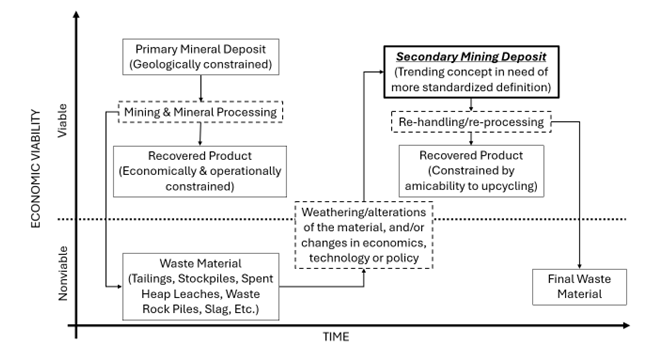
Material transitions from a primary mineral deposit to ore/ waste based on economic conditions at the time of extraction. Waste materials may later be reclassified as secondary mining deposits due to internal characteristic changes from natural causes or external changes to modifying factors, such as commodity prices, processing technology, regulatory frameworks, or societal demand, demonstrating temporal and economic fluidity. Secondary Mining Deposits are typically spatially concentrated, crudely characterized, and located within existing mine footprints. As such, they differ fundamentally from diffuse industrial or municipal waste streams and deserve at least their own diacritic within the larger framework of the circular economy [10].
Economic and Technological Drivers
The reclassification of waste as a resource is most often driven by economic change. Fluctuations in commodity prices directly influence cut-off grades and can render previously uneconomic material viable with little or no physical modification. Given the latent nature of these deposits, to the extent economics can be forecasted, it may be possible to leverage secondary mining deposits to stabilize economies in much the same way legacy standby power systems stabilize the grid to variable forecasts in renewable energy production [11,12]. Technological development plays a similarly important role. Advances in comminution, flotation chemistry, hydrometallurgy, and bioleaching have repeatedly expanded the range of materials that can be processed economically [13]. Spent heaps, historical tailings and waste rock piles often reflect the technological limitations of their time rather than an absence of valuable constituents. In addition, evolving demand for critical and strategic minerals has shifted attention toward byproducts that were previously ignored [14,15]. Many legacy operations were designed around a single primary commodity, resulting in the systematic disposal of elements that now carry economic or strategic importance.
Environmental and Operational Considerations
Secondary mining deposits occupy a unique position at the intersection of resource recovery and environmental management. On one hand, they represent potential sources of value; on the other, they often constitute long-term environmental liabilities [16]. Reprocessing secondary deposits can reduce risks associated with geotechnical instability [17], acid generation, metal leaching, climate [18] and dust emissions while simultaneously recovering metals. In some cases, remediation objectives and economic incentives may align, allowing environmental risk reduction to occur as part of resource extraction rather than as a purely costdriven obligation [19]. Operationally, the recognition of secondary mining deposits encourages mine planning approaches that treat waste storage as a dynamic system rather than a terminal endpoint. This perspective has implications for facility design, monitoring, and closure planning.
Implications for Resource Classification
Existing mineral resource classification systems offer limited guidance on how to re-evaluate mine waste beyond its disposal. The introduction of secondary mining deposits as a formal concept does not require a restructuring of these systems, but it does suggest a need for greater wisdom in how material classifications are understood over time [20]. By explicitly acknowledging that ore/waste distinctions are temporally bound, this framework supports more adaptive approaches to resource stewardship. It also emphasizes that mining is not a single extractive event, but an enviro-socio-techno-geo-economical ballet.
Conclusion
Whether the exact definition sticks or some other term is used for the official nomenclature, secondary mining deposits, as they have been defined in this article, represent an emerging multidisciplinary research frontier. As demand for metals continues to evolve, particularly for critical minerals, secondary mining deposits may play an increasingly important role in resource supply. Formalizing this concept will provide a useful foundation for not only integrating economic variability, technological progress, and environmental responsibility into mining and mineral exploration thinking, but also help bridge the gap between relevant intersectional research domains
References
- Chowdhury MO, Talan D (2025) From waste to wealth: A circular economy approach to the sustainable recovery of rare earth elements and battery metals from mine tailings. Separations 12(2):
- Graybeal FT (2025) Evolution of best practice. Aspects of Mineral Exploration Thinking in Geology and Mining. In: Wood Ao D, Hedenquist J (Eds.), Society of Economic Geologists.
- Cox DP, Singer DA (1986) Mineral deposit models. USGPO.
- Schieferdecker AAG (1959) Geological nomenclature: Royal geological and mining society of the Netherlands.
- Hoover TJ (1948) The economics of mining. Stanford University Press, USA. p. 551.
- Lim B, Alorro RD (2021) Technospheric mining of mine wastes: A review of applications and challenges. Sustainable Chemistry 2(4): 686-706.
- DeSisto SL, Jamieson HE, Parsons MB (2017) Arsenic mobility in weathered gold mine tailings under a low-organic soil cover. Environmental Earth Sciences 76(22): 773.
- Young A, Rogers WP (2021) Modelling large, heaped fill stockpiles using FMS data. Minerals 11: 636.
- Young A, Rogers WP (2022) A high-fidelity modelling method for mine haul truck dumping process. Mining 2(1): 86-102.
- Tayebi-Khorami M, Edraki M, Corder G, Golev A (2019) Re-Thinking mining waste through an integrative approach led by circular economy aspirations. Minerals 9(5): 286.
- Machalek D, Young A, Blackburn L, Rogers P, Powell KM (2020) Mine operations as a smart grid resource: leveraging excess process storage capacity to better enable renewable energy sources. Minerals Engineering 145(1): 106103.
- Kilinc-Ata N, Alshami M, Munir K (2023) How do strategic mineral resources affect clean energy transition? Cross-sectional autoregressive distributed lag (CS-ARDL) approach. Mineral Economics 36(4): 643-654.
- Seal T (2013) Operational techniques to recover metal values from heap inventory and in situ chemical alteration prior to closure. Proceedings of Heap Leach-13, Vancouver, Canada.
- Nwaila GT, Ghorbani Y, Zhang SE, Tolmay LCK, Rose DH, et al. (2021) Valorisation of mine waste - Part II: Resource evaluation for consolidated and mineralised mine waste using the Central African Copperbelt as an example. Journal of Environmental Management 299: 113553.
- Nwaila GT, Ghorbani Y, Zhang SE, Frimmel HE, Tolmay LCK, et al. (2021) Valorisation of mine waste - Part I: Characteristics of, and sampling methodology for, consolidated mineralised tailings by using Witwatersrand gold mines (South Africa) as an example. Journal of Environmental Management 295: 113013.
- Álvarez-Ayuso E, Murciego A, Rodríguez MA, Fernández-Pozo L, Cabezas J, et al. (2022) Antimony distribution and mobility in different types of waste derived from the exploitation of stibnite ore deposits. Science of the Total Environment 816: 151566.
- Abbasi B, Babak A, Seyedsaeid A, Thom S, Bryan U (2020) The effect of hydro-jex operation on the stability of heap leach pads: A case study of a heap leach operation in central Mexico. Mining, Metallurgy & Exploration 37(5): 1583-1592.
- Kusin FM, Syed Hasan SNM, Hassim MA, Molahid VLM (2020) Mineral carbonation of sedimentary mine waste for carbon sequestration and potential reutilization as cementitious material. Environmental Science and Pollution Research 27(11): 12767-12780.
- Adrianto LR, Pfister S (2022) Prospective environmental assessment of reprocessing and valorization alternatives for sulfidic copper tailings. Resources, Conservation and Recycling 186: 106567.
- Vidal O, Boulzec HL, Andrieu B, Verzier F (2022) Modelling the demand and access of mineral resources in a changing world. Sustainability 14: 11.
© 2026 Aaron Young. This is an open access article distributed under the terms of the Creative Commons Attribution License , which permits unrestricted use, distribution, and build upon your work non-commercially.
Editor In Chief






.jpg)






























Signup for Newsletter

Quick Links
 Editorial Board Registrations
 Submit your Article
 Best Paper of the Volume
 Reprints
 Refer a Friend
 Advertise With Us
Our Recent Edition

.jpg)



Top Editors




.jpg)

















.bmp)
.jpg)
.png)
.jpg)













.jpg)





.png)

.png)




.png)




Financial Support

Sponsors

Latest e-Books

Latest Video

 a Creative Commons Attribution 4.0 International License. Based on a work at www.crimsonpublishers.com.
Best viewed in
a Creative Commons Attribution 4.0 International License. Based on a work at www.crimsonpublishers.com.
Best viewed in 
 | Above IE 9.0 version