

- About Us
- Information
-

The Author ensures that the research has been conducted responsibly and ethically with adherence to all relevant regulations. read more..
- For Authors
- For Reviewer
- Manuscript Guidelines
- Membership
- Publication Ethics
-
- Journals
- Reprints
- e-Books
- Videos
- Policies
- Contact Us
 COVID-19
- Submissions



Full Text
Academic Journal of Engineering Studies
The Matter Creation a New Perspective on the Universe
Ahmad Waguih Elescandaranya*
Faculty of Engineering, Alexandria University, Egypt
*Corresponding author:Ahmad Waguih Elescandaranya, Faculty of Engineering, Alexandria University, Lotfy El Sayed Street, Ebrahimia, Alexandria, Egypt
Submission: May 27, 2026;Published: July 07, 2026
.jpg)
ISSN:2694-4421 Volume4 Issue 3
Abstract
In conventional physics, matter formation begins with the Quark-Gluon Plasma (QGP). A new concept proposes a system for forming the fundamental components of matter based on Planck’s length at the most basic level. A novel min-max formula is introduced to control the size of the formed body and prevent successive and excessive growth. Two new statistical parameters have been found, where the first has the same value as the fine structure constant (α ) in conventional physics, and the second (β )represents the minimal construction base unit value. The quark and gluon masses were precisely determined, and the mathematical calculations suggest that the electron and proton are hollow bodies rather than solid. New unconventional structures clarify the mass difference between the neutron and proton, and the force analyses of both show that the quarks’ charges are the sole reason for isotopes, whether in terms of numbers or stability. The primary dimensions of the universe’s block mass are determined, and the multiverse reality is mathematically proved, and the number of universes is finite rather than infinite.
Keywords:Particle formation, Proton structure, Neutron structure, Electron velocity, Universe and multiverse, Atomic number and isotopes, Critical density
Symbols: C. A = Complete annihilation; C. M = Complete merging; Ch = Charge; d = Down quark; e = electron; f.u = Force unit; F = Force; g = Gluon; L = length; ly = Light year; m.f = Moment unit; M = Mass; N = Neutron, Number; P = Proton; P. A = Partial annihilation; R= Radius; t = Thickness; u = Upper quark; v = Velocity; V = Volume, Value
Latin
α = The control breeding factor (1/137).
β = The minimal construction base unit value (0.2268 or 1)
Δ = Neutron-Proton mass difference
ρ = Density
Suffix: atr = Attraction; c = Cylinder; cb = Cube; co = Cone; h = Horizontal; sh = Half sphere; ch = Half cylinder; cho = Oblique half cylinder; e = Electron; ep = Equilateral prism; p = Proton; pl =Planck; q = Quark; n = Neutron; netn= Neutron net; netp= Proton net; rep = Repulsion; rp = Right angle prism; s = Sphere; sp = Spherical segment; st = String; thsp = Sphere thickness; v = vertical; univ = Universe
Introduction
The universe has experienced a remarkable transformation over the 13.8 billion years since the Big Bang. Yet, in the fleeting moments following that monumental event, the fundamental building blocks of everything, from the tiniest microbes to the vast expanses of galaxies, were forged. Particle physics is a field of study concerned with the most fundamental constituents of matter and the forces governing their interactions. By probing the structure of subatomic particles, this field aims to uncover the laws of the universe at the most elementary level. The Standard Model of particle physics has been the dominant theory for describing three of the four fundamental forces--electromagnetic, weak, and strong--and the particles that interact through them. While successful, it is incomplete, leaving out gravity and mysteries such as dark matter and dark energy. Particle physics continues to evolve, with theoretical advancements such as string theory and loop quantum gravity offering new insights into the nature of the universe [1-7].
Matter formation refers to the processes in the universe, primarily occurring shortly after the Big Bang, involving fundamental particles such as quarks and gluons. In the first few microseconds following the Big Bang, the universe was in such a state called Quark-Gluon Plasma (QGP). During this phase, quarks and gluons were not confined within protons and neutrons; instead, they existed freely. Once the universe cooled below a critical temperature, quarks and gluons combined to form composite particles called hadrons, which include protons and neutrons, and led to the creation of atomic nuclei, ultimately leading to the matter-dominated universe we inhabit today. Although the exact mechanism of hadron formation is not fully understood, the STAR Collaboration has reported observations in Nature’s journal regarding the formation of hadrons after high-energy particle collisions. These collisions involve pairs of quarks that exhibit correlations, defined by quantum physics and can emerge from what appears to be empty space. These fundamental particles, known as quarks, can be created in quantum-correlated pairs, and these correlations can be transferred to larger particles that form from the quarks. These particles occur in two basic types called quarks and leptons.
Each group consists of six particles, which are related in pairs, or “generations.” The lightest and most stable particles make up the first generation, whereas the heavier and less stable particles belong to the second and third generations. All stable matter in the universe is made from particles that belong to the first generation; any heavier particles quickly decay to more stable ones. The six quarks are paired in three generations--the “up quark” and the “down quark” form the first generation, followed by the “charm quark” and “strange quark,” then the “top quark” and “bottom (or beauty) quark.” Quarks also come in three different “colors” and only mix in such ways as to form colorless objects. The six leptons are similarly arranged in three generations--the “electron” and the “electron neutrino,” the “muon” and the “muon neutrino,” and the “tau” and the “tau neutrino.”
The electron, the muon, and the tau all have an electric charge and a sizable mass, whereas the neutrinos are electrically neutral and have very little mass. Even though the Standard Model is currently the best description of the subatomic world, it does not explain the complete picture. The theory incorporates only three out of the four fundamental forces, omitting gravity. There are also important questions that it does not answer, such as “What is dark matter?” or “What happened to the antimatter after the Big Bang?” “Why are there three generations of quarks and leptons with such a different mass scale?” and more. Last but not least, there is a particle called the Higgs boson, an essential component of the Standard Model. The ATLAS and CMS experiments at CERN’s Large Hadron Collider (LHC) announced they had each observed a new particle in the mass region around 126GeV. This particle was consistent with the Higgs boson, but further work was needed to determine whether it was the Higgs boson predicted by the Standard Model. The Higgs boson, as proposed within the Standard Model, is the simplest manifestation of the Brout-Englert-Higgs mechanism. Other types of Higgs bosons are predicted by other theories that go beyond the Standard Model. The standard model of particle physics provides a framework for understanding how these particles are formed and interact. Understanding these processes is crucial for unraveling the fundamental nature of the universe and the laws of physics that govern it. Several mechanisms have been proposed to explain how this matter-antimatter asymmetry occurred, including baryogenesis and leptogenesis.
One of the significant mysteries in cosmology is the baryon asymmetry problem, which refers to the observed imbalance between matter and antimatter in the universe. Theoretical models suggest that, in the early universe, matter and antimatter were created in equal amounts. However, a slight excess of matter, about one part in ten billion, has allowed for the existence of the matterdominated universe we observe today. This asymmetry is thought to arise from processes that violate Charge-Parity (CP) symmetry in particle interactions [8-16]. An explanation of how particles arise naturally as an effect of waves, known as “resonance,” and that the particle concept, properly understood, is not to somehow incompatible with the existence of waves. The definitions of fermions and bosons’ fields, often associated with matter and energy particles, are used. The solidity of objects is a direct consequence of fermions’ wave properties [17]. A detailed study on the effect of the particles created by black holes discovered by Hawking (1974, 1975) as a result of the vacuum instability in a strong gravitational field. The action of such a field on vacuum virtual particles provides a part of them with sufficient energy to become real. Some particles created near the black hole are swallowed, while others escape to infinity and produce Hawking radiation [18]. The relationship between protons and neutrons is that they are both found in the nucleus of an atom and are collectively known as nucleons.
While similar in some aspects, they possess distinct attributes that make them unique. Protons carry a positive charge, determine the atomic number, and interact strongly with electromagnetic forces. Neutrons, on the other hand, are electrically neutral, help stabilize the nucleus, and play a crucial role in nuclear reactions. Understanding the properties and behavior of neutrons and protons is essential for comprehending the fundamental building blocks of matter and the intricate workings of the atomic world [19]. A recent study presents a new perspective on the universe by utilizing a mathematical engineering model based on fundamental principles of physics. This model employs an innovative mathematical tool to provide accurate estimates of composition. Additionally, the study introduces a mechanism that explains how the primary entities exist and how interact generating matter and antimatter in the presence of a catalyst [20]. Planck Length, Time and Mass are defined exclusively by three physical constants: c, G and ħ. Scientists believe they are the smallest scales in the universe, even though the real physical meanings are not fully understood.
In fact, Planck Length 1.616255×10⁻³⁵ m and Planck Time 5.39×10−44 s are extremely small, but unexpectedly Planck Mass 2.176434 x 10⁻⁸ kg (equivalent to 1.22 x 10¹⁹Gev) is much bigger than that of all the subatomic particles (for example, Top Quark 171.2 Gev) which has caused a great deal of confusion [21]. The fine structure constant is a fundamental dimensionless constant that characterizes the strength of the electromagnetic interaction between elementary charged particles, with a value approximately equal to (1/137) [22]. Cosmic space is big - perhaps infinitely so. Some theories suggest a person would meet his cosmic twin - A copy of him living in a copy of our world, but in a different part of the multiverse. Theoretical physics provides multiple frameworks suggesting that our universe may be just one of countless others, potentially infinite in number.
The precise count remains uncertain and may never be measurable, but the multiverse concept is a significant focus in cosmology and quantum physics. According to quantum mechanics theory, every choice we make branches into different realities. If you make choice A in one universe, you’ll make choice B in the other. The multiverse, therefore, consists of universes that contain all possible choices ever made. There are too many to count. Scientists studying string theory have estimated that the number of possible structures--and, consequently, the number of potential universes-- can vary significantly. Estimates range 10500 , with possibilities both above and below this range [23-25]. In a recent study, physicists from Stanford calculated the total number of possible universes and arrived at the astonishing figure of 10160 .
While this number is already incredibly large, the scientists note that it could have been even more staggering. This limitation arises from our capacity as observers, which restricts our ability to differentiate between more universes. If not for this constraint, the number could reach as high as 10700 universes [26]. The present study continues the author’s previous concept (the new perspective on the universe). A particle creation mechanism is proposed, and the fine structure constant appears. The proton-neutron relation analysis demystifies, mathematically, the mass difference puzzle and the number of stable isotopes that could exist. How can the new formula relating the minimality and maximality expect the minimum electron velocity (at its lowest energy level) and the maximum atomic number of an element, regardless of whether it is natural or synthetic; And finally, the original dimensions of the universe and the expected number of the multiverse.
A New Concept
A close look at the standard model of the particle physics
Before going deep, it is necessary to answer the following question:
Which is first, the mass or the energy?
From Einstein equation (E = mC2 ), it could be easily and logically realized that the energy is the mass movement which means that the mass is first, this could be found in [1]. Therefore, it could be argued that mass precedes energy in this framework.
How the universe came into existence
It is currently continuing Elescandarany new perspective on the universe [1], which briefly states that the cubic block unit of origin matter has been dynamically extruded and centrifugally fractionalized (spalled) into an infinite number of tiny segments.
The tiny segments
The tiny segments representing the 5.07 percent (matter and antimatter) of the total mass unity and filling the reaction activity domain (crucible), take some simple primary geometrical forms like prism, sphere, cylinder, cube, and rhomb, cone etc….
The segment mass and dimensions
The smallest (minimum) side of the geometrical segment shape is the length unity and the density is unity, hence the unit segment mass has a cubic shape with a unit density.
The indivisible segments
These segments have masses less than the unity with positive and negative charges and their sides could not fractionalize as seen in Table 1.
Table 1:Moisture and volatile content of the samples.

The particles formation
Definitions
A. Complete merging process
It means that segments of different masses merge together to breed a heavier segment, also anti-segments do.
B. Partial annihilation process
It means that an anti-segment of a certain mass annihilates an equal value of mass of a heavier segment and vice verse.
C. Complete annihilation process
It means that an anti-segment of a certain mass annihilates a segment having the same value of mass.
D. Breeding process
It means that segments and anti-segments breed particles through the different aforementioned processes.
E. Division process
It means that heavy segments or anti-segments could divide into three charged types of blocks or segments ( + ve,− ve and 0 ne).
F. Spallation process
It means that segments or anti-segments can break into spalls with masses less than the minimum indivisible.
G. Fractionalization process
It means that the heavy segments and anti-segments can break into divisible, indivisible segments and spalls.
H. Primary particles
These entities exist from the segments and anti-segments through the breeding process.
I. Gluing process
It means that the bred particles join forming an entity (fundamental particle).
J. Fundamental particles
These entities exist from primary particles through the gluing process.
K. The fundamental entity the of matter
This entity is the building unit of matters exists from the fundamental particles.
The minimum segment mass is (0.2267), the less masses could be bred from the partial annihilation process.
The formation mechanism: After the universe mass unit extrusion and separation to infinite segments (segments and antisegments), the active reaction started its function. The different processes took place starting the bodies’ existence: matter, antimatter, dark matter, dark energy and the catalyst [20].
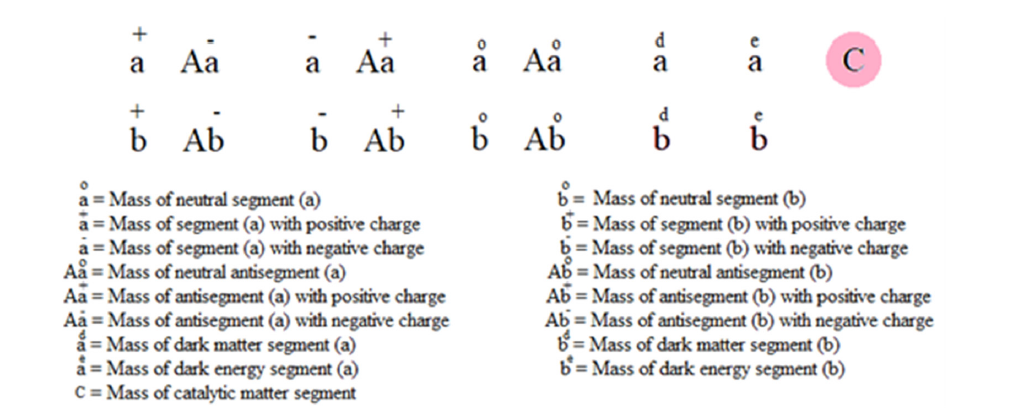
The simplest mechanism of breeding bodies: This mechanism depends on two pairs segment of matter, antimatter, dark matter, dark energy and a catalytic segment. This mechanism produces 137 probable products (17C2 +1 =136 +1 ) for the first path of the chain reaction Figure 1
Figure 1:General mechanism for breeding bodies.
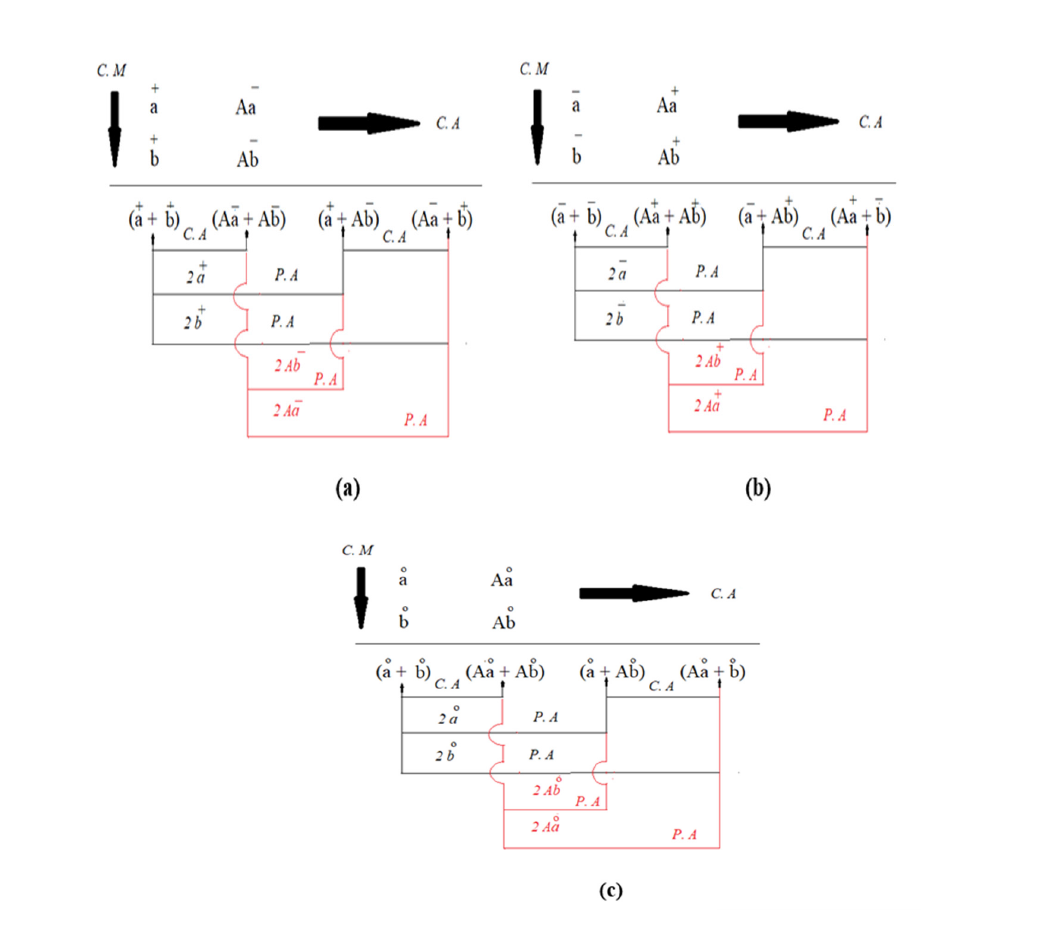
The detailed procedures of chain reaction to breed bodies: For simplicity, two pairs of charged and neutral segments of matter and antimatter have been considered to clarify the two paths of the chain reaction, as shown in Figure 2a - 2c.
Main probable products got by the first path
From Figure 2a - 2c twelve products could be got through the mathematical combination process as:
Figure 2:Simple mechanism for breeding bodies.
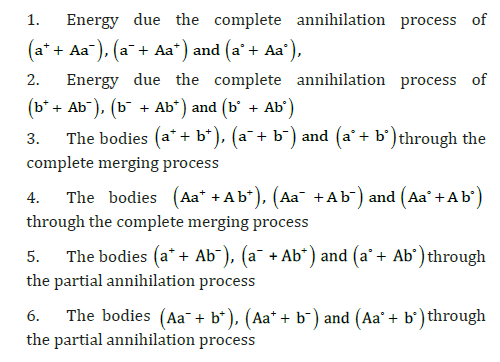
Main probable products got by the second path
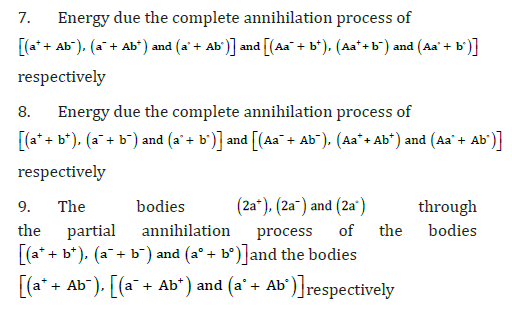
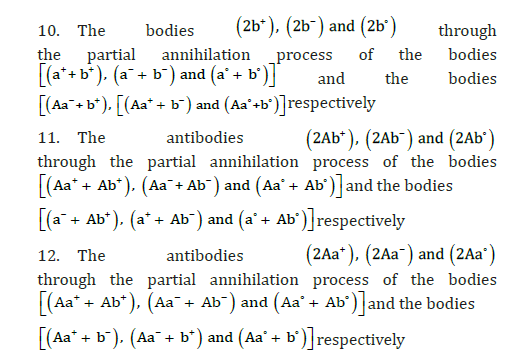
The factor controlling the breeding process: Continuing the reproduction process (chain reaction) leads to a divergence state in the reaction, resulting in bodies with uncontrolled mass values. Therefore, there must be a dominant factor restrains the interaction and sets a maximum mass value for the body.
Hence, the minimum and maximum mass values must relate confirming the unity. This relation could be in the form of:
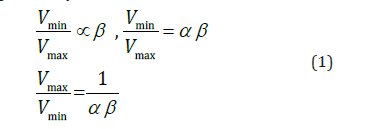
Hint:
It is a general formula, which relates the minimality and maximality.
From the simplest mechanism the probable products number is (137) i.e. (N = 137) hence, statistically the control breeding factor (α ) is
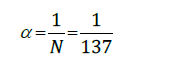
Where:
(α ) is the control breeding factor (1 137) .
(β )is the minimal construction base unit value
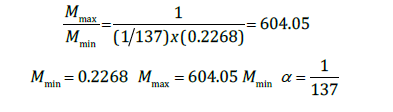
From Table 1 the minimum base mass value is (0.2268), then:
Formation of a charged pair of particles of a unit mass
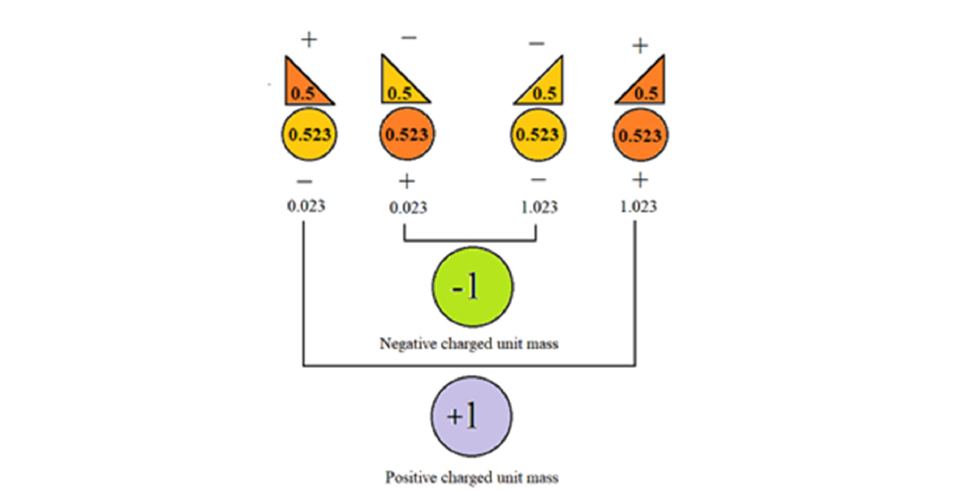
The existence of such pair is an example of the breeding, annihilation and merging process’s function. Considering two sets of four indivisible segments as in Figure 3, each set contains two right prismatic and two spherical segments (blocks). The collision of each two blocks as in the figure, leads to emerging them producing positive and negative blocks of (1.023) mass unit for the left set, while leads to the partial annihilation in the right set producing positive and negative blocks of (0.023) mass unit. The partial annihilation of the negative block (1.023) in right set with the positive block (0.023) in the left set, and the positive block (1.023) in the right set with the negative block (0.023) in the left set produces a pair of positive and negative particles of (1.0) unit mass.
Figure 3:Charged pair of particles of a unit mass formation.
Formation of the particles of maximum mass: The generated bodies with maximum mass are formed through a chain reaction, which determines the relationship between the minimum and maximum masses, where the maximum mass never exceeds (604.05) mass units.
The Atom and Conventional Physics
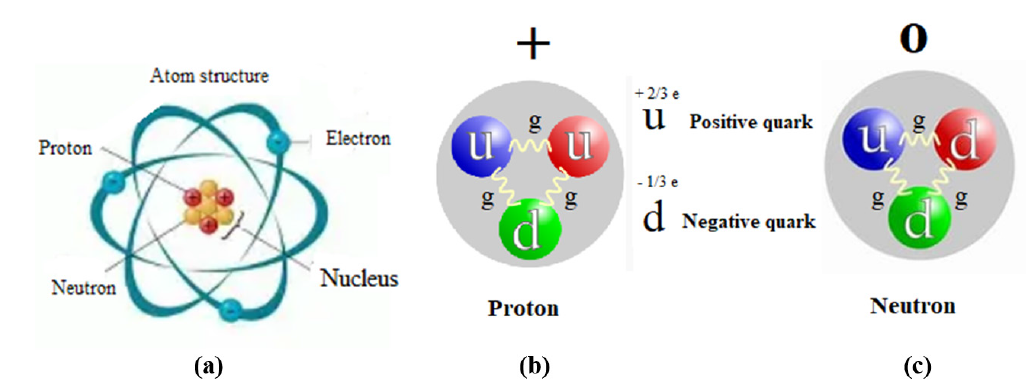
Simply put, the atom is the basic unit of matter. It consists of several negatively charged particles (electrons) orbiting a nucleus containing positively charged and neutral particles (protons and neutrons, respectively). Classical physics considers the hydrogen atom to be the simplest, consisting of one proton and one electron, while the helium atom is the simplest, with a compound nucleus (two protons and two neutrons). A proton is composed of three mass-less gluons and three charged quarks, two up and one down, with positive (2/3 e) and negative (1/3 e) charges, respectively. A neutron also consists of three mass-less gluons and three charged quarks, two down and one up, with negative and positive charges, respectively. The mass of a proton is slightly less than that of a neutron, about 1836 times the mass of an electron Figure 4.
Figure 4:Conventional physics
(a) Atom structure
(b) Proton structure
(c) Neutron structure
Comments on the atom constituents
A deep look at the structure and constituents of the atom could raise questions that have no answers, or even no convincing answers such as:
a) The mass difference between the neutron and proton, which equals to 2.531times the electron mass

b) The mass and charge of the up quark and the down quark, and the state of changing one to another
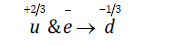
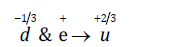
This formula definitely proves that the claim that the down quark is heavier than the up quark is incorrect.
c) The(±) beta decay of proton and neutron
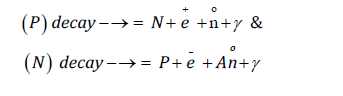
How can protons and neutrons emit positrons and electrons without being contained in their internal structure?
The hypothetical concept of the W and Z bosons for quark conversion is inconvenient.
Comments on the atom structure
Why do neutrons tend to bind with protons, and what is the maximum possible number that can bind with a proton in the atomic nucleus?
There are no answers found.
New Concept
The new concept starts with the atomic nucleus structure.
The proton
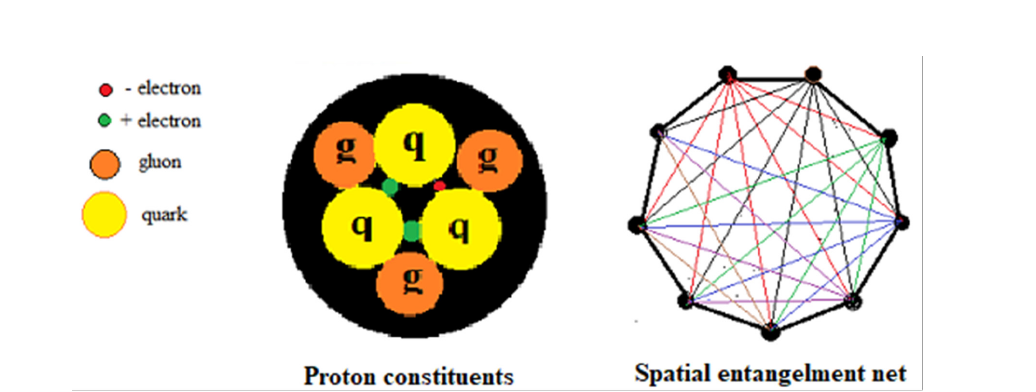
The proton elements: The Proton consists of three quarks, three gluons, two positive electrons, and one negative electron, in addition to a virtual entanglement net representing the proton’s spatial domain Figure 5.
Figure 5:The new proton structure.
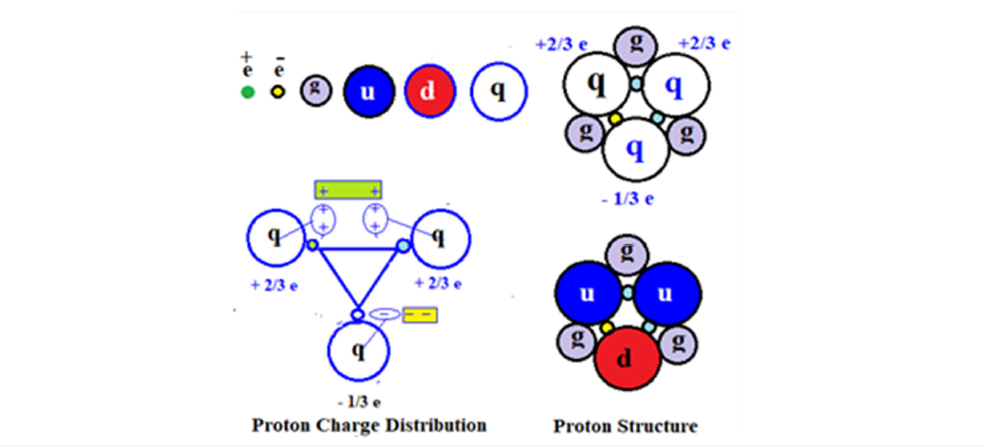
The charge distribution: The charges of the positive and the negative electrons are distributed as in Figure 6, or mathematically as follows:
Figure 6:The charge distribution and the new proton structure.
A. Distributing the positive charge
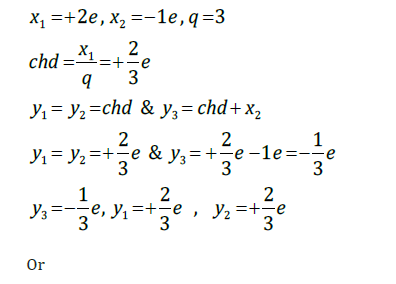
B. Distributing the negative charge
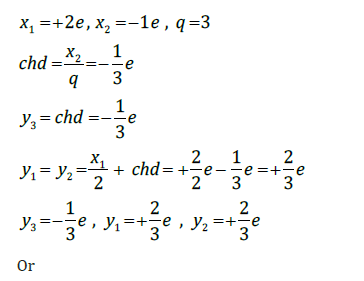
C. Determining the charges with the aid of the neutron
With aid of the neutron information which come afterwards,
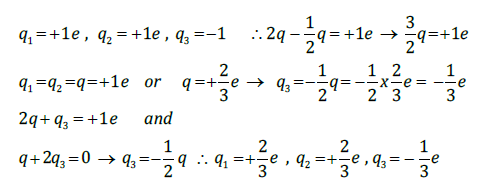
It is easy to see that many solutions can make the positron positively charged (+1e). Still, the dominant factor in obtaining this solution is the neutron’s neutrality. The neutron, which could really be called the proton’s spouse, will be handled later.
Hint:
The positive and negative two-thirds of the inactive charges (green and yellow) do not annihilate each other, but rather balance each other, thus cancelling out each other’s effects.
The spatial entanglement net
This virtual net connects the proton nine elements where it represents the proton spatial domain as in Figure 5. The net’s strings number could be determined as:

Where:
n = The number of the proton elements
r = Two elements selected
The charge of the spatial entanglement net
The spatial entanglement net’s charge is the positive domain of the proton; it equals the algebraic sum of the three quarks’ charges.
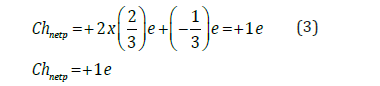
The equivalent mass of the spatial entanglement net
The equivalent mass of the spatial entanglement net represents the invasion ability to the proton’s domain in the form of mass; it equals the mass of the active part of the three electrons divided by the number of strings.
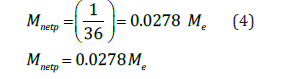
The neutron
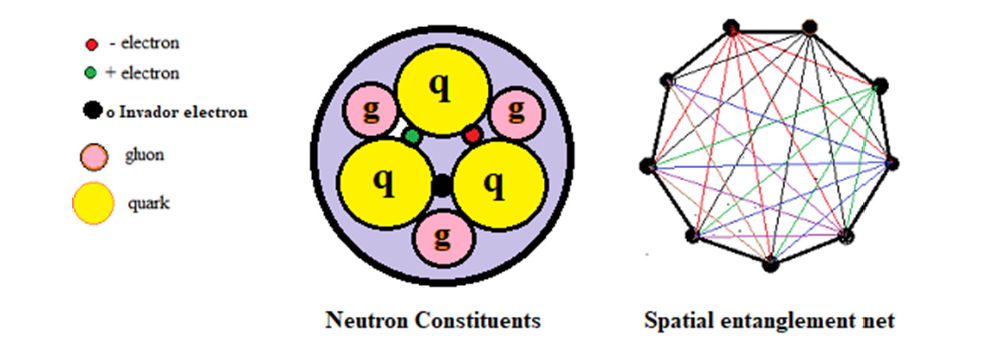
The neutron elements: The neutron is bred from a proton through its invasion by an electron. It consists of three quarks, three gluons, positive electron, negative electron and the invader electron, in addition to the spatial entanglement net which represent the spatial domain of the neutron Figure 7.
Figure 7:The new neutron structure.
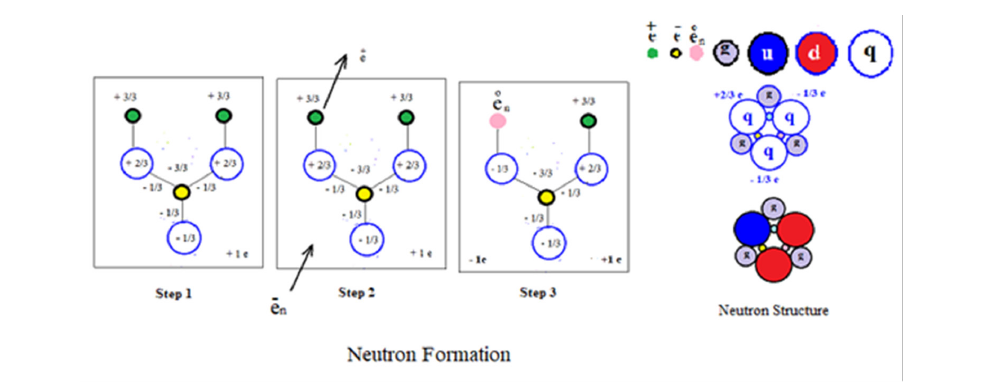
The neutron formation: The neutron is produced as result of colliding an electron with a proton through a formation mechanism of three steps as in Figure 8.
A. The first step
An electron invades (collides with) a proton, which captures it inside its positive domain (the spatial entanglement net).
B. The second step
Capturing the electron, the positive domain and the negative electron become neutrals due to the equilibrium between their charges.
C. The third step
As the domain and the invader electron are neutral, spontaneously the charges of the three quarks become in equilibrium through getting rid of one of the two positive electrons, changing the quark to a negative quark due to the (− 1/3 e) charge remainder.
Hence, the neutron structure is as in Figure 8: two negative quarks of charge (-1/3 e), one positive quark of charge (+2/3 e), one positive electron, one negative electron, and the neutral invader electron Figure 8.
Figure 8:The Neutron creation through the Proton invasion by an electron.
The spatial entanglement net: This virtual net connects the neutron nine elements where it represents the neutron spatial domain as in Figure 7. The net’s strings number could be determined as before:

Where:
n = the number of the proton elements
r = two elements selected
The charge of the spatial entanglement net: The spatial entanglement net’s charge is the neutral domain of the neutron; it equals the algebraic sum of the three quarks’ charges.
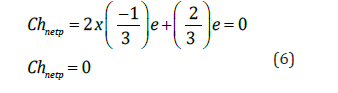
The equivalent mass of the spatial entanglement net: The equivalent mass of the spatial entanglement net represents the invasion ability to the proton’s domain in the form of mass; it equals the mass of the absolute active parts of the three electrons divided by the number of strings.

The difference in mass between the neutron and the proton: As is known in conventional physics, there is a slight mass difference between the neutron and the proton; physicists consider it negligible, which has no mathematical or logical interpretation. The new conception studies their constructions and offers a mathematical interpretation.
From Table 2:
Table 2:Mass of the atom constituents in different units.

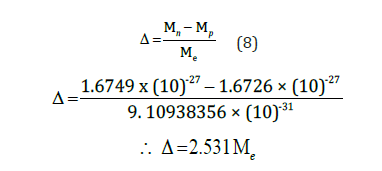
The mathematical interpretation of the mass difference in the new conception: The secret of the mass difference lies in the properties of the spatial domains (spatial entanglement nets) and the invading electron captured by the proton.
Back to the neutron and the proton structure Figure 5- Figure 8, the mass difference is as follows:
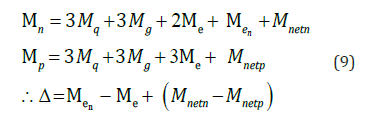
Determination of the invading electron mass: According to the modified relativistic equation by Elescandarany [20], the maximum mass of an electron travelling at the speed of light is 5.02 times its rest mass.
Then, the invading electron mass, just before its collision with the proton, is (5.02 Me ).
When captured in the proton domain, the invading electron mass decreases due to its retardation.
The factors affecting the invader are the two electrons (positive and negative) and the entanglement net masses Figure 8. Hence:
The captured mass become as follows:
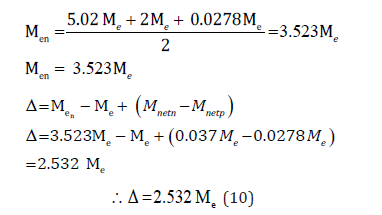
Looking at the neutron-proton mass difference calculated by the new conception and that calculated from Table 2, the coincidence shows the best explanation for this value, which remains unexplained in conventional physics.
Determination the quark and gluon masses
From Figure 5 & Figure 6, the proton structure consists of three quarks, three electrons (+ve & -ve) , three gluons, and an entanglement net. Hence:
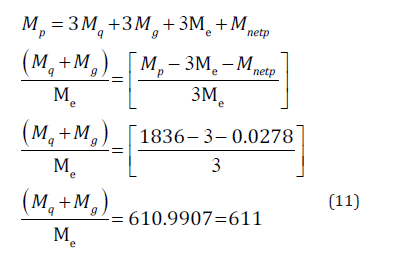
From the particle formation, the body of maximum mass has 604.05 of mass units; And the analogy of the charged particle and the heaviest particle with the electron and the quark, results in determining the quark mass to be 604 times the electron mass, i.e. Mq = 604Me , hence:
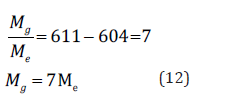
Hence, the atom constituents become according to the new conception as in Table 3.
Table 3:Mass of the atom constituents by the new conception.

The atom nucleus
The atom is the first brick in the universe’s structure, where its nucleus, a proton that attracts and holds an electron in orbit through the balance of their different charges, forms the basis of the periodic table’s elements (Hydrogen). Then, protons and neutrons collect, forming the simplest compound nucleus, two protons and two neutrons, initiating the second element (Helium), and so on, more protons and neutrons, more complex nuclei and more elements.
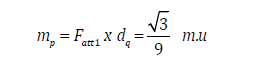
Charge force analysis for proton and neutron: Let the quark diameter (dq ) be a length unit (l. u), the attraction or repulsion force between charges of the positive and negative electrons (e+ & e− )is a force unit ( f . u) and the force unit times the length unit is a moment unit (m. u) .
A. Analysis for the proton
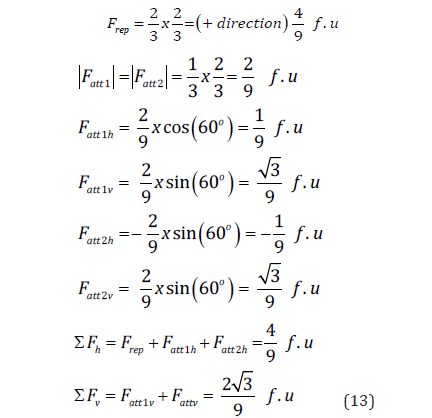
Shifting the force (Fatt1 ) to (Fatt2 ) results in a moment of:
B. Analysis for the neutron

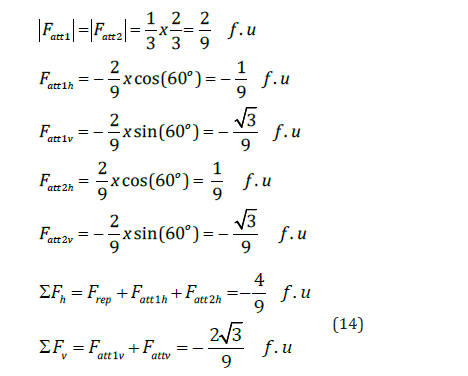
Shifting the force ( Fatt1 ) to (Fatt2 ) results in a moment of:

The analysis illustrated in Figure 9 combines the forces and moments of protons and neutrons.
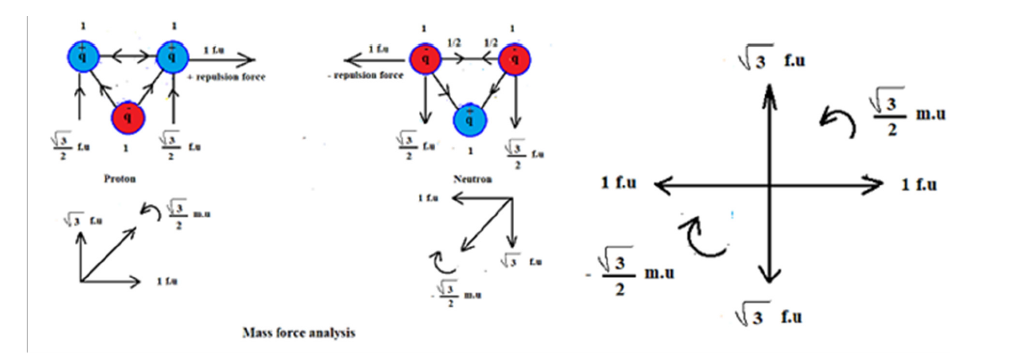
Mass force analysis: As done before:
Let the quark diameter ( dq ) be a length unit (l. u), the attraction or repulsion force between quarks masses is a force unit ( f . u) and the force unit times the length unit is a moment unit (m. u).
Applying the analysis as before, Figure 10 illustrates the combined forces and moments of the proton and neutron.
The nucleus oscillation: As illustrated in Figure 9 & 10, the positive moment causes the proton to rotate counterclockwise, while the negative moment results in the neutron rotating clockwise. Consequently, when a neutron and a proton combine, neither will rotate; both will oscillate.
The neutron-proton union: From the charge and mass force analyses Figure 9 & 10, it is clear that a neutron can cling to a proton, forming a stable combination. Since the mass force analysis reveals that only one neutron can cling to the proton, the charge force analysis shows that the proton can accommodate three more neutrons, which form rather stable isotopes. The stability of these isotopes differs from one to another depending on the number of neutrons.
Figure 9:Charge force analyses for proton and neutron.
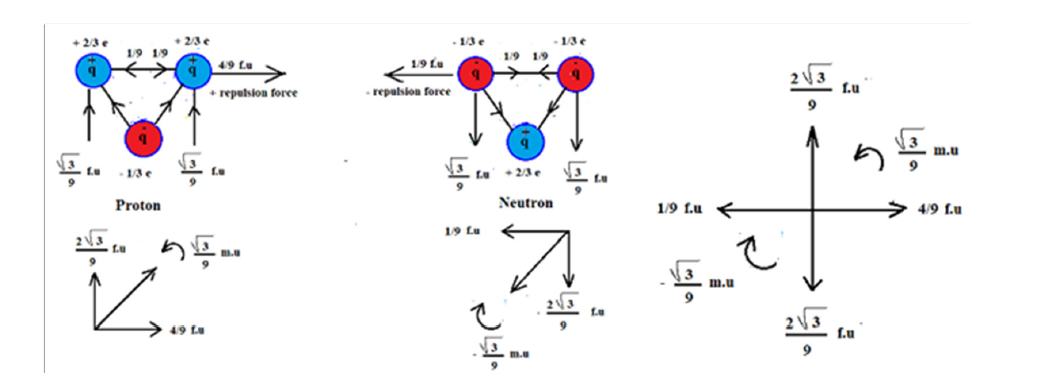
Figure 10:Mass force analyses for proton and neutron.
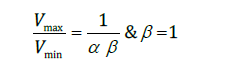
The ultimate number of protons that the nucleus can include: Applying the general formula, which relates the minimality and maximality, the ultimate number of protons could be determined. Hence:
From the hydrogen atom, the minimal Value (number) of protons (β )= 1 (indivisible unity)
Then:
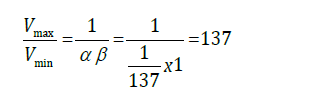
Then, the ultimate numbers of protons can a nucleus include is 137 protons.
The electron minimum velocity: The minimum velocity of the electron is at its minimum energy level in the atom, this velocity could be found in the Hydrogen atom. Hence, applying the min-max formula:
The minimum length and the universe primary block unity
In Elescandarny [20], the primary universe mass is represented as a cube, with its properties: mass, volume, length, and density are expressed in a single unit for each. By using the Planck’s length as the minimum measurement, the primary universe mass specifications could be estimated as follows:
From Figure 11 and Table 4:
Table 4:Some universal data from conventional physics.

Figure 11:The universe primary mass block dimensions as in [20].
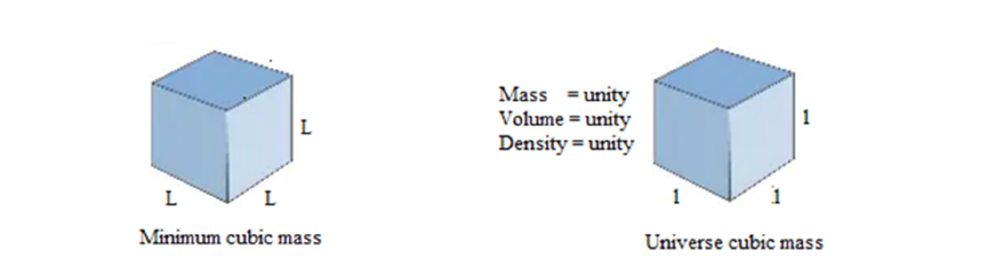
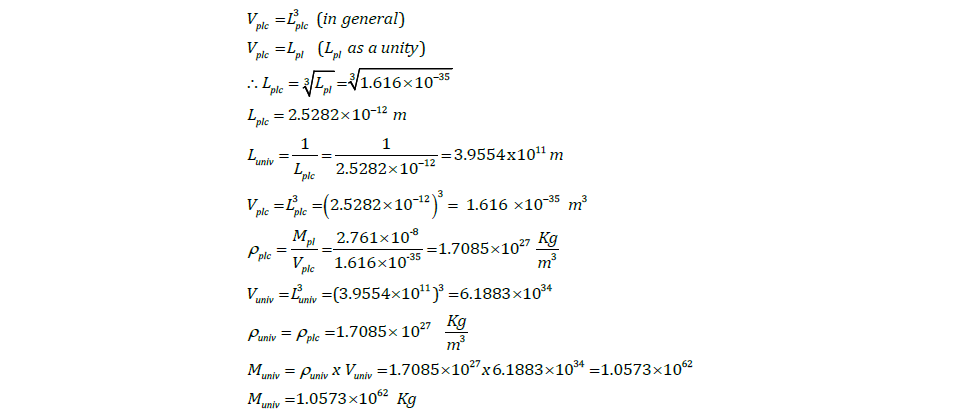
Then:
The primary mass block data become as in Figure 12 and Table 5.
Figure 12:The universe primary mass block dimensions as in [20].
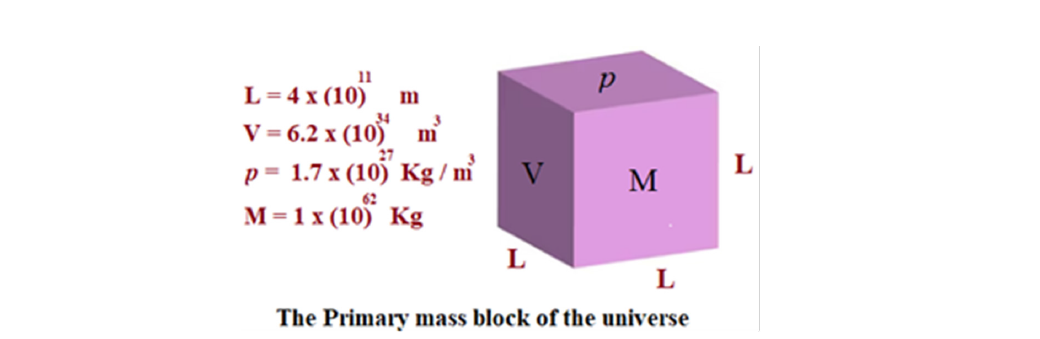
Table 5:The primary universe block data from the new concept.

The structure nature of the nucleus particles
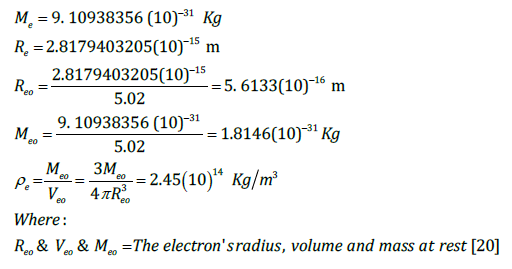
It is necessary to study the structural nature of electrons and quarks as fundamental entities after finding the original mass density.
The structure nature of the electron
The structure nature of the quark
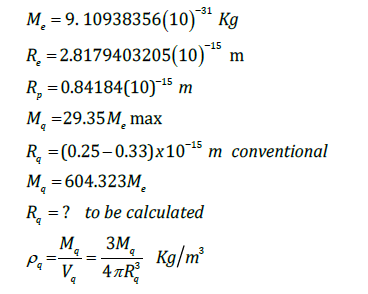
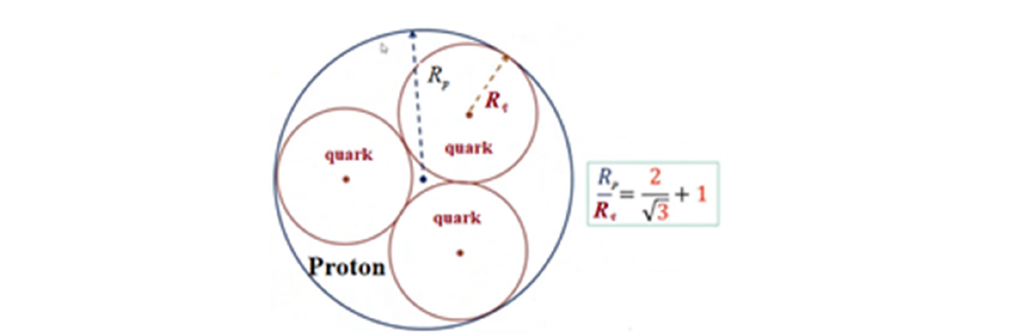
A. Determining the quark radius
From Figure 13:
Figure 13:Quark--Proton radius relation.
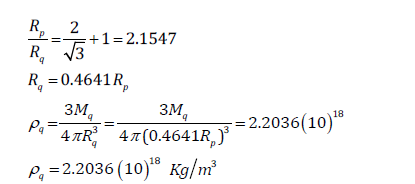
Regardless of the problem of the radius contradiction of the electron and proton (conventional physics), the calculations show that the electron and quark densities are:
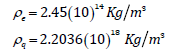
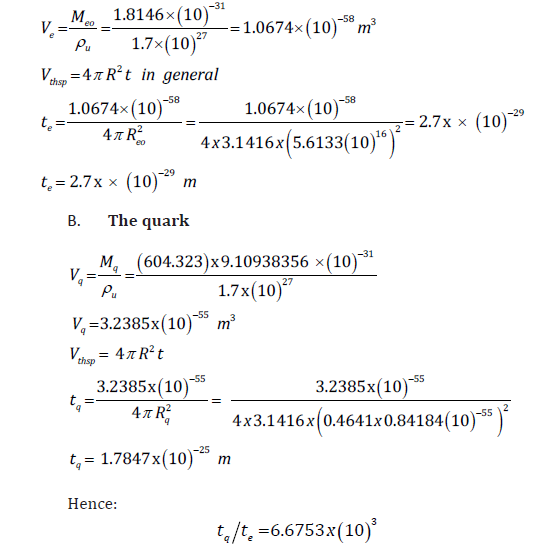
Whereas they are fundamental particles and their densities are less than the universe’s primary density, they should be hollow bodies. Hence, their thicknesses are calculated as follows:
The thickness determination
A. The electron
The min-max formula and the number of universes
Since the Plank length represents the smallest possible length in the universe there must also be a maximum length that can be determined by using the general min-max formula. Hence, the maximum length, volume and maximum mass or minimum density could be determined as follows:
The multiverse case: In this case the origin universe mass is just a brick among multi-bricks, which fill the maximum spce.
From the general min-max formula:
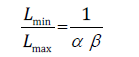
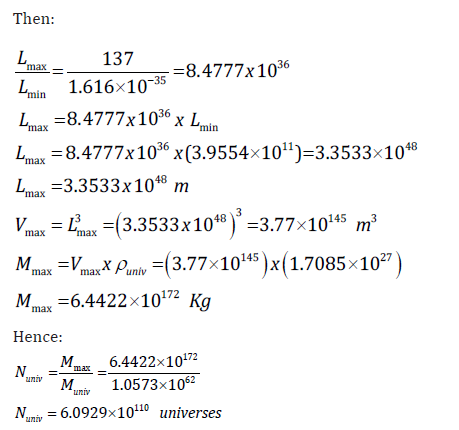
This is the utmost possible number of universes.
The single universe case: In this case the origin universe mass is the mass that will fill the maximum space, which leads to the density decrease.
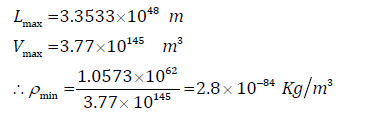
Then, the final state of this single universe if does not rupture before reaching this state, will be at the utmost inflation to reach its maximum volume with its lowest density.
Result
The new concept introduces a breeding system that produces bodies through a chain reaction between primary indivisible segments via various processes. A general deduced formula, from segments’ combinations, yields the fine structure constant, relating minimality and maximality. The study of the proton and neutron interpreted the slight difference between their masses mathematically, determined their parts’ masses and dimensions. Also, analysed the charge force and mass force, showing how they join and how many isotopes can exist. Based on Planck’s length and mass, and Elescandarany’s model, the primary universe block’s mass, volume, length, and density were determined; finally, the number of universes was determined. As they are fundamental bodies, the quark and electron masses prove that, they are not solid bodies but hollow.
Discussion
The Breeding system
The study introduces a novel technique that describes how particles are formed through various processes applied to 17 indivisible segments, including a segment acting as a catalyst, following the Elescandarany technique [20]. The interchange reaction among these indivisible segments produces 137 potential bodies, including the catalyst. Continuous interaction can lead to uncontrolled product sizes, resulting in an imbalance. Therefore, a method must be established to control the reaction and terminate it at a defined limit. Table 1 shows the possible indivisible segments shapes and sizes that could react with each other to create different bodies. Figure 1 shows two segments (a, b) with their possible states (charged and neutral; segment and anti-segment; dark segment; dark energy segment) and a catalyst segment (C). The possible bred bodies of the reaction are 137 (including the catalyst) according to the mathematical combination. Figure 2a - 2c shows a sample of the produced bodies through three different processes (complete merging, complete and partial annihilation) of the breeding system. Figure 3 shows a sample for pair charged bodies (unit mass) formation. The charged unit mass pair bodies could mathematically represent the electron and the positive electron.
The minimality-maximality formula
This formula was introduced to manage the reaction, control and prevent the body’s size inflation. It establishes a statistical relationship between the body’s minimum size and its maximum possible size, which cannot be exceeded. This formula depends on a control-breeding statistical factor (α = 1 137) , which is typically considered as the physically known fine-structure constant, and a novel factor (β = 0.2267 or 1) defined as the minimum construction base unit value. The maximum produced body mass by the breeding system is (604.23 unit mass)based on the novel factor (β = 0.2267). According to this formula, the minimum electron velocity of the atom is approximately 2190 Km/s, which coincides with that calculated for the first orbit in the Bohr model [27]. In addition, the maximum possible atomic number of a matter (natural or synthetic) is 137. It is important to mention that the heaviest atom has been synthetically produced is the Oganesson element 118 Og 294 [28].
The new concept of the atom structure
The study explores atomic structure from a new perspective focused on protons, neutrons, and electrons. This innovative viewpoint enables the research to address previously mentioned questions regarding the mass difference between neutrons and protons, the formation of neutrons, and the role of electrons in forming quark charge and mass. While Figure 4 shows the conventional atom structure where each of a proton and a neutron consists of three quarks (2u, d for proton & u, 2d for neutron), and three gluons, Figure 5 and 7 show the new perspective construction of the proton and neutron. The proton consists of three quarks, two positive electrons, one negative electron, three gluons and a spatial entanglement net, while the neutron consists of three quarks, one negative electron, one positive electron, one invader electron, three gluons and a spatial entanglement net. Figure 6 shows the proton elements and how the charge is distributed on the quarks, and how they become like the charged up and down quarks of conventional physics. Figure 8 shows the neutron’s creation system through the invasion of a proton by an electron and the new perspective construction of the neutron.
According to the new conception, the neutron-proton mass difference is mathematically calculated with the aid of Elescandarany modified special relativistic equation [20]. The calculated mass difference is 2.532 me compared with 2.531 me calculated by conventional physics, which could not interpret this difference considering it negligible. The mass summation of the proton or neutron constituents in Table 2 is much less than the proton or neutron itself, which means that conventional physics is not convenient for accepting these constituents’ masses. Table 3 shows the mass of the atom constituents, after determining the quark mass to be 604.33 me , and the gluon mass 6.667 me , through the new concept, where the mass summation of the proton or neutron’s constituents equals that of the proton or neutron itself.
The atom nucleus
Figure 9 & 10 show the charge and mass force analysis respectively for the proton and neutron nuclei. Figure 9 shows that the proton has a horizontal positive force of (4 9 f. u) , a positive vertical force of (2x30.5/ 9 f. u)and a positive moment of (30.5 /9 m. u) . The neutron has a negative horizontal force of (1/9 f . u), a negative vertical force of (2x30.5 9 f .u) and a negative moment of (30.5 / 9 m. u) . The proton horizontal force allows a single neutron to cling strictly to the proton forming a stable compound where their vertical forces are in balance. This compound will vibrate due to their equal opposite moments. Due to the proton horizontal force, which is four times of that of the neutron, three other neutrons can cling to the proton forming three, fair stabled, isotopes. The more clung neutrons, the more isotope instability. Figure 10 shows that the proton has a horizontal positive force of (1.0 f. u) , a positive vertical force of (30.5 f . u) and a positive moment of (0.5x30.5 m. u) . The neutron has a negative horizontal force of (1.0 f. u) , a negative vertical force of (30.5 f. u) and a negative moment of (0.5x30.5 m. u) . The proton horizontal force allows only a single neutron to cling strictly to the proton forming a stable compound where their vertical forces are in balance. This compound will vibrate due to their equal opposite moments. The mass force analysis does not allow isotopes forming. Hence, after the charge and mass force analysis, it could certainly be said that the quarks’ charges are the sole reason for creating the isotopes and the atom nucleus is vibrating.
The Primary universe block and the atom particles nature
Figure 11 & 12 show the primary universe block and its relative dimensions, as in Figure 11, obtained from Elescandarany [20], and its calculated dimensions through applying the new concept with the aid of Planck length and mass as in Figure 12. Table 4 & 5 show the universe dimensions according to conventional physics compared with the calculated dimensions of the universe’s primary block according to the new concept. Figure 13 expresses the geometrical shape of a proton containing three quarks and the relation between their radii. Because electrons and quarks are primary particles, their densities should equal the universe’s primary block density; however, the calculations reveal that their densities are lower than the original density, indicating that these particles are hollow rather than solid. Based on the origin density and their masses, their thicknesses are calculated to find that the quark thickness equals about 6675 times that of the electron.
The universe and multiverse
With the aid of the min-max formula, the utmost length, in turn, the volume and mass were calculated. This utmost mass is equivalent to 6 × 10110 times the mass of the conventional universe. Therefore, it can be stated that the multiverse is a reality, and the number of universes is finite rather than infinite. Physicists Anderi L. and Vitaly V. have attempted to calculate and predict the number of possible universes based on quantum fluctuations during cosmic inflation. They estimate that the number of universes distinguishable by human observers is about 10160 , limited by the amount of information a human brain can process. If not constrained by human perception, the number could theoretically reach 10700 universes, reflecting the vast diversity of possible quantum outcomes [26]. In case of a single universe, the mass of the conventional universe will fill the utmost volume, i.e. utmost inflation, which leads to the minimal density 2.8 × 10−84 Kg m3 if the universe keeps its sphericity and does not fail before reaching this state [20]. Whereas the critical density is approximately 10−26 Kg m3 , the universe in this case is an open universe in a hyperbolic geometry and expands forever as Einstein stated [29], which means that it loses its sphericity. But its expansion is finite rather than infinite (forever). Table 6 shows the universe and multiverse comparison.
Table 6:Universe and multiverse comparison.

Conclusion
Resuming the author’s previous research chain, “a new perspective on the universe”, this research handles the particle breeding system and how a novel min-max formula is introduced to control the particle size and prevent excessive growth. Results and findings could be concluded as:
a) Novel system for breeding particles
b) Novel formula for controlling the particle size preventing its
excessive growth
c) A unit charged particle formation to represent an electron
d) A maximum sized particle to represent a quark
e) Novel construction for the proton
f) Novel construction for the neutron
g) Determining the quark mass
h) Determining the quark nature
i) Determining the electron nature
j) Determining the gluon mass
k) Interpreting the mass difference between the neutron and
proton mathematically
l) Charge and mass force analyses showing that the quarks
charges are the sole reason of isotopes formation
m) Finding out a statistical parameter that is exactly the fine
structure constant (α ) in addition to another parameter (β )
which represents the minimal construction base unit value
n) Applying the novel min-max formula to find:
The minimum electron velocity at the first orbit in the Bohr model
The maximum possible atomic number
The number of universes and proving the multiverse reality.
References
- Cern accelerating science. “The early universe”.
- Center of Astrophysics; Harvard & Smithsonian, “What happened in the early universe?
- University of Oregon. “The early universe”.
- Mark P Hertzberg (2020) Structure formation in the very early universe. Physics 13: 16.
- Angela A, Hakim A, Micaela B, Eduardo B, Kirk S, et al. (2025) The first billion years according to JWST. Nature Astronomy 9: 1134-1147.
- Pasquale Di Bari (2022) Review on the origin of the universe. Journal of progress in particles and nuclear physics, p. 122.
- Troy Stephens (2024) Elementary particles and particle physics theory.
- Yasmine Amhis (2026) Particle collisions cast light on how matter forms from seemingly empty space. Nature 650: 44-45.
- Cern accelerating science, “The standard model” The Standard Model | CERN
- Modern physics “Fundamental particles and forces”.
- Sylvie Braibant, Giorgio Giacomelli, Maurizio Spurio (2012) Particles and fundamental interaction. Springer, Berlin, Germany.
- Muhammad Tuhin (2025) Why does matter exist? A physics deep dive. Science News Today.
- Filatov AV, Lavkin AG, Smolyansky SA, Bravina LV, Zabrodin EE (2007) Vacuum particle creation in plasma. Translation of the facsimile 8: 101-109.
- Fundamental Physics: Elementary Particles and processes, Cambridge University Press & Assessment, UK.
- Roy DP (1996) The Standard model of the fundamental particles-a review. JSTOR 71(2): 111-115.
- Cern accelerating science. How did matter form?
- David W Snoke (2024) 2- How Fields Generate Particles. Cambridge University Press & Assessment, pp. 18-34.
- Frolov VP (1990) Particle creation and vacuum polarization near black holes. In: Audretsch J, de Sabbata V (Eds.), Quantum Mechanics in Curved Space-Time. NATO ASI Series 230: Springer, Boston, USA, pp. 141-201.
- Neutron vs. Proton - What's the Difference?
- Elescandarany A Waguih (2025) Rational Unity and Total Constant a New Perspective on the Universe. International Journal of Physics Research and Applications 8(9): 268-282.
- Edward TH Wu (2024) Planck Length, Time and Mass Versus Wu’s Unit Length, Time and Mass Based on Graviton Radiation and Contact Interaction Theory. Journal of Applied Physics 16(1): 43-48.
- Fine-structure constant | physics | Britannica
- Are there multiple universes? - New Scientist
- How many universes are there besides our own?
- Amanda Gefter (2009) How many universes are there in the multiverse? New scientist Journal 204(2732): 11.
- Liza Zyga (2009) Physicists calculate the number of parallel universes. Physics News.
- Calculate the velocity of an electron in the first Bohr orbit of a hydrogen atom.
- Oganesson Suppliers | AMERICAN ELEMENTS ®
- Cosmos-The SAO Encyclopedia of Astronomy, "Critical density”.
© 2026 Ahmad Waguih Elescandaranya. This is an open access article distributed under the terms of the Creative Commons Attribution License , which permits unrestricted use, distribution, and build upon your work non-commercially.
Editor In Chief







.jpg)































Signup for Newsletter

Quick Links
 Editorial Board Registrations
 Submit your Article
 Best Paper of the Volume
 Reprints
 Refer a Friend
 Advertise With Us
Our Recent Edition

.jpg)



Top Editors




.jpg)

















.bmp)
.jpg)
.png)
.jpg)













.jpg)






.png)

.png)




.png)




Financial Support

Sponsors

Latest e-Books

Latest Video

 a Creative Commons Attribution 4.0 International License. Based on a work at www.crimsonpublishers.com.
Best viewed in
a Creative Commons Attribution 4.0 International License. Based on a work at www.crimsonpublishers.com.
Best viewed in 
 | Above IE 9.0 version