

- About Us
- Information
-

The Author ensures that the research has been conducted responsibly and ethically with adherence to all relevant regulations. read more..
- For Authors
- For Reviewer
- Manuscript Guidelines
- Membership
- Publication Ethics
-
- Journals
- Reprints
- e-Books
- Videos
- Policies
- Contact Us
 COVID-19
- Submissions



Abstract
Advances in Complementary & Alternative medicine
Disease and Drug Dynamics in Homoeopathy: An Interface of Pathology, Systems Biology, and Pharmacodynamics
-
Open or CloseIndrani Halder1*, Shubhamoy Ghosh2, Poorav Desai3 and Kausik Datta4
1 Department of Homoeopathic Repertory & Case Taking, Jawaharlal Nehru Homoeopathic Medical College, Parul University, Gujarat, India
2 Department of Pathology & Microbiology, D. N. De Homoeopathic Medical College & Hospital, Govt. of West Bengal, Affiliated with the West Bengal University of Health Sciences, India
3 Department of Human Anatomy, Jawaharlal Nehru Homoeopathic Medical College, Parul University, Vadodara, Gujarat, India
4 Consultant Physician & Independent researcher; 71, Prasanta Datta Sarani, Bhadrakali, Hooghly, West Bengal, India
*Corresponding author:Indrani Halder, Department of Homoeopathic Repertory & Case Taking, Jawaharlal Nehru Homoeopathic Medical College, Parul University, Gujarat, India
Submission: August 09, 2026;Published: September 25, 2026

ISSN: 2637-7802Volume9 Issue 4
Abstract
Pathology provides the scientific framework for understanding disease etiology, pathogenesis, and progression, traditionally linking basic biomedical science with clinical practice. Contemporary systems biology further conceptualizes disease as a dynamic disturbance of interacting regulatory networks rather than as isolated structural or molecular defects. Within this context, homoeopathy adopts an individualized and dynamic view of disease, emphasizing patient-specific symptom patterns and biological reactivity. This article emphasizes disease dynamics and drug dynamics in homoeopathy through an integrative lens incorporating pathology, systems biology, and pharmacodynamic principles. Disease expression is interpreted as an emergent property of altered network regulation influenced by genetic variability, environmental factors, and susceptibility. Symptoms are considered system-level signals reflecting functional imbalance rather than direct representations of pathology alone. Drug dynamics are discussed as non-linear and potency-dependent, ranging from conventional molecular interactions at lower dilutions to proposed regulatory or informational effects at higher dilutions. Individualized therapeutic decision-making is framed as the alignment of disease dynamics with the dynamic action profile of the remedy rather than reliance on static diagnostic categories. This integrative framework does not claim mechanistic proof for high dilutions but offers a coherent conceptual model for individualized practice and a foundation for future hypothesis-driven research using systems biology, dynamic modelling, and personalized medicine approaches.
Major findings
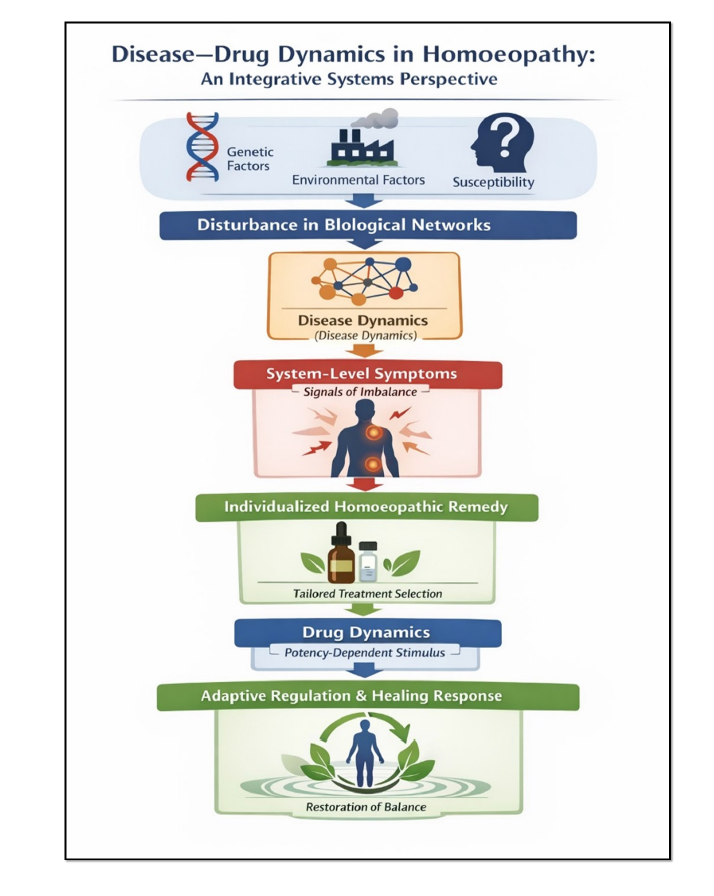
The study presents an integrative framework linking homoeopathic disease-drug dynamics with Pathology, Systems Biology, and Pharmacodynamics. Disease is viewed as a disturbance in biological regulatory networks, while individualized remedy selection aligns drug action with patient-specific disease dynamics (Figure 1).
Figure 1:Graphical abstract.
Keywords: Disease dynamics; Drug dynamics; Pathology; Systems biology; Pharmacodynamics; Non-linear biological systems; Homoeopathy
Editor In Chief







.jpg)































Signup for Newsletter

Quick Links
 Editorial Board Registrations
 Submit your Article
 Best Paper of the Volume
 Reprints
 Refer a Friend
 Advertise With Us
Our Recent Edition




Top Editors




.jpg)

















.bmp)
.jpg)
.png)
.jpg)













.jpg)






.png)

.png)




.png)




Financial Support

Sponsors

Latest e-Books

Latest Video

 a Creative Commons Attribution 4.0 International License. Based on a work at www.crimsonpublishers.com.
Best viewed in

 | Above IE 9.0 version