

- About Us
- Information
-

The Author ensures that the research has been conducted responsibly and ethically with adherence to all relevant regulations. read more..
- For Authors
- For Reviewer
- Manuscript Guidelines
- Membership
- Publication Ethics
-
- Journals
- Reprints
- e-Books
- Videos
- Policies
- Contact Us
 COVID-19
- Submissions



Full Text
Advances in Complementary & Alternative medicine
Disease and Drug Dynamics in Homoeopathy: An Interface of Pathology, Systems Biology, and Pharmacodynamics
Indrani Halder1*, Shubhamoy Ghosh2, Poorav Desai3 and Kausik Datta4
1 Department of Homoeopathic Repertory & Case Taking, Jawaharlal Nehru Homoeopathic Medical College, Parul University, Gujarat, India
2 Department of Pathology & Microbiology, D. N. De Homoeopathic Medical College & Hospital, Govt. of West Bengal, Affiliated with the West Bengal University of Health Sciences, India
3 Department of Human Anatomy, Jawaharlal Nehru Homoeopathic Medical College, Parul University, Vadodara, Gujarat, India
4 Consultant Physician & Independent researcher; 71, Prasanta Datta Sarani, Bhadrakali, Hooghly, West Bengal, India
*Corresponding author:Indrani Halder, Department of Homoeopathic Repertory & Case Taking, Jawaharlal Nehru Homoeopathic Medical College, Parul University, Gujarat, India
Submission: August 09, 2026;Published: September 25, 2026

ISSN: 2637-7802 Volume 9 Issue 4
Abstract
Pathology provides the scientific framework for understanding disease etiology, pathogenesis, and progression, traditionally linking basic biomedical science with clinical practice. Contemporary systems biology further conceptualizes disease as a dynamic disturbance of interacting regulatory networks rather than as isolated structural or molecular defects. Within this context, homoeopathy adopts an individualized and dynamic view of disease, emphasizing patient-specific symptom patterns and biological reactivity. This article emphasizes disease dynamics and drug dynamics in homoeopathy through an integrative lens incorporating pathology, systems biology, and pharmacodynamic principles. Disease expression is interpreted as an emergent property of altered network regulation influenced by genetic variability, environmental factors, and susceptibility. Symptoms are considered system-level signals reflecting functional imbalance rather than direct representations of pathology alone. Drug dynamics are discussed as non-linear and potency-dependent, ranging from conventional molecular interactions at lower dilutions to proposed regulatory or informational effects at higher dilutions. Individualized therapeutic decision-making is framed as the alignment of disease dynamics with the dynamic action profile of the remedy rather than reliance on static diagnostic categories. This integrative framework does not claim mechanistic proof for high dilutions but offers a coherent conceptual model for individualized practice and a foundation for future hypothesis-driven research using systems biology, dynamic modelling, and personalized medicine approaches.
Major findings
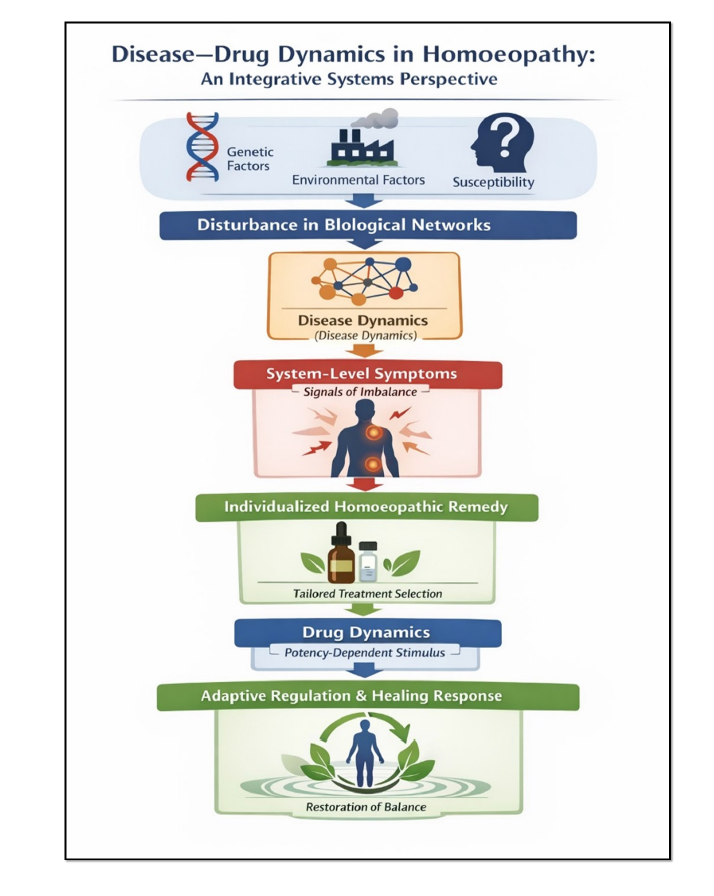
The study presents an integrative framework linking homoeopathic disease-drug dynamics with Pathology, Systems Biology, and Pharmacodynamics. Disease is viewed as a disturbance in biological regulatory networks, while individualized remedy selection aligns drug action with patient-specific disease dynamics (Figure 1).
Figure 1:Graphical abstract.
Keywords: Disease dynamics; Drug dynamics; Pathology; Systems biology; Pharmacodynamics; Non-linear biological systems; Homoeopathy
Introduction
Pathology is the scientific study of disease, encompassing its etiology, pathogenesis, structural alterations, and functional consequences, and serves as a critical bridge between basic biomedical science and clinical practice. Disease arises when normal structural or functional parameters deviate beyond physiological limits, leading to disordered regulation and clinical manifestations. In contemporary medicine, increasing emphasis is placed on understanding not only static pathological changes but also the dynamic behaviour of disease processes over time. Homoeopathy approaches disease from a dynamic perspective, emphasizing individualized patterns of symptoms rather than isolated pathological entities. Homoeopathic pharmacy focuses on drug dynamics—the manner in which remedies, prepared through dilution and potentization, interact with the organism’s regulatory systems to stimulate adaptive responses. Integration of pathological knowledge with homoeopathic principles refines remedy selection, informs potency and dosage decisions, and aids in assessing disease stage, prognosis, and therapeutic limits.
Advances in systems biology further support a non-reductionist view of disease, conceptualizing health and illness as emergent properties of interconnected biological networks. Disease is increasingly understood as a disturbance of system dynamics, regulatory coherence, and biological oscillations rather than as dysfunction of single molecular targets. Within this framework, symptoms represent system-level signals of network disturbance, and therapeutic interventions aim to restore regulatory balance. This review emphasizes the interface between pathology, systems biology, and pharmacodynamics to propose an integrated framework of disease dynamics and drug dynamics in homoeopathy. By correlating pathological processes with individualized drug action, potency-dependent pharmacodynamics, and patientspecific susceptibility, the paper seeks to provide a rational, systems-oriented basis for individualized homoeopathic practice while acknowledging the need for further empirical validation of proposed mechanisms.
Pathology and Disease
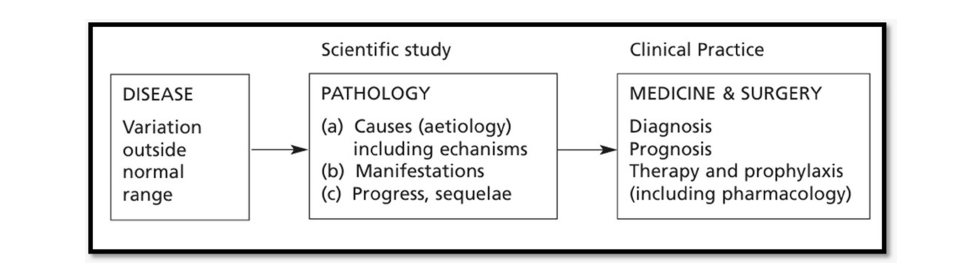
Pathology is the study of disease. It describes the effects, progress and consequences of the disease and attempts to determine the cause (aetiology) and underlying mechanisms (pathogenesis). It forms a bridge between basic science and clinical practice (Figure 2) and has traditionally had the same role in linking pre-clinical and clinical study for medical students [1].
Figure 2:Disease occurs when there are variations of function or structure outside the normal range.
Pathological basis of individualized homoeopathic drug selection
Pathology explains disease dynamics through genetic variability, mutations, susceptibility, resistance, and environmental interactions, highlighting why diseases manifest differently in individuals. Variations in normal genes and abnormal genes determine individual susceptibility, chronicity, and prognosis of disease, forming the biological basis of individualization. Homoeopathic Pharmacy provides insight into drug dynamics, where preparation, dilution, and potentization aim to stimulate the organism’s adaptive and regulatory responses.
Understanding pathological stages (functional, structural, genetic, or degenerative) guides the selection of potency, dosage, and repetition of the remedy. Homeopaths with a strong background in pathology are more equipped to choose personalized (Individualized) medicines based on the unique symptoms and course of the condition, which yields better results. A complete comprehension of disease process or mechanism, its manifestations enable homeopaths to choose remedies with knowledge. This information not only improves the efficacy of therapies but also fortifies the scientific basis of homeopathic practitioners’ work, connecting them with modern medical understanding [1-3].
Principles governing the selection of dose and potency in homoeopathic practice
Posology is the doctrine of doses of medicine. According to homoeopathy, a dose is the particular preparation of medicine used, the quantity form of preparation and the administration of the medicine. Basically, a homoeopathic dose includes potency, quantity, form and number of administrations of medicine.
A. Selection of the proper dose is essential, as an incorrect
potency may lead to failure of even a well-indicated remedy.
B. Potency depends mainly on the susceptibility of the
patient, which is higher when symptoms are clear, peculiar, and
characteristic.
C. Age, temperament, constitution, habits, and environment
influence susceptibility.
D. Highly sensitive, intellectual, and sedentary individuals
usually require higher potencies, while sluggish, physically
laborious individuals need lower potencies.
E. Gross pathological or terminal conditions generally
demand low or material doses.
F. The seat of disease matters-vital organs and marked
structural changes require lower potencies.
G. Functional and acute diseases respond better to high
potencies.
H. Organic and chronic diseases respond better to low or
medium potencies.
I. Advanced incurable cases often need low to medium
potencies, while terminal stages may benefit from higher
potencies.
J. Overall, the relationship between dose, susceptibility,
and similarity is non-linear; higher susceptibility and closer
similarity require a minimal, often infinitesimal dose [2,3].
A dynamic vision of pathology
The concept of disease is central to any medical approach because it unavoidably determines (consciously or unconsciously) the diagnostic methods and therapeutic interventions employed. Understanding the nature of the homeopathic approach to treatment requires adopting the framework of a non-reductionist view of pathology, regarded not as a rupture of a single mechanism but as a disturbance of biological networks.
Symptoms as signals of network disturbance
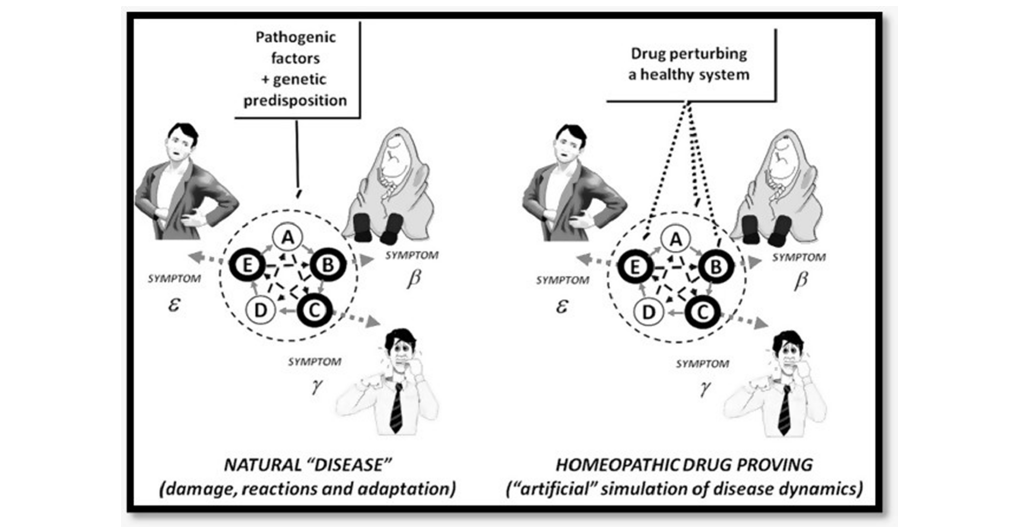
Homeopathy analyses symptoms, which reflect internal network disturbances, not the disease itself. The similia principle guides remedy selection by mimicking symptom patterns to restore balance. Symptoms are emergent properties of the patient’s global network. Treatment is individualized, considering somatic, psychic, behavioural, and environmental factors. Disease is viewed as a dynamic network disturbance, linking disease dynamics with drug dynamics. The most appropriate regulatory medicine is one that can guide the restoration of homeodynamic equilibrium by eliciting behavioural or symptom patterns similar to those expressed by the disease itself. When a homoeopathic medicine produces a symptom profile that closely resembles the disease manifestations, it becomes therapeutically relevant, as it can effectively interact with and modulate the specific biological systems underlying the disease process [4] (Figure 3).
Figure 3:Schematic view of homeopathic concepts based on similarity of symptoms. In a ‘‘healthy’’ regulating system network, an exogenous pharmacological signal can trigger multiple signs that mimic the natural disease. The disease (left) produces an internal disruption of the homodynamic networks which is manifested in the form of symptoms and can be (also) characterized by a symptom pattern unique to the disease and to the individual patient. The homeopathic proving methodology (right) characterizes drugs according to their ability to induce perturbations, manifested as symptoms, in healthy subjects.
Possible mechanisms and scientific basis of homoeopathic medicines
A key point of debate in homeopathy is the requirement for a credible explanation of how the extremely High Dilutions (HDs) commonly employed can exert a therapeutic effect [5-7] i.e. how does it work? This section explores the scientific attempts made to understand how homoeopathic medicines may act and the possible mechanisms behind their therapeutic effects.
Physicochemical nature of the remedy: Research in this area examines the physical and chemical characteristics of highly diluted homoeopathic remedies. Scientists have used various analytical techniques such as spectroscopy, nanoparticle analysis, thermoluminescence, and nuclear magnetic resonance to study these preparations. Some investigations also focus on the concept of the structural organization of water, often referred to as the “memory of water.” Through such studies, researchers aim to detect measurable changes in the solvent that may occur during the process of potentization and to identify any analytical evidence supporting these structural modifications.
Pharmacodynamic aspects (action on the body): Another line of research focuses on understanding how homoeopathic medicines interact with biological systems. Experimental studies, including laboratory investigations, cell culture experiments, and animal models, are conducted to observe the biological responses triggered by these medicines. These studies explore potential mechanisms such as immune modulation, anti-inflammatory activity, and the regulation of physiological processes. The findings contribute to the development of scientific hypotheses and theoretical models that seek to explain the mode of action of homoeopathic medicines.
Systems biology relevance to homoeopathy
Systems biology views health and disease as emergent properties of interacting biological networks rather than isolated molecular events. System structure, dynamics, regulation, and robustness determine physiological stability and response to perturbation. Disease represents disturbed network dynamics and loss of regulatory coherence. Functional behaviour cannot be explained by static gene or protein lists alone but requires analysis of time-dependent interactions. Therapeutic intervention targets regulatory control points rather than single components. Individual variability reflects differences in network sensitivity and adaptability. Homoeopathy similarly conceptualizes disease as a dynamic imbalance of the organism’s regulatory system. Symptoms emerge as system-level signals of disturbance. Remedy action may be interpreted as a targeted perturbation aimed at restoring network coherence. This convergence supports individualized and non-linear models of healing [8].
Disease dynamics as disturbed biological oscillations
From a systems pathology perspective, disease may be conceptualized not merely as structural or biochemical abnormality, but as a disturbance in dynamic regulatory processes governing biological oscillations. Living organisms’ function through multiple interacting rhythms-neuro-endocrine signalling, immune modulation, enzymatic reactions, cellular membrane potentialseach operating within specific frequency domains.
Disease dynamics, therefore, may represent:
a) Loss of synchronization among physiological oscillators
b) Breakdown of coherent communication between
regulatory subsystems
c) Shift from stable homeostasis to unstable or bifurcationprone
states
Drug dynamics beyond molecular interaction
Conventional pharmacology largely explains drug action through dose-dependent molecular interactions (receptor binding, enzyme inhibition, replacement therapy). However, such models may be insufficient to explain the observed effects of ultra-low and ultra-diluted substances. In Homoeopathic point of view of drug dynamics:
a) The remedy is not only a chemical agent but also a carrier
of structured information
b) Potentization is viewed as a process that modifies
the physical organization of the solvent system, potentially
encoding bio-informational patterns
c) Drug action is interpreted as regulatory rather than
suppressive or substitutive
This does not negate molecular pharmacology but complements it by introducing non-molecular, informational dimensions of drug action [9].
Law of similars as a principle of informational specificity
The law of similars can be interpreted as a principle for maximizing informational specificity between the remedy and the diseased system. By matching drug-induced symptom patterns with disease expressions, homoeopathy aims to achieve selective regulatory signalling, independent of complete mechanistic knowledge. Individualization further enhances specificity, aligning with contemporary concepts of personalized medicine and interindividual variability in drug response [10].
Drug dynamics: Conventional pharmacology perspective
a. Pharmacokinetics (absorption, distribution, metabolism,
elimination)
b. Pharmacodynamics (dose–response, receptor sensitivity)
c. Disease-modified drug responses
d. Non-linear and paradoxical drug effects
Drug dynamics in homoeopathic pharmacy2-3
a. Concept of dynamization/potentization
b. Primary and secondary drug action
c. Role of susceptibility
d. Potency selection as a dynamic decision
e. Time-dependent response to remedies
Pharmacodynamic implications of homeopathic ultradilution
A central challenge in homeopathy is the use of ultra-low doses, more accurately described as high dilutions, which may contain negligible or no molecules of the original substance.
Two fundamental questions arise:
A. Can a solvent, such as water or hydro-alcoholic mixtures,
acquire and retain structural or energetic information from the
original solute during serial dilution and succussion?
B. If pharmacological information is retained in highly
diluted preparations, by what mechanisms is this information
conveyed to the organism to influence physiological regulation
and therapeutic response? Within the framework of disease
dynamics and drug dynamics, high potencies are conceptualized
not as material dose–response agents, but as informational
stimuli, interacting with the organism’s regulatory networks to
modulate pathological processes.
The physical nature of the remedy
Several studies have investigated the physicochemical properties of highly diluted homeopathic preparations. Experimental observations suggest that serial dilution and succussion may induce measurable changes in solvent properties-such as electrical conductivity, NMR profiles, optical activity, and thermoluminescent behaviours-when compared with control solvents. In some models, non-linear or oscillatory biological responses have also been reported. To account for these findings, theoretical models have proposed solvent structuring and electromagnetic memory of water, suggesting that exposure to substances or electromagnetic fields may induce persistent, non-random changes in water organization. While such hypotheses remain speculative, they offer a conceptual framework for investigating non-molecular effects in ultra-diluted systems. The relevance of these phenomena to therapeutic outcomes, however, remains unproven and requires further rigorous validation [10].
Potency-dependent drug dynamics
Homeopathic drug action may be conceptualized as potencydependent, shifting from material interactions at lower dilutions to informational and systemic modulation at higher dilutions. This transition reflects a change in the mode of pharmacodynamic engagement rather than a linear dose–response relationship.
Nature of the medicinal signal
At lower and medium potencies, remedies may retain trace molecular presence or nanoparticles, allowing conventional molecular interactions. In contrast, higher potencies are hypothesized to act through structured solvent systems, including water organization and coherence phenomena, functioning as carriers of pharmacological information rather than material dose.
Biological targets and systemic engagement
Lower potencies predominantly influence local cellular targets, such as receptors, enzymes, and gene expression pathways. Higher potencies appear to engage system-level regulatory networks, including neuro-immunological and bioelectrical systems, thereby interacting with the global dynamics of disease rather than isolated pathological sites.
Amplification and non-linear responsiveness
Biological amplification at lower potencies may occur through cell sensitization, signal transduction, and hormetic mechanisms. At higher potencies, responses are described as non-linear, involving threshold effects, network-level sensitivity, and dynamic shifts in physiological regulation.
Information transfer mechanisms
Information transfer in lower potencies is consistent with classical molecular signalling. In higher potencies, proposed mechanisms include frequency-dependent signalling, water structuring, and electromagnetic interactions, often discussed under the concept of electromagnetic memory of water. These models remain theoretical and require further validation.
Similia as dynamic regulation
Within a disease–drug dynamics framework, the similia principle may be interpreted as a regulatory inversion of disease dynamics, where the remedy introduces a targeted perturbation that facilitates adaptive reorganization of the organism’s pathological steady state toward physiological balance [11].
Complementarity of disease dynamics and drug dynamics in individualized homoeopathic practice
Guiding Accurate Prescription: Disease dynamics describe the functional and temporal behaviour of pathology, including symptom evolution, system sensitivity, and regulatory imbalance. Drug dynamics, in contrast, characterize the pattern of action of a remedy across different potencies and biological contexts. Accurate prescription emerges from the convergence of these two dynamic profiles, where the qualitative pattern of the remedy corresponds to the dynamic expression of disease rather than to a static diagnosis. This interaction supports the similia principle as a context-dependent regulatory response, not merely symptom similarity [1,10,11].
Assessing Prognosis through Dynamic Responsiveness: Prognosis in homoeopathy depends less on nosological classification and more on the reactivity of the organism. Disease dynamics provide insight into the depth, chronicity, and reversibility of pathological processes, while drug dynamics help predict whether a given stimulus is likely to elicit a curative response. Favourable prognosis is associated with adaptive responses, orderly symptom evolution, and restoration of regulatory function, whereas poor prognosis reflects rigid or exhausted dynamic states. This dynamic assessment aligns with non-linear biological models and systems medicine [12-14].
Establishing a Scientific Basis for Individualization: Individualization in homoeopathy can be scientifically framed as the matching of system states rather than substances. Disease dynamics represent the patient-specific configuration of disturbed regulatory networks, while drug dynamics represent the capacity of a remedy to act as a targeted informational perturbation. High dilutions, in particular, are hypothesized to operate through nonmolecular signalling and system-level modulation, influencing stressed or primed biological networks. This framework situates individualized homoeopathic treatment within contemporary concepts such as hormesis, adaptive regulation, and network pharmacology [14-16].
Future research directions
a. Mathematical modelling of disease–drug interaction
b. Systems biology approaches in homoeopathy
c. Time-series analysis of clinical response
d. Biomarker-based assessment of disease dynamics
Conclusion
Understanding disease and drug dynamics in homoeopathy through the lens of pathology and systems biology provides a rational framework for individualized therapy. Disease is conceptualized as a dynamic disturbance of regulatory networks, while remedies act as informational perturbations aimed at restoring systemic balance. Integrating pharmacodynamics with network-level insights supports precise selection of potency, dose, and timing. Individual variability, including genetic, physiological, and environmental factors, underlies differential responses and guides personalization. High dilutions may exert regulatory rather than purely material effects, complementing conventional pharmacological models. The similia principle can be interpreted as a context-dependent modulation of system states. This approach bridges traditional homoeopathic practice with contemporary scientific understanding. Future research using systems biology, computational modelling, and biomarkers can further elucidate mechanisms and optimize outcomes. The convergence of pathology, drug dynamics, and network biology reinforces the scientific basis of individualized homoeopathic treatment.
Author Contributions
Indrani Halder conceptualized the review, developed the core theoretical framework, conducted the comprehensive literature search, and drafted the initial manuscript. Shubhamoy Ghosh conceptualized the review, contributed expert inputs on pathology aspects, conducted the comprehensive literature search, critically analyzed the literature. Poorav Desai contributed to conceptual refinement, and critically revised the manuscript for intellectual content. Kausik Datta conceptual refinement, and critically revised the manuscript for intellectual content. All authors reviewed and approved the final manuscript and agree to be accountable for all aspects of the work.
Funding
No funding was received for this work.
Data Availability Statement
No new data were generated or analyzed in this article. All information discussed in this manuscript is derived from previously published literature.
Conflict of Interest
The authors declare no conflict of interest.
Acknowledgement
Not applicable.
References
- (2011) In: Reid R, Roberts F, MacDuff E (Eds.), Pathology Illustrated, Churchill Livingstone, Elsevier Publishers, Netherlands.
- Hahnemann S (2011) Organon of medicine. (6th edn), B Jain Publishers, New Delhi, India.
- Banerjee DD (2015) Textbook of pathology for homoeopaths. New Central Book Agency, New Delhi, India.
- Bellavite P, Olioso D, Marzotto M, Moratti E, Conforti A (2013) A dynamic network model of the similia principle. Complementary Therapies in Medicine 21(6): 750-761.
- Fisher P (2012) What is homeopathy? An introduction. Front Bio sci (Elite Ed) 4: 1669-1682.
- Rutten L, Mathie RT, Fisher P, Goossens M, Van WM (2012) Plausibility and evidence: The case of homeopathy. Med Health Care Philos 16(3): 525-532.
- Bellavite P, Marzotto M, Olioso D, Moratti E, Conforti A (2014) High-dilution effects revisited. 1. Physicochemical aspects. Homeopathy 103(1): 4-21.
- (1998) In: Schulte J, Endler PC (Eds.), Fundamental research in ultra-high dilution and homoeopathy. Kluwer Academic Publishers, India.
- Bellavite P, Ortolani R, Pontarollo F, Pitari G, Conforti A (2007) Immunology and homeopathy. 5. The rationale of the “simile.” Evid Based Complement Alternat Med 4(2): 149-163.
- Bellavite P, Marzotto M, Olioso D, Moratti E, Conforti A (2014) High-dilution effects revisited. 2. Pharmacodynamic mechanisms. Homeopathy 103(1): 22-43.
- Jonas WB, Kaptchuk TJ, Linde K (2003) A critical overview of homeopathy. Ann Intern Med 138(5): 393-399.
- Kitano H (2002) Systems biology: A brief overview. Science 295(5560): 1662-1664.
- Calabrese EJ, Baldwin LA (2003) Hormesis: The dose-response revolution. Annu Rev Pharmacol Toxicol.; 43: 175-197.
- Bell IR, Koithan M (2012) A model for homeopathic remedy effects: Low dose nanoparticle signaling. BMC Complement Altern Med 12: 191.
- Conforti A, Bellavite P (2016) The role of biological complexity in homeopathy. Homeopathy 105(1): 42-50.
© 2026 Indrani Halder. This is an open access article distributed under the terms of the Creative Commons Attribution License , which permits unrestricted use, distribution, and build upon your work non-commercially.
Editor In Chief







.jpg)































Signup for Newsletter

Quick Links
 Editorial Board Registrations
 Submit your Article
 Best Paper of the Volume
 Reprints
 Refer a Friend
 Advertise With Us
Our Recent Edition



Top Editors




.jpg)

















.bmp)
.jpg)
.png)
.jpg)













.jpg)






.png)

.png)




.png)




Financial Support

Sponsors

Latest e-Books

Latest Video

 a Creative Commons Attribution 4.0 International License. Based on a work at www.crimsonpublishers.com.
Best viewed in

 | Above IE 9.0 version