

- About Us
- Information
-

The Author ensures that the research has been conducted responsibly and ethically with adherence to all relevant regulations. read more..
- For Authors
- For Reviewer
- Manuscript Guidelines
- Membership
- Publication Ethics
-
- Journals
- Reprints
- e-Books
- Videos
- Policies
- Contact Us
 COVID-19
- Submissions



Full Text
Trends in Telemedicine & E-health
Artificial Intelligence in Paediatric Vision Screening: Current Evidence, Clinical Applications, and Public Health Implications - A Narrative Review
Ragni Kumari1 and Adesh Kumar2*
1Department of Optometry, UPUMS, India
2Pro Vice Chancellor and Dean, UPUMS, India
*Corresponding author:Adesh Kumar, Pro Vice Chancellor, UPUMS and Dean, FAHS, UPUMS, Saifai, Etawah, UP, India
Submission: October 10, 2026;Published: October 27, 2026

ISSN: 2689-2707 Volume 6 Issue 5
Abstract
Background: Childhood visual impairment can adversely affect visual development, educational
attainment, psychosocial well-being, and quality of life. Early identification of refractive errors,
amblyopia risk factors, strabismus, and other ocular abnormalities is therefore an important component
of paediatric eye care. However, conventional screening programmes may be constrained by shortages
of trained personnel, limited infrastructure, difficulties in examining young children, and inadequate
referral follow-up. Artificial Intelligence (AI), particularly machine learning, deep learning, and computer
vision, offers potential approaches to improving the accessibility and consistency of paediatric vision
screening.
Objective: This review examines current evidence on AI-assisted paediatric vision screening, with
particular emphasis on refractive error detection, amblyopia risk assessment, strabismus identification,
smartphone-based screening, and potential public health applications.
Methods: A narrative review approach was used to synthesise relevant published research, clinical
validation studies, systematic reviews, and World Health Organization guidance on paediatric vision
screening and AI-enabled ophthalmic assessment. Evidence was examined according to screening
modality, target condition, diagnostic performance, clinical applicability, and implementation challenges.
Results: Published studies demonstrate promising applications of AI-assisted screening. A smartphonebased
deep-learning system for detecting visual impairment in children younger than four years
reported an area under the receiver operating characteristic curve of 0.940 in internal validation and
0.843 in external validation. A separate deep-learning photoscreening study reported 90.8% accuracy
for identifying amblyopia risk factors. Smartphone-based systems have also demonstrated potential for
refractive error classification and strabismus detection. Nevertheless, performance varies according
to the algorithm, target condition, patient population, reference standard, and screening environment.
Limited external validation, population bias, inconsistent reporting, data privacy concerns, and
uncertainty regarding cost-effectiveness remain important barriers to implementation.
Conclusion: AI-assisted vision screening may complement conventional paediatric optometric services
by supporting early risk identification, task-sharing, and referral prioritisation. Its implementation
should be guided by prospective clinical validation, transparent performance reporting, human oversight,
data protection, and reliable referral pathways. AI should be regarded as an adjunct to, rather than a
replacement for, comprehensive paediatric eye examination.
Keywords:Artificial intelligence; Paediatric optometry; Vision screening; Machine learning; Deep learning; Refractive error; Amblyopia; Strabismus; School eye health and Public health
Introduction
Vision is fundamental to childhood development, learning, mobility, social interaction, and participation in everyday activities. The visual system undergoes substantial development during early childhood, making timely identification of visual abnormalities particularly important. Uncorrected refractive errors, amblyopia, strabismus, congenital ocular abnormalities, and other vision-threatening conditions may remain undetected when children cannot reliably communicate their symptoms or when access to eye care is limited.
Paediatric vision screening aims to identify children who require further assessment by an appropriately trained eye care professional. It is not intended to establish a definitive diagnosis in every child. Rather, screening identifies possible abnormalities and facilitates timely referral, diagnostic evaluation, and treatment. The World Health Organization’s Vision and Eye Screening Implementation Handbook provides guidance for delivering screening services across community and primary care settings, including school-aged populations [1]. In India, national consensus recommendations have also emphasised the importance of appropriate paediatric eye examination, refraction, and amblyopia management [2].
Paediatric vision screening aims to identify children who require further assessment by an appropriately trained eye care professional. It is not intended to establish a definitive diagnosis in every child. Rather, screening identifies possible abnormalities and facilitates timely referral, diagnostic evaluation, and treatment. The World Health Organization’s Vision and Eye Screening Implementation Handbook provides guidance for delivering screening services across community and primary care settings, including school-aged populations [1]. In India, national consensus recommendations have also emphasised the importance of appropriate paediatric eye examination, refraction, and amblyopia management [2].
Artificial intelligence has emerged as a potential means of addressing some of these limitations. Machine-learning algorithms identify patterns in data, while deep-learning models can analyse complex visual information, including photographs, videos, pupillary reflexes, facial characteristics, and ocular alignment. Smartphone-based systems may combine image acquisition, automated interpretation, risk classification, and digital referral documentation within a single workflow. Early research has investigated AI for detecting amblyopia risk factors, estimating refractive error, identifying strabismus, and recognising signs of visual impairment in children who cannot complete standard testing [3-6]. These applications differ substantially in their intended purpose and level of clinical maturity. Some estimate the likelihood of a condition, whereas others classify images or predict a screening outcome.
Their reported accuracy should therefore not be interpreted as equivalent to the diagnostic accuracy of a comprehensive optometric examination. More recent work has broadened the evidence base: a systematic review has examined AI-enabled Paediatric ophthalmic screening across screening, triage, diagnosis, and surveillance pathways [7], while a study using mobile photographs evaluated AI-based identification of Paediatric myopia, strabismus, and ptosis [8]. Furthermore, technical performance alone does not establish public health effectiveness. A screening technology must be affordable, acceptable to children and caregivers, operationally feasible, equitable across populations, and connected to accessible diagnostic and treatment services. An algorithm that identifies a high proportion of children requiring referral will have limited impact if referred children cannot obtain confirmatory examinations, spectacles, or treatment. This review discusses the current evidence on AI-assisted paediatric vision screening and considers its potential role in clinical optometry, school eye health, tele-optometry, and community-based eye care. Particular attention is given to diagnostic performance, implementation in resource-constrained settings, and the research required before widespread adoption.
Review Approach
This article uses a narrative review approach to synthesise published evidence concerning AI-assisted paediatric vision screening. Relevant literature was identified through searches of PubMed/MEDLINE and accessible scholarly sources, supplemented by reference checking and examination of relevant clinical guidance and systematic reviews. The evidence considered included studies of smartphone-based deep learning, automated photoscreening, refractive error estimation, amblyopia risk assessment, strabismus detection, and digital visual assessment in children.
Priority was given to peer-reviewed clinical validation studies, systematic reviews, and guidance relevant to screening implementation. The review considered children and adolescents, with attention to differences between preschool screening, school-based screening, and assessment of children with limited cooperation. Evidence was synthesised thematically rather than through quantitative pooling. No new patient data were collected, and no meta-analysis was performed. As this was a narrative review, it should not be interpreted as an exhaustive systematic review or as a formal assessment of the risk of bias of every eligible study. The numerical findings presented below are those reported in the cited publications.
Artificial Intelligence in Paediatric Vision Screening
Machine learning and deep learning
Machine learning involves computational models that identify patterns in data and use those patterns to classify observations or generate predictions. In paediatric vision screening, inputs may include clinical measurements, refractive data, questionnaire responses, ocular photographs, or images captured using specialised screening devices. Deep learning is a subset of machine learning that uses multilayer neural networks to learn increasingly complex representations of data. Convolutional Neural Networks (CNNs), for example, can analyse spatial features in photographs and have been investigated for identifying ocular alignment abnormalities and estimating refractive error from photorefraction images. Computer vision refers to methods used to extract meaningful information from images or videos. In paediatric eye care, these methods may assess the relative position of the pupils, corneal light reflexes, red reflex characteristics, facial features, or responses to visual stimuli.
The technologies are related but not interchangeable. A computer-vision application may use relatively simple imageprocessing rules, whereas an AI-based application may employ a trained predictive model. Consequently, the presence of a smartphone interface does not itself establish that a tool uses AI or that it has undergone adequate clinical validation.
Principal screening modalities
AI-assisted paediatric vision screening can be broadly classified
into four approaches:
1. Image-based screening: Photographs or videos of the
face and eyes are analysed to identify patterns associated with
ocular abnormalities.
2. AI-assisted photoscreening: Images of pupillary reflexes
or other optical features are used to estimate refractive error or
identify amblyopia risk factors.
3. Digital visual acuity assessment: Smartphone or
computer-based systems present visual targets and record
responses to estimate visual acuity or identify children
requiring further examination.
4. Multimodal screening: Several information sources,
such as visual responses, facial features, ocular alignment,
and clinical history, are combined to generate an overall risk
assessment.
Each approach has different technical requirements and clinical limitations. Image-based systems depend on image quality and the characteristics represented in the training dataset. Digital visual acuity tests depend on appropriate test distance, display characteristics, optotype selection, and the child’s ability to understand and respond to the task. Photo screening estimates risk and does not independently establish a final refractive prescription.
Clinical Applications
Detection of refractive errors
Uncorrected refractive error is an important cause of avoidable visual impairment in school-aged children. Myopia, hyperopia, and astigmatism can reduce visual performance and may contribute to amblyopia when significant refractive abnormalities remain uncorrected during visual development. Traditional screening methods include monocular distance visual acuity assessment, pinhole testing when indicated, and objective refractive assessment using appropriate instruments. These methods remain clinically useful, but they may be difficult to implement consistently in very young children or in large community programmes without adequate equipment and trained personnel.
AI-assisted refractive screening commonly relies on photorefraction images, pupillary reflex patterns, or image-derived ocular features. In a study of 305 eccentric photorefraction images from children, a deep-learning model classified refractive error into seven spherical-equivalent categories with an overall accuracy of 81.6% [3]. The results demonstrated technical feasibility but also indicated that classification performance differed across refractive error categories. A 2026 narrative review focused specifically on Paediatric myopia also discusses the emerging use of AI for myopiarelated assessment and prediction, while underscoring the need to interpret model outputs in the context of the intended clinical task [9].
A smartphone-based photoscreening workflow has also been developed to estimate refractive error and identify risk patterns associated with myopia, anisometropia, and strabismus. Its preliminary field evaluation included a small group of children aged 8-10 years, supporting feasibility rather than establishing population-level diagnostic accuracy [4]. These technologies may assist with identifying children who need confirmatory refraction. Nevertheless, several factors influence their performance, including pupil size, illumination, fixation, accommodation, camera characteristics, working distance, and the distribution of refractive errors in the tested population.
In paediatric practice, screening estimates must not be confused with a definitive refractive prescription. Cycloplegic refraction remains particularly important when clinically indicated, because accommodation can influence refractive measurements in children. Indian consensus recommendations emphasise the importance of appropriate refraction techniques and clinical assessment in paediatric care [2].
Identification of amblyopia risk factors
Amblyopia is a developmental visual disorder associated with abnormal visual experience during childhood. Significant refractive error, anisometropia, strabismus, and visual deprivation can contribute to amblyopia. Early identification is important because appropriate intervention during childhood may improve visual outcomes. AI-assisted photoscreening seeks to identify risk factors that warrant comprehensive examination. These systems may analyse pupillary reflexes, ocular appearance, facial photographs, and refractive estimates to classify children as being at higher or lower risk.
A prospective study evaluated the Kanna photo screener in 654 participants younger than 18 years. The deep-learning-based system reported 90.8% accuracy, 83.6% sensitivity, and 94.5% specificity for identifying amblyopia risk factors [5]. These findings are encouraging, but the reported estimates relate to the study population and its reference standard. They should not be assumed to apply uniformly to community screening, preschool populations, or populations with different distributions of ocular conditions. Sensitivity is particularly important when screening for potentially vision-threatening conditions because false-negative results may delay assessment. However, excessive false-positive results can overwhelm referral services and impose unnecessary travel and financial costs on families.
A screening programme should therefore select thresholds according to the clinical consequences of missed cases, the prevalence of target conditions, available referral capacity, and the relative costs of false-positive and false-negative results. AI can support risk stratification, but it cannot independently determine whether a child has amblyopia. Diagnosis requires appropriate assessment of visual acuity, refractive status, ocular alignment, and other relevant clinical findings.
Early identification of visual impairment in young children
Assessing visual function in infants and preschool children is challenging because conventional optotype-based testing may be unreliable or impossible. Children may have limited language, attention, or task-completion abilities, while parents may not recognise subtle abnormalities. A smartphone-based deep-learning system, Apollo Infant Sight, was developed to identify visual impairment in children using recorded gaze behaviour and facial features under visual stimuli. The study included 3,652 children aged 48 months or younger. The system reported an area under the receiver Operating Characteristic Curve (AUC) of 0.940 in internal validation and 0.843 in external validation across multiple ophthalmology clinics. An at-home evaluation involving untrained parents or caregivers reported an AUC of 0.859 [6].
The findings illustrate the potential of smartphone-based AI to extend preliminary visual assessment beyond specialist clinics. In particular, such systems may help identify children who need further evaluation despite limited cooperation with conventional tests. However, AUC represents the ability of a model to discriminate between groups across possible classification thresholds; it does not by itself establish sensitivity at a clinically selected threshold, calibration, or the proportion of children who will receive appropriate treatment after screening. The reduction in AUC between internal and external validation also highlights the importance of evaluating performance in settings different from those used for model development. For practical use, screening tools for young children should incorporate ageappropriate stimuli, clear instructions for caregivers, mechanisms for identifying unusable recordings, and straightforward referral recommendations. Children with concerning findings should receive timely professional assessment irrespective of a reassuring automated result when clinical suspicion remains.
Detection of strabismus
Strabismus is a misalignment of the eyes that can interfere with binocular vision and may be associated with amblyopia. Its detection in community settings may be challenging when deviations are intermittent, small, or difficult to observe during brief examinations. Computer-vision methods can analyse photographs of the eyes to identify patterns associated with ocular misalignment. A deep-learning study investigated the detection of referable horizontal strabismus from primary-gaze photographs and reported AUC values of approximately 0.99 in its development and validation analyses [10]. Such results demonstrate the potential of image-based classification under study conditions. They do not establish that the same performance will be achieved in unselected school populations or in children with variable fixation, unusual head posture, intermittent deviations, or poor-quality images. Photographic screening also has inherent limitations.
A single image may not capture intermittent strabismus or provide sufficient information about ocular motility, binocular function, or the nature of a deviation. Clinical assessment may require cover testing, ocular motility examination, corneal light reflex assessment, and additional investigations as indicated. AIassisted image analysis should therefore be used to flag possible abnormalities and support referral rather than to replace a comprehensive assessment of ocular alignment and binocular function.
Digital visual acuity testing
Smartphone applications can present optotypes, control test distance, record responses, and store screening results. When appropriately validated, these applications may improve documentation and facilitate screening in schools or community settings. However, digital visual acuity testing is not necessarily AI-based. A smartphone application that presents an optotype and records a child’s response may use conventional programmed logic without machine learning. The reliability of digital acuity assessment depends on several factors: calibrated display size, correct test distance, monocular testing, adequate occlusion, suitable optotypes, standardised illumination, and examiner supervision. Uncontrolled viewing distance or inconsistent test conditions can produce misleading measurements.
A systematic review of smartphone technology for paediatric ocular disease identified applications targeting refractive errors, amblyopia risk factors, strabismus, leukocoria, stereoacuity, and other ocular conditions [11]. The review supports the potential usefulness of smartphone-based assessment but also illustrates the heterogeneity of technologies and outcomes. Research using mobile photographs has additionally explored the detection of multiple pediatric eye diseases, including myopia, strabismus, and ptosis, supporting further investigation of smartphone-based image analysis while not establishing a substitute for confirmatory examination [8]. For clinical implementation, applications should be evaluated against appropriate reference standards and should report test-retest reliability, agreement with conventional testing, age-specific performance, and the proportion of children who cannot complete testing successfully.
Evidence of Diagnostic Performance
Reported AI performance varies across target conditions and screening modalities. Accuracy, sensitivity, specificity, and AUC describe different aspects of performance and should not be treated as interchangeable.
Accuracy is the proportion of all classifications that are correct. Sensitivity is the proportion of children with the target condition who are correctly identified, whereas specificity is the proportion without the target condition who are correctly classified as negative. Positive and negative predictive values depend partly on the prevalence of the condition in the population being screened. AUC measures discrimination across thresholds (Table 1).
Table 1:Selected studies of AI-assisted or smartphone-based paediatric vision screening.
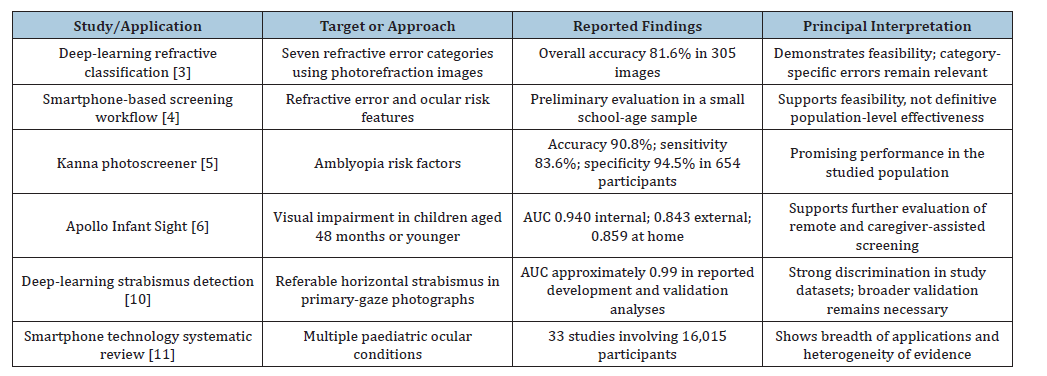
Abbreviations: AI: Artificial Intelligence; AUC: Area Under the Receiver Operating Characteristic Curve
The reported findings should be interpreted in the context of study design, sample selection, target-condition prevalence, and the reference standard used. High performance in a selected clinical dataset does not automatically translate into equivalent performance in a school-based screening programme. Comparative validation also demonstrates that AI-enabled devices may not consistently outperform established screening instruments. A study comparing the AI-Optic and PlusoptiX photoscreeners in 200 children with a high prevalence of amblyopia risk factors found that PlusoptiX performed better on several measures of risk-factor validation in that particular sample [12]. This is an important reminder that introducing AI does not guarantee improved diagnostic accuracy or clinical utility.
Before selecting a screening device, optometry services should examine independent validation data, age-specific results, indeterminate-test rates, false-negative results, referral burden, and the relevance of the reference standard to the intended population. Recent literature reinforces the distinction between promising model performance and readiness for routine deployment. The 2026 systematic review by Somerville and colleagues examines AI-enabled paediatric ophthalmic applications across primary, community, and referral-linked pathways [7]. The mobilephoto study by Shu and colleagues provides evidence that facial photographs can support AI-based detection of selected paediatric eye diseases, but its cross-sectional design and study-specific dataset mean that results should not be assumed to generalize to all school or community populations [8]. The 2026 review of AI in paediatric myopia further indicates that this is a developing application area requiring evaluation according to the specific task and intended use [9].
Potential Public Health Applications
School-based vision screening
Schools offer an efficient setting for reaching large numbers of children. AI-assisted screening may support standardised image capture, automated risk classification, electronic record generation, and referral prioritisation. A school screening workflow could involve registration, parental consent, age-appropriate visual assessment, AI-assisted screening where indicated, review of flagged results by trained personnel, and referral to an optometrist or ophthalmologist. Digital records could also help track referrals and document whether children receive prescribed spectacles. However, the introduction of an AI tool should not be considered the principal indicator of programme success. The relevant outcomes include screening coverage, confirmed detection of clinically significant conditions, completion of referral, spectacle delivery, treatment uptake, and subsequent visual outcomes.
Rural and underserved populations
Rural and underserved communities may face barriers related to distance, transport, affordability, and limited availability of eye care professionals. Portable smartphone-based systems could enable trained community health workers or school personnel to undertake preliminary screening under an established clinical protocol. Remote review may be useful when images or screening results can be transmitted securely to an optometrist or ophthalmologist. Nevertheless, connectivity, device maintenance, staff training, and referral access must be addressed. AI can potentially support task-sharing, but it does not eliminate the need for skilled clinical personnel. A screening programme should specify which tasks can be performed by non-specialist workers, which findings require professional review, and how urgent referrals will be handled.
Integration with tele-optometry
Tele-optometry can connect screening sites with optometrists and ophthalmologists who may be located elsewhere. AIassisted systems could support image quality assessment, risk prioritisation, digital reporting, and identification of children requiring more urgent evaluation. A practical system should allow clinicians to inspect the underlying images and screening results rather than relying solely on an automated classification. Inconclusive images should trigger repeat acquisition or referral instead of being automatically labelled normal. Integration with tele-optometry may be particularly useful for remote schools and community programmes, provided that secure communication, clinical accountability, and timely follow-up are maintained.
Integration with national and school eye health programmes
The World Health Organization’s guidance emphasises the organisation of screening and referral services, rather than screening as an isolated activity [1]. AI could be incorporated into existing school eye health programmes to support documentation, risk-based referral, and follow-up. For India, implementation should be aligned with local service capacity, established paediatric examination protocols, spectacle provision, and referral arrangements [2]. Local validation is essential because model performance may vary with age distribution, ocular disease prevalence, demographic characteristics, smartphone quality, and the clinical skills of screening personnel.
Limitations and Implementation Challenges
Limited external validation
Many AI systems are developed and evaluated using datasets collected at a small number of centres. Performance may decline when a model is applied to different populations, devices, lighting conditions, or screening workflows. External validation should involve independent sites, different operators, diverse age groups, and children with a representative range of ocular conditions. Temporal validation is also important to determine whether performance remains stable as devices, populations, and clinical practices change.
Bias and generalisability
AI models can reproduce biases present in their training data. Under-representation of certain demographic groups or ocular conditions may lead to poorer performance in those populations. Potential sources of bias include differences in skin pigmentation, iris characteristics, facial morphology, refractive error distribution, image quality, and the prevalence of specific disorders. Models developed in one country should not automatically be assumed to be suitable for Indian children. Researchers should report subgroup performance where feasible and investigate whether sensitivity, specificity, and indeterminate-test rates differ across age groups, sexes, demographic groups, and relevant clinical subgroups.
False-negative and false-positive results
False-negative results can delay the diagnosis of amblyopia risk factors, strabismus, or other ocular abnormalities. False-positive results can increase anxiety, travel costs, waiting times, and pressure on referral services. The consequences of these errors depend on the target condition and screening context. For potentially serious abnormalities, the referral threshold may need to prioritise sensitivity. However, a threshold that produces excessive referrals may undermine programme feasibility. Screening thresholds should therefore be selected and evaluated using clinically meaningful outcomes rather than overall accuracy alone.
Data privacy and consent
Photographs and videos of children’s faces and eyes constitute sensitive personal information. AI-enabled screening may involve data transmission, remote storage, or third-party processing. Programmes should obtain appropriate parental or guardian consent, explain how data will be used, minimise unnecessary data collection, restrict access, and establish clear retention and deletion policies. Identifiable images should not be retained or shared beyond what is necessary for the stated clinical purpose and applicable legal requirements. Data governance should also clarify who is responsible for security breaches, model updates, secondary use of data, and withdrawal of consent where applicable.
Cost-effectiveness and sustainability
The initial cost of a screening application may appear low, particularly when it uses a smartphone. However, total programme costs include devices, software licensing, staff training, connectivity, maintenance, technical support, confirmatory examinations, and treatment. Economic evaluations should compare AI-assisted screening with established alternatives and assess cost per child screened, cost per confirmed case detected, referral completion, and cost per child successfully treated. A less expensive device may not offer better value if it produces substantially more falsepositive or false-negative results.
Human oversight and accountability
AI-generated classifications may be difficult to interpret, particularly when the system provides only a risk score without indicating which features influenced the result. Clinicians should be able to review the evidence underlying a screening decision and recognise circumstances in which automated results may be unreliable. Responsibility for interpreting results, communicating risk, arranging referral, and managing children with concerning findings must remain clearly defined. An AI system should not be permitted to overrule clinical concern or prevent a child from receiving an indicated examination.
Regulatory and ethical considerations
AI-based screening tools intended for clinical use require appropriate evaluation of safety, performance, intended use, and applicable regulatory requirements. Software updates may alter performance and should be managed through documented quality assurance procedures. Recent commentary on AI in paediatric eye care likewise emphasizes that adoption should be guided by clinical need, evidence of benefit, and the practical implications for paediatric services [13]. The Track AI project protocol illustrates a complementary research approach: developing and evaluating an AI system to identify visual problems in children across a structured study pathway [14]. Ethical implementation also requires transparency about the limitations of screening, equitable access to follow-up services, and avoidance of exaggerated claims regarding diagnostic capability. Parents and school authorities should understand that a screening result indicates whether further assessment may be needed; it does not necessarily establish or exclude a diagnosis.
Recommendations for Clinical Practice and Future Research
Future research should move beyond algorithm development towards prospective evaluation in real-world screening programmes. The following priorities are particularly relevant to optometry and public health.
1. First, conduct independent multicentre validation. Studies
should recruit children from diverse clinical, school, rural, and
urban settings. Validation should include preschool children,
school-aged children, and children with developmental or
communication difficulties where relevant.
2. Second, use appropriate reference standards. Refractive
screening should be compared with suitable clinical refraction,
including cycloplegic refraction when indicated. Amblyopia
risk assessment should be evaluated against comprehensive
paediatric eye examination, and strabismus detection should
be compared with an appropriate clinical assessment of ocular
alignment.
3. Third, standardise reporting. Studies should report
sensitivity, specificity, predictive values, confidence intervals,
AUC where appropriate, calibration, indeterminate results,
image-quality failures, and subgroup performance. Reporting
should distinguish image-level from child-level outcomes to
avoid overstating performance.
4. Fourth, evaluate programme effectiveness. Research
should measure whether AI improves screening coverage,
detection of confirmed abnormalities, referral completion,
spectacle uptake, and treatment outcomes compared with
conventional methods. Diagnostic performance alone is
insufficient to establish public health benefit.
5. Fifth, examine cost-effectiveness. Economic studies should
consider both the cost of screening and the downstream costs
associated with false referrals, missed cases, and treatment
delays. This is particularly important for public-sector school
eye health programmes.
6. Sixth, develop locally validated systems. Indian studies
should include geographically and socioeconomically diverse
populations and should evaluate the performance of AI tools
across relevant age groups and clinical conditions.
7. Seventh, strengthen data governance. Research protocols
should establish appropriate consent procedures, secure
storage, access control, data minimisation, and transparent
policies for the secondary use of children’s images.
8. Eighth, maintain human-in-the-loop workflows.
Automated results should be reviewed within a defined clinical
pathway. Unusable images, inconclusive results, and concerning
symptoms should trigger repeat assessment or referral rather
than automatic reassurance.
Together, these priorities can help determine whether AIassisted screening improves meaningful clinical outcomes and whether its benefits justify the resources required for implementation.
Implications for Optometry
Optometrists have an important role in selecting, validating, implementing, and evaluating AI-assisted vision screening technologies. Their expertise is necessary to determine whether a screening tool is clinically appropriate, interpret abnormal results, perform confirmatory assessment, and coordinate referral and management. AI may reduce the time required for certain preliminary tasks and support the work of trained screeners. However, the broader responsibilities of optometric practiceincluding binocular vision assessment, refractive evaluation, clinical judgement, patient communication, and follow-up-cannot be reduced to an automated risk score. Optometrists should also contribute to training programmes for school personnel and community health workers. Training should cover correct image acquisition, recognition of technical failures, referral criteria, informed consent, and communication with parents.
At the programme level, optometrists can help establish quality assurance systems, audit referral outcomes, assess the reasons for missed cases, and evaluate whether AI improves access without compromising patient safety. Their involvement is essential to ensure that technological innovation strengthens rather than fragments paediatric eye care.
Conclusion
Artificial intelligence has the potential to improve paediatric vision screening by supporting automated image analysis, refractive risk assessment, amblyopia risk identification, strabismus detection, and digital assessment of visual function. Smartphonebased systems may be particularly useful in settings where access to specialist services is limited and conventional screening is difficult to deliver consistently. Nevertheless, promising results from individual validation studies should not be interpreted as evidence that AI can replace comprehensive paediatric eye examination. Differences in study populations, reference standards, testing environments, and model performance limit direct comparisons across technologies. In addition, false-negative results, data privacy, algorithmic bias, cost-effectiveness, and referral capacity remain important considerations.
The most appropriate current approach is to integrate validated AI tools into supervised screening pathways with clear referral criteria and reliable access to confirmatory assessment and treatment. Prospective multicentre research, locally relevant validation, transparent reporting, and economic evaluation are needed to establish their role in routine practice. When implemented responsibly, AI may become a useful adjunct to optometry-led school and community eye health programmes, supporting earlier identification of childhood visual disorders and more equitable access to care.
References
- World Health Organization (2024) Vision and eye screening implementation handbook. World Health Organization, Geneva, Switzerland.
- Saxena R, Sharma P, Gopal S (2020) Pediatric ophthalmology expert group. National consensus statement regarding pediatric eye examination, refraction, and amblyopia management. Indian J Ophthalmol 68(2): 325-332.
- Chun J, Kim Y, Shin KY, Han SH, Oh SY, et al. (2020) Deep learning-based prediction of refractive error using photorefraction images captured by a smartphone: model development and validation study. JMIR Med Inform 8(5): e16225.
- Shuoxin Ma, Yongqing Guan, Yazhen Yuan, Yuan Tai, Tan Wang (2020) A one-step, streamlined children's vision screening solution based on smartphone imaging for resource-limited areas: design and preliminary field evaluation. JMIR Mhealth Uhealth 8(7): e18226.
- Murali K, Viswesh Krishna, Krishna V, Kumari B, Raveendra Murthy S, et al. (2021) Effectiveness of Kanna photoscreener in detecting amblyopia risk factors. Indian J Ophthalmol 69(8): 2045-2049.
- Chen, Ruiyang Li, Qinji Yu, Andi Xu, Yile Feng, et al. (2023) Early detection of visual impairment in young children using a smartphone-based deep learning system. Nat Med 29(2): 493-503.
- Somerville J, Mustafa MH, Seweid MM, El Arab RA (2026) Clinical performance and implementation of AI-enabled paediatric ophthalmic screening, triage, diagnosis, and surveillance in primary, community, and referral-linked pathways: a systematic review. Diagnostics (Basel) 16(15): 2389.
- Shu Q, Pang J, Liu Z, Liang X, Chen M, et al. (2024) Artificial intelligence for early detection of pediatric eye diseases using mobile photos. JAMA Netw Open 7(8): e2425124.
- Pawar N, Berendschot TTJM, Bauer NJC, Meenakshi R, Maheshwari D, et al. (2026) Artificial intelligence in pediatric myopia-a narrative review. Graefes Arch Clin Exp Ophthalmol 264(8): 2257-2288.
- Zheng C, Yao Q, Lu J, Xiaolin Xie, Shibin Lin, et al. (2021) Detection of referable horizontal strabismus in children's primary gaze photographs using deep learning. Transl Vis Sci Technol 10(1): 33.
- Vijendran S, Alok Y, Kuzhuppilly NIR, Bhat JR, Yogish SK, et al. (2025) Effectiveness of smartphone technology for detection of paediatric ocular diseases-a systematic review. BMC Ophthalmol 25: 323.
- Arnold RW (2022) Comparative validation of PlusoptiX and AI-Optic photoscreeners in children with high amblyopia risk factor prevalence. Clin Ophthalmol 16: 2639-2650.
- Anitha V, Ravindran M (2025) Artificial intelligence in pediatric eye care: assessing the necessity and impact. Indian J Ophthalmol 73(8): 1219-1221.
- Pueyo V, Pérez-Roche T, Prieto E, Castillo O, Gonzalez I, et al. (2020) Development of a system based on artificial intelligence to identify visual problems in children: study protocol of the Track AI project. BMJ Open 10(2): e033139.
© 2026 Adesh Kumar. This is an open access article distributed under the terms of the Creative Commons Attribution License , which permits unrestricted use, distribution, and build upon your work non-commercially.
Editor In Chief







.jpg)































Signup for Newsletter

Quick Links
 Editorial Board Registrations
 Submit your Article
 Best Paper of the Volume
 Reprints
 Refer a Friend
 Advertise With Us
Our Recent Edition





Top Editors




.jpg)

















.bmp)
.jpg)
.png)
.jpg)













.jpg)






.png)

.png)




.png)




Financial Support

Sponsors

Latest e-Books

Latest Video

 a Creative Commons Attribution 4.0 International License. Based on a work at www.crimsonpublishers.com.
Best viewed in

 | Above IE 9.0 version