

- About Us
- Information
-

The Author ensures that the research has been conducted responsibly and ethically with adherence to all relevant regulations. read more..
- For Authors
- For Reviewer
- Manuscript Guidelines
- Membership
- Publication Ethics
-
- Journals
- Reprints
- e-Books
- Videos
- Policies
- Contact Us
 COVID-19
- Submissions



Full Text
Trends in Telemedicine & E-health
Tele-Neurorehabilitation for Neurological Disorders: A Systematic Review and Conceptual Framework Integrating Neuroplasticity and Digital Health
Jane Maslarova Gelov1, Ivan Gelov2, Desislava Drenska3 and Dimitar Maslarov3,4*
1Senior Social Media Executive, Barchester Healthcare Ltd, United Kingdom
2IT Security Expert, Technology and Banking Industry, United Kingdom
3Neurology Clinic, University First MHAT, St. Joan Krastitel, Bulgaria
4Yordanka Filaretova Medical College, Medical University, Bulgaria
*Corresponding author:Dimitar Maslarov, Neurology Clinic, University First MHAT, St. Joan Krastitel and Yordanka Filaretova Medical College, Medical University, Sofia, Bulgaria
Submission: April 21, 2026;Published: May 01, 2026

ISSN: 2689-2707 Volume 6 Issue 4
Abstract
Background: Tele-neurorehabilitation has emerged as a transformative model integrating
neuroplasticity-driven interventions with digital health technologies.
Objective: To systematically evaluate the clinical effectiveness of tele-neurorehabilitation and to propose
a conceptual framework linking neuroplasticity mechanisms with remote care delivery.
Methods: A PRISMA-compliant systematic review was conducted across PubMed/MEDLINE, Scopus and
Cochrane Library for studies published between January 2015 and January 2025. Randomized controlled
trials, controlled studies and systematic reviews evaluating tele-neurorehabilitation in neurological
disorders were included. Risk of bias was assessed using the Cochrane RoB 2 tool and ROBINS-I for nonrandomized
studies.
Result: Sixty-two studies met inclusion criteria. Tele-neurorehabilitation demonstrated non-inferiority
or superiority to conventional rehabilitation in motor outcomes (standardized mean difference 0.38-
0.61), adherence (+20-30%) and patient engagement. Technology-enhanced modalities, including
virtual reality, robotics and brain-computer interfaces, provided additive benefits by increasing training
intensity and feedback-driven learning.
Conclusion: Tele-neurorehabilitation represents a paradigm shift from episodic, institution-based care
toward continuous, personalized and home-centered rehabilitation. Future research should focus on
protocol standardization, cost-effectiveness and long-term outcomes.
Keywords:Tele-neurorehabilitation; Neuroplasticity; Digital health; Stroke; Virtual reality; Robotics; Brain computer interface; Home based rehabilitation
Introduction
Neurorehabilitation has undergone a profound transformation over the past decades, shifting from compensatory approaches toward interventions grounded in neuroplasticity. This transition has been driven by advances in neuroscience, digital health and artificial intelligence [1-6]. Neuroplasticity, defined as the brain’s capacity to reorganize structurally and functionally following injury, has become the central therapeutic principle underlying contemporary rehabilitation strategies [1-3,7-9]. Simultaneously, demographic trends, particularly population aging, have increased the global burden of neurological disability, including stroke, neurodegenerative disorders and traumatic brain injury [10-12]. These developments have exposed limitations of traditional hospital-based rehabilitation models, which are often resource-intensive, episodic and limited in accessibility. Telemedicine has emerged as a pivotal solution, enabling remote delivery of therapy, continuous monitoring and expansion of access beyond specialized centers [13-19]. The integration of neuroplasticity principles with telemedicine technologies has led to the emergence of tele-neurorehabilitation, a rapidly evolving field that redefines rehabilitation delivery. This systematic review aims to evaluate the clinical effectiveness of tele-neurorehabilitation and propose a conceptual framework integrating neuroplasticity mechanisms with digital health technologies.
Methods
This systematic review was conducted in accordance with the Preferred Reporting Items for Systematic Reviews and Meta- Analyses (PRISMA) 2020 guidelines. A comprehensive literature search and review was performed in PubMed/MEDLINE, Scopus and Cochrane Library databases for studies published between January 2015 and January 2025. The search strategy combined Medical Subject Headings (MeSH) and keywords related to tele-neurorehabilitation, neurological disorders and digital rehabilitation technologies.
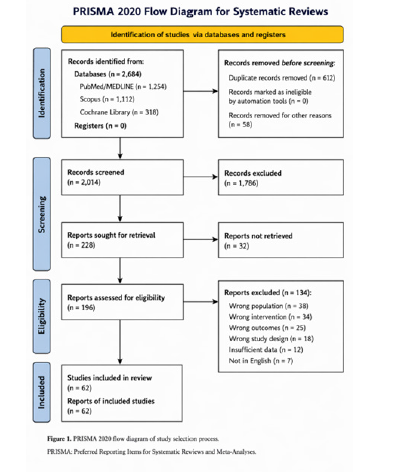
Study selection was performed independently by two reviewers. Risk of bias was assessed using the Cochrane RoB 2 tool for randomized trials and ROBINS-I for non-randomized studies. Two independent reviewers screened titles and abstracts. Full-text articles were assessed for eligibility. Discrepancies were resolved by consensus. Studies were included if they met the following criteria: randomized controlled trials, controlled clinical trials or systematic reviews; adult neurological populations; tele-neurorehabilitation interventions; reported clinical outcomes. Studies were excluded if they: Included pediatric populations; were case reports or narrative reviews; lacked clinical outcome measures. The study selection process is illustrated in Figure 1 below.
Figure 1:PRISMA 2020 flow diagram of study selection process. PRISMA: Preferred reporting items for systematic reviews and meta-analyses.
Result
A total of sixty-two studies met inclusion criteria. Teleneurorehabilitation interventions were evaluated across stroke, Parkinson’s disease, multiple sclerosis, dementia and traumatic brain injury populations. The characteristics of included studies are summarized in Table 1. Tele-neurorehabilitation demonstrated significant improvements in motor recovery among stroke populations. Fugl-Meyer Assessment gains ranged from 5 to 10 points, with effect sizes between 0.38 and 0.61. Home-based interventions demonstrated higher adherence compared with conventional rehabilitation [13,14,20]. Technology-enhanced interventions, including virtual reality and robotic-assisted rehabilitation [21-23], demonstrated additional improvements in upper limb function and gait recovery [24-28]. In Parkinson’s disease, wearable technologies enabled continuous monitoring of motor fluctuations and improved therapy optimization. These interventions were associated with improvements in mobility and functional outcomes [29-31]. In multiple sclerosis. telerehabilitation interventions demonstrated reductions in fatigue and improvements in mobility and quality of life measures [31- 34]. Brain-computer interface-based rehabilitation demonstrated improvements in motor recovery, particularly among patients with severe motor impairment [35-37].
Table 1: Characteristics of Included Studies evaluating tele-neurorehabilitation interventions.

Digital Technologies in Tele-Neurorehabilitation
The robotic rehabilitation provides high-intensity repetitive training, objective performance metrics and remote programmability. These systems demonstrated improvements in motor recovery and functional independence [24-28,38,39]. Virtual reality enables immersive and task-specific training environments, combining motor and cognitive rehabilitation. These interventions improved engagement and functional outcomes [25-28]. Braincomputer interfaces enable closed-loop neurofeedback-driven rehabilitation and improved motor recovery in severe neurological impairment [35-37,40-43]. Wearable sensors enable continuous monitoring of motor performance and remote therapy optimization [29,30] (Table 2).
Table 2:Overview of technologies used in tele-neurorehabilitation.

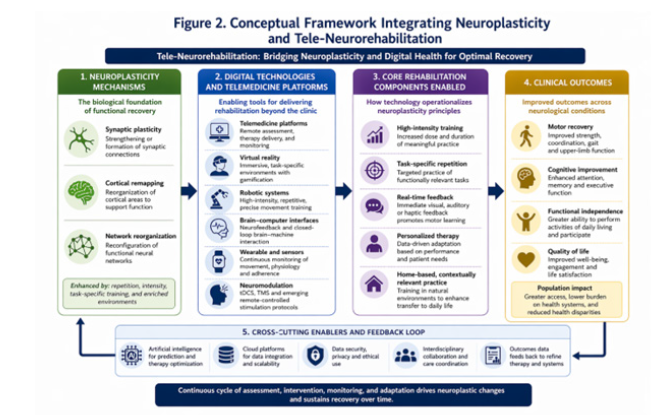
Figure 2:Conceptual framework integrating neuroplasticity and tele-neurorehabilitation.
Discussion
Tele-neurorehabilitation demonstrated consistent effectiveness across neurological disorders. The observed clinical benefits may be explained by mechanisms related to neuroplasticity, including synaptic reorganization, cortical remapping and network reconfiguration [1-3,7-9]. Tele-neurorehabilitation represents a conceptual shift in rehabilitation delivery. Traditional institutionbased rehabilitation is increasingly replaced by home-based, continuous and personalized interventions. This transition enables ecologically valid training within patients’ daily environments. Telemedicine technologies also bridge the translational gap between neuroscience research and clinical practice. Continuous monitoring, adaptive training and personalized interventions improve therapy effectiveness and adherence [4-6,18-22]. However, several limitations remain. These include heterogeneity of intervention protocols, variability in outcome measures and limited long-term follow-up data. In addition, disparities in access to technology remain an important challenge [20-22,44-49]. A conceptual framework integrating neuroplasticity and telemedicine is presented in Figure 2 below [50-80].
Conclusion
Tele-neurorehabilitation represents a paradigm shift in neurological care. By integrating neuroplasticity principles with digital health technologies, tele-neurorehabilitation enables continuous, personalized and scalable rehabilitation. Future research should focus on standardization of protocols, integration of artificial intelligence and long-term clinical validation. Teleneurorehabilitation is expected to become a central component of modern neurological care.
Funding
This material is published with the financial support of the Brain Health Council - Bulgaria
References
- Cramer SC, Sur M, Dobkin BH, Charles OB, Terence DS, et al. (2011) Harnessing neuroplasticity for clinical applications. Brain 134(6): 1591-1609.
- Nudo RJ (2013) Recovery after brain injury: Mechanisms and principles. Front Hum Neurosci 7: 887.
- Kleim JA, Jones TA (2008) Principles of experience-dependent plasticity: Implications for rehabilitation after brain damage. J Speech Lang Hear Res 51(1): S225-S239.
- Dorsey ER, Topol EJ (2016) State of telehealth. N Engl J Med 375(2): 154-161.
- Dorsey ER, Venkataraman V, Grana MJ, et al. (2018) Virtual neurology care. Lancet Neurol 17(1): 95-105.
- Topol EJ (2019) High-performance medicine: The convergence of human and artificial intelligence. Nat Med 25(1): 44-56.
- Murphy TH, Corbett D (2009) Plasticity during stroke recovery: From synapse to behaviour. Nat Rev Neurosci 10(12): 861-872.
- Krakauer JW 2006) Motor learning: Its relevance to stroke recovery and neurorehabilitation. Curr Opin Neurol 19(1): 84-90.
- Carmichael ST (2006) Cellular and molecular mechanisms of neural repair after stroke: Making waves. Ann Neurol 59(5): 735-742.
- Feigin VL, Norrving B, Mensah GA (2017) Global Burden of Stroke. Circ Res 120(3): 439-448.
- Gorelick PB (1995) Stroke prevention. Arch Neurol 52(4): 347-35.
- Kim AS Johnston SC (2015) Global variation in the relative burden of stroke and ischemic heart disease. Circulation 124(3): 314-323.
- Laver KE, Adey WZ, Crotty M, Lannin NA, George S, et al. (2020) Telerehabilitation services for stroke. Cochrane Database Syst Rev 1(1): CD010255.
- Sarfo FS, Ulasavets U, Opare SOK, Ovbiagele B (2018) Tele-rehabilitation after stroke: An updated systematic review of the literature. J Stroke Cerebrovasc Dis 27(9): 2306-2318.
- Chen J, Jin W, Zhang XX, Xu W, Liu XN, et al. (2015) Telerehabilitation approaches for stroke patients: Systematic review and meta-analysis of randomized controlled trials. J Stroke Cerebrovasc Dis 24(12): 2660-2668.
- Cottrell MA, Galea OA, Leary SPO, Hill AJ, Russell TG (2017) Real-time telerehabilitation for musculoskeletal conditions is effective and comparable to standard practice: A systematic review and meta-analysis. Clin Rehabil 31(5): 625-638.
- Prvu BJ, Resnik LJ (2020) Telerehabilitation in the age of COVID-19: An opportunity for learning health system research. Phys Ther 100(11): 1913-1916.
- Jack CL (2021) Telehealth outcomes. Stroke 52(4): e111-e118.
- Laver KE (2020) Telehealth review. J Telemed Telecare 26(7-8): 395-403.
- Clemens SK, Priyanka K, Kelli S, Lokesh V, Karuna R, et al. (2018) Evaluating barriers to adopting telemedicine worldwide: A systematic review. Telemedicine barriers 24(1): 4-12.
- Joshua TLA, Lindsay MB, Kristen LS, Laura FB, Gary BW (2022) Telehealth adoption during the COVID-19 pandemic: A social media textual and network analysis. Digital Health 8: 20552076221090041.
- Wade VA (2014) Telehealth effectiveness. J Telemed Telecare 20(8): 444-452.
- Winstein CJ, Stein J, Arena R, Bates B, Cherney LR, et al. (2016) Guidelines for adult stroke rehabilitation and recovery: A guideline for healthcare professionals from the American heart association/American stroke association. Stroke 47(6): e98-e169.
- Mehrholz J, Thomas S, Kugler J, Pohl M, Elsner B, et al. (2017) Electromechanical-assisted training for walking after stroke. Cochrane Database Syst Rev 5(5): CD006185.
- Laver KE, Lange B, George S, Judith ED, Maria C, et al. (2017) Virtual reality for stroke rehabilitation. Cochrane Database Syst Rev 11(11): CD008349.
- Maier M, Rubio BB, Duff A, Duarte OE, Verschure P (2019) Effect of specific over nonspecific VR-based rehabilitation on poststroke motor recovery: A systematic meta-analysis. Neurorehabilitation and Neural Repair 33(2): 112-129.
- Veerbeek JM, Anneli CLA, Erwin EHW, Carel GMM, Gert K (2017) Effects of robot-assisted therapy for the upper limb after stroke. Neurorehabil Neural Repair 31(2): 107-121.
- Langhorne P, Bernhardt J, Kwakkel G (2011) Stroke rehabilitation. Lancet 377(9778): 1693-1702.
- Dorsey ER, Bloem BR (2024) Parkinson's Disease Is Predominantly an Environmental Disease. J Parkinsons Dis 14(3): 451-465.
- Bastiaan RB, Michael SO, Christine K (2021) Parkinson care. Lancet 397(10291): 2284-2303.
- Robert WM, Brian MS, Gert K, Ulrik D, Anthony F, et al. (2017) Exercise in patients with multiple sclerosis. Lancet Neurol 16(10): 848-856.
- Amy ELC, Kathleen AMG, Audrey LH, Robert WM, Lara AP, et al. (2013) Development of evidence-informed physical activity guidelines for adults with multiple sclerosis. Arch Phys Med Rehabil 94(9): 1829-1836.
- Christoph H, Köpke S, Richter T, Kasper J (2013) Shared decision making and self-management in multiple sclerosis--a consequence of evidence. Mult Scler 254(2): 116-121.
- Learmonth YC, Paul L, Miller L, Mattison P (2012) The effects of a 12-week leisure centre-based, group exercise intervention for people moderately affected with multiple sclerosis: A randomized controlled pilot study. Clin Rehabil 26(7): 579-593.
- Ang KK, Guan C (2015) Brain-computer interface for neurorehabilitation of upper limb after stroke. Proceedings of the IEEE 103(6): 944-953.
- Biasiucci A, Leeb R, Iturrate I, Perdikis S, Al KA, et al. (2018) Brain-actuated functional electrical stimulation elicits lasting arm motor recovery after stroke. Nat Commun 20:9(1): 2421.
- Ramos MA, Broetz D, Rea M, Läer L, Yilmaz O, et al. (2013) Brain-machine interface in chronic stroke rehabilitation: A controlled study. Ann Neurol 74(1): 100-108.
- Pichiorri F, Morone G, Petti M, Toppi J, Pisotta I, et al. (2015) Brain-computer interface boosts motor imagery practice during stroke recovery. Ann Neurol 77(5): 851-865.
- Kwakkel G, Kollen BJ, Krebs HI (2004) Robot-assisted therapy. Stroke 35(11): 2529-2539.
- Hidler J, Nichols D, Pelliccio M (2009) Robotic gait training. Neurorehabil Neural Repair 23(1): 5-13.
- Daly JJ, Wolpaw JR (2008) Brain-computer interfaces in neurological rehabilitation. Lancet Neurol 7(11): 1032-1043.
- Soekadar SR, Birbaumer N, Slutzky MW, Cohen LG (2015) Brain-machine interfaces in neurorehabilitation of stroke. Neurobiol Dis 83: 172-179.
- Paul T, Varshney A, Singh AP (2022) Effectiveness of neurofeedback therapy adjunct to cognitive behavioral therapy in agoraphobia: A case study. Ann Neurosci 29(4): 249-254.
- Shih JJ, Krusienski DJ, Wolpaw JR (2012) Brain-computer interfaces in medicine. Mayo Clin Proc 87(3): 268-279.
- Rashid LB, Joel DH, Elizabeth AK, Kathryn MH, Noura B, et al. (2016) The empirical foundations of telemedicine interventions in primary care. Telemed J E Health 22(5): 342-375.
- Totten AM, Womack DM, Karen KB, McDonagh MS, Griffin JC, et al. (2016) Telehealth: Mapping the evidence for patient outcomes from systematic reviews. Ann Intern Med 165(12): 876-886.
- Fatehi F (2020) Telehealth adoption. JMIR 22: e17439.
- Kruse CS, Karem P, Shifflett K, Vegi L, Ravi K, et al. (2018) Evaluating barriers to adopting telemedicine worldwide: A systematic review. J Telemed Telecare 24(1): 4-12.
- Ronald SW, Ana ML, Bellal AJ, Kristine AE, Michael H, et al. (2014) Telemedicine, telehealth, and mobile health applications that work: Opportunities and barriers. Am J Med 127(3): 183-187.
- Tenforde AS, Hefner JE, Kodish WJE, Iaccarino MA, Paganoni S (2017) Telehealth in physical medicine and rehabilitation. PM R 9(5S): S51-S58.
- Kairy D, Lehoux P, Vincent C, Visintin M (2009) A systematic review of clinical outcomes, clinical process, healthcare utilization and costs associated with telerehabilitation. Disabil Rehabil 31(6): 427-447.
- Tousignant M, Boissy P, Moffet H, Hélène C, Francois C (2011) In-home telerehabilitation for post knee arthroplasty: A pilot study. Int J Telerehabil 1(1): 9-16.
- Lloréns R, Noé E, Colomer C, Alcañiz M (2015) Effectiveness, usability, and cost-benefit of a virtual reality-based telerehabilitation program for balance recovery after stroke: A randomized controlled trial. Arch Phys Med Rehabil 96(3): 418-425.
- Brennan DM, Mawson S, Brownsell S (2009) Telerehabilitation: Enabling the remote delivery of healthcare, rehabilitation, and self-management. Stud Health Technol Inform 145: 231-248.
- Johansson BB (2000) Brain plasticity and stroke rehabilitation. Stroke 31(1): 223-230.
- Wieloch T, Nikolich K (2006) Mechanisms of neural plasticity following brain injury. Curr Opin Neurobiol 16(3): 258-264.
- Espay AJ, Hausdorff JM, Sánchez FÁ, et al. (2019) Digital biomarkers in neurology. Mov Disord 34(9): 1412-1421.
- Sim I (2019) Mobile devices and health. NPJ Digit Med 381(10): 956-968.
- Rajpurkar P, Chen E, Banerjee O, Topol EJ (2022) AI in medicine. Nat Med 28(1): 31-38.
- Ziad O, Powers B, Vogeli C, Sendhil M (2019) Dissecting racial bias in an algorithm used to manage the health of populations. Science 366(6464): 447-453.
- Beam AL, Kohane IS (2018) AI in healthcare. JAMA 319(13): 1317-1318.
- Esteva A, Kuprel B, Novoa RA, Justin Ko, Susan MS, et al. (2017) Dermatologist-level classification of skin cancer with deep neural networks. Nature 542: 115-118.
- Gulshan V, Peng L, Coram M (2016) Deep learning in ophthalmology. JAMA 316(22): 2402-2410.
- Louie DR, Eng JJ (2016) Powered robotic exoskeletons in post-stroke rehabilitation of gait: A scoping review. J Neuroeng Rehabil 13(1): 53.
- Levin MF, Weiss PL, Keshner EA (2016) VR rehabilitation. Nat Rev Neurol 11(6): 307-318.
- Fluet GG, Qiu Q (2015) VR in stroke. J Neuroeng Rehabil 12: 76.
- Subramanian SK, Levin MF (2013) VR therapy. Stroke 44(3): e34-e35.
- Saposnik G, Teasell R, Mamdani M, Hall J, McIlroy W, et al. (2010) Effectiveness of virtual reality using wii gaming technology in stroke rehabilitation: A pilot randomized clinical trial and proof of principle. Stroke 41(7): 1477-1484.
- Bernhardt J, Hayward KS, Kwakkel G, Ward NS, Wolf SL, et al. (2017) Agreed definitions and a shared vision for new standards in stroke recovery research: The Stroke Recovery and Rehabilitation Roundtable taskforce. Int J Stroke 12(5): 444-450.
- Dobkin BH (2005) Clinical practice. Rehabilitation after stroke. N Engl J Med 352(16): 1677-1684.
- Langhorne P, Baylan S (2017) Early supported discharge services for people with acute stroke. Cochrane Database Syst Rev 7(7): CD000443.
- Pollock A, Farmer SE, Brady MC, Langhorne P, Gillian E Mead GE, et al. (2014) Interventions for improving upper limb function after stroke. Cochrane Database Syst Rev 2014(11): CD010820.
- Johnston SC, Mendis S, Mathers CD (2009) Global variation in stroke burden and mortality: Estimates from monitoring, surveillance, and modelling. Lancet Neurol 8(4): 345-354.
- Saver JL (2006) Time is brain quantified. Stroke 37(1): 263-266.
- Gunduz ME, Bucak B, Keser Z (2023) Advances in stroke neurorehabilitation. Nat Rev Neurol. 2017;13(4):241-252.
- Krakauer JW (2012) Stroke recovery. Neuron 75(6): 923-934.
- Terry E, Cees JG, Robert GF, Erik CW, Gert K, et al. (2005) Efficacy of a physical therapy program in patients with Parkinson's disease: a randomized controlled trial. Arch Phys Med Rehabil 86(4): 626-632.
- Victoria AG, Suzanne HR, Rod ST, Adrian HT, et al. (2008) The effectiveness of exercise interventions for people with Parkinson's disease: A systematic review and meta-analysis. Mov Disord 23(5): 631-640.
- Claire LT, Clare PH, Carl EC, Charmaine M, Smitaa P, et al. (2014) Physiotherapy for Parkinson's disease: A comparison of techniques. Cochrane Database Syst Rev 2014(6): CD002815.
- Nieuwboer A, Kwakkel G, Rochester L, Jones D, Van WE, et al. (2007) Cueing training in the home improves gait-related mobility in Parkinson's disease: The Rescue trial. J Neurol Neurosurg Psychiatry 78(2): 134-140.
© 2026 Dimitar Maslarov. This is an open access article distributed under the terms of the Creative Commons Attribution License , which permits unrestricted use, distribution, and build upon your work non-commercially.
Editor In Chief







.jpg)































Signup for Newsletter

Quick Links
 Editorial Board Registrations
 Submit your Article
 Best Paper of the Volume
 Reprints
 Refer a Friend
 Advertise With Us
Our Recent Edition

.jpg)



Top Editors




.jpg)

















.bmp)
.jpg)
.png)
.jpg)













.jpg)






.png)

.png)




.png)




Financial Support

Sponsors

Latest e-Books

Latest Video

 a Creative Commons Attribution 4.0 International License. Based on a work at www.crimsonpublishers.com.
Best viewed in
a Creative Commons Attribution 4.0 International License. Based on a work at www.crimsonpublishers.com.
Best viewed in 
 | Above IE 9.0 version