

- About Us
- Information
-

The Author ensures that the research has been conducted responsibly and ethically with adherence to all relevant regulations. read more..
- For Authors
- For Reviewer
- Manuscript Guidelines
- Membership
- Publication Ethics
-
- Journals
- Reprints
- e-Books
- Videos
- Policies
- Contact Us
 COVID-19
- Submissions



Full Text
Trends in Telemedicine & E-health
Simulation in General Surgery and Surgical Specialties Initial Experience
Nicolás Tarigo1*, Mariana Zeoli2, Nicolás Geribaldi3, Andrés Salom4 and Roberto Valiñas5
1Adjunct Professor Surgical Academic Unit F. Hospital of Clinics, Uruguay
2Former Assistant Surgical Academic Unit F. Hospital of Clinics, Uruguay
3Assistant Surgical Academic Unit F. Hospital of Clinics, Uruguay
4Associate Professor Surgical Academic Unit F. Hospital of Clinics, Uruguay
5Professor Chief Director Surgical Academic Unit F. Hospital of Clinics, Uruguay
*Corresponding author:Nicolás Tarigo, Adjunct Professor Surgical Academic Unit F. Hospital of Clinics, Montevideo, Uruguay
Submission: March 16, 2026;Published: April 16, 2026

ISSN: 2689-2707 Volume 6 Issue 4
Summary
Simulation: Based training through different tools has been shown to reduce the learning curve of
surgical techniques. Simulation consists of implementing something that resembles reality in the
best possible way, with different models for this. This has the advantage of generating a safe learning
environment where mistakes can be made without resulting in harm to the patient
Objectives: To demonstrate the development and acquisition of basic skills and abilities in laparoscopic
surgery using simulation teaching methodology.
Material and methods: The methodology used is through evaluation sessions by standardized exercise
modules, in which an evaluation is carried out once they have been completed. At the end of the course,
we carry out a survey to each of the participants to evaluate its usefulness.
Results: The results are assessed in the short term by incorporating skills and abilities in the resolution
of all the exercises and in the long term by whether the incorporation of these skills and abilities is useful
in the care of patients.
Conclusion: Learning through simulation allows participants to acquire basic motor skills in a short
period of time, where they can practice multiple times in a safe, less stressful environment, allowing to
shorten learning curves in a safe and controlled environment.
Keywords:Simulation; Educational tools; Laparoscopic surgery; Cost; Sense
Introduction
Simulation-based training through different tools such as virtual reality, bench models or box trainers, laboratories with cadaveric material has been shown to reduce the learning curve and costs in the development of laparoscopic surgery. Simulation has emerged as one of the most important educational tools for surgical training, shortening learning curves through deliberate practice, where residents and surgeons in training can learn from their mistakes without compromising patient safety. In this sense, feedback with expert surgeons is a crucial factor in improving the acquisition of motor skills, although tutors are not always available due to the high opportunity cost and demanding daily schedules, which can lead in some places to limited training in terms of quality and duration, with few hours of training and condensed lessons [1]. There is a general understanding that simulation-based training improves knowledge and reduces the risk of adverse surgical events associated with laparoscopic surgery [2].
The traditional methodology of learning surgical techniques based on the traditional method designed in the nineteenth century by William Halsted in which responsibilities were progressively taken, guided by a tutor of greater experience and training the techniques directly on the patient, is becoming obsolete due to the presence of multiple pressures such as the limited time of training, the large number of skills to be acquired and the need to guarantee patient safety and cost containment in health managers [3]. The need for this change in the teaching paradigm amply justifies the transfer of at least part of the surgeon’s training outside the surgical block, specifically in a simulation laboratory [4]. This has the advantage of generating a safe, structured environment, where mistakes can be made without resulting in harm to the patient and controlled, since they will not be exposed to unforeseen events or critical situations, allowing all attention to be focused on the acquisition of skills, also reducing the time in which the learning curve is achieved for certain procedures [4]. Simulation consists of presenting something that resembles reality in the best possible way, there are various simulation models as we mentioned in the first paragraph, we will refer to the box trainers that are the most used and the ones we have in our institution [4].
Objective
Demonstrate the development and acquisition of basic skills and abilities in laparoscopic surgery using a validated and standardized methodology such as teaching through simulation, aimed at residents of general surgery, surgical specialties and surgeons in training.
Material and Methods
The methodology implemented is through evaluation sessions by standardized exercise modules, in which a first stage of pretraining is carried out, then individual training and a post-training evaluation at the end of each exercise module. We started in 2018, with an interruption in the years 2020, 2021, 2022 due to the pandemic, with groups of up to 6 students, being a total of 12 students who take the course annually. This number may vary depending on the number of residents per year and the surgeons in training who want to take the course.
Each session of the course lasts 90 minutes and is implemented in 4 sessions for the basic course.
Figure 1:Box trainer. Optician.
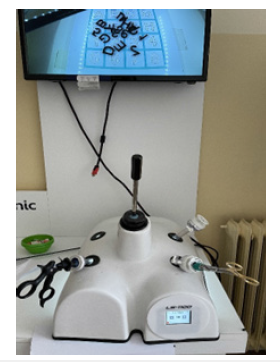
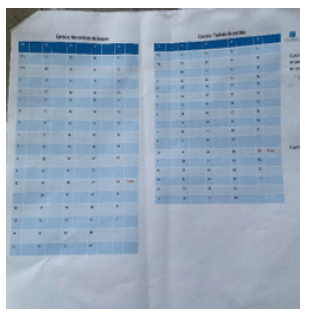
The materials used are training simulators or box trainers, 0- and 30-degree optics, laparoscopic surgical instruments such as Maryland forceps, Grasper, scissors and the necessary supplies for each module (Figure 1 & 2). Each participant performs 3 pretraining tests and then practices autonomously until they achieve 2 consecutive tests in stipulated fitness time (Figure 3). The fitness time is variable for each exercise and is based on an average time performed by experts. The maximum number of repetitions for each module is 80 and 2 repetitions must be performed in order to pass the same in a time of 3 consecutive. At the end of the course, a survey is carried out on the participants to evaluate its usefulness and after 6 months, where we evaluate its usefulness in professional practice.
Figure 2:Laparoscopic forceps.
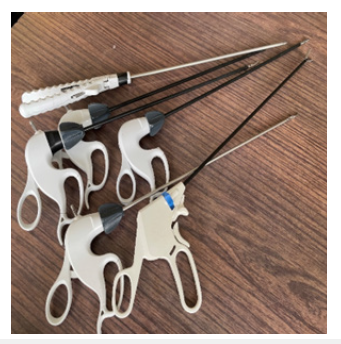
Figure 3:Exercise sheet.
Result
The results are valued in the short term, valuing the incorporation of skills and abilities in the resolution of the different exercises, which all achieve. In the long term, it is important to assess for each participant whether the acquisition of training skills has been useful in the patient’s care. As for the surveys at the end of the course, there is a uniform approval of it, based on questions of whether it was useful to them, if it will help them in their training and if they would like to have more courses. In the long term, there is also uniformity in that it is extremely useful for patient care.
Discussion
Simulation emerges as a complementary element to traditional teaching for the acquisition of surgical skills, allowing learning curves to be shortened in a safe and controlled environment. Training through simulation offers the opportunity to learn in a safe, structured and efficient environment without compromising patient integrity, and allows equal access to all learners [5]. The traditional teaching of surgery based on the model of tutelage and practice on living patients due to the pressure on current health systems, ethical imperatives and the circumstances of daily clinical practice make it necessary to look for other complementary alternatives [6]. In fact, simulation-based medicine is being introduced into the training curriculum of different areas of surgical specialties, having good results in terms of performance [6].
The use of simulation in the academic training of medicine is not a recent idea, already in the sixteenth century mannequins or ghosts were used for obstetrics practices and in the nineteenth century surgeons began to practice with human and animal cadavers, however with the passage of time certain limitations in these models became evident such as imperfect anatomy, scarcity of material and ethical problems, therefore the need arises to promote the creation of artificial simulators [6]. Among the aspects to be evaluated in the development of simulation training programs are surgical techniques, correct handling of the camera, hand-eye coordination and bimanual coordination [7]. Various studies show that there are superior surgical performance and greater acquisition of laparoscopic surgical skills in those who use simulators over those who perform traditional learning in the operating room [7]. Training in simulated environments for the development of technical skills in laparoscopy has proven its effectiveness in recent years, with a growing number of publications indicating a decrease in the time on the learning curve and some outcomes in patient safety such as a decrease in the number of complications and shorter hospital stays. The advantage of the presence of laparoscopic simulation programs in terms of operative and educational outcomes is evident, as well as the ethical benefit in the training of the surgeon, who must guarantee the safety of the patient when he develops his learning curve, also allowing learning in which the quantity and complexity of the procedures progressively increase [7,8]. The advent of laparoscopic surgery has allowed and promoted the development in the training of laparoscopic skills, added to technological advances in the area of simulation, strengthens psychomotor development, as well as objective learning of the surgical technique [8].
On the other hand, simulation not only allows the training of specialists in training, but also allows the preoperative planning of patients with complex pathologies for trained surgeons [9]. Considering the countless possibilities that simulation provides, the last decade has seen the development of new and more complex simulators, generated by computers and virtual reality [9]. It is also essential to have a structured training plan based on learning outcomes, assessment instruments with teachers trained in their use and to create strategies that allow feedback in relation to the performance of students in real scenarios [10].
Patient safety is a fundamental principle in health care, which is especially important in the current context of health systems due to the high-risk health events that have occurred in recent years, resulting in issues to be addressed during undergraduate teaching and with greater emphasis during postgraduate since it implies the reduction to an acceptable minimum of the risks of unnecessary harm related to the health care [11]. In this environment, simulation becomes a didactic strategy that encourages students to approach situations similar to those they must face in reality and develop autonomous, meaningful, cooperative, reflective learning with critical thinking [11]. The performance of laparoscopic surgical procedures requires special skills that allow overcoming certain difficulties specific to this technique such as 2-dimensional vision, reduced range of motion of the instruments, loss of tactile sensation and the disparity between visual perception and proprioceptive feedback or fulcrum effect [12]. Mastering laparoscopic surgery requires supervised training and teaching [12].
Table 1:
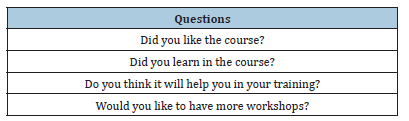
It is worth highlighting the role that simulation teaching has played during the pandemic, along with online activities, forums and videos, where many surgical training programs for residents were affected, especially by the absenteeism of health personnel and the decrease in the number of scheduled and emergency surgeries [13]. Simulation models have also gained popularity in teaching medical students, particularly in basic procedures [14]. These workshops allow students to acquire basic motor skills in a short period of time, where they can practice multiple times in a safe, less stressful environment, and usually with immediate feedback from a teacher [14]. The introduction of minimally invasive surgery came to question the educational model since a set of new technical skills different from those already used in open cavity surgery suddenly began to be required [15]. The long exposure to open surgery is not enough to ensure the ability to perform minimally invasive surgery and therefore there is no alternative but to resort to structured educational methods that are different from the existing ones [15]. The educational demand in this new context was seen in the need to migrate from what has always been done to what works best to train professionals [15] (Table 1).
Conclusions
This study demonstrates how simulation-based learning allows for the acquisition of basic motor skills in a short period of time, enabling multiple practice sessions in a safe, less stressful environment, thus shortening learning curves in a secure and controlled setting. It strengthens psychomotor development, facilitates objective learning of surgical techniques, and also enables preoperative planning for patients with complex pathologies by trained surgeons.
References
- Quezada J, Achurra P, Asbun D, Polom K, Roviello F, et al. (2019) Smartphone application supplements laparoscopic training through simulation by reducing the need for feedback from expert tutors. Surg Open Sci 1(2): 100-104.
- Vanderbilt AA, Grover AC, Pastis NJ, Feldman M, Granados DD, et al. (2014) Randomized controlled trials: A systematic review of laparoscopic surgery and simulation-based training. Glob J Health Sci 7(2): 310-327.
- Ruiz GJL, Martín PJI, González NM, Redondo FCG, Manuel PJC (2018) Simulation as a surgical teaching model. Spanish Surgery 96(1): 12-17.
- Chinelli J, Rodríguez G (2018) Simulation in laparoscopy during the training of the general surgeon. Initial review and experience. Medical Journal of Uruguay 34(4): 234-241.
- León FF, Varas CJ, Buckel SE, Crovari EF, Pimentel MF, et al. (2015) Simulation in laparoscopic surgery. Spanish Surgery 93(1): 4-11.
- Juvin BCE, Torrejón DJM, Tena SG, Laviana MF, Rojas BC, et al. (2017) Simulation in cardiac surgery: The future of teaching in our specialty? Cardiovascular Surgery 24(4): 236-246.
- Pérez MA, Garzón MM, Pineda GAI, Miranda CÁD, Villamizar GL (2019) Acquired skills with laparoscopic simulators in gynaecological laparoscopic surgery training programs: A review of reviews. Educación Medica 20(5): 309-324.
- Gómez RJ, Toribio VC, Ballesteros RC, Taratkin M, Marenco JL, et al. (2021) Artificial intelligence and simulation in urology. Actas Urológicas Españolas 45(8): 524-529.
- Berner JE, Ewertz E (2018) Theoretical bases of the use of simulation for training in surgery. Chilean Journal of Surgery 70(4): 382-388.
- Rodríguez FZ (2022) Historical trends in the training of general surgeons worldwide. Educ Med Super 36(3): 1-16.
- Vidal LMJ, Roque GR, Alberto J, Bravo M (2022) Educational strategies. Patient Safety and Simulation 36(4): 1-14.
- Kerrigan N (2017) Simulation, a necessity in training for laparoscopic colorectal surgery? Chilean Journal of Surgery 69(6): 508-512.
- Uribe M, Martínez SGA, Sepúlveda R, Lanzarini E, García C, et al. (2021) Effects of the pandemic on surgery training programs. Problems and solutions. Rev Cir (Mex) 73(1): 107-113.
- González LR, Alarcón OF, Molina ZH, García HDM, Stevens MP, et al. (2020) Retention of procedural competencies in medical students after training using a simulation model. Rev Med Chil 148(10): 1427-1434.
- Marinkovic B (2020) Innovative teaching in surgery. Rev Cir (Mex) 72(4): 369-374.
© 2026 Nicolás Tarigo. This is an open access article distributed under the terms of the Creative Commons Attribution License , which permits unrestricted use, distribution, and build upon your work non-commercially.
Editor In Chief







.jpg)






























Signup for Newsletter

Quick Links
 Editorial Board Registrations
 Submit your Article
 Best Paper of the Volume
 Reprints
 Refer a Friend
 Advertise With Us
Our Recent Edition

.jpg)



Top Editors




.jpg)

















.bmp)
.jpg)
.png)
.jpg)













.jpg)






.png)

.png)




.png)




Financial Support

Sponsors

Latest e-Books

Latest Video

 a Creative Commons Attribution 4.0 International License. Based on a work at www.crimsonpublishers.com.
Best viewed in
a Creative Commons Attribution 4.0 International License. Based on a work at www.crimsonpublishers.com.
Best viewed in 
 | Above IE 9.0 version