

- About Us
- Information
-

The Author ensures that the research has been conducted responsibly and ethically with adherence to all relevant regulations. read more..
- For Authors
- For Reviewer
- Manuscript Guidelines
- Membership
- Publication Ethics
-
- Journals
- Reprints
- e-Books
- Videos
- Policies
- Contact Us
 COVID-19
- Submissions



Full Text
Trends in Telemedicine & E-health
Social Behavior Impairment in Triple- Transgenic Model of Alzheimer’s Disease
Yadan Zheng1, Yijie Du2* and Suzhen Dong1*
1Shanghai Engineering Research Center of Molecular Therapeutics and New Drug Development, School of Chemistry and Molecular Engineering, East China Normal University, China
2Qingpu Traditional Chinese Medicine Hospital, China
*Corresponding author:Yijie Du, Qingpu Traditional Chinese Medicine Hospital, Shanghai, 201799, China and Suzhen Dong, Shanghai Engineering Research Center of Molecular Therapeutics and New Drug Development, School of Chemistry and Molecular Engineering, East China Normal University, Shanghai, 200062, China
Submission: January 20, 2026;Published: March 11, 2026

ISSN: 2689-2707 Volume 6 Issue 4
Abstract
Progressive memory loss, behavioral and psychological symptoms of dementia and abolishment of daily life activities are symptoms of Alzheimer’s disease. But few studies have addressed the issues of social behavior. A series of behavior tests (include barber test, tube test, urine-making test, home cage behavioral recording and nesting tests) were used to assess the social behavior ability of the 3×Tg-AD mice. 3×Tg-AD mice couldn’t build up well-organized dominance hierarchy sequence and were impaired in nest building behavior. The impairment in social behavior in 3×Tg-AD mice provide another behavioral tool to assess the benefits of therapeutic strategies in this animal model.
Keywords:3×Tg-AD mice; Social behavior; Dominance hierarchy; Nesting behavior
Introduction
Alzheimer’s Disease (AD) is an age-related neurodegenerative disease that represents the most common cause of dementia among people age 65 or older. It is characterized by two classical lesions: diffuse and neurotic plaques composed of extracellular deposits of the Aβ peptide and neurofibrillary tangles made of filamentous aggregates of hyperphosphorylated tau protein [1-3]. Aβ is derived from its Aβ Precursor Protein (APP) by sequential proteolytic cleavages by β-site APP-Cleaving Enzyme1(BACE1) and γ-secretase complex [1]. BACE1 cleaves APP to form Aβ N-terminus and generate a C-terminal fragment, C99, as the substrate for γ-secretase [2]. γ-Secretase is an intramembranous complex, of which PS1 constitute the active site [4]. Thus APP, BACE1, PS1/PS2 and Tau play an essential role in the progress of the disease. In fact, it is thought that the gene mutation of APP, PS1 or PS2 is the cause of some Familial AD (FAD). It has been found that the gene mutation of tau in connection with AD or Frontotemporal Dementias (FTD).
Experimental animal models have already been proven as a valuable tool for understanding pathogenesis and developing related drugs. In order to study the pathogenesis of AD, many different transgenic mice have been generated to elucidate the pathophysiology of AD, including FAD-linked mutant APP or PS1 transgenic mice, co-expressing mutant PS1 and APP transgenic mice, mutant Tau transgenic mice and PS1/PS2 conditional double knock-out mice, etc. [5-7]. But these transgenic mice models can simply represent some neurodegenerative disease symptoms with amyloid plaque deposition or Tau pathological symptoms. They cannot completely simulate the pathological symptoms of AD patients. In 2003, a tripletransgenic mouse model (3×Tg-AD) was established by Oddo and his colleagues. The tripletransgenic model harbors PS1 M146V, APPS we and Tau P301L transgene. With increasing age, the 3×Tg-AD mice develop a progressive and age-dependent Aβ deposits, neurofibrillary formation and cognitive disorder that is similar with AD patients [8]. It is widely considered that the 3×Tg-AD mouse is the closest model that mimic the developmental changes in human AD brains [9]. In recent years, researchers have obtained a number of important results using the 3×Tg-AD transgenic mice and have gotten several breakthroughs in revealing the pathogenesis of AD [10,11].
In addition to memory loss, the symptoms of AD patients include behavioral and psychological symptoms of dementia and abolishment of daily life activities [12]. Therefore, it is important to get the information of AD animal models in preclinical behavioral screening. But till now, few researches have been performed to study such social behaviors. By chance, we observed that there was difference in the whiskers of 3×Tg-AD and wild-type mice. Almost all 3×Tg-AD mice have full sets of whiskers. But only one of the 129/C57BL6 mice has full sets of whiskers. The others lost part of whiskers. Even some lost full sets of whiskers. Previous studies have showed that whisker trimming is an indicator of social hierarchy [13]. Therefore, loss of whisker trimming in 3×Tg- AD mice may indicate the changes of dominance hierarchy. So, the rank hierarchy of 3×Tg-AD mice and their wild-type counterparts were detected by barber test, tube test and urine marking assay [14]. Impairment in executive functions and daily life activities are early signs of Alzheimer’s disease. This issue in 3×Tg-AD mice has not been studied in details. Nesting behavior is a natural daily life activity. Here, the nest building ability of 3×Tg-AD was also analysed. Meanwhile, some home cage behaviors, like self-grooming, social grooming, mounting, tail pulling and sniffing were also detected.
Material and Methods
Animals
3×Tg-AD mice on 129/C57BL6 background were purchased from Jackson lab and were breed in our lab. The age-matched male mice with the same genetic background (B6CBA) were served as wild-type (wt.) control. Six months old 3×Tg-AD mice (n=48, 24 females and 24 males) and control mice (n=44, 22 females and 22 males) were housed (four mice per cage) on a 12h light/dark cycle under constant temperature and humidity. The animals were provided with free access to food and water. All animal experiments were approved by the Committee for the Care and Use of Laboratory Animals at ECNU and conducted in accordance with the regulations (2004) from the Chinese Ministry of Science and Technology.
Barber test
After housing the mice together for two weeks, the percentage of subjects having a full complement of whiskers was recorded. To determine if whiskers loss observed in wild-type mice resulted from social interactions when housed with other wild-type mice, the 3×Tg-AD mice were housed with other 3×Tg-AD mice. After 6 weeks, the presence of whiskers in both wild-type and 3×Tg-AD mice was recorded and taken a picture [15].
Tube test
The tube test assay was performed according to [15,16]. Briefly, each mouse was placed at one end of the tube in a 30 cm long and three cm diameter (as shown below) until it got out at opposite ends of the tube (8 times at each direction,16 times in all). Before the test, each mouse was placed at each end three times for training. Then, two mice were placed at opposite ends of the tube and released. A subject was declared a “loser” when it backed out of the tube within two minutes (round robin, four mice at each cage, a total of six pairs). In addition, randomly selected 20 wide-type and 3×Tg-AD mice, a wide-type and a 3×Tg-AD mice were placed in the tube for the test. Between each experiment, using 75% alcohol cleaned the pipe.
Urine-marking test
Urine marking test were performed in the cages (26cm×21cm×26cm) separated by the wire mesh with white filter paper below the bottom of the cage. Each pair of mice was placed in the cage for two hours. The urine marking was observed under the excitation of UV light. The area of the urine marking was calculated and recorded [17].
Home cage behavioral video recording
The home cage behavior was analyzed according to previous studies [15]. Eight cages of wide-type and eight cages of 3×Tg- AD mice were video recorded simultaneously for 4h (two hours during the dark cycle and two hours during the light cycle). Various home cage behaviors (including self-grooming, social grooming, mounting, tail pulling and sniffing) were scored by two experimenters.
Nesting patterns
Nesting building ability was assessed according to previous studies15. Briefly, a 5×5 cm piece of cotton nesting material was put in each cage. After 45 min, photographs were taken of each nest and each nest depth was measured.
Statistical analysis
All data were analyzed by SPSS 10.0. The intergroup difference of measurement data was compared by using two-tailed t-tests or Mann-Whitney U test. Count data between groups were compared using the χ2 test, Values are expressed as mean±SEM. P value of <0.05 was considered as “significant” and p value of <0.001 was as “highly significant”.
Result
Barber test
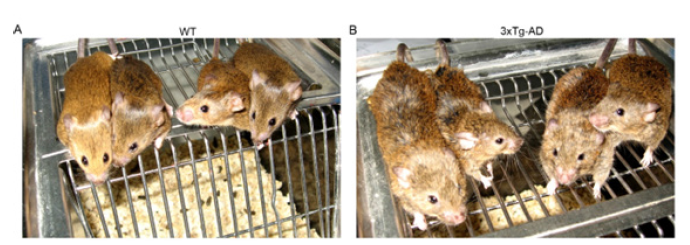
Whiskers of wild-type mice and 3×Tg-AD mice were checked in this test. The results showed that a significant difference had been observed in wide type mice and the 3×Tg-AD mice. In each cage, only one mouse had intact whiskers, while its cage-mates had patches of missing facial fur (Figure1A). But in all the 12 cages of 3×Tg-AD mice, all mice had full sets of whiskers (Figure 1B), indicating that no social hierarchy had been established for them.
Figure 1:Representative Facial whisker patterns of 3×Tg-AD mice (A) and wild-type mice (B). There was one mouse with intact whisker (barber) and the rest 3 mice with whiskers trimmed or plucked in wild-type cage. In contrast, all 3xTg-AD mice had full sets of whiskers.
Tube test
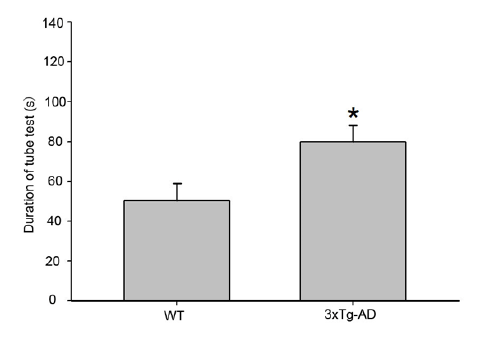
Tube test was used to identify pairs of dominant and submissive mice. Mice were tested pair-wise using a round robin design, and the social rank was assessed on the basis of winning against the other cage mates. In 11 cages of wide-type mice, two cages of mice failed to establish social hierarchy. However, ten cages of 3×Tg- AD mice (in total of 12 cages) failed to establish social hierarchy. Meanwhile, the latency of social hierarchy establishment in tube test was longer for 3×Tg-AD mice than that for wild-type mice. In the tests between wide-type mice and 3×Tg-AD mice, 70% widetype mice acquired a dominant position, indicating that the 3×Tg- AD mice have a reduction in the ability of competing the dominant position (χ2=6.40,p<0.05) (Figure 2).
Figure 2:Time spent in the tube of the wild-type mice and 3×Tg-AD mice. The wild-type mice spent less time than 3×Tg-AD mice.
Urine-marking test
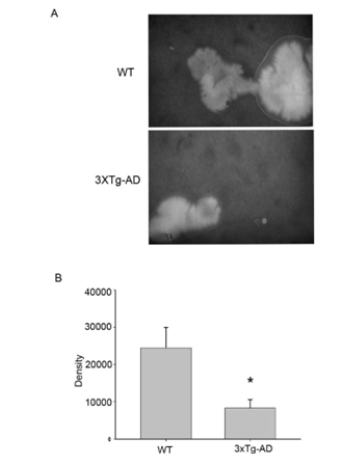
In 12 cages of 3×Tg-AD mice, eleven cages of mice didn’t have established a dominance-subordinate relationship. But only 2 of 11 cages wide-type mice didn’t have established the relationship. Compared to the wide-type mice, 3×Tg-AD mice obviously had smaller urine-marking areas (p<0.05) (Figure 3). The results revealed that the ability of establishment social hierarchy was impaired in 3×Tg-AD mice.
Figure 3:The representative view and integrated optical density of urine-marking between wild-type and 3×Tg-AD mice. (A) Representative urine-marking of wild-type and 3×Tg-AD mice. (B) The statistic results of integrated optical density of urine, which is the sum of all pixel grey levels over the urine which determined from the original grey scale image.
Home cage behavioral video recording
Wide type mice and 3×Tg-AD mice were video recorded for four hours (2 hours during the dark cycle and 2 hours during the light cycle) and the frequencies of social interaction and self-grooming were recorded. The results showed there was no difference in the frequency of social interaction and self-grooming between wide type mice and 3×Tg-AD mice (Figure S1).
Nesting patterns
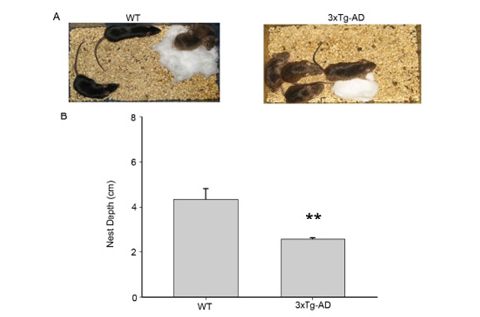
For nest building test, the wide type mice torn apart cotton cushion to form fluffy nests within 45 minutes, while the 3×Tg-AD mice almost did nothing to build nests (Figure 4A). In addition, wild-type mice-built nests that averaged 4 cm in depth, while 3×Tg- AD mice built shallower, with depths that averaged about 2cm (Figure 4B), indicating impairment of the latter in nesting behavior.
Figure 4:The representative nests and depth of nesting patterns between wild-type and 3×Tg-AD mice. (A)The photograph of the depth of the nest (B) After 45 minutes, the introduction of a nestlet wafer into each cage. **P<0.01.
Discussion
It is well known that 3×Tg-AD mouse is the best AD animal model that mimics most of the symptoms of AD patients. Many researches have been done to elucidate the phenotypes of the mice. However, the social behavior ability of this animal model is still unknown. Our analysis of 3×Tg-AD mice by whisker trimming, tube test and urine marking assay showed that 3×Tg-AD mice can’t establish a well-organized dominance-subordinate relationship like what their wild-type counterparts do. Besides, the nesting ability of 3×Tg-AD mice is impaired.
The social behavior of animals refers to various forms of the mutual influence and interaction between social animals. Animals living in the community (e.g. lions, wolves, monkey, chicken, rats, ants and bees, etc.) have more opportunity to contact with each other, so individual animal obtains corresponding position by competition based on own strength. Then they formed the individual dominant and subordinate, called the dominance hierarchy sequence. The dominance hierarchy sequence has an extremely important position in animal social behavior. First, it guarantees that the superiority individual (i.e. has a strong body, well-developed skills and a good reactivity, etc.) enjoy the food, areas and mate resources priority. Second, it reduces the damage by avoiding the frequent fights between group members. Ultimately, in the dominance hierarchy sequence, the superiority individual establishes authority and leads the subordinate individual to defend against enemies and maintain the interests and security of the whole community. Therefore, it is a benefit for social animals to establish dominance hierarchy sequence. But here it has been showed that 3×Tg-AD mice can’t establish a stable social hierarchy, which might indicate that social behavior of the mice was greatly impaired. Although no reports on changes in social hierarchy in AD animal models have been found till now, deficits in social communication [18], exploring social odors, discriminating social individuals, and habituation [19] have been described in APP/ PS1 double mutant model of AD. The impairment of 3×Tg-AD mice in establishing social hierarchy may be derived from deficits of social communication, which need further investigations. Nesting construction is an affiliative social behavior that may reflect daily life activities. Previous studies have revealed that nesting ability is progressively impaired in Tg2576 mice [20] and APPswe/PS1 bigenic model of Alzheimer’s disease, Besides, other groups also found abnormal nesting behavior in 3×Tg-AD mice [21,22], which is consistent with our results.
Conclusion
In summary, the present study showed that 3×Tg-AD mice can’t establish well-organized social hierarchy and exhibit impaired nesting ability, indicating that the mice are abnormal in the daily life activity. Thus, the mice can mimic the symptoms of AD patients in social behavior, which make them a better tool to study AD mechanisms and assess new AD drugs.
Acknowledgement
This work was supported by National Key R&D Program (2021YFC2501405) for financial support.
References
- Selkoe DJ (2001) Alzheimer's disease: Genes, proteins, and therapy. Physiological reviews 81(2): 741-766.
- Vassar R, Bennett BD, Babu KS, Kahn S, Mendiaz EA, et al. (1999) β-Secretase cleavage of Alzheimer’s amyloid precursor protein by the transmembrane aspartic protease BACE. Science 286(5440): 735-741.
- Dong S, Duan Y, Hu Y, Zhao Z (2012) Advances in the pathogenesis of Alzheimer's disease: A re-evaluation of amyloid cascade hypothesis. Transl Neurodegener 1(1): 18.
- Strooper DB (2003) Aph-1, Pen-2, and nicastrin with presenilin generate an active γ-secretase complex. Neuron 38(1): 9-12.
- Mahadomrongkul V, Huerta PT, Shirao T, Aoki C (2005) Stability of the distribution of spines containing drebrin A in the sensory cortex layer I of mice expressing mutated APP and PS1 genes. Brain Research 1064(1-2): 66-74.
- Borchelt DR, Ratovitski T, van LJ, Lee MK, Gonzales V, et al. (1997) Accelerated amyloid deposition in the brains of transgenic mice coexpressing mutant presenilin 1 and amyloid precursor proteins. Neuron 19(4): 939-945.
- Oddo S, Caccamo A, Kitazawa M, Tseng BP, LaFerla FM (2003) Amyloid deposition precedes tangle formation in a triple transgenic model of Alzheimer’s disease. Neurobiology of Aging 24(8): 1063-1070.
- Salvatore O, Antonella C, Jason DS, Paul MM, Todd EG, et al. (2003) Triple-transgenic model of Alzheimer's disease with plaques and tangles: Intracellular Abeta and synaptic dysfunction. Neuron 39(3): 409-421.
- Sterniczuk R, Dyck RH, Laferla FM, Antle MC (2010) Characterization of the 3xTg-AD mouse model of Alzheimer's disease: Part 1. Circadian changes. Brain Res 1348: 139-148.
- Saina SP, Emily NB, Tyler C, Steven B, Dharendra T, et al. (2025) Mid-life exposure to chronic stress accelerates cerebrovascular dysfunction and upregulates oxidative stress in Alzheimer's disease mice. J Alzheimers Dis 107(2): 653-670.
- Reji B, Jessica HH, Michelle MS, Ryan M, Mariah FC, et al. (2025) Fasting is required for many of the benefits of calorie restriction in the 3xTg mouse model of Alzheimer's disease. Nat Commun 16(1): 7147.
- Littbrand H, Stenvall M, Rosendahl E (2011) Applicability and effects of physical exercise on physical and cognitive functions and activities of daily living among people with dementia: A systematic review. Am J Phys Med Rehabil 90(6): 495-518.
- Long SY (1972) Hair-nibbling and whisker-trimming as indicators of social hierarchy in mice. Anim Behav 20(1): 10-12.
- Wang F, Zhu J, Zhu H, Zhang Q, Lin Z, et al. (2011) Bidirectional control of social hierarchy by synaptic efficacy in medial prefrontal cortex. Science 334(6056): 693-697.
- Lijam N, Paylor R, McDonald MP, Crawley JN, Deng CX, et al. (1997) Social interaction and sensorimotor gating abnormalities in mice lacking Dvl1. Cell 90(5): 895-905.
- Wang F, Zhu J, Zhu H, Zhang Q, Lin Z, et al. (2011) Bidirectional control of social hierarchy by synaptic efficacy in medial prefrontal cortex. Science 334: 693-697.
- Drickamer LC (2001) Urine marking and social dominance in male house mice (Mus musculus domesticus). Behavioural Processes 53(1-2): 113-120.
- Filali M, Lalonde R, Rivest S (2011) Anomalies in social behaviors and exploratory activities in an APPswe/PS1 mouse model of Alzheimer's disease. Physiol Behav 104(5): 880-885.
- Portales A, Chamero P, Jurado S (2023) Natural and pathological aging distinctively impacts the pheromone detection system and social behavior. Mol Neurobiol 60(8): 4641-4658.
- Wesson DW, Wilson DA (2011) Age and gene overexpression interact to abolish nesting behavior in Tg2576 amyloid precursor protein (APP) mice. Behavioural Brain Research 216(1): 408-413.
- Torres LV, Giménez LL (2013) Impairment of nesting behaviour in 3xTg-AD mice. Behavioural Brain Research 247: 153-157.
- Filali M, LalondeR (2009) Age-related cognitive decline and nesting behavior in an APPswe/PS1 bigenic model of Alzheimer's disease. Brain Res 1292: 93-99.
© 2026 Yijie Du& Suzhen Dong. This is an open access article distributed under the terms of the Creative Commons Attribution License , which permits unrestricted use, distribution, and build upon your work non-commercially.
Editor In Chief







.jpg)































Signup for Newsletter

Quick Links
 Editorial Board Registrations
 Submit your Article
 Best Paper of the Volume
 Reprints
 Refer a Friend
 Advertise With Us
Our Recent Edition

.jpg)



Top Editors




.jpg)

















.bmp)
.jpg)
.png)
.jpg)













.jpg)






.png)

.png)




.png)




Financial Support

Sponsors

Latest e-Books

Latest Video

 a Creative Commons Attribution 4.0 International License. Based on a work at www.crimsonpublishers.com.
Best viewed in
a Creative Commons Attribution 4.0 International License. Based on a work at www.crimsonpublishers.com.
Best viewed in 
 | Above IE 9.0 version