

- About Us
- Information
-

The Author ensures that the research has been conducted responsibly and ethically with adherence to all relevant regulations. read more..
- For Authors
- For Reviewer
- Manuscript Guidelines
- Membership
- Publication Ethics
-
- Journals
- Reprints
- e-Books
- Videos
- Policies
- Contact Us
 COVID-19
- Submissions



Full Text
Trends in Telemedicine & E-health
Artificial Intelligence Assisted Tele-ECG Interpretation for Early Cardiovascular Risk Stratification
Filza Haq Nawaz1*, Nimrah Zafar2, Mubashir Jahangir3, Adil Zulfiqar4, Afaq Ahmad5 and Muhammad Hassaan6
1 Hunan Normal University, China
2 Asian Medical Institute, Kyrgyzstan
3 Nishtar Medical University, Pakistan
4 University of South China, China
5 Avicenna International Medical University, Kyrgyzstan
6 S. Tentishev Asian Medical Institute, Kyrgyzstan
*Corresponding author:Filza Haq Nawaz, Hunan Normal University, China
Submission: January 14, 2026;Published: February 16, 2026

ISSN: 2689-2707 Volume 6 Issue 3
Abstract
Delayed diagnosis, limited access to specialist care and variability in ECG interpretation contribute to suboptimal cardiovascular risk assessment and preventable adverse outcomes. Tele-ECG has helped address some of these barriers by enabling remote ECG acquisition and transmission. However, its clinical potential is substantially enhanced when integrated with Artificial Intelligence (AI). This review highlights the manner in which AI-assisted tele-ECG can revolutionize the cardiovascular sector by early risk stratification, real-time monitoring and personalized clinical decision support. AI technologies such as deep learning-based ECG interpretation, predictive risk models and wearable ECG devices contribute to the precision of the diagnosis, reducing the variability between different readers and enabling the medical intervention to be timely even in places that are not traditionally covered by the healthcare services. At the same time, challenges such as model interpretability, data privacy, algorithmic bias, infrastructure limitations and the need for clinician oversight remain significant. Overcoming these challenges will demand joint efforts that include the creation of regulatory frameworks, standardized validation, clinician training and the devising of ethical deployment strategies. Ultimately, AI-enabled tele-ECG represents more than a technological advancement. It is a critical approach to improving early cardiovascular risk detection, optimizing preventive care and reducing disparities in access to highquality cardiovascular services.
Keywords:Artificial intelligence; Tele-ECG; Cardiovascular risk stratification; Electrocardiography; Deep learning; Remote monitoring; Digital cardiology
Introduction
Cardiovascular Diseases (CVDs) continue to be the primary cause of illness and death globally, with more than 17.9 million people dying each year and as a result, leaving a significant impact on the economy and healthcare [1]. However, the timely detection and accurate risk stratification of patients is crucial for good prognosis and prevention of unfavourable outcomes. Nevertheless, conventional diagnostic techniques such as clinicianinterpreted ECGs and standard risk scores are usually factored on subjectivity, observer variation and insensitivity to the early stages or subclinical disease [1]. Artificial Intelligence (AI) has been recognized as a revolutionary tool in the field of cardiology, granting diagnostic accuracy, risk prediction, and patient care personalization that were previously impossible. AI approaches such as machine learning, deep learning, Convolutional Neural Networks (CNNs) and hybrid models help identify very subtle and difficult to spot patterns in ECG signals which are sometimes even beyond the capability of human evaluators [1- 3]. So, the capacity of AI-assisted systems to detect the presence of structural heart defects, arrhythmias, myocardial infarction, atrial fibrillation and Heart Failure (HF) with precision is undoubtedly a great advantage.
Systematic reviews and meta-analyses give a lot of evidence that AI performs very well in ECG interpretation where the diagnosis is concerned, particularly in the case of HF detection which has pooled sensitivities of 0.93 to 0.95, specificities of 0.95 to 0.98 and diagnostic odds ratios of more than 300-800, thus, showing the consistency of AI models across different population groups and study settings [3]. Ectopic heartbeats done using AI techniques have already shown their performance in detecting subclinical cardiovascular conditions, so, in the future, they will be able to pick up such cases or provide better detection through real-time monitoring with the help of smart wearables and remote patient management support [1]. AI-infused ECG algorithms have the ability to collate minute ECG changes that could be associated with left ventricular systolic dysfunction in patients admitted to a cardiac intensive care unit and assign them a mortality risk, independent of the findings from echocardiographic tests. This shows how much AI-ECG can play in the early cardiovascular risk stratification over and above the laboratory tests [4].
Moreover, the use of AI in cardiovascular imaging and telehealth systems has impressed us to change the old way of doing something by introducing the new method which is dynamic, individualized and data-driven, instead of the old way which was static and centered on population-based risk scoring. The use of explainable AI models has been facilitating the transparency of the clinicians and making clinical decision-making more interpretable [1,3]. Collectively, these developments highlight the transformative potential of AI-assisted tele-ECG, offering a pathway toward precision cardiovascular medicine and improved patient outcomes.
Tele‑ECG & Cardiovascular Risk Prediction
Tele-ECG, which is AI-assisted, is quickly changing the way cardiovascular risk is predicted. It can detect accurately and from a distance the biggest group likely to suffer from cardiac problems. Conventional models for risk prediction are deeply dependent on clinical scrutiny and conventional scoring systems, which may be limited due to the different interpretations and access issues. AI-fortified ECG is about to break these limitations by revealing subtle electrical patterns that can predict the disease risk from ECG recordings even before clinical symptoms show up. In the risk assessment process, AI-ECG has become the main player. For instance, prediction of coronary artery disease and Athero Sclerotic Cardio Vascular Disease (ASCVD) outcomes. In a large retrospective cohort, AI models analyzing standard 12-lead ECG data exhibited a strong ability to distinguish between groups with high and low coronary artery calcium scores and obstructive disease. Furthermore, AI-guided stratification rendered incremental prognostic value beyond the traditional pooled cohort equations, with significantly raised hazard ratios for acute coronary events and all-cause mortality in individuals with positive ECG-AI profiles [5]. These results point out the capacity of AI-ECG to sharpen risk assessments for ASCVD and to direct early preventive measures.
Besides the risk posed to the heart by coronary arteries, the AI-ECG techniques have successfully predicted Heart Failure (HF), which is one of the main causes of cardiovascular morbidity and mortality. An ECG-AI model that used deep learning and various clinical variables got a predictive accuracy similar to those of the established risk calculators such as the ARIC and Framingham models. The output of the AI was seen as the most influential predictor of future HF events. This was the case because not only was the ECG-AI output considered the most significant predictor but also combining it with conventional risk factors in machine learning frameworks yielded excellent predictive performance. The integration of ECG-derived signals and clinical data was, therefore, essential for robust risk modeling. A multinational research project has also confirmed that AI-ECG can be used for HF risk stratification in a variety of populations in the US, UK and Brazil. The results indicated that an AI-ECG screen that yielded positive results came with significantly higher hazard ratios for new HF right from the start. The method also revealed better discrimination when applied to the traditional PCP-HF equations. This implies that tele-ECG AI models could potentially function as easily accessible digital biomarkers for HF risk in patients and also in the community settings. These studies validate that AI-assisted tele-ECG can enhance risk prediction for significant cardiovascular events by allowing early, accessible and precise stratification.
AI-ECG for Targeted Cardiovascular Condition Prediction
AI applied to Electro-Cardio-Graphy (AI-ECG) is not only being used for general cardiovascular risk assessment but also for precise forecasting and diagnosis specific to the condition, which has proven to be very accurate for different heart and related body system diseases. An important example of this is predicting postoperative Atrial Fibrillation (AF), which is a common complication after heart surgeries accompanied by considerable patient suffering. A vast retrospective cohort investigation revealed that an AI-ECG model which was exposed to an enormous number of non-AF ECGs received an area Under the Receiver Operating Characteristic Curve (AUROC) of 0.901 for identifying very faint electrophysiologic signs linked to AF risk. Moreover, the AI score predicted postoperative AF independently and added to the risk assessment when combined with the conventional clinical risk scores, thus suggesting its noninvasive nature as a preoperative risk assessment biomarker [6].
Not only in the case of arrhythmia prediction, but also in the case of AI-ECG, its role in Heart Failure (HF) management has stretched from monitoring the patient’s condition to the use of AI-ECG in stratification of patients with acute and chronic heart failure. AI ECG proved to be a good indicator in predicting hospital death and long-term survival of patients with acute HF even when clinical and echocardiographic variables were controlled. Thus, patients with higher AI-derived risk scores had a strong correlation with death. These results signify that AI-ECG could be an innovative prognostic marker in acute cardiovascular syndromes thereby standing alongside the traditional clinical indicators [7]. As illustrated in Figure 1, AI-enhanced ECG analysis enables the detection and risk stratification of a broad spectrum of cardiovascular conditions, including heart failure, atrial fibrillation, coronary artery disease, pulmonary hypertension, mortality risk, and future pacemaker requirement. AI-ECG approaches are also put into practice to predict future negative incidents in purely structural and conduction disease. For example, the AUCs of the trained models were more than 0.87 for predicting the risk of pacemaker implantation within 30-90 days and they were able to predict future pacemaker implantation with utmost precision. The patients identified by the AI model not only had significantly higher risks of pacemaker insertion but also of all-cause and cardiovascular mortality and new adverse events highlighted by ECG-based AI as a tool for disease prediction and intervention needs [8].
Figure 1:Spectrum of cardiovascular conditions detectable using AI-enhanced ECG analysis.

AI-ECG prediction runs side by side with some particular structural cardiac problems. The detection of pulmonary hypertension has been the subject of AI algorithms development and validation. These algorithms exhibit remarkable diagnostic performance during and even up to years before the manifestation of the clinical condition. The ability to recognize the early signs promotes the preemptive identification and management of pulmonary vascular disease [9]. Moreover, the ECG-AI systems are being created for the prediction of the Implantable Cardioverter- Defibrillator (ICD) needed for forecasting and electrolyte imbalance risk assessment. The early evidence, however, suggests that such interpretations might be coming up with the traditional diagnostic methods in terms of revealing subtle ECG abnormalities associated with these outcomes [10].
Risk Prediction Models & Comparative Performance
Risk prediction models for Electro-Cardio-Grams (ECGs) enabled by Artificial Intelligence (AI) are developing at a fast pace and are already regarded as powerful tools that might either surpass or work alongside the traditional clinical risk calculators. The possible future cardiovascular outcomes are being estimated straight from the ECG signals through the application of deep learning as well as the use of advanced analytics. The clinical variables are often incorporated to further improve the prognostic accuracy of the models. In direct comparisons with traditional diagnostic evidence, the AI-ECG risk prediction models often provide the same or better prognostic performance. For instance, when predicting long-term Heart Failure (HF), the models using the ECG-AI outputs along with demographic and clinical risk factors are superior to the clinical calculators such as the ARIC and Framingham risk scores. In this scenario, the combined AI-ECG models were able to reach AUCs of up to ~0.84 in some groups, thus revealing a higher discrimination capability when the ECG-derived features are integrated with the conventional predictors. Furthermore, AI-ECG outputs frequently rank as the toughest individual predictors within composite models, which highlights their importance in detecting electrophysiological signals that are indicative of the underlying disease processes.
These results make it clear that the AI-ECG risk prediction models give clinical models of the traditional kind, which are sound and possibly superior to performance, especially when used together with the established risk scores. This affirms their increasing significance in assessing cardiovascular risk and the possibility of their informing personalized preventive strategies. The analysis of ECG with the help of artificial intelligence significantly improves the early detection of cardiovascular risk by finding subtle arrhythmias and patterns that are not recognized by the conventional interpretation [11]. The combination of deep neural networks and engineered features have shown a very high level of accuracy in the detection of cardiac arrhythmias through ECG recording [12]. The hybrid ECG-based deep learning models can point out the patients who are at an increased risk of major cardiovascular events, especially among the hypertensive people [13].
The AI-assisted ECG algorithms can classify patients according to their risk of death and can also back up the plan of the early intervention that goes beyond the regular clinical assessment [14]. Besides, the application of the deep learning methods for the detection of heartbeats and ECG signal analysis are seen as potential for the implementation of tele-ECG monitoring on a large scale [15]. In short single-lead ECG recordings, the most reliable beat morphology and heart rate variability features were ranked for detecting atrial fibrillation. This showed that the specific timedomain and morphological ECG parameters could significantly improve the classification performance in single-lead arrhythmia analysis [16]. If these AI-assisted analyses could be incorporated into remote ECG systems, it would enable the doctors to easily screen large groups of people and give them the necessary timely interventions. The tele-ECG platforms that use AI, support the direct monitoring, risk assessment and the creation of individualized management plans, which can lead to a reduction of cardiovascular diseases and deaths. This method is a major breakthrough in cardiovascular care and the management of population health.
AI‑ECG in Prognosis & Outcomes
Besides the accuracy in diagnosis and the prediction of risks, the AI-Electrocardiogram (AI-ECG) has been found to have a great deal of prognostic value revealing the patients who are at a higher risk of experiencing adverse outcomes before and that too, through the use of traditional methods. The AI-ECG risk scores represent not only the current disease states but also point out the future clinical deterioration and the risk of death, thus providing clinicians with practical insights for intervention and follow-up care. Most importantly, the output generated by AI-ECG could be used as a clinical decision support tool that brings about changes in real-world outcomes. In a pragmatic randomized clinical trial, the use of AI-ECG alerts for hospital patients caused the identification of high-risk patients, where the clinical intervention resulted in increased medical attention, making the care more aggressive and thus leading to a considerable decrease in both all-cause and cardiac mortality over a 90-day period as compared to standard care. Such a trial demonstrates that the AI-ECG not only forecasts the prognosis but, when inserted into the workflow, can lead to better clinical outcomes that are measurable [17]. On the whole, the above research work and the studies argue that AI-ECG is a cool tool to prognosticate beyond the existing clinical methods. It is a dynamic and sensitive tool that can detect latent risk, thereby support targeted intervention and eventually facilitate better patient outcomes in the field of cardiovascular care.
AI‑ECG Implementation & Guideline Context
The clinical admission of AI-ECG for the early identification of cardiovascular risk factors will not solely depend on the availability of advanced technology but also on the concurrence of the aforementioned innovation with clinical practice guidelines, evidence reviews and real-world applicability frameworks. One of the critical elements to the adoption of AI-ECG in the established care pathways is the reproducible benefit backed by clinicians’ acceptability, clear regulations and endorsement by guidelines. The management of Atrial Fibrillation (AF) has already been influenced by guidelines that begin to admit the role that AI and digital tools are likely to play in clinical practice. Nevertheless, the traditional guidelines such as the ACC/AHA/HRS recommendation frameworks continue to be based on evidence‑based risk scoring (e.g., CHA2DS2‑VASc), but recent systematic reviews have shown that AI-enhanced ECG algorithms outperform the conventional risk models in terms of AF prediction and monitoring accuracy [18]. AI algorithms, which can be based on deep learning and machine learning among other techniques, have been proven to be more sensitive and specific in the prediction of AF onset or burden, and may complement the existing clinical tools by detecting the highrisk patients through the conventional screening methods before the latter are due. Nonetheless, those who write the guidelines have pointed out that standardization of the validation, openness of the model’s behavior and clinical trials with future patients are strictly needed before the formal merger of the routine AF management approach and creaming off of the best patients [18]. These factors illustrate that the use of AI-ECG for the evaluation of AF risk is valuable but will require a solid clinical trials base and a standard evaluation framework to determine the direction of the future guideline recommendations.
Expanded Evidence Base: Key AI‑ECG Studies Supporting Diagnostic and Prognostic Utility
Over the past few years there has been a very quick increase in the evidence supporting the use of Artificial Intelligence (AI) in the areas of ECG interpretation, prediction and cardiac risk stratification in various clinical contexts. A number of systematic reviews and meta-analyses have concluded that AI-based tools exceed the traditional methods with regard to ECG diagnostics and prognostics. For instance, a thorough review that considered 46 studies revealed that AI models, especially Convolutional Neural Networks (CNNs), Recurrent Neural Networks (RNNs) and hybrid architectures, have considerably increased the diagnosis of arrhythmia, myocardial infarction and heart failure detection when compared to the conventional ECG interpretation, and have also reduced the time to diagnosis, thus allowing for personalized treatment planning in cardiology [19]. AI‑enhanced ECG (AI‑ECG) techniques utilize advanced computational models on the raw ECG waveforms and therefore provide scalable and objective insights that go beyond the conventional criteria, with the possible applications spanning from screening asymptomatic dysfunction to estimating prognostic mortality [20].
Detection of left ventricular dysfunction is the biggest area where AI has successfully impressed the world. Regular electrocardiograms have been very poor in diagnosing ALVD, which is the silent form of left ventricular dysfunction, and that is a condition with great risk of developing heart failure if treated late. AI models learning from very large matched pairs datasets of ECG and echocardiography have determined the presence of ALVD by at least 97% correct; this is because they can detect ECG patterns that are almost invisible but run parallel to poor ventricular function [20]. Such ability to unmask subclinical systolic irregularities is a signal that AI can be used to raise ECG from a primitive diagnostic method to a predictive screening one for the high-risk people suffering from adverse outcomes in the future [21].
AI-ECG algorithms are also being applied in the comprehensive screening and risk stratification of larger populations. Retrospective cohort studies have shown that AI-ECG probability estimates for left ventricular systolic dysfunction have a separate association with in-hospital mortality in critically-ill patients, which proves the ECG-derived AI risk scores have prognostic value that goes beyond the standard imaging-based metrics [22]. In a huge, multi-centered study, it was found that the deep learning-based ECG interpretation did not only predict that coronary artery disease would be the next cause of a heart attack but also stratified the risk of the event and mortality in the old heart attack patients by independent and additive ways to the traditional pooled cohort equations, which suggested a place of ECG-AI in the already established cardiovascular risk prediction frameworks [23].
AI-ECG has numerous applications, including preventative heart failure and cardiovascular events statutory modeling. Largescale multinational research that utilized AI and trained models on ECG patterns found a relationship between AI features and long-term patient hospitalizations due to heart failures which in turn suggested that AI could trace even those risk paths coming from standard ECGs which humans could not see [24]. In addition, machine learning models based on the ECG have not only been able to identify those patients who are more likely to die from heart diseases but also provided predictive insights which can now be used in deciding the treatment priority in emergency departments [25]. The systematic reviews show us how deep neural networks can perform detection of diseases like arrhythmias, cardiomyopathies and valvular diseases plus much more with ECG signals correctly almost all the time if not better than that of the traditional automated interpretation algorithms [26]. An instance could be the application of AI models for recognizing diastolic dysfunction and heightening supply pressure parameters that normally need echocardiography for analysis, using only ECG data, thereby enlarging the capacity of ECG in noninvasive risk assessment [27].
Deep learning methods, to some extent, involving convolutional neural networks and hybrid models, alongside the state-of-theart performance the latter have demonstrated with regards to extracting clinically relevant features from high-dimensional ECG traces compared to rule-based or traditional machine learning methods has been the major reason for their wider adoption in the field [25]. According to meta-analyses evaluating the AI detection of heart failure, the report about the pooled sensitivities and specificities of AI-ECG diagnostic tools surpassed 0.90 in large patient cohorts, thereby establishing the credibility of these tools in diagnosing HF by [28]. The AI‑ECG models are getting stronger and stronger thanks to better generalization and larger training datasets, which also include multimodal and temporal frameworks that show both the local and the global ECG features [26].
Major systematic reviews of AI‑ECG technologies stress that even though the performance in terms of diagnosis and prediction is very convincing, the non‑biased reporting, external validation in different population groups, and openness in model design are the aspects that are vital to guaranteeing reproducibility and equal supply of care [21]. Furthermore, integration into clinical workflows has to make clear how the AI outputs will be interacting with clinician decision‑making since this interaction might lead to either too much or too little reliance on the algorithmic predictions [22]. The future of AI in reshaping the cardiovascular care industry will be greatly influenced by factors like continuous improvements in the model reliability, clinical trials and strategies for implementing AI in clinical settings [20].
Technological advancement of Al-enabled tele- ECG.
The fast pace of Artificial Intelligence (AI) development has radically changed tele-Electro-Cardio-Graphy (tele-ECG) for the better, turning it from a simple remote rhythm-monitoring tool into a highly predictive and diagnostic platform that can even support full-scale decentralized cardiology. The modern AI-ECG systems use the deep learning architectures that are the result of training on millions of digital ECG sweeps, which leads to an extraction of features that goes beyond the traditional intervals and morphologies, thus improving the sensitivity of diagnostics while at the same time decreasing the variability between the different observers in remote settings [29]. The connection between AI and tele-ECG has increased the latter’s capabilities by not only supporting transmission but also interpretation, risk stratification, and early detection; thus, making the technology invaluable for the whole humankind especially for the areas with limited physicians and rough access. Furthermore, the recent breakthroughs have led to the incorporation of AI-ECG algorithms into smart and portable wearable devices, allowing for uninterrupted monitoring together with effortless data transfer to internet-based platforms for professional assessment [30].
The systems in question are capable of detecting very faint electrical signals that are linked to ischemia, conduction disease and cardiomyopathies, thus preventing cardiology via telemedicine frameworks [30]. Moreover, AI-based remote ECG yielded very strong results in the automated detection of arrhythmias, such as atrial fibrillation, ventricular ectopy and conduction blocks, with a significant reduction of the time to arrive at a diagnosis in outpatient and home-based care models [31]. More than just rhythm analysis, innovation in the field made it possible to predict hidden or subclinical cardiovascular diseases like asymptomatic left ventricular dysfunction by employing standard 12-lead ECGs that are captured remotely, stressing the growth in tele-ECG diagnostics [31].
AI-influenced ECG models have been proven to have very good predictive power for left ventricular systolic dysfunction even in patients who do not show signs of heart failure, thus indicating that a change in the paradigm has taken place where tele-ECG can be viewed as a low-cost, large-scale screening tool for structural heart disease [32]. Such developments are more so felt in telehealth environments where the early detection of ventricular dysfunction can receive a referral for echocardiography and expert care, therefore, the optimized resources [32]. In addition, recent literature reviews reveal that the use of AI-assisted ECG interpretation for outpatient and telemedicine purposes has the same effect as improving the accuracy of diagnosis, reducing the waiting time and the physician’s load, making the process more efficient [33]. Besides, the use of artificial intelligence in tele-ECG platforms not only provides ongoing monitoring of patients but also gives the physician dynamic risk assessment and personalized treatment decision-making over time.
AI in the Remote ECG Analysis
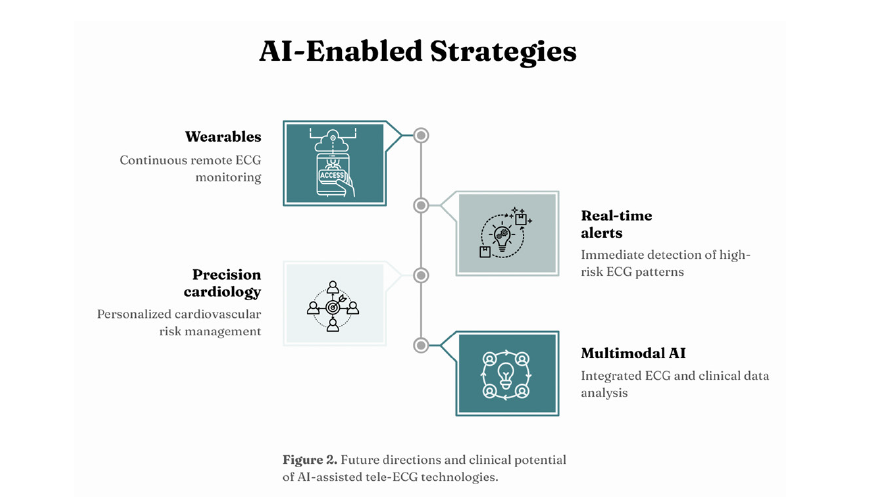
Artificial Intelligence (AI) has made a great impact on the practice of electrocardiography, the development of automated, accurate and scaled interpretation of ECGs is one of the major shifts that AI has brought to this area. The state-of-the-art reviews speak of the ability of AI algorithms, especially deep learning models, to not only classify Cardiac rhythms but also to detect structural heart disease and, most importantly, pinpoint subtle abnormalities that traditional interpretation often misses [34]. AI’s potential is not limited to mere interpretation; the narrative analyses indicate that the AI-driven ECG tools have the ability to provide predictive insights and to take part in continuous monitoring, thus preparing the ground for becoming a part of telemedicine and remote patient management [35]. Figure 2 summarizes emerging AIenabled strategies in tele-ECG systems, including wearable-based continuous monitoring, real-time alert generation, multimodal data integration, and personalized precision cardiology approaches. Research highlights that the AI-enabled ECG systems can even pick up early signals of cardiac abnormalities in patients that are not necessarily symptomatic, hence preventing the situation where high-risk populations are not treated early even when they are outside the conventional clinical settings [36]. AI-ECG programs have undergone validation against the interpretations of cardiologists, having gained a high level of conformity and proving their practicability for broad adoption in both hospital and remote monitoring scenarios, which centers on tele-ECG applications [37].
Figure 2:Future directions and clinical potential of AI-assisted tele-ECG technologies.
Conclusion
Artificial intelligence assisted tele-Electro-Cardio-Graphy (AI‑Tele-ECG) is a revolution in cardiovascular care to be more precise. Traditional electrocardiography interpretation methods, although widely used, still present the downsides of human error among different observers, low sensitivity regarding the cases of silent disease and late detection of high-risk patients. The algorithms strengthened by AI can eliminate these restrictions by uncovering minute electrophysiological patterns that may precede overt clinical manifestations, thus allowing timely risk identification for heart failure, arrhythmias, or other cardiovascular events [5,37]. Tele-ECG combined with AI not only expands the area of cardiovascular assessment but also provides a huge advantage of accessibility outside the hospital. Remote monitoring systems that come with AI installed may decode ECG signals instantly, giving doctors the chance to act upon and, in a way, even intervene at the very first possible moment, especially in communities where people are denied care due to various reasons or among populations of high-risk individuals [5,37]. Research has shown that AI‑Tele- ECG models not only result in higher diagnostic accuracy but also allow patients to have better prognostic assessments, where the prediction of future cardiovascular events and mortality is done with higher precision than only using the standard risk scores [6,13].
The combination of AI‑ECG with standard medical care guidelines is an indication of its clinical adoption. Through comparative studies, it has been concluded that AI-supported ECG interpretation lessens the differences in results among different observers, provides similar performance in various population groups, and develops huge patient cohorts at low cost [18]. However, there are still some unresolved issues. The discussion about the shortcomings is focused on the different AI models used, the possible demographic influences in the training datasets, and the requirement for external validation to prove that the method works in different populations and healthcare settings. Only through the process of rigorous multicenter trials, establishing standard reporting protocols and integrating into clinical decisionmaking will it be possible to fully utilize the potential of AI‑Tele- ECG [5,38-40]. To sum up, AI-based Tele-ECG is a game-changing device for the quick identification of patients with cardiovascular risk. It provides early detection of at-risk patients, increases the accuracy of prognosis, and facilitates timely clinical interventions by combining remote monitoring with advanced AI interpretation. The continuous improvement, validation, and implementation of AI‑Tele-ECG in accordance with the guidelines will be pivotal in converting this technology into a better cardiovascular outcome for the whole population.
References
- Velandia H, Pardo A, Vera MI, Vera M (2025) Systematic review of artificial intelligence and electrocardiography for cardiovascular disease diagnosis. Bioengineering 12(11): 1248.
- Niazai A, Jamil H, Hameed M, Sheikh S, Nisar MR (2025) Artificial intelligence in cardiovascular diagnostics: A systematic review and descriptive analysis of clinical applications and diagnostic performance. BMC cardiovascular disorders 25(1): 849.
- Khan S, Qayyum K, Qadeer A, Khalid M, Anthony S, et al. (2025) Efficacy of AI models in detecting heart failure using ECG data: A systematic review and meta-analysis. Cureus 17(2): e78683.
- Jacob CJ, Anthony HK, Francisco LJ, Zachi IA, Suraj K, et al. (2021) Mortality risk stratification using artificial intelligence-augmented electrocardiogram in cardiac intensive care unit patients. European Heart Journal Acute Cardiovascular Care 10(5): 532-541.
- Samir A, Nikhil S, Yash G, Ausath GA, Shahir A, et al. (2023) Identification and risk stratification of coronary disease by artificial intelligence-enabled ECG. E Clinical Medicine 65: 102259.
- Joseph B, Xin L, Ahmed K, Akash M, Ibrahim A, et al. (2024) Artificial intelligence for ventricular arrhythmia capability using ambulatory electrocardiograms. European Heart Journal Digital Health 5(3): 384-388.
- Han C, Soh S, Park JW, Pak HN, Yoon D (2025) Artificial intelligence-based electrocardiogram model as a predictor of postoperative atrial fibrillation following cardiac surgery: Retrospective cohort study. Journal of Medical Internet Research 27: e77164.
- Georgios C, Jonathan GR, Camden LL, Xiaoxi Y, Zachi IA, et al. (2020) Artificial intelligence-electrocardiography to predict incident atrial fibrillation: A population-based study. Circulation Arrhythmia and Electrophysiology 13(12): e009355.
- Jonas LI, Mathias B, Astrid NLH, Molly M, Dominik L (2022) Artificial intelligence for the detection, prediction and management of atrial fibrillation. Pacemaker Therapy Electrophysiology 33(1): 34-41.
- Gilbert J, Alexis NL, Olivier T, Denis C, Paloma J, et al. (2024) Prediction of incident atrial fibrillation using deep learning, clinical models and polygenic scores. European Heart Journal 45(46): 4920-4934.
- Hong S, Zhou Y, Wu M, Shang J, Wang Q, et al. (2019) Combining deep neural networks and engineered features for cardiac arrhythmia detection from ECG recordings. Physiological measurement 40(5): 054009.
- Parvaneh S, Rubin J, Babaeizadeh S, Xu WM (2019) Cardiac arrhythmia detection using deep learning: A review. Journal of Electrocardiology 57: S70-S74.
- Paragliola G, Coronato A (2021) A hybrid ECG-based deep network for the early identification of high-risk to major cardiovascular events for hypertension patients. Journal of biomedical informatics 113: 103648.
- Mathews SM, Kambhamettu C, Barner KE (2018) A novel application of deep learning for single-lead ECG classification. Computers in Biology and Medicine 99: 53-62.
- Murat F, Yildirim O, Talo M, Baloglu UB, Demir Y, et al. (2020) Application of deep learning techniques for heartbeats detection using ECG signals-analysis and review. Computers in Biology and Medicine 120: 103726.
- Ivaylo C, Vessela K, Iana S, Tatiana N, Ramun S (2018) Ranking of the most reliable beat morphology and heart rate variability features for the detection of atrial fibrillation in short single-lead ECG. Physiological Measurement 39(9): 094005.
- Georgios C, Zachi IA, Holly KVH, Xiaoxi Y, Rickey EC, et al. (2022) Artificial intelligence-electrocardiography to detect atrial fibrillation: Trend of probability before and after the first episode. European heart journal. Digital health 3(2): 228-235.
- Popat A, Yadav S, Obholz J, Hwang EA, Rehman AU, et al. (2025) The efficacy of artificial intelligence in the detection and management of atrial fibrillation. Cureus 17(1): e77135.
- Oke OA, Cavus N (2025) A systematic review on the impact of artificial intelligence on electrocardiograms in cardiology. International Journal of Medical Informatics 195: 105753.
- Zachi IA, Suraj K, Francisco LJ, Paul MM, Dorothy JL, et al. (2019) Screening for cardiac contractile dysfunction using an artificial intelligence-enabled electrocardiogram. Nature Medicine 25(1): 70-74.
- Shao M, Bin G, Wu S, Bin G, Huang J, et al. (2018) Detection of atrial fibrillation from ECG recordings using decision tree ensemble with multi-level features. Physiological Measurement 39(9): 094008.
- Marco VP, Kenneth WM, Haley H, John SR, Ariadna G, et al. (2019) Large-scale assessment of a smartwatch to identify atrial fibrillation. The New England Journal of Medicine 381(20): 1909-1917.
- Barbara JD, Robert MC, Marjorie F, Elizabeth SK, Mitchell WK, et al. (2024) Practice standards for electrocardiographic monitoring in hospital settings: An American heart association scientific statement from the councils on cardiovascular nursing, clinical cardiology and cardiovascular disease in the young: Endorsed by the international society of computerized electro cardiology and the American association of critical-care nurses. Circulation 110(17): 2721-2746.
- Kipp WJ, Jessica TS, Benjamin SG, Khader S, Riccardo M, et al. (2018) Artificial Intelligence in cardiology. Journal of the American College of Cardiology 71(23): 2668-2679.
- Rudin C (2019) Stop explaining black box machine learning models for high stakes decisions and use interpretable models instead. Nature Machine Intelligence 1(5): 206-215.
- Rajpurkar P, Chen E, Banerjee O, Topol EJ (2022) AI in health and medicine. Nature Medicine 28(1): 31-38.
- Gari DC, Chengyu L, Benjamin M, Li HL, Ikaro S, et al. (2017) AF classification from a short single lead ECG recording: The physionet/computing in cardiology challenge 2017. Computing in Cardiology 44: 10.22489.
- Zachi IA, Peter AN, Francisco LJ, Samuel JA, Abhishek JD, et al. (2019) An artificial intelligence-enabled ECG algorithm for the identification of patients with atrial fibrillation during sinus rhythm: A retrospective analysis of outcome prediction. Lancet 394(10201): 861-867.
- Stefano P, Marco V, Fu SN, Zachi A, Youngjin C, et al. (2025) Artificial intelligence and the electrocardiogram: A modern renaissance. European Journal of Internal Medicine140: 106329.
- Bartusik AD, Rogóż K, Aebisher D (2025) Artificial intelligence and ECG: A new frontier in cardiac diagnostics and prevention. Biomedicines 13(7): 1685.
- Elantary R, Othman S (2025) Artificial intelligence in electrocardiography: From automated arrhythmia detection to predicting hidden cardiovascular disease. Cureus 17(10): e94065.
- Philip MC, Machteld JB, Cornelis PA, Bauke KOA, Lovedeep SD, et al. (2026) Artificial intelligence enhanced electrocardiogram models for detection of left ventricular dysfunction. JACC Advances 5(2): 102572.
- Raghavee N, Oksana D, Mollie G, Mark L, Brandon N, et al. The use of artificial intelligence in ecg interpretation in the outpatient setting: A scoping review. Cureus 17(10): e94113.
- Benjamin O, Zeeshan S, Amulya G, Christian T, Chris H, et al. (2024). Artificial intelligence interpretation of the electrocardiogram: A state-of-the-art review. Current Cardiology Reports 26(6): 561-580.
- Fabrizio R, Maria LR, Giandomenico B, Davide M, Sabina G, et al. Artificial intelligence-enhanced ECG interpretation: A new era for electrocardiography? G Ital Cardiol 26(9): 635-646.
- Chin SL, Wei TL, Yuan HC, Shih HL, Chin L (2025) Artificial intelligence-enabled electrocardiography from scientific research to clinical application. EMBO Molecular Medicine 18(1): 22-40.
- Lovedeep SD, Arya A, Veer S, Aline FP (2025) Heart failure risk stratification using artificial intelligence applied to electrocardiogram images: A multinational study. European Heart Journal 46(11): 1044-1053.
- Oguz A, Liam B, Ibrahim K, Patricia PC, Dalane WK, et al. (2021) ECG-AI: Electrocardiographic artificial intelligence model for prediction of heart failure. European Heart Journal Digital health 2(4): 626-634.
- Xin ML, Xin YG, Gary T, Shen DH, Kang YC, et al. (2022) Electrocardiogram-based artificial intelligence for the diagnosis of heart failure: A systematic review and meta-analysis. Journal of Geriatric Cardiology 19(12): 970-980.
- Anthony HK, Wei YK, Zachi IA, Michal SC, Paul AF, et al. (2020) A comprehensive artificial intelligence-enabled electrocardiogram interpretation program. Cardiovascular Digital Health Journal 1(2): 62-70.
© 2026 Filza Haq Nawaz. This is an open access article distributed under the terms of the Creative Commons Attribution License , which permits unrestricted use, distribution, and build upon your work non-commercially.
Editor In Chief







.jpg)































Signup for Newsletter

Quick Links
 Editorial Board Registrations
 Submit your Article
 Best Paper of the Volume
 Reprints
 Refer a Friend
 Advertise With Us
Our Recent Edition

.jpg)



Top Editors




.jpg)

















.bmp)
.jpg)
.png)
.jpg)













.jpg)






.png)

.png)




.png)




Financial Support

Sponsors

Latest e-Books

Latest Video

 a Creative Commons Attribution 4.0 International License. Based on a work at www.crimsonpublishers.com.
Best viewed in
a Creative Commons Attribution 4.0 International License. Based on a work at www.crimsonpublishers.com.
Best viewed in 
 | Above IE 9.0 version