

- About Us
- Information
-

The Author ensures that the research has been conducted responsibly and ethically with adherence to all relevant regulations. read more..
- For Authors
- For Reviewer
- Manuscript Guidelines
- Membership
- Publication Ethics
-
- Journals
- Reprints
- e-Books
- Videos
- Policies
- Contact Us
 COVID-19
- Submissions



Full Text
Trends in Textile Engineering & Fashion Technology
From Digital to Wearable: The Expanding Role of Additive Manufacturing in Personalized Fashion and Functional Textiles
Behnam Akhoundi*
Department of Mechanical Engineering, Sirjan University of Technology, Sirjan, Iran
*Corresponding author:Department of Mechanical Engineering, Sirjan University of Technology, Sirjan, Iran
Submission: May 29, 2026; Published: July 13, 2026

ISSN 2578-0271 Volume11 Issue 5
Abstract
Additive manufacturing (AM) has emerged as a transformative technology in the fashion and textile industries, enabling unprecedented levels of design freedom, personalization, and on‑demand production. This paper explores the diverse applications of Fused Deposition Modeling (FDM) in creating functional and aesthetic fashion items-from fully 3D‑printed footwear and flexible garments to rigid accessories and metal‑filled decorative pieces. Key material classes including Thermoplastic Polyurethane (TPU), Thermoplastic Elastomer (TPE), Nylon, PLA, and copper‑filled composites are examined in terms of printability, mechanical behavior, and application suitability. The study further highlights recent advancements in consumer 3D printing systems, particularly the integration of Automatic Material Switching (AMS) and multi‑nozzle technologies, which enable simultaneous printing of dissimilar materials (e.g., ABS with TPU) in a single seamless structure-a capability largely unexplored in existing literature. A case study on reproducing a complex Nike Jordan footwear model using TPU 90A on a Bambu Lab A1 printer (44 hours, ~$60 cost) demonstrates the economic and technical feasibility of distributed, domestic manufacturing of high‑value fashion goods. The paper concludes by identifying promising research directions, including systematic parametric studies of identical textile patterns across multiple materials and the development of multi‑material functional textiles with spatially graded mechanical properties.
Keywords: Additive Manufacturing; Fused Deposition Modeling; Fashion Technology; 3D Printed Footwear; Multi Material Printing; AMS; TPU; Functional Textiles
Introduction
Additive manufacturing (AM), commonly known as 3D printing, builds objects layer by layer directly from digital models, offering design flexibility and material efficiency unattainable through conventional subtractive or formative methods [1]. The introduction of AM to the fashion industry gained formal recognition in the autumn of 2013 at New York Fashion Week and has since expanded rapidly across apparel, footwear, and accessories sectors [2]. The digital workflow underpinning modern fashion design-rooted in CAD modeling, CAM slicing, and G‑code generation-aligns naturally with the capabilities of AM systems [3]. This synergy enables designers to produce prototypes rapidly, iterate designs with minimal lead time, and offer highly personalized products on a per‑customer basis. However, despite its creative potential, the adoption of AM in textiles remains challenged by limitations in material softness, breathability, print speed, surface quality (e.g., stair‑stepping effects), and build volume constraints [4]. Recent technological breakthroughs-particularly in consumer‑grade FDM printers equipped with Automatic Material Switching (AMS) and hardened nozzles-are beginning to address these limitations [5]. This paper systematically reviews AM applications across the fashion domain, categorizing materials by their mechanical properties and use cases, and presents original experimental findings on multi‑material and metal‑filled printing. The study also identifies underexplored territories, such as simultaneous printing of incompatible material pairs (e.g., ABS with TPU) and systematic property mapping of identical textile geometries across different filament types.
Applications of Additive Manufacturing in Fashion and Textiles
Footwear: The vanguard of AM adoption
Footwear represents the most commercially advanced application of AM in fashion. Major brands including Nike, Adidas, and CUPRA have launched 3D printed shoe models leveraging lattice structures for customized cushioning and fit. The opensource shoe, developed by Bambu Lab and Presq, exemplifies the democratization of footwear manufacturing: users can download design files and print functional, customizable shoes at home using TPE 85A filament. Footwear has seen the most commercial success with additive manufacturing [6,7]. Major brands like Nike, Adidas, and CUPRA have released 3D-printed shoes featuring lattice structures for customized cushioning and fit. Open-source projects such as the shoe by Bambu Lab and Presq further show how accessible this technology has become - anyone can now download files and print functional shoes at home using flexible TPE or TPU filaments.
Case study - 3D Printed Nike Jordan Replica
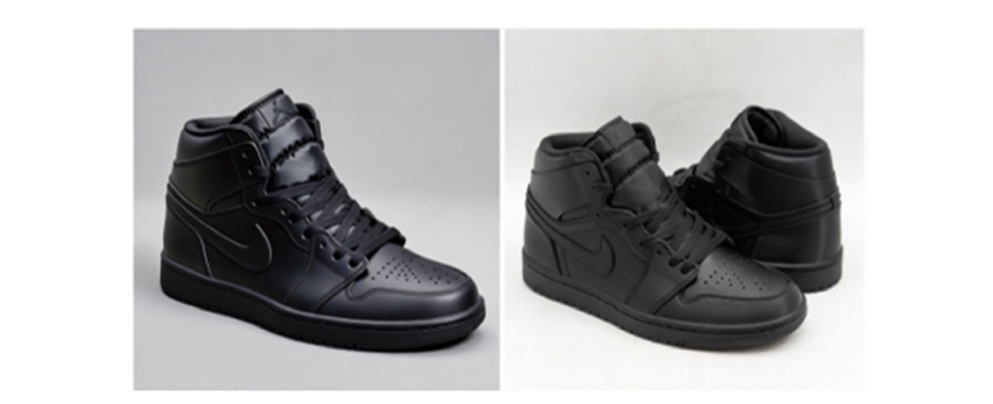
A high complexity Jordan sneaker model was 3D scanned, processed in Eureka Slicer, and printed on a Bambu Lab A1 printer using TPU 90A filament. With appropriate scaling, a complete pair was fabricated in 44 hours at an approximate material cost of $60 (Figure 1). This demonstrates that complex, previously inaccessible footwear designs can now be produced with high fidelity and reasonable efficiency. A highly detailed Jordan sneaker model was scanned, prepared in slicing software, and printed using TPU 90A on a Bambu Lab A1 printer. A complete pair took approximately 44 hours and cost around $60 in filament. This example clearly shows that complex, previously expensive footwear designs can now be produced locally with good quality and reasonable cost.
Figure 1:3D printed TPU 90A footwear model (Nike Jordan replica) produced on Bambu Lab A1 printer. Left: 3D model view; Right: printed pair (44 hours total, ~$60 material cost).
Flexible textiles and garments
TPU and TPE filaments are the primary materials for producing soft, stretchable, and wearable textile-like structures via FDM. Studies have shown that TPU exhibits significantly lower tensile stress than PLA, enabling better flexibility, tension recovery, and deformation recovery-properties essential for clothing applications [8]. Research on 3D printed knit fabric structures has confirmed that TPU is easier to tension and recover from tensile deformation compared to PLA, indicating strong potential for apparel use [9,10]. Chainmail inspired interlocked structures represent a particularly innovative class of 3D printed textiles. Researchers at NTU Singapore and Caltech have developed polyamide chain mail that remains flexible under normal conditions but becomes 25X stiffer when vacuum packed, enabling programmable stiffness for protective garments, exoskeletons, and soft robotics [11]. These geometrically interlocked discrete cells can be fabricated in one print cycle, eliminating assembly requirements.
Rigid and semi rigid accessories
For applications requiring structural stability-such as watches, jewelry, helmets, and decorative bag components-materials including Nylon (Polyamide), PLA, Polystyrene, and photopolymer resins are employed-1. Nylon, processed via SLS or FDM, enables highly complex lattice geometries with high tensile strength and dimensional stability, making it suitable for avant garde garments (e.g., Iris van Herpen‘s collections) and structural fashion accessories. SLA resins offer the highest surface quality and fine detail resolution, ideal for jewelry and intricate decorative pieces, though with lower impact resistance [12].
Metal filled and composite filaments
Copper filled PLA filaments (Cu PLA) contain up to 80 90wt% copper powder, providing the appearance, weight, and conductivity of metal while remaining printable on standard FDM systems equipped with hardened nozzles [13]. Applications in fashion include custom jewelry, decorative ornaments, and weighted accessories. However, such composites remain underexplored in fashion contexts due to higher printing demands (abrasive nozzles, precise temperature control). Recent parametric studies on Cu PLA have shown that infill percentage, pattern, and layer thickness significantly influence failure load and elongation at break, enabling optimization for specific design requirements [14].
Multi material integration via AMS
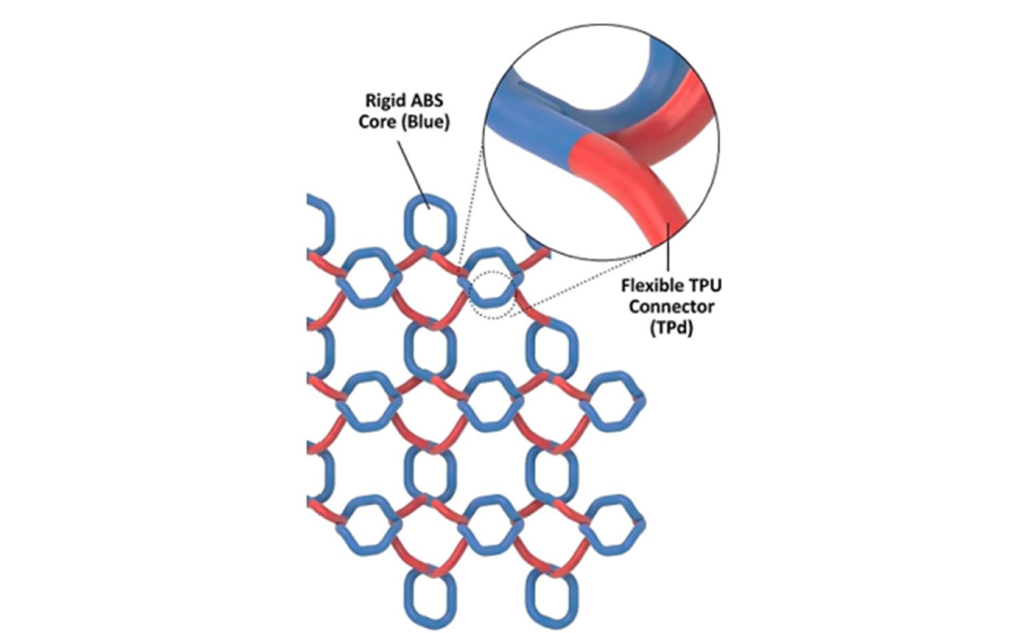
A largely unaddressed frontier is the simultaneous printing of dissimilar materials-such as ABS/ASA for rigid structural cores combined with TPU for flexible interconnects-within a single, continuous textile like fabric (Figure 2). Automatic Material Switching (AMS) systems, available on advanced consumer printers (e.g., Bambu Lab X1C, P1S, H2D), allow up to 16 materials to be swapped automatically during a print [15]. This capability enables:
• Graded mechanical properties: Graded transitions from
rigid to flexible zones within a single printed panel.
• Heterogeneous structures: Locking mechanisms where
rigid ABS cores are surrounded by flexible TPU links, producing
fabrics with both shape retention and elasticity.
• Multi color and multi texture effects: Simultaneous
aesthetic and functional customization.
Figure 2:Conceptual diagram of a multi material textile produced via AMS, combining rigid ABS cores (blue) with flexible TPU connectors (red) in a continuous single print process.
No systematic study has yet been published that maps the mechanical behavior of identical fabric patterns printed across these heterogeneous material combinations. This represents a significant research opportunity.
Emerging materials and effects
Color shifting (thermochromic/photochromic) filaments enable garments and accessories that change appearance in response to temperature or UV exposure-effects impossible with traditional textile manufacturing. Similarly, carbon fiber reinforced filaments (e.g., ASA CF) provide high stiffness to weight ratios and engineered aesthetics, though they remain underutilized in fashion due to their association with engineering applications [16].
Comparative Material Matrix
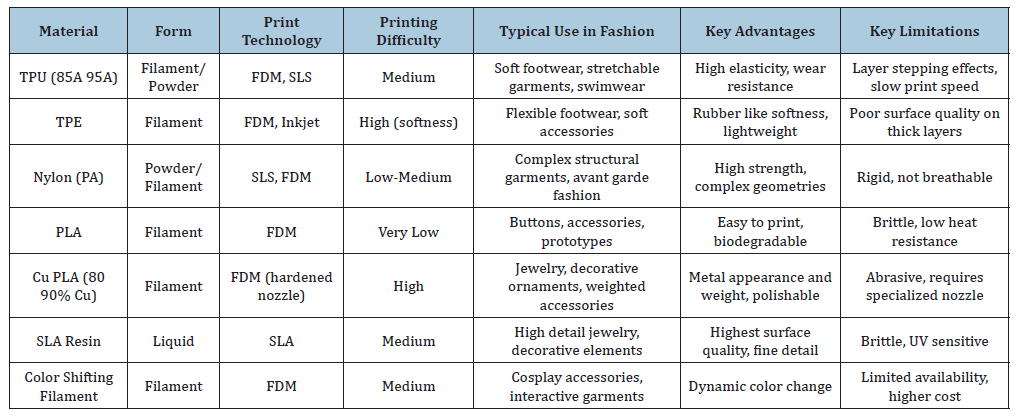
Table 1 summarizes key additive manufacturing materials relevant to fashion applications, including printability, mechanical properties, and typical use cases.
Table 1:Comparison of AM materials for fashion and textile applications. Data compiled from filament manufacturer specifications and experimental observations.
Sustainability Implications
Additive manufacturing offers substantial environmental benefits compared to traditional fashion production. A commissioned study by AMGTA and Stratasys demonstrated that AM print to textile production reduces CO₂ emissions by 24.8% compared to conventional processes, saves 49.9% of stock material across the supply chain, eliminates water consumption (saving over 300,000 liters for a production run of 8,000 shoe pairs), and cuts electrical energy consumption by over 64%. Furthermore, AM reduces supply chain dependencies from 4 technologies to 1 and compresses production stages from 12 to 2 [17]. These metrics underscore that beyond design innovation, AM aligns with circular economy principles: on demand production eliminates overstock waste, digital distribution replaces physical inventory, and emerging recycled material filaments (e.g., denim waste recycled into TPU) close material loops [18].
Research Gaps and Future Directions
Based on the review of existing literature and experimental observations, the following research gaps are identified:
A. Systematic parametric studies on identical textile patterns
across multiple materials - No comprehensive study has been
published that holds textile geometry (e.g., a specific chainmail
or auxetic pattern) constant while systematically varying
filament material (TPU, PLA, PETG, nylon, CF reinforced) and
measuring corresponding mechanical properties (tensile
strength, elongation, stiffness, recovery). Such a “material
property map” would provide designers with predictive design
tools.
B. Multi material functional textiles using AMS - The ability
to combine rigid (ABS, ASA, PC) and flexible (TPU, TPE)
materials within a single, continuous fabric structure has not
been systematically investigated. Future work should fabricate
graded panels and characterize their mechanical behavior
under tensile, bending, and cyclic loading.
C. Metal filled and specialty filaments in wearable applications
- Cu PLA, bronze filled, and carbon fiber filled filaments are
underutilized in fashion contexts. Their wearability, comfort,
and long-term durability require assessment.
D. Sustainable and recycled filaments for fashion AM
- Recycled TPU, bio-based elastomers, and leather waste
composites- are emerging, but standardized characterization
specific to textile applications is lacking.
Conclusion
This paper has surveyed the expanding landscape of additive manufacturing in fashion and functional textiles, highlighting the transition from prototyping to direct digital production of end use garments, footwear, and accessories. FDM technologies, particularly when enhanced with multi material AMS capabilities, offer a powerful platform for creating textile structures with spatially graded mechanical properties-from rigid structural zones to flexible, stretchable regions-in a single, seamless print process. Experimental reproduction of complex footwear models (44 hours, ~$60 cost) confirms the feasibility of domestic, distributed manufacturing of high value fashion items. Key material families (TPU, TPE, nylon, PLA, Cu PLA) have been characterized with respect to printability, mechanical behaviour, and application suitability. However, significant research opportunities remain, particularly in systematic multi material parametric studies and the development of textile geometry material property databases. As consumer 3D printing systems continue to advance in speed, material compatibility, and ease of use, the integration of AM into mainstream fashion production-from haute couture to everyday apparel-appears not only possible but inevitable.
References
- Casciani D, Ciurnelli M (2026) Supporting fashion eco-designers in 3D printing. Customized Methodologies, Physical and Digital Tools. In: Cantista I (Ed.), Global Fashion Conference, Cham, Switzerland, pp: 118-135.
- Akhoundi B, Mashayekhi A (2023) A mini-review of using additive manufacturing in the fashion & textile industry? Trends in Textile Engineering & Fashion Technology 7(5): 905-907.
- Akhoundi B, Safi Jahanshahi A, Abbassloo A (2024) G-code generation for deposition of continuous glass fibers on curved surfaces using material extrusion-based 3D printing. Engineering Research Express 6(1): 015401.
- Liu J, Hu L, Lui KW, Wong SWf Jiang Sx (2025) Design and characterization of breathable 3D printed textiles with flexible lattice structures. Journal of Manufacturing Processes 141: 48-58.
- Kantaros A, Katsantoni M, Ganetsos T, Petrescu N (2025) The evolution of thermoplastic raw materials in high-speed FFF/FDM 3D printing era: Challenges and opportunities. Materials 18(6): 1220.
- Xi T (2025) Metal additive manufacturing capabilities for footwear prototyping and product creation. Massachusetts Institute of Technology, USA.
- Mallakpour S, Radfar Z, Hussain CM (2024) 6 - Advanced application of additive manufacturing in the footwear industry: From customized insoles to fully 3D-printed shoes. In: Mallakpour S, Mustansar Hussain C (Eds.), Medical Additive Manufacturing pp: 153-178.
- Desai SM, Sonawane RY, More AP (2023) Thermoplastic polyurethane for three-dimensional printing applications: A review. Polymers for Advanced Technologies 34(7): 2061-2082.
- Fajardo JI, Farez MV, Paltán CA (2023) Experimental analysis of the relationship between textile structure, tensile strength and comfort in 3D printed structured fabrics. Polymers 15(1): 152.
- Lekeckas K, Stirbe J, Ancutiene K, Valusyte R (2023) Testing of 3D printing on textile fabrics for garments application within circular design. International Journal of Clothing Science and Technology 35(4): 627-647.
- Ransley M, Smitham P, Miodownik M (2017) Active chainmail fabrics for soft robotic applications. Smart Materials and Structures 26(8): 08LT02.
- Safaei B, Memarzadeh A, Asmael M, Sahmani S, Zeeshan Q, et al. (2024) Challenges and advancements in additive manufacturing of nylon and nylon composite materials: A comprehensive analysis of mechanical properties, morphology, and recent progress. Journal of Materials Engineering and Performance 33(13): 6261-6305.
- Ulkir O (2024) Investigation on the mechanical and thermal properties of metal-PLA composites fabricated by FDM. Rapid Prototyping Journal 30(10): 2113-2122.
- Moradi M, Mehrabi O, Rasoul FA, Mattie AA, Schaber F, et al. (2024) Enhancing 3D printing copper-PLA composite fabrication via fused deposition modeling through statistical process parameter study. Micromachines 15(9): 1082.
- Kalman O, Lazorík P, Rybarczyk J, Husár J (2026) Enhancing precision, efficiency, and adaptability in 3D printer monitoring through real-time control systems. In: Piteľ J, Iakovets A, Berladir K (Eds.), The 3rd EAI International Conference on Automation and Control in Theory and Practice, Springer Nature, Cham, Switzerland, pp: 45-57.
- Sharath BN, Yashas Gowda TG, Puttegowda M (2025) 15-Prospects of synthetic fiber-reinforced polymer composites in engineering and commercial applications. In: Puttegowda M, Yashas Gowda TG, B JS, Rangappa SM, Siengchin S (Eds.), Applications of Composite Materials in Engineering. Elsevier Science Ltd, pp: 365-395.
- Jung S, Kara LB, Nie Z, Simpson TW, Whitefoot KS (2023) Is additive manufacturing an environmentally and economically preferred alternative for mass production? Environmental Science & Technology 57(16): 6373-6386.
- Ronchini A, Moretto AM, Caniato F (2023) Adoption of additive manufacturing technology: Drivers, barriers and impacts on upstream supply chain design. International Journal of Physical Distribution & Logistics Management 53(4): 532-554.
© 2026 Behnam Akhoundi. This is an open access article distributed under the terms of the Creative Commons Attribution License , which permits unrestricted use, distribution, and build upon your work non-commercially.
Editor In Chief







.jpg)































Signup for Newsletter

Quick Links
 Editorial Board Registrations
 Submit your Article
 Best Paper of the Volume
 Reprints
 Refer a Friend
 Advertise With Us
Our Recent Edition

.jpg)



Top Editors




.jpg)

















.bmp)
.jpg)
.png)
.jpg)













.jpg)






.png)

.png)




.png)




Financial Support

Sponsors

Latest e-Books

Latest Video

 a Creative Commons Attribution 4.0 International License. Based on a work at www.crimsonpublishers.com.
Best viewed in
a Creative Commons Attribution 4.0 International License. Based on a work at www.crimsonpublishers.com.
Best viewed in 
 | Above IE 9.0 version