

- About Us
- Information
-

The Author ensures that the research has been conducted responsibly and ethically with adherence to all relevant regulations. read more..
- For Authors
- For Reviewer
- Manuscript Guidelines
- Membership
- Publication Ethics
-
- Journals
- Reprints
- e-Books
- Videos
- Policies
- Contact Us
 COVID-19
- Submissions



Full Text
Trends in Textile Engineering & Fashion Technology
Analyzing the Barriers and Challenges of Technology Transfer in the Textile Industry of Bangladesh
Saima Sultana Urmi1,2* and Md. Farhad Ahmed Bhuyan2,3
1BGMEA University of Fashion & Technology (BUFT), Nishatnagar, Turag, Bangladesh
2Bangladesh University of Textiles (BUTEX), Tejgaon, Bangladesh
3National Institute of Textile Engineering and Research (NITER), University of Dhaka, Nayarhat, Savar, Dhaka-1350, Bangladesh
*Corresponding author:Saima Sultana Urmi, BGMEA University of Fashion & Technology (BUFT), Nishatnagar, Turag, Dhaka-1230, Bangladesh Bangladesh University of Textiles (BUTEX), Tejgaon, Bangladesh
Submission: December 15, 2025; Published: May 22, 2026
ISSN 2578-0271 Volume11 Issue 5
Abstract
Technology is essential to developing and expanding many sectors, including the textile industry. There have been notable technological developments in Bangladesh’s textile and garment sector, supporting the nation’s GDP and employing millions of people. The industry does, however, have difficulties with energy use, safety, working conditions, and manufacturing efficiency. Delivering scientific and technological research results to the market requires technology transfer (TT). By bridging the technological gap between developed and developing countries, technology transfer promotes sustainability, efficiency, and creativity. The purpose of this study is to investigate the current status of technology advancement and examine the barriers and challenges of technology transfer in Bangladesh’s textile industry. In this study, 26 barriers have been selected from secondary data by literature review and listed in seven contexts of barriers. Particularly, selected barriers have been discussed by dividing them into two aspects, such as internal and external factors. Furthermore, this study also discussed some solutions for overcoming these barriers to transferring technology in the textile sectors of Bangladesh.
Keywords: Technology; Barriers; Textiles; Technology transfer
Introduction
Today’s human lives and progress have been significantly impacted by technology. The most effective resource for practically any industry to advance and grow is technology. The application of scientific and engineering principles to the design and management of all aspects of fibre, textile, and clothing processes, as well as their products and machinery, is known as textile technology. Bangladesh’s textile and apparel industry is acknowledged as a significant industry.
This industry has grown to be a significant production factor in the modern corporate environment. Similarly, large stitched fabrics are now produced by modern machinery like knitting and pleating machines, resulting from technological breakthroughs in the textile industry [1]. Bangladesh’s textile sector is well known for providing a steady flow of raw materials to the rapidly expanding apparel industry. Over 4 million people are employed in Bangladesh’s textile and apparel sector, with women accounting for the bulk of workers. About 11% of Bangladesh’s GDP comes from the textile and apparel sector [2]. However, the nation has fallen to third place behind China and Vietnam due to several problems with safety, working conditions, non-renewable energy use, and a lack of energy-efficient technologies. Technology transfer (TT) is an essential component of technological innovation since it describes the process of bringing scientific and technological research outcomes, as well as related skills and practices, to the market and broader society. Bangladesh’s textile and apparel industry must focus on developing technological fundamentals to adapt to global market dynamics and embrace organizational change for improvement. Technology transfer in the textile sector involves innovation and product development, process improvement, sustainability, knowledge exchange, globalization of markets, and commercialization of R&D [3]. It involves the exchange of new textile technologies, such as advanced weaving techniques, digital printing methods, and fibre production technologies, enabling manufacturers to produce higher-quality fabrics and diverse products [4]. It also helps in bridging the technological gap between developed and developing markets and enables manufacturers to scale new products and techniques. Technology transfer is a crucial factor in the textile sector, driving innovation, efficiency, and sustainability, enabling technological advancement and market growth. This study mainly presents an extensive overview of barriers that hinder the technology transfer in the textile sector in Bangladesh.
Research questions and objectives
This study addresses critical gaps in understanding technology
transfer barriers within Bangladesh’s textile industry context. The
following research questions guide this investigation:
Research questions: RQ1: What are the primary barriers
hindering effective technology transfer in Bangladesh’s textile
industry?
RQ2: How do internal and external factors differentially impact
technology adoption processes?
RQ3: What strategic interventions can effectively mitigate
identified barriers to enhance technology transfer?
Research objectives: To systematically identify and categorize
barriers affecting technology transfer in Bangladesh’s textile sector.
To analyse the relative impact of internal versus external
barrier factors.
To develop a comprehensive framework for understanding
barrier interdependencies.
To propose evidence-based solutions for overcoming
technology transfer obstacles.
Literature Review on Technology Transfer
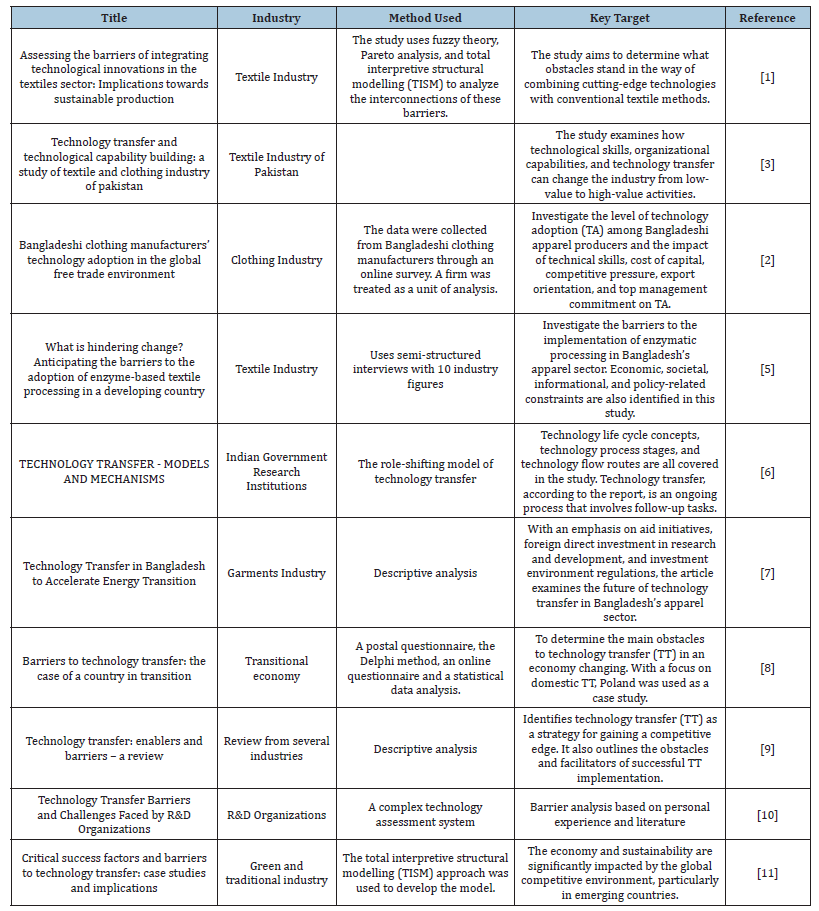
Transferring technology, technical skills, or knowledge from one organization to another is referred to as technology transfer. It covers a range of interactions between consumers and sources, including those involving private companies, governmental organizations, academic institutions, and even whole countries. The process by which concepts, proofs-of-concept, and prototypes go from the research to the manufacturing stages is referred to as technology transfer in large, research-intensive private companies. Table 1 summarizes the literature on technology transfer, especially based on the textile and RMG sectors [1-11].
Table 1:Summary of literature review on technology transfer.
Technology transfer in the context of the textile sector in Bangladesh
Technology transfer (TT) is the exchange of technology, information, and skills within the textile industry, aiming to enhance productivity, innovation, sustainability, and competitiveness by implementing new production methods, materials, and procedures. This process improves product quality, competitiveness, costeffectiveness, and environmental impact, contributing to Bangladesh’s GDP and maintaining a competitive edge.
Current Scenario of technological advancement in the Textile sector: Significant technological developments, such as automation, artificial intelligence, and the Internet of Things, are being felt in Bangladesh’s textile industry. Manufacturers can now meet rising demand, optimize supply chain management and product design, and streamline production processes thanks to these technologies. By linking machines, gadgets, and sensors, the Internet of Things (IoT) enables real-time production process monitoring and optimization [12]. Nonetheless, issues like high upfront investment costs, a lack of skilled workers, and cybersecurity risks must be resolved. Despite these obstacles, Bangladesh’s textile sector can establish itself as a world leader by producing high-quality goods with careful planning and ongoing innovation. IR 4.0, the fourth industrial revolution, integrates digital technologies, artificial intelligence, robotics, and IoT in manufacturing processes, transforming textile industries with smart factories, automation, and data-driven decision-making [13]. Bangladesh’s textile industry has adopted IR 4.0 technologies at a comparatively slow pace when compared to other nations, despite the potential advantages of this technology. Many textile factories have had difficulty implementing advanced technologies due to a lack of skilled workers, limited access to capital, and infrastructure issues. Nonetheless, a few of Bangladesh’s top textile producers have adopted IR 4.0 solutions to improve productivity and obtain a competitive advantage in the international market.
Benefits of technology transfer for the Textile sector: Technology transfer refers to the sharing of knowledge, skills, and technologies across businesses or countries. In Bangladesh’s textile business, innovative technology from wealthy countries is being used to improve efficiency, quality, and competitiveness. This technique increases productivity, enhances quality, lowers costs, and promotes innovation. Bangladesh’s textile sector may improve its competitiveness and efficiency by updating manufacturing methods, following best practices, and adopting cost-effective solutions [14].
Increased productivity
Bangladesh’s textile sector can modernize its production methods thanks to technology transfer, which boosts output and efficiency. Modern equipment and automation facilitate resource optimization, waste reduction, and operational efficiency
Better quality
Bangladeshi textile producers can raise the calibre of their goods by implementing advanced technologies and industry best practices from developed nations. This improves customer satisfaction in addition to making the industry more competitive on the global stage.
Cost reduction
Using cost-effective production techniques and solutions is a common part of technology transfer. Bangladesh’s textile industry can lower production costs, cut waste, and increase profit margins by utilizing new technologies.
Diversity and innovation
Within the textile sector, technology transfer promotes both of these traits. Bangladeshi businesses can join specialized markets, develop new product lines, and keep ahead of industry trends by using innovative technologies and procedures.
Development of skill<
Technology transfer is essential for creating capacity and developing skills. As local workers are trained to operate and maintain advanced machinery, they acquire valuable skills that can enhance their career prospects and contribute to the overall growth of the industry.
Barriers to Transferring and Integrating New Technology in the Context of the Textile Sector of Bangladesh
Bangladesh’s textile industry faces obstacles to transfer and technological integration. These include a lack of knowledge and comprehension among industry participants, restricted access to capital and resources, a conventional attitude and opposition to change, and limitations about infrastructure and connection. This sector has several obstacles to overcome to adopt and incorporate new technologies. The barriers to the seamless adoption and transfer of new technologies in Bangladesh’s textile industry will be examined in this article.
Barriers to technology transfer
In the context of the textile industry in Bangladesh, several barriers hinder the smooth transfer of technology for future advancement. By doing an extensive literature review, seven criteria of barriers are separated (Table 2) [15-34], which have an impact on transferring technology in the textile sector of Bangladesh.
Table 2:Barriers to technology transfer in the textile sector of Bangladesh.
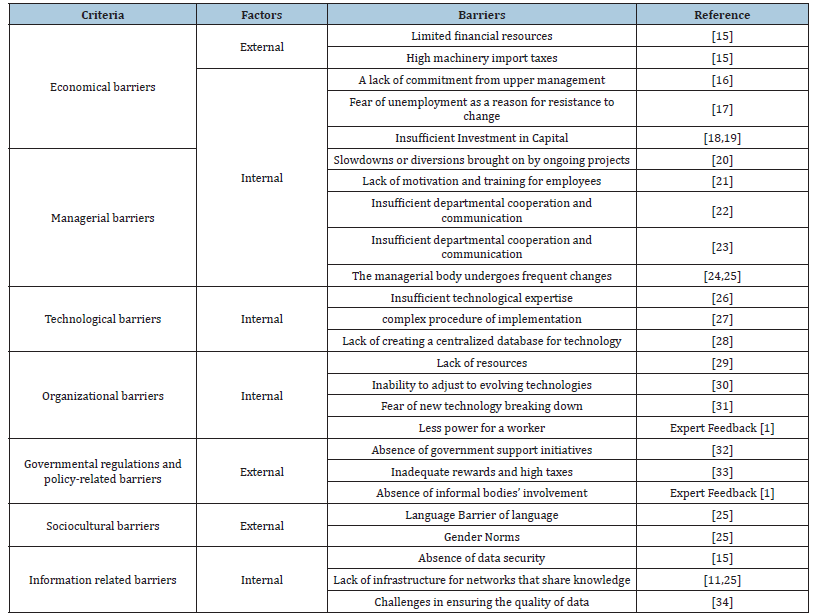
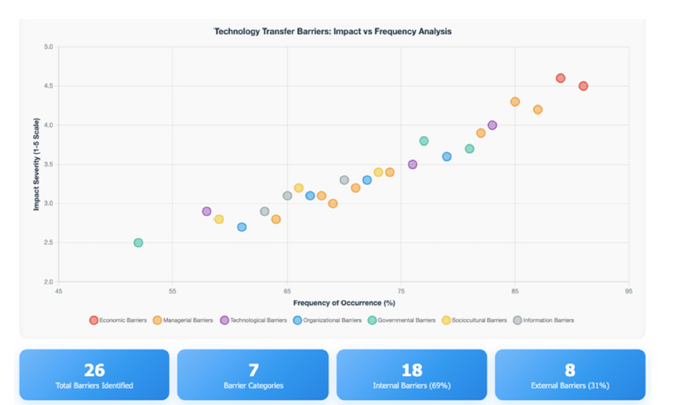
Figure 1 illustrates the relationship between barrier frequency and impact severity, providing a visual framework for prioritization. The matrix reveals that economic and managerial barriers cluster in the high-impact, high-frequency quadrant, validating their classification as critical priorities.
Figure 1:Technology transfer barriers - impact severity vs. frequency matrix. Barriers in quadrant I (high impact, high frequency) represent critical priorities requiring immediate intervention.
Barriers from internal & external aspects
Technology transfer is essential for innovation and progress in various industries. However, it can be a challenging process due to internal and external barriers. Internal barriers include poor communication, resistance to change, and lack of expertise. External barriers include intellectual property concerns, regulatory hurdles, and cultural differences [34]. Table 2 shows different barriers by dividing them into internal and external factors or categories. Organizations may lead effective technology transfer activities and maintain their competitive edge in the current business environment by comprehending and resolving the separating hurdles of technology transfer.
Evaluation of the barriers
Bangladesh’s textile industry faces several barriers to technology transfer and integration, including a lack of knowledge, restricted access to capital and resources, a conventional attitude, and limitations in infrastructure. These barriers include economic barriers such as limited financial resources and high machinery import taxes, managerial barriers like lack of commitment, fear of unemployment, insufficient investment in capital, slowdowns or diversions, lack of motivation, and insufficient departmental cooperation. Technological barriers include insufficient expertise, complex implementation procedures, and a lack of a centralized database. Organizational barriers include a lack of resources, fear of new technology breaking down, and less power for workers. Government regulations and policy-related barriers include a lack of support initiatives, inadequate rewards, high taxes, informal bodies’ involvement, sociocultural barriers, language barriers, gender norms, and traditional mindsets. To overcome these barriers, organizations must understand and resolve these hurdles to lead effective technology transfer activities and maintain their competitive edge.
Challenges Faced in Technology Transfer
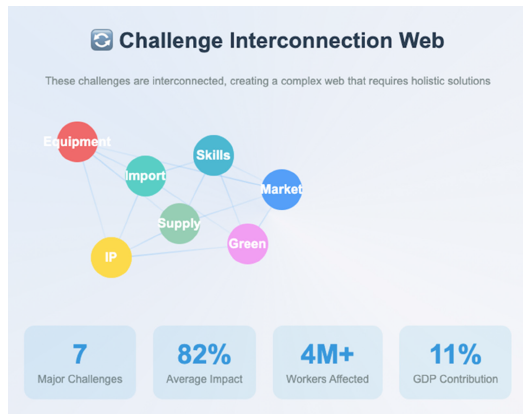
The growth and competitiveness of Bangladesh’s textile sector
are hampered by several unique technology transfer issues. Here
are a few important issues [33,34]:
A. Obsolete Equipment: A lot of textile businesses still use
antiquated machinery, which restricts their capacity to adopt
new technologies and increase output. One major obstacle to
effective manufacturing and innovation is a lack of investment
in contemporary machinery.
B. High Import Dependency: The sector is largely dependent
on imported raw materials, especially cotton, which can
make the process of knowledge transfer more difficult. This
dependence raises susceptibility to changes in the global
market and makes it challenging to apply regional remedies.
C. Skill Shortages: The workforce’s skill levels are noticeably
lacking, especially when it comes to using cutting-edge
technologies. Initiatives for upskilling are required to guarantee
that employees can use them.
D. Complexity of the Supply Chain: The textile business
depends on an intricate worldwide supply chain. It can
be difficult to integrate new technology across different
manufacturing and distribution phases, especially when
working with several partners and suppliers.
E. Intellectual Property Issues: It can be challenging to
protect technological transfer breakthroughs, particularly in
a global market where intellectual property regulations differ
greatly. Concerns about the theft of proprietary technologies
may result from this.
F. Sustainability Pressures: Textile companies must integrate
eco-friendly technologies while preserving profitability as
customer demand for sustainable practices rises. Research
and development expenditures for environmentally friendly
materials and procedures are necessary for this.
G. Market Dynamics: Consumer preferences and market
trends are vulnerable to swift changes in the textile sector. To
stay up with these changes, businesses need to be flexible in
their technology transfer procedures, which can be challenging
in a sector that has historically been conservative (Figure 2).
Figure 2:Challenge interconnection web.
Solutions to Overcome the Barriers
The enhancement of Bangladesh’s textile sector necessitates the implementation of comprehensive strategic interventions encompassing technological modernization, human capital development, financial assistance mechanisms, and strengthened research and development initiatives. These measures include streamlined regulatory frameworks to mitigate compliance burdens, fostering public-private partnerships, and implementing awareness campaigns to promote technological adoption. The development of locally contextualized solutions ensures alignment with existing industrial infrastructure and socio- economic conditions. Furthermore, financial support mechanisms, academic-industry collaborations, and expedited regulatory processes constitute essential components of this strategic framework. Awareness initiatives are crucial for transforming societal perceptions regarding innovation adoption within the manufacturing sector.
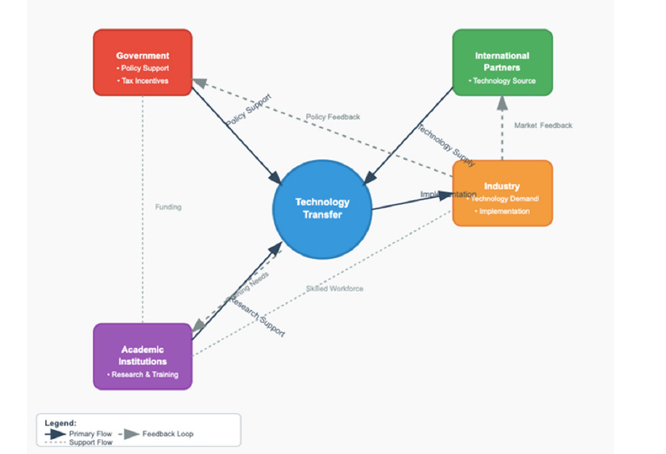
The success of these interventions depends on effective stakeholder collaboration and coordination. Figure 3 demonstrates the interconnected nature of stakeholder relationships required for successful technology transfer enhancement The systematic implementation of these strategic interventions is anticipated to yield enhanced global competitiveness, improved sustainability practices, and increased operational efficiency in international markets.
Figure 3:Stakeholder interaction network for technology transfer enhancement. Arrow thickness indicates interaction strength, with bidirectional arrows representing mutual dependencies in the collaborative ecosystem.
Conclusion
Technology transfer constitutes a fundamental mechanism within the textile industry, facilitating the dissemination of knowledge, technical competencies, and technological innovations across organizational and national boundaries. Within Bangladesh’s context, this phenomenon serves as a strategic instrument for enhancing operational efficiency, product quality, and competitive positioning through the modernization of manufacturing processes, adoption of industry best practices, and implementation of cost-effective technological solutions. These interventions consequently yield enhanced productivity, superior quality standards, cost optimization, product diversification, innovation capacity, and workforce skill enhancement. The assimilation of advanced technologies and established practices from developed economies enables Bangladeshi textile manufacturers to achieve improved customer satisfaction metrics and strengthened market competitiveness. Technology transfer facilitates diversification and innovation initiatives, enabling domestic enterprises to penetrate specialized market segments and develop novel product portfolios. Concurrently, skill development and capacity-building initiatives remain paramount, as the training of local personnel in advanced machinery operation and maintenance enhances individual career trajectories while contributing to sectoral growth.
Bangladesh’s textile industry encounters significant impediments to technology transfer and integration, including knowledge deficits, constrained capital access, traditional organizational cultures, and infrastructural limitations. Sectorspecific challenges encompass obsolete equipment, import dependency, skill gaps, supply chain complexity, intellectual property constraints, sustainability imperatives, and dynamic market conditions. The mitigation of these barriers necessitates comprehensive strategic interventions encompassing technological modernization, human capital development, financial assistance mechanisms, research and development enhancement, regulatory streamlining, public-private partnerships, awareness campaigns, and locally contextualized solutions. These measures collectively promote innovation, reduce compliance burdens, and enhance productivity. Furthermore, financial support, academic-industry collaborations, and expedited regulatory frameworks contribute to technological adoption awareness, ultimately fostering enhanced sustainability, competitiveness, and operational efficiency within global markets. Building upon the identified barriers and proposed solutions in Bangladesh’s textile industry, future research directions should focus on addressing the relationship among these barriers and finding out which barriers should be focused on more to overcome the challenges and efficient transfer of technology in Bangladesh.
Acknowledgement
The authors would like to express their sincere gratitude to all individuals and institutions who supported this research through their valuable insights and technical assistance. The authors declare that no funding was received from any agency, organization, or grant for the conduct of this study.
References
- Md Bin Alam F, Md Hosen I, Mridha JH, SE Chowdhury, Md Rahman A (2023) Assessing the barriers of integrating technological innovations in textiles sector: Implications towards sustainable production. Green Technologies and Sustainability 1(3): 100039.
- Park-Poaps H, Md Bari S, Sarker ZW (2021) Bangladeshi clothing manufacturers’ technology adoption in the global free trade environment. Journal of Fashion Marketing and Management 25(2): 354-370.
- (2019) Technology transfer and technological capability building: A study of textile and clothing industry of Pakistan Nazia Nazeer.
- Ali M, Salah B, Habib T (2024) Utilizing industry 4.0-related technologies and modern techniques for manufacturing customized products-Smart yogurt filling system. Journal of Engineering Research 12(3): 468-475.
- Rahman M, Billah MM, Hack-Polay D (2019) What is hindering change? Anticipating the barriers to the adoption of enzyme-based textile processing in a developing country. Business Strategy and Development 2(2): 137-147.
- The Journal of Technology Studies.
- 77_Focus-77.
- Jasinski AH (2009) Barriers for technology transfer: the case of a country in transition. Journal of Technology Management in China 4(2): 119-131.
- Kaushik A, Kumar S, Luthra S, Haleem A (2014) Technology transfer: Enablers and barriers-A review. International Journal of Technology, Policy and Management 14(2): 133-159.
- Mazurkiewicz A, Poteralska B (2017) Technology transfer barriers and challenges faced by R&D organisations. Procedia Engineering 182: 457-465.
- Martyniuk AO, Jain RK, Stone HJ (2003) Critical success factors and barriers to technology transfer: Case studies and implications. International Journal of Technology Transfer and Commercialisation 2(3): 306-327.
- Ghobakhloo M (2018) The future of manufacturing industry: A strategic roadmap toward Industry 4.0. Journal of Manufacturing Technology Management 29(6): 910-936.
- Stojkovic M (2023) Industry 4.0 maturity of Composite industry in the UK CUK Industry 4.0 maturity of the composites manufacturing industry in the UK.
- Vieira M, Lucato WC, Vanalle RM, Jagoda K (2014) Effective management of international technology transfer projects: Insights from the Brazilian textile industry. Journal of Manufacturing Technology Management 25(1): 69-99.
- Shahriar MM, Parvez MS, Islam MA, Talapatra S (2022) Implementation of 5S in a plastic bag manufacturing industry: A case study. Clean Eng Technol 8: 100488.
- Rafieyan A, Sarvari H, Chan DWM (2022) Identifying and evaluating the essential factors affecting the incidence of site accidents caused by human errors in industrial parks construction projects. International Journal of Environmental Research and Public Health 19(16): 10209.
- Ahmad S, Miskon S, Alabdan R, Tlili I (2020) Towards sustainable textile and apparel industry: Exploring the role of business intelligence systems in the era of industry 4.0. Sustainability 12(7): 2632.
- Norman F (2020) Key Factors to promote industry 4.0 readiness at Indonesian Textile and Clothing Firm. Engineering, Mathematics and Computer Science Journal (EMACS) 2(2): 73-83.
- Kazancoglu I, Kazancoglu Y, Kahraman A, Yarimoglu E, Soni G (2022) Investigating barriers to circular supply chain in the textile industry from Stakeholders’ perspective. International Journal of Logistics Research and Applications 25(4-5): 521-548.
- Xiao Z, Chen X, Dong MC, Gao S (2022) Institutional support and firms’ entrepreneurial orientation in emerging economies. Long Range Plann 55(1): 102106.
- Sarangee K, Schmidt JB, Srinath PB, Wallace A (2022) Agile transformation in dynamic, high-technology markets: Drivers, inhibitors, and execution. Industrial Marketing Management 102: 24-34.
- Shove E (1998) Gaps, barriers and conceptual chasms: Theories of technology transfer and energy in buildings. Energy Policy 26(15): 1105-1112.
- Stulga P, Whitfield RI, Love J, Evans D (2022) Towards sustainable manufacturing with industry 4.0: A framework for the textile industry. Proceedings of the Design Society 2: 283-292.
- Maware C, Parsley DM (2022) The challenges of lean transformation and implementation in the manufacturing sector. Sustainability 14(10): 6287.
- Yeung K, Bygrave LA (2022) Demystifying the modernized European data protection regime: Cross-disciplinary insights from legal and regulatory governance scholarship. Regul Gov 16(1): 137-155.
- Queiroz MM, Fosso Wamba S, Chiappetta Jabbour CJ, Machado MC (2022) Supply chain resilience in the UK during the coronavirus pandemic: A resource orchestration perspective. Int J Prod Econ 245: 108405.
- Sharma M, Joshi S, Luthra S, Kumar A (2022) Managing disruptions and risks amidst COVID-19 outbreaks: Role of blockchain technology in developing resilient food supply chains. Operations Management Research 15(1-2): 268-281.
- Javed AR, Shahzad F, Rehman S, Zikria YB, Razzak I, et al. (2022) Future smart cities: requirements, emerging technologies, applications, challenges, and future aspects. Cities 129: 103794.
- Moser C, Yared P (2022) Pandemic lockdown: The role of government commitment. Rev Econ Dyn 46: 27-50.
- Rybak A, Joostberens J, Manowska A, Pielot J (2022) The impact of environmental taxes on the level of greenhouse gas emissions in Poland and Sweden. Energies 15(12): 4465.
- Greiner MA, Franza RM (2003) Barriers and bridges for successful environmental technology transfer. The Journal of Technology Transfer 28: 167-177.
- Lin BW (2003) Technology transfer as technological learning: A source of competitive advantage for firms with limited R&D resources. R and D Management 33(3): 327-341.
- (2005) JBS 7(2), Combined.
- Haque M (2021) Technology transfer in agro-based industry of Bangladesh: Opportunities, challenges and options. The International Journal of Engineering and Science 10(10): 38-52.
© 2026 Saima Sultana Urmi. This is an open access article distributed under the terms of the Creative Commons Attribution License , which permits unrestricted use, distribution, and build upon your work non-commercially.
Editor In Chief







.jpg)































Signup for Newsletter

Quick Links
 Editorial Board Registrations
 Submit your Article
 Best Paper of the Volume
 Reprints
 Refer a Friend
 Advertise With Us
Our Recent Edition

.jpg)



Top Editors




.jpg)

















.bmp)
.jpg)
.png)
.jpg)













.jpg)






.png)

.png)




.png)




Financial Support

Sponsors

Latest e-Books

Latest Video

 a Creative Commons Attribution 4.0 International License. Based on a work at www.crimsonpublishers.com.
Best viewed in
a Creative Commons Attribution 4.0 International License. Based on a work at www.crimsonpublishers.com.
Best viewed in 
 | Above IE 9.0 version