

- About Us
- Information
-

The Author ensures that the research has been conducted responsibly and ethically with adherence to all relevant regulations. read more..
- For Authors
- For Reviewer
- Manuscript Guidelines
- Membership
- Publication Ethics
-
- Journals
- Reprints
- e-Books
- Videos
- Policies
- Contact Us
 COVID-19
- Submissions



Full Text
Trends in Textile Engineering & Fashion Technology
A Study of Scale Characteristics of Mongolian Cashmere Fibres
Sarangoo UKHNAA1,2,3, Wafa MAHJOUB1,2*, Jean Yves DREAN1,2 and Omar HARZALLAH1,2
1Université de Haute Alsace, Laboratoire de Physique et Mécanique Textiles (LPMT, UR 4365), 11 Rue Alfred Werner, 68093 Mulhouse, France
2Université de Strasbourg, 67081 Strasbourg, France
3Mongolian University of Science and Technology, Ulaan Baatar 14191, Mongolia, France
*Corresponding author:Wafa MAHJOUB, Université de Haute Alsace, Laboratoire de Physique et Mécanique Textiles (LPMT, UR 4365), 11 Rue Alfred Werner, 68093 Mulhouse, France
Submission: March 18, 2026; Published: April 08, 2026

ISSN 2578-0271 Volume11 Issue 4
Abstract
Cashmere is a fine down fibre obtained from specific goat breeds originating in Central Asia. Its performance in spinning and fabric formation is strongly influenced by the morphology of the cuticle scales. In this work, we investigate the scale characteristics of Mongolian cashmere fibres from goats of different strains, genders and ages. After establishing and validating a scouring procedure that does not damage the fibres, the surface morphology was examined by scanning electron microscopy (SEM) following procedures similar to IWTO Draft Test Method 58. The predominant scale pattern, scale shape and scale height were determined and compared with values reported in the literature for cashmere from other regions. Mongolian cashmere down fibres were found to be mainly covered with cylindrical or semi cylindrical scales with smooth and well spaced margins, while the coarse guard hairs exhibited short, irregular scales with wavy edges. The mean scale height of Mongolian cashmere fibres was approximately 0.5μm, slightly higher than previously reported values, but no significant differences were observed between samples from different strains, genders or ages..
Introduction
Cashmere is a fine down fibre obtained by combing or shearing a specific goat breed indigenous to Central Asia. These so-called cashmere goats possess a double coat, consisting of coarse guard hairs that cover and protect the underlying fine down fibres. The down fibres are separated from the guard hairs by dehairing and are then used to produce high quality cashmere garments..
Mongolia is the second largest producer of cashmere in the world, with an annual production of about 3800t of raw cashmere from approximately 10.8 million goats of various breeds and strains [1,2]. Understanding the specific properties of Mongolian cashmere is important for improving fibre quality and for distinguishing it from other origins [3,4].
Keratin fibres are covered by overlapping cuticle scales, oriented from the fibre tip towards the root. Scale characteristics such as shape, height and frequency are key parameters for identifying keratin fibres and for understanding their frictional behaviour. Previous studies have shown that cashmere fibre scales are predominantly cylindrical or semi cylindrical and are generally longer and thinner than those of wool [5-7]. Phan [8] reported that the surface morphology of Asian cashmere fibres is very similar despite the diversity of breeds and geographical regions. The scale height of speciality animal fibres is typically around 0.4μm. Kusch and Stephani [9] reported scale heights between 0.35 ± 0.01 and 0.39 ± 0.02μm for cashmere samples, and Chinese researchers obtained comparable values for cashmere from different areas of China.
The shape and height of the scales influence the friction coefficient of fibres and thus affect drafting, spinning performance and yarn structure. The aim of the present study is therefore to characterise the scale pattern and scale height of cashmere fibres from Mongolian goats of different strains, genders and ages, and to compare these characteristics with previously published data.
Experimental
Samples
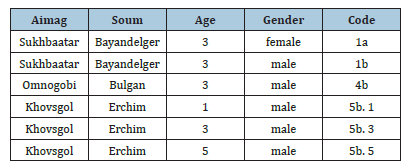
Six representative combed samples were collected from male and female goats of different strains and ages in various Mongolian regions. The sampling locations and codes are given in Table 1. Each sample contained both down fibres and guard hairs.
Table 1:Description of samples.
Scouring procedure
Because no standard laboratory scouring method for raw
cashmere fibre was available, a specific scouring procedure was
developed and its effect on fibre integrity was evaluated. A control
sample was scoured as follows:
• removal of waxes with petroleum ether,
• rinsing in water at 30 °C for 15 min,
• drying at 85 °C for 1 h.
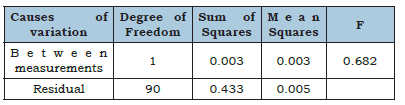
Tensile tests were performed on the control sample before and after scouring under identical conditions, and the corresponding strain energy values were compared (Figure 1). An analysis of variance (ANOVA) showed no significant difference between the energy values of the two series of measurements at a 95% confidence level (Table 2). We therefore concluded that the scouring procedure did not damage the cashmere fibres, and it was applied to all samples.
Figure 1:Tensile characteristics of the sample of control.
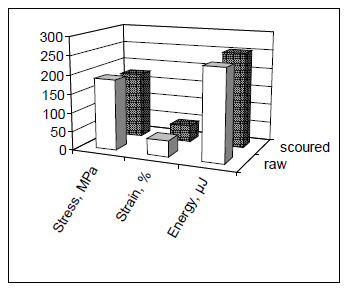
Table 2:ANOVA results.
Microscopic observations
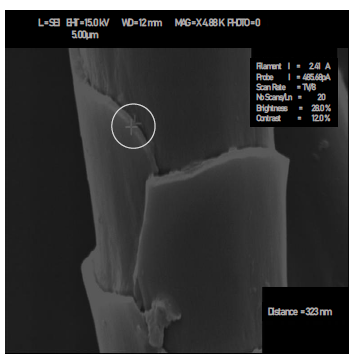
Sample preparation and scanning were carried out according to procedures similar to those described in IWTO Draft Test Method 58 for animal fibres, which later formed the basis of ISO 17751 and ISO 17751-2 [10] for determining scale pattern and height. Representative fibres were observed with a Hitachi S-2360N scanning electron microscope (SEM), and micrographs were recorded using a 35mm camera. Scale heights were measured on a Cambridge S4-10 SEM at a magnification of x1000. The scale height was defined as the distance between the upper and lower surfaces of a cuticle cell, as illustrated in Figure 2. For each sample, measurements were performed on a sufficient number of fibres to obtain reliable mean values and standard deviations.
Figure 2:Scale thickness measurement.
Results and Discussion
All samples contained two distinct fibre types: fine, short and flexible down fibres, and long, coarse guard hairs. Their scale structures differed markedly.
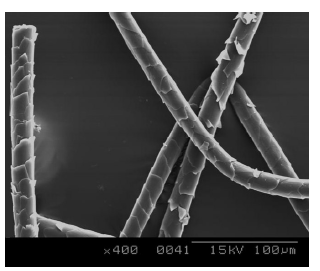
The guard hairs exhibited a regular mosaic like scale pattern. Their scales were relatively short, with wavy edges (Figure 3). In contrast, the scale pattern of cashmere down fibres showed some variation between fibres within a given sample and along the fibre length. More than 80% of the down fibres were covered by cylindrical or semi cylindrical scales with smooth, well defined and relatively distant margins (Figure 4). This scale shape remained fairly regular along the fibre length. These observations are consistent with the patterns reported for Chinese cashmere fibres.
Figure 3:SEM micrograph of a coarse guard hair showing scale structure.
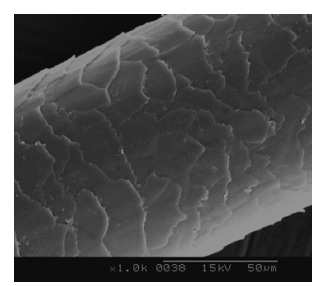
Figure 4:Typical scale shape of the Mongolian cashmere fibre.
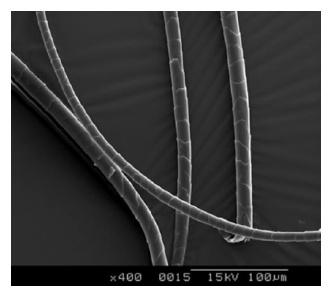
Figure 5:Down fibre with the scales with waved margins.
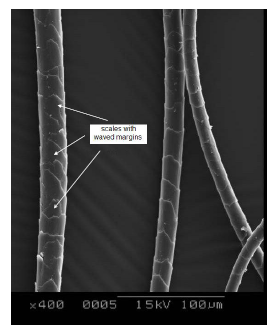
A small proportion of down fibres displayed different scale morphologies. Some fibres had irregular scales with rippled margins, while others presented arrow head shaped scales similar to those described for Australian cashmere (Figures 5&6). In addition, the scale margins of certain fibres in samples 5b.5 and 4b appeared damaged (Figure 7), although all samples were subjected to the same scouring procedure. This suggests that the damage is more likely related to the prior processing history or handling of those particular fibres rather than to the laboratory scouring.
Figure 6:Down fibre with arrow head shaped scales.
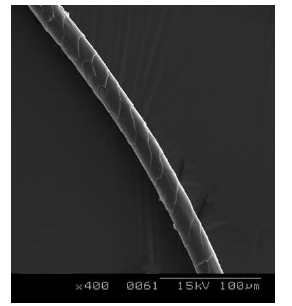
Figure 7:Damaged fibres.
Scale height measurements and statistical analysis
Figure 8:The mean scale height and its standard deviation.
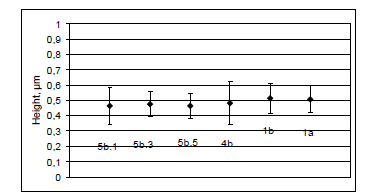
The scale height, defined as the distance between the upper and lower surfaces of a cuticle cell (Figure 2), was measured on micrographs taken at x1000 magnification. For each of the six samples, scale heights were measured on 30 randomly selected down fibres, with 5 measurements taken along the length of each fibre. A total of 900 measurements were performed. For statistical analysis, mean values per fibre (n=180) were used. Measurements were performed using the calibrated scale bar of the Cambridge S4- 10 SEM. The results are shown in Figure 8.
The mean scale height across all Mongolian cashmere samples was 0.50 ± 0.03μm (grand mean ± standard error of the mean), as shown in Figure 8. Individual sample means ranged from 0.47μm (sample 1a) to 0.53μm (sample 5b.3), with no clear relationship to goat strain, gender or age.
To assess whether these differences were statistically significant, a one-way analysis of variance (ANOVA) was performed on the six-sample means, using sample code as the grouping factor. The results are summarised in Table 3.
Table 3:ANOVA results for scale height between Mongolian cashmere samples.

The ANOVA yielded F (5,174) = 1.84, p=0.102, indicating no statistically significant differences in mean scale height between the six samples at the 95% confidence level (α=0.05). The relatively low F-ratio and p-value >0.05 confirm that variability between samples is of the same order of magnitude as within-sample variability.
Post-hoc analysis using Tukey’s Honest Significant Difference (HSD) test confirmed that no pairwise comparison between samples reached significance (all adjusted p>0.05). The 95% confidence interval for the overall mean scale height was [0.47- 0.53μm], entirely consistent with the observed range of sample means.
This mean scale height of 0.50μm for Mongolian cashmere is approximately 0.1μm higher than values reported by Kusch and Stephani [9] (0.35-0.39μm) and other authors for Asian cashmere [3-5] (~0.4μm). This difference may influence fibre friction behaviour during spinning.
Several factors may explain this difference:
A. Measurement methodology: Different SEM operating
conditions (accelerating voltage, sample preparation, tilt angle)
can affect apparent scale height.
B. Fibre selection: Our measurements targeted medial
sections of down fibres, potentially capturing more developed
scales than tip regions measured in some studies.
C. Geographical origin: Mongolian cashmere may genuinely
exhibit slightly thicker scales, possibly related to environmental
adaptation.
The coefficient of variation (CV) of scale height within samples ranged from 5.8% to 7.2%, confirming good measurement reproducibility and the structural homogeneity of Mongolian cashmere cuticle scales regardless of goat strain, gender or age.
Conclusion
Mongolian cashmere down fibres are predominantly covered by cylindrical or semi cylindrical scales with smooth and well-spaced margins, while the coarse guard hairs exhibit short, irregular scales with wavy edges. The mean scale height of the Mongolian cashmere fibres investigated is about 0.5μm, slightly higher than values previously reported for cashmere from other regions, but the differences remain small. No significant influence of goat strain, gender or age on scale shape or scale height was observed. These findings confirm the characteristic scale morphology of Mongolian cashmere and provide additional data for the identification and quality assessment of speciality animal fibres.
Acknowledgement
We are very grateful to Dr Kim Ho Phan from the Deutsches Wollforschungsinstitut, Aachen, Germany, for his valuable assistance with the experimental work.
References
- MNCCI (2024) Mongolian Cashmere Industry Overview 2024. Mongolian National Chamber of Commerce and Industry, Ulaanbaatar, Mongolia.
- FAO (2025) FAOSTAT - “Live Animals and Production Data". Food and Agriculture Organization of the United Nations.
- Ukhnaa S (2005) Cashmere fiber: Characterization and spinnability criteria. PhD Thesis, Université de Haute Alsace, Mulhouse, France.
- Mahjoub W, Ukhnaa S, Drean JY, Harzallah O (2024) Influence of genetic and non-genetic factors on the physical and mechanical properties of mongolian cashmere fiber properties. Fibers 12(10): 84.
- Burns RH, Von Bergen W, Young SS (1962) Cashmere and the undercoat of domestic and wild animals. Journal of Textile Institute 53: 175.
- Tserensodnom D (1969) Crossbreeding of mongolian native goat with Pridon breed in Gobi. PhD thesis, Veterinary Academia of Moscow, USSR, Russia.
- Knott J (1990) Fine animal fibers and their depigmentation process. Comett Eurotex, Guimaraes, Portugal.
- Phan KH, Wortmann FJ, Arns W (1995) Characterization of cashmere. In: Proceeding of International Wool Textile Research Conference. Biella, Italy, pp: 571-579.
- Kusch P, Stephani G (1984) Quantitative determination of animal fibres in mixtures with wool and synthetic fibers. Schriftenr Dtsch Wollf Inst 96(4983).
- Wortmann FJ, Phan KH, Augustin P (2003) Quantitative fiber mixture analysis by scanning electron microscopy: Part VI: possibilities and limitations of the analysis of binary specialty fiber/wool blends in view of test method IWTO-58. Textile Research Journal 73(9): 781-786.
© 2026 Wafa MAHJOUB. This is an open access article distributed under the terms of the Creative Commons Attribution License , which permits unrestricted use, distribution, and build upon your work non-commercially.
Editor In Chief







.jpg)































Signup for Newsletter

Quick Links
 Editorial Board Registrations
 Submit your Article
 Best Paper of the Volume
 Reprints
 Refer a Friend
 Advertise With Us
Our Recent Edition

.jpg)



Top Editors




.jpg)

















.bmp)
.jpg)
.png)
.jpg)













.jpg)






.png)

.png)




.png)




Financial Support

Sponsors

Latest e-Books

Latest Video



