

- About Us
- Information
-

The Author ensures that the research has been conducted responsibly and ethically with adherence to all relevant regulations. read more..
- For Authors
- For Reviewer
- Manuscript Guidelines
- Membership
- Publication Ethics
-
- Journals
- Reprints
- e-Books
- Videos
- Policies
- Contact Us
 COVID-19
- Submissions



Full Text
Trends in Textile Engineering & Fashion Technology
Recent Progress in Hollow-Core Fibers
Wei Gao, Weizhen Zhu, Xiaokang Ma, Qiujun Ruan, Zhijun Luo, Yabin Pi, Zhenggang Lian*
Yangtze Optical Electronic Co. Ltd., Wuhan 430205, China
*Corresponding author:Zhenggang Lian, Yangtze Optical Electronic Co. Ltd., Wuhan 430205, China
Submission: October 31, 2025;Published: November 19, 2025

ISSN 2578-0271 Volume11 Issue 2
Abstract
This paper reviews the development of hollow-core fibers, outlines their applications based on superior performance, and discusses prospects for the technology.
Keywords:Hollow-core fiber; Hollow-core anti-resonant fiber; Hollow-core photonic bandgap fiber
Introduction
Since the theory of optical waveguide was proposed in 1966 [1], optical fibers have rapidly become the major role of global communication networks, and multiple fields such as fiber sensing and fiber lasers have been developed [2-3]. Reducing loss has been a primary goal in the development of fibers. However, despite significant efforts, the loss of traditional solid-core fiber has only been decreased by 0.0087dB/km in the last 22 years (from 0.1484 in 2002 [4] to 0.1397dB/km in 2024 [5]). Furthermore, the performance of conventional solidcore fibers in terms of damage threshold, delay, and radiation resistance is also insufficient to meet the requirements of new application scenarios such as high-power laser delivery and high-precision fiber optic gyroscopes.
Hollow-core fiber (HCF) seems to be an ideal optical waveguide [6], the greatest contribution of which is to confine light transmission within the air core, thereby overcoming the ultimate limitation of conventional solid-core fiber-the intrinsic constraints of silica materials. Based on the light-guiding mechanism, HCF are divided into hollow-core photonic bandgap fiber (HC-PBGF [7]) and hollow-core anti-resonant fiber (HC-ARF [8]). From the current development perspective, HC-ARF appear to have the upper hand when the goal is to achieve ultra-low loss. The latest result, reported by Microsoft and University of Southampton to show that HC-ARF have achieved an ultra-low loss of 0.05dB/km at 1550nm, which is nearly three times lower than that of conventional solid-core fiber.
This paper reviews the development of HCF and summarizes recent advancements in their applications, including high-power laser delivery and fiber-optic gyroscopes. Finally, we provide an outlook on future directions for the HCF.
The development of HCF
The development of HCFs is shown in Figure 1. The concept of photonic crystal fiber was first proposed by Philip Russell at the University of Bath in 1991. The first photonic crystal fiber was successfully fabricated in 1997 [9]; however, this initial demonstration was still based on an index-guiding mechanism, meaning it retained a solid-core structure. Two years later, Russell’s team fabricated the world’s first hollow-core photonic crystal fiber (also known as HC-PBGF), which experimentally demonstrated for the first time that light could be guided within an air core [10]. Subsequently, efforts to advance HC-PBGFs focused on strategies such as increasing the cladding air-filling ratio and improving the purity of the fiber preform materials [11]. However, as research progressed, a fundamental limitation emerged: a unique mode inherent to HC-PBGFs, known as the surface mode [12], proved exceptionally difficult to eliminate. This issue confined the transmission loss of HC-PBGFs to the range of 3-5dB/km [13] (with a record low of 1.2dB/km reported by the University of Bath in 2005 [14]). Ultimately, due to the persistent challenge of further loss reduction, HC-PBGFs were gradually abandoned.
Figure 1:The development of hollow-core fibers.
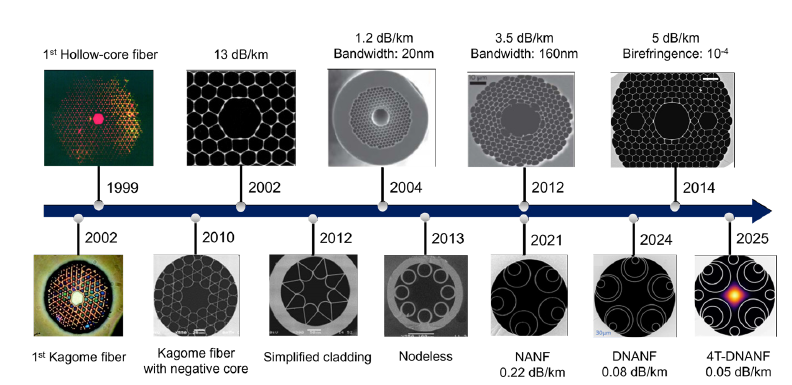
The rapid development of HC-ARF has rekindled researchers’ interest in HCF. The earliest HC-ARF was a Kagome-cladding fiber reported in 2002 by Fetah Benabid at the University of Bath [15]. This fiber attracted significant attention because its cladding holes lacked a strictly periodic arrangement, yet it could still guide light through an air core. This led to the understanding that a different light-guiding mechanism-anti-resonant guidance [16]-was at work, distinct from the photonic bandgap effect. Over the past decade, researchers have proposed various theoretical models to explain this guiding mechanism, which has greatly accelerated the advancement of HC-ARF. Key breakthroughs contributing to the reduction in transmission loss include the introduction of a negative-curvature core [17], nodeless design [18], and multi-reflection layers [18]. As a result, the attenuation of HC-ARFs has decreased by four orders of magnitude over two decades, achieving a record low loss of 0.05dB/ km and a single-draw length of up to 83km. Notably, beyond ultralow loss, HC-ARF also exhibits excellent performance in terms of delay, bandwidth, radiation resistance, and damage threshold. These superior properties have greatly facilitated their application in ultra-broadband communication networks, high-power laser delivery, and high-precision fiber optic gyroscopes.
The application of HCF
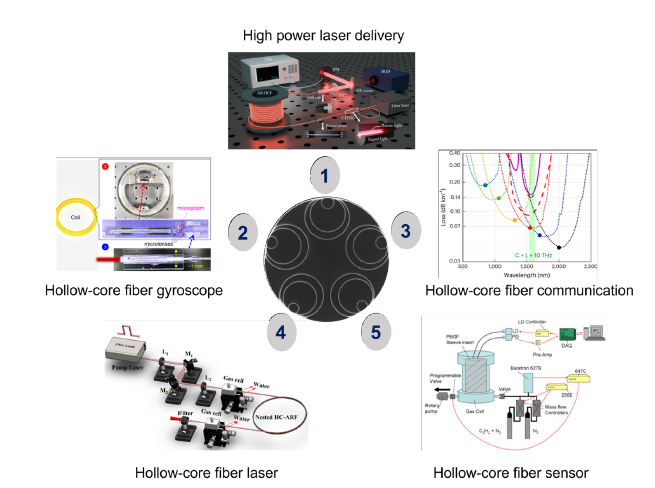
The applications of HC-ARFs are determined by their advantages as shown in Figure 2. Considering the ultra-low loss, ultra-low delay and ultra-low dispersion, they can be applied in fiber communication networks and delay-sensitive systems [19]; considering their ultrahigh damage threshold and ultra-low nonlinearity, they are suitable for high-power laser delivery, including KW-level continuous-wave lasers [20-21] and GW-level pulsed lasers [22]; and due to their radiation resistance, they can be used in high-precision fiber optic gyroscope systems [23]. Additionally, when HC-ARFs are extended to wavelength bands such as the ultraviolet [24], visible [25] and mid-infrared [26], they exhibit better performance than existing solid-core optical fibers. Except HC-ARF, HC-PBGF is mostly used in sensing field, such as irradiation environment [27].
Figure 2:The application of hollow-core fibers.
Summary
As an emerging technology, HCFs have transitioned from theory to reality, and advanced from laboratory research to mass production after more than two decades of development. While HCPBGFs have not demonstrated significant advantages in ultra-low loss, they can achieve a high birefringence on the order of 10⁻⁴ and a millimeter-scale bending radius [28]-performance metrics that remain challenging for HC-ARFs to match. In contrast, the absolute advantages of HC-ARFs have facilitated their demonstration applications in multiple fields and attracted attention from researchers worldwide such as ultra-low loss, ultra-low delay and other aspects. Looking ahead, further increasing the single drawing length, optimizing the uniformity of fiber structure, and promoting their widespread application in more fields will be the development trends of HC-ARFs.
References
- Kao KC, Hockham GA (1966) Dielectric-fibre surface waveguides for optical frequencies. Proceedings of the Institution of Electrical Engineers 113(7): 1151-1158.
- Giallorenzi TG, Bucaro JA, Dandridge A, Sigel GH, Cole JH, et al. (1982) Optical fiber sensor technology. IEEE Transactions on Microwave Theory and Techniques 30(4): 472-511.
- Shi W, Fang Q, Zhu X, et al. (2014) Fiber lasers and their applications. Applied Optics 53(28): 6554-6568.
- Nagayama K, Kakui M, Matsui M, Saitoh T, Chigusa Y (2002) Ultra-low-loss (0.1484 dB/km) pure silica core fibre and extension of transmission distance. Electronics Letters 38(20): 1168-1169.
- Sato S, Kawaguchi Y, Sakuma H, et al. (2024) Record low loss optical fiber with 0.1397 dB/km. Optical Fiber Communication Conference 2024: Tu2E. 1.
- Komanec M, Dousek D, Suslov D, Zvanovec S (2020) Hollow-core optical fibers. Radioengineering 29(3): 417-430.
- Poletti F, Petrovich MN, Richardson DJ (2013) Hollow-core photonic bandgap fibers: Technology and applications. Nanophotonics 2(5-6): 315-340.
- Ding W, Wang YY, Gao SF, Wang ML, Wang P (2019) Recent progress in low-loss hollow-core anti-resonant fibers and their applications. IEEE Journal of Selected Topics in Quantum Electronics 26(4): 1-12.
- Birks TA, Knight JC, Russell PSJ (1997) Endlessly single-mode photonic crystal fiber. Optics letters 22(13): 961-963.
- Cregan RF, Mangan BJ, Knight JC, Birks TA, Russell PS, et al. (1999) Single-mode photonic band gap guidance of light in air. Science 285(5433): 1537-1539.
- Smith CM, Venkataraman N, Gallagher MT, Muller D, West JA, et al. (2003) Low-loss hollow-core silica/air photonic bandgap fibre. Nature 424(6949): 657-659.
- West J, Smith C, Borrelli N, Allan D, Koch K (2004) Surface modes in air-core photonic band-gap fibers. Optics Express 12(8): 1485-1496.
- Poletti F, Wheeler NV, Petrovich MN, Baddela N, Fokoua EN, et al. (2013) Towards high-capacity fibre-optic communications at the speed of light in vacuum. Nature Photonics 7(4): 279-284.
- Roberts PJ, Couny F, Sabert H, Mangan B, Williams D, et al. (2005) Ultimate low loss of hollow-core photonic crystal fibres. Optics Express 13(1): 236-244.
- Benabid F, Knight JC, Antonopoulos G, St J Russell P (2002) Stimulated Raman scattering in hydrogen-filled hollow-core photonic crystal fiber. 298(5592): 399-402.
- Wang YY, Light PS, Benabid F (2008) Core-surround shaping of hollow-core photonic crystal fiber via HF etching. IEEE Photonics Technology Letters 20(12): 1018-1020.
- Kolyadin AN, Kosolapov AF, Pryamikov AD, Biriukov AS, Plotnichenko VG, et al. (2013) Light transmission in negative curvature hollow core fiber in extremely high material loss region. Optics express 21(8): 9514-9519.
- Poletti F (2014) Nested antiresonant nodeless hollow core fiber. Optics Express 22(20): 23807-23828.
- Wheeler NV, Petrovich MN, Slavik R, et al. (2012) Wide-bandwidth, low-loss, 19-cell hollow core photonic band gap fiber and its potential for low latency data transmission. National Fiber Optic Engineers Conference. Optica Publishing Group 2012: PDP5A. 2.
- Mulvad HCH, Abokhamis Mousavi S, Zuba V, Xu L, Sakr H, et al. (2022) Kilowatt-average-power single-mode laser light transmission over kilometre-scale hollow-core fibre. Nature Photonics 16(6): 448-453.
- Shi J, Rao B, Chen Z, Wang Z, Sun G, et al. (2025) All-fiber highly efficient delivery of 2kW laser over 2.45km hollow-core fiber. Nature Communications 16(1): 8965.
- Lekosiotis A, Belli F, Brahms C, Sabbah M, Sakr H, et al. (2023) On-target delivery of intense ultrafast laser pulses through hollow-core anti-resonant fibers. Optics express 31(19): 30227-30238.
- Li M, Sun Y, Gao S, Zhao X, Hui F, et al. (2025) Navigation-grade interferometric air-core antiresonant fibre optic gyroscope with enhanced thermal stability. Nature Communications 16(1): 3449.
- Mears R, Harrington K, Wadsworth WJ, Knight JC, Stone JM, et al. (2024) Guidance of ultraviolet light down to 190nm in a hollow-core optical fibre. Optics Express 32(6): 8520-8526.
- Fu Q, Davidson IA, Mousavi SMA, et al. (2024) Hollow‐core fiber: Breaking the nonlinearity limits of silica fiber in long‐distance green laser pulse delivery. Laser & Photonics Reviews 18(4): 2201027.
- Fu Q, Wu Y, Davidson IA, Xu L, Jasion GT, et al. (2022) Hundred-meter-scale, kilowatt peak-power, near-diffraction-limited, mid-infrared pulse delivery via the low-loss hollow-core fiber. Optics Letters 47(20): 5301-5304.
- Gu S, Lian Z, Yu Q, Xu J, Huang B, et al. (2023) Radiation-induced attenuation of hollow-core photonic bandgap fiber for space applications. Infrared Physics & Technology 131: 104709.
- Fini JM, Nicholson JW, Mangan B, Meng L, Windeler RS, et al. (2014) Polarization maintaining single-mode low-loss hollow-core fibres. Nature Communications 5(1): 5085.
© 2025 Zhenggang Lian. This is an open access article distributed under the terms of the Creative Commons Attribution License , which permits unrestricted use, distribution, and build upon your work non-commercially.
Editor In Chief







.jpg)































Signup for Newsletter

Quick Links
 Editorial Board Registrations
 Submit your Article
 Best Paper of the Volume
 Reprints
 Refer a Friend
 Advertise With Us
Our Recent Edition

.jpg)



Top Editors




.jpg)

















.bmp)
.jpg)
.png)
.jpg)













.jpg)






.png)

.png)




.png)




Financial Support

Sponsors

Latest e-Books

Latest Video

 a Creative Commons Attribution 4.0 International License. Based on a work at www.crimsonpublishers.com.
Best viewed in
a Creative Commons Attribution 4.0 International License. Based on a work at www.crimsonpublishers.com.
Best viewed in 
 | Above IE 9.0 version