

- About Us
- Information
-

The Author ensures that the research has been conducted responsibly and ethically with adherence to all relevant regulations. read more..
- For Authors
- For Reviewer
- Manuscript Guidelines
- Membership
- Publication Ethics
-
- Journals
- Reprints
- e-Books
- Videos
- Policies
- Contact Us
 COVID-19
- Submissions



Full Text
Strategies in Accounting and Management
There’s Not Enough Value Being Generated
John P O’Connell1* and Arthur Jonath2
1 Professor Emeritus, Department of Chemical Engineering, University of Virginia, Charlottesville, VA, USA
2 Co-founder, Profit and Entropy, Portola Valley, CA, USA
*Corresponding author:John P O’Connell, Professor Emeritus, Department of Chemical Engineering, University of Virginia, Charlottesville, VA, USA
Submission:August 26, 2026;Published: September 28, 2026

ISSN:2770-6648Volume6 Issue 3
Abstract
There are many sources of the nation’s current economic angst and malaise including: growing income and wealth inequality, overemphasis on economic efficiency relative to social equity, little access to essentials such as health, food and shelter for too many in our society, corruption and greed in industry and government, financial engineering schemes to avoid taxes. These arise from insufficient creation of economic value for growth and general well-being, while massive profits are dispersed to idle accounts and unproductive assets. We identify a policy for profit allocation toward economic and social value while preserving agent independence and choices for profit distribution.
Introduction
Pernicious economic inequality, profit shifting, labor displacement, and buybacks that do not add value are growing elements of the American economy [1-5]. Executives of large corporations, abetted by politicians, are increasingly directing earnings away from the value creation needed for strengthening and stabilizing the economy through innovation, investing in employee competence, productivity and satisfaction, enhancing health, safety and environmental protections, and promoting social well-being. These destructive actions occur because distribution of corporate profits is mostly in the hands of executives motivated by rewards they receive from increased stock prices. While abuses might be controlled by tax policies and regulations, current taxing seems unable to constrain misallocation and tax avoidance for reasons explained below. A significant aspect of this development is that until very recently, taxation was considered necessary for quality social functioning. In Paul Krugman’s interview of Vanessa Williamson about her book, “The Price of Democracy”, [5] she states, “Most Americans say that paying taxes is patriotic. If you ask people what their top concerns are about the tax system, their top two concerns for literally decades have been that corporations and the wealthy are not paying their share.” In other words, Americans do not consider the current tax system to be fair. The data compiled by Balkir et al. [6] show this is warranted. They estimate the total effective tax rate, i.e., all taxes paid as proportion of economic income, for the top 0.0002% (approximately the “top 400”) averaged 24% in 2018–2020 compared with 30% for the full population and 45% for top labor income earners. Further, the top 400 rate fell from 30% in 2010-2017 to 24% in 2018–2020, indicating the inequities are worsening.
Williamson traces the history of attitudes toward taxes, showing that until recently, especially during World War II, most segments of American society accepted the necessity of taxes and did not agitate against them. In the past few decades, political movements to limit or reduce taxes, especially for high-income earners and corporations, have appeared because “government is too large, wasteful, and corrupt”. Despite a lack of popular support and social safety net deprivation, the current federal administration has furthered these initiatives, with strong support from the ultra-wealthy and large corporations, by allowing enormous wealth accumulation that does not add value to the economy and skews fairness. Further, if a system is considered unfair, social cohesion and trust deteriorate [7,8]. Exacerbating the situation, the enormous and increasing federal debt has begun to trouble even those who recently were not concerned about its impact. Tax cuts by recent federal administrations have caused the debt to begin outrunning GDP increases so the debt may no longer be serviceable and could crush the economy. While some call for austerity to meet the challenge, this is not likely to be the solution [9,10]. This troubling scenario demands a different view for collecting resources for economic and social health. Traditional mechanisms are flawed by collecting receipts without affecting firm behavior, as well as suffering from complexity, loopholes, and not being applied to transactions of resources already removed from the economic system. Exacting a portion of profits must not only be effective, their basis and rationale must be acceptable to both populace and capitalists. Most people believe in social support programs and want business to contribute its fair share. If there are to be limitations on profit retention and allocation, businesspeople want options. Further, when solving complex problems, policy makers need vision about outcomes and acceptance and to be creative in finding acceptable solutions.
Here we discuss the proposed Non-Value-Added Tax (NVAT), a new tax which would introduce a large change in focus and reliability with only small changes for computation and collection. It is a policy and mechanism that simultaneously accomplishes the positive objectives and obviates the negatives of multiple problems while meeting the concerns of the public and business. We assert that fairness is enhanced when those who direct profits toward genuine value are rewarded relative to those who extract profit without adding value. Implementing such a policy with taxes means the greater the added value, the lower the tax, with higher taxes when added-value is decreased. To be feasible, an objective measure of value and a scale for calculating the tax are required. The next section gives practical definitions of profit and value on which to build a tax system. The following section describes how the tax would be determined from available information and be collected from consumer-producer transactions as well as those by the ultra-wealthy for further accumulation. After that is a brief discussion of how NVAT differs from common tax policies, followed by indicators of NVAT effectiveness. Elaborations on these topics are in Jonath [11].
Profit, value, and worth
Profit is the difference between price and cost. In large part, transactions are driven by producers earning a profit over the costs of the goods and services provided. Costs for constructing and marketing a good or service are returned to the economic system principally as worker wages and government payments. Economic strength depends on efficiency in costs and the creation of profits but deteriorates when economic activity declines. More subtly, how profits are used also affects the economy. Withholding profits to build wealth is equivalent to tax avoidance, causing segments of society to suffer in the same way. Profits not used to create value within the system are confiscatory. Taxes can be a suitable mechanism to discourage such profit extraction when applied properly. Consumers often conflate value, worth, and price. An original definition of value was in the Labor Theory of Value [12] where value equaled cost. Roncaglia [13] describes differences among economists in judging value, including identifying value with price. Though worth is generally associated with wealth, which is usually accumulated from retained profits, transactional worth is the same as price. We wish to establish a quantitative basis for taxing profits. As a result, all terms need to have numbers assigned to them. This can be accomplished by the following relations:
Worth = Price
Value = Cost
Profit = Price - Cost
Each quantity on the right-hand side is already part of ordinary accounting records, so the variables on the left-hand side can be evaluated. Relative amounts of tax can then be calculated from them.
The NVAT system of collection and dispersion
The objective is to encourage producers to sequester less profit in relation to their costs. This is best done with a ratio; we suggest the Value Recovery Ratio (VRR) with
VRR = Value/Profit = Cost/Profit
Cost is the recorded cost of producing what is sold and profit refers to the pre-tax gain from the transaction. VRR is the portion of a transaction’s financial return associated with production rather than rent extraction. High VRR values are desirable. Transactions with low VRR, such as those generating large profits relative to recorded production costs, would fall into higher NVAT brackets. Transactions with high VRR have lower rates. In practice, the policy could be a tiered tax schedule setting a firm’s rate for a given VRR. This might need to be adapted for different economic sectors. In any case, a simple schedule is preferable because it improves transparency and reduces compliance costs. Investing and reinvesting expenditures would be included in costs, increasing VRR and decreasing the NVAT assessment. Lowering profits would also increase VRR and lower NVAT. Once the schedule of rates for a firm has been established, the executives have the option to choose prices and costs that would establish an acceptable NVAT. From the reported NVAT revenues and their dispersion, the populace could recognize that a system has been constructed to provide incentives for business to invest in value which should be seen in greater wages or special taxes, and thus, promoting fairness. The simulation results reported later in this paper indicate this incentive structure would reduce cash flow distribution into idle cash accumulation outside the system and expand both consumption and investment.
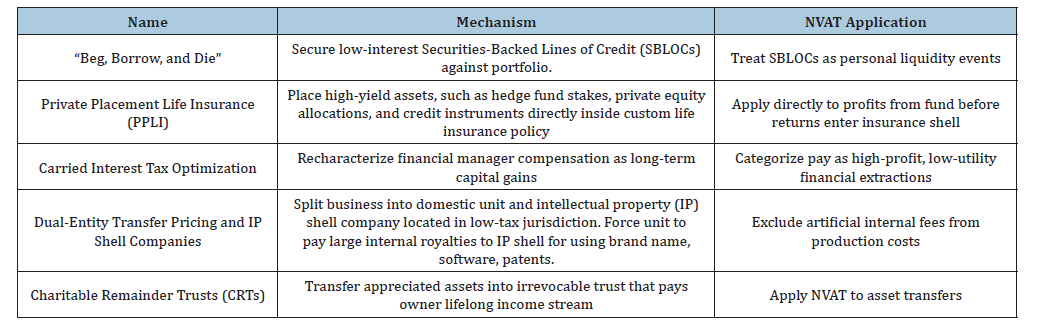
In addition to transactions involving goods and services, NVAT can be applied to actions commonly used to grow wealth by financial engineering, private asset wrappers, and multi-generational legal structures while paying near-zero effective taxes. Table 1 gives a short list of these along with ways that NVAT might prevent such abuses. Executing any of these requires large amounts of money so only the ultra-wealthy, not any others in our society, are able to take advantage of them. An issue related to fairness is whether “workers” includes all business executives, many of whom receive a salary and extra compensation including stocks. Excessive executive remuneration leads to unfair profit distribution but allowing it to be a “cost” would defeat the objective of encouraging higher VRR. Thus, executive pay counted as cost should be limited, perhaps to an amount relative to the company average, a certain fraction of company sales, or a fixed dollar limit. If, when costs and profits are tabulated for a firm’s NVAT assessment, excess amounts have been included in costs and deducted from profits, the VRR must be revised to deduct the excess from costs and added to profits. Again, the decision about the NVAT increase is determined by the firm, not the collecting agency.
Table 1:Methods used to increase wealth without taxes and NVAT applications.
Other possible incentives to increase value generation and VRR could include demonstrated reductions in carbon footprint or effluent pollution rate. These amounts would be added to cost and deducted from profit, decreasing both VRR and tax rate. Finally, revenue collected under NVAT would be recirculated in the economy. Various options exist to foster fairness and equity. Funds could be sent to underfunded local, regional, or national nonprofit or government agencies providing health, safety, housing, and counseling services. Resources to deal with urban firestorms and other consequences of climate change could be supported. Rough calculations suggest that the expected collections could fund the expected Social Security and Medicare shortfalls. Alternatively, there could be direct payments to all individuals or households up to a certain income level such as in the COVID stimulation plan of 2021. The amounts could vary depending on how far the recipients were below the optimal log-normal income distribution determined by Venkatasubramanian [14]. Regardless, none of these approaches require significant administrative processing. While the choice of recycling mechanism is important, it is organizationally separate from the tax itself. Since our central focus is the tax mechanism and its impacts, the revenue-use issue is left as a policy extension rather than fundamental to the NVAT system.
How NVAT is different from traditional taxes
The literature includes a variety of instruments beyond income and pension taxes. These include Value Added Taxes (VAT), Excess Profit Taxes (EPT), Windfall Profit Taxes (WPT), and Financial Transaction Taxes (FTT), and Pigouvian Taxes (PT). These address different margins of tax design, but all are flawed with respect to our goals of probity and simplicity. NVAT differs from these instruments because it is flexible and calculated from the use of profits after production rather than to consumption, extraordinary rents, financial trading volume or harm to externalities. VATs are widely used in advanced and developing economies as levies on consumption. Being related to purchases, they place heavier burdens on lower-income households unless offset by compensating transfers [15,16]. In the United States, longstanding political and institutional resistance and concern about inequitable distributional effects have prevented a national VAT [17]. EPT and WPT have historically been used in periods of war, crisis, or commodity price shocks, targeting profits above “normal” bases [18]. Both taxes have significant administrative challenges, including complex calculations of “normal” profits and high costs to gain compliance. FTT is an excise tax levied on the buying and selling of financial assets with the tax being a percentage of the asset’s value when traded, whether or not the trade is profitable [19]. They are usually justified by reducing speculative activity or raise revenue but multiple studies have concluded that FTTs economically damage the jurisdictions imposing them, cause trading volume and liquidity decreases, increase costs, and shift markets to jurisdictions without transaction taxes [18]. PT are welfare-corrective taxes to minimize harm to externalities such as health, safety, public welfare, and environment when the actor bears little, if any, of the social cost [20]. Kallbekken [21] describes diverse attempts to implement PT and shows that their benefits are considerably less than revenues as well as lack public acceptability. Complaints about all the above taxes focus on their lack of fairness and the burdens they place on labor, firms, or society in general. All are levied in addition to corporate income and government pension taxes, as is NVAT. However, NVAT differs from the above as a corrective tax on nonproductive profit rather than on transaction price.
In addition, NVAT taxes in several respects: it specifically targets profit allocation; the levy is based on a well-defined ratio from available price and cost data of existing accounting records; it creates incentives for corporate investment including selfregulation because firms can lower their liability by supporting value-adding activities; its apparent fairness should make it highly acceptable. These attributes benefit both labor and firms. Jonath [11] discuss how NVAT could also be applied in Lower Income Countries (LICs), especially those depending upon ineffective VATs [22]. NVAT collections from low VRR sectors such as extractives, oligopolistic services, and speculative financing could be targeted to basic health and education spending, or climate resilience investments that would directly benefit low income households. Using such new revenues to finance visible, pro poor programs apparently strengthens social legitimacy and supports improvements in tax compliance [23].
Indicators of NVAT effectiveness
Though NVAT has not yet been implemented as a policy of any economy, we have examined its possible impacts with simulations of high frequency stock trading (HFT) [24] and on investment and wealth sequestration in a new structure of macroeconomic cash flows [25]. In the first case, NVAT, with a trial schedule of VRR, reduced the magnitude of stock market bubbles by nearly an order of magnitude by incentivizing value-adding trades and discouraging unproductive profit-seeking. In the second case, calculations show that application of NVAT would have directed large amounts of profits to capital investment instead of to unproductive wealth accumulation using data and equations covering 1995 to 2023.
Conclusion and Recommendations
The Non-Value-Added Tax (NVAT) is a graduated tax on producer profits that varies inversely with a firm’s Value-Recovery Ratio (VRR) straightforwardly computed from well-documented costs and profits. The amount of tax is determined by businesses choosing investment relative to wealth accumulation rather than by government edict and disposition of tax revenues can directly promote social support and fairness. NVAT can create incentives for reinvestment in productive activity and equitable resource distribution while disincentivizing retention of profits for nonproductive uses. This novel policy has the potential of adding real value to the economy and addressing multiple issues simultaneously.
References
- Lazonick W (2019) The value-extracting CEO: How executive stock-based pay undermines investment in productive capabilities. Structural Change and Economic Dynamics 48: 53-68.
- Lazonick W (2023) Investing in innovation: Confronting predatory value extraction in the US corporation. Cambridge, Cambridge University Press, UK.
- Lazonick W, Shin JS (2019) Predatory value extraction: How the looting of the business corporation became the US norm and how sustainable prosperity can be restored. Oxford, Oxford University Press, UK.
- Weissman R, Claybrook J (2023) The corporate sabotage of America’s future and what we can do about it. Washington, DC, Public Citizen, USA.
- Krugman P (2026) Vanessa Williamson on taxes and democracy what tax history teaches us about this dire moment.
- Balkir A, Saez E, Yagan D, Zucman G (2025) How much tax do US billionaires pay? Evidence from administrative data. NBER Working Paper 34170.
- Bienstman S (2023) Does inequality erode political trust? Frontiers in Political Science 5: 1197317.
- Fehr D, Raua H, Trautmanna S, Xua Y (2020) Inequality, fairness and social capital. European Economic Review 129:103566.
- Krugman P (2026) Jared Bernstein on debt how worried should we be?
- Mattei C (2022) The capital order: How economists invented austerity and paved the way to fascism. Chicago, University of Chicago Press. ISBN-10-0226836746.
- Jonath A, O’Connell J (2026) Non-value-added tax: Improving economic fairness for all of society. 2026 Financial Markets and Nonlinear Dynamics International Workshop Proceedings.
- Smith A (1904) An inquiry into the nature and causes of the wealth of nations. In: Cannan E (Ed.), Methuen & Co Ltd, London.
- Roncaglia A (2017) A brief history of economic thought. Cambridge, Cambridge University Press, UK.
- Venkatasubramanian V (2017) How much inequality is fair? Columbia University Press, New York, USA.
- Alavuotunki K, Haapanen M, Pirttilä J (2017) The effects of the value-added tax on revenue and inequality. The Journal of Development Studies 55:490-508.
- Schneider F, Kearney M, Mahoney N (2022) VAT and inequality: Evidence from cross-country microdata. American Economic Journal: Economic Policy 14(1): 1-34.
- Mehrotra A (2022) Fiscal exceptionalism: The US debate over a national consumption tax. Law & Social Inquiry 47(2): 345-374.
- Burman L, Gale W, Gault S, Kim B, Nunns J, et al. (2015) Financial transaction taxes in theory and practice. National Tax Journal 69(1).
- Miller C, Tyger A (2020) The impact of a financial transaction tax foundation.
- Kagan J (2026) Pigovian tax explained: Definition, purpose, and real-world examples.
- Kallbekken S (2013) Public acceptability of incentive-based mechanisms, encyclopedia of energy, natural resource and environmental economics, pp. 306-312.
- International Monetary Fund (2025) G20 background note on enhancing domestic revenue mobilization through strengthening revenue administration.
- Baer K, Bellon M, Davies M, de Mooij R, Gaspar V, et al. (2025) Building tax capacity for growth and development: Evidence-based analysis for mobilizing domestic revenue. IMF eLibrary 2025(7): 48.
- Veryzhenko I, Jonath A, Harb E (2022) Non-value-added tax to improve market fairness and quality. Financial Innovation 8(1): 18.
- O’Connell J, Jonath A (2025) A new macroeconomic cash flow model that includes profit distribution and a proposal for improving economic equity. Financial Innovation, In press.
© 2026 John P O’Connell. This is an open access article distributed under the terms of the Creative Commons Attribution License , which permits unrestricted use, distribution, and build upon your work non-commercially.
Editor In Chief







.jpg)































Signup for Newsletter

Quick Links
 Editorial Board Registrations
 Submit your Article
 Best Paper of the Volume
 Reprints
 Refer a Friend
 Advertise With Us
Our Recent Edition

.jpg)



Top Editors




.jpg)

















.bmp)
.jpg)
.png)
.jpg)













.jpg)






.png)

.png)




.png)




Financial Support

Sponsors

Latest e-Books

Latest Video

 a Creative Commons Attribution 4.0 International License. Based on a work at www.crimsonpublishers.com.
Best viewed in
a Creative Commons Attribution 4.0 International License. Based on a work at www.crimsonpublishers.com.
Best viewed in 
 | Above IE 9.0 version