

- About Us
- Information
-

The Author ensures that the research has been conducted responsibly and ethically with adherence to all relevant regulations. read more..
- For Authors
- For Reviewer
- Manuscript Guidelines
- Membership
- Publication Ethics
-
- Journals
- Reprints
- e-Books
- Videos
- Policies
- Contact Us
 COVID-19
- Submissions



Full Text
Strategies in Accounting and Management
When Does Economic Freedom Enhance Life Satisfaction? The Conditioning Role of Governance in Europe
Silvia Román Pineda1 and Juan Cándido Gómez Gallego²*
1 Department of Applied Economics, University of Murcia, Murcia, Spain
2 DEciDE Doctoral Program, Faculty of Economics and Business, University of Murcia, Murcia, Spain
*Corresponding author:Juan Cándido Gómez Gallego, DEciDE Doctoral Program, Faculty of Economics and Business, University of Murcia, Murcia, Spain
Submission:August 19, 2026;Published: September 24, 2026

ISSN:2770-6648Volume6 Issue 3
Abstract
Although economic freedom fosters economic growth, its direct impact on subjective well-being remains a subject of intense academic debate. This study investigates the relationship between economic freedom and life satisfaction through the mediating mechanism of economic growth, while assessing the conditional moderating role played by the quality of governance. Utilizing a balanced panel dataset of 90 observations from 30 European countries over the 2018-2023 period, we estimate a moderated mediation model using bootstrap regressions and the conditional process analysis framework (Hayes Model 14). The empirical findings reveal that economic growth fully mediates the relationship between economic freedom and life satisfaction, as the direct effect of economic freedom turns out to be statistically insignificant. Crucially, governance quality negatively moderates the growth-to-well-being nexus: the indirect effect of economic freedom is positive and highly significant in low-to-medium governance environments, but diminishes and vanishes in nations characterized by high institutional quality. We conclude that in advanced European economies, the marginal well-being dividend of economic growth is not uniform, exhibiting diminishing returns in the presence of strong democratic institutions and providing robust empirical support for ‘Beyond GDP’ multidimensional development frameworks.
Keywords: Quality of life; Economic freedom; Good governance; Moderated mediation; Beyond GDP; Subjective well-being
JEL Classification: I31; O43; C30; P51
Introduction
The debate surrounding the nexus between economic growth and human well-being has undergone a profound paradigm shift over the past two decades. Historically, Gross Domestic Product (GDP) per capita reigned as the unquestioned conventional benchmark of national progress and development. However, pioneering policy frameworks-such as the OECD Better Life Initiative-alongside a robust body of seminal literature have demonstrated that subjective well-being, commonly operationalized as Life Satisfaction (LS), is rooted in a multidimensional architecture that transcends purely monetary metrics [1-3]. In highly developed regions such as Europe, material affluence alone no longer guarantees proportional gains in human happiness, prompting researchers to disentangle the non-economic and institutional forces that fundamentally underpin human flourishing. Within this ‘Beyond GDP’ paradigm, Economic Freedom (EF) has emerged as a crucial upstream determinant of societal outcomes. Grounded in institutional economics, economic freedom-characterized by secure property rights, stable monetary systems, freedom to trade internationally, and efficient regulatory environments-has been widely validated as a core driver of allocative efficiency and macroeconomic performance [4,5]. Nevertheless, its direct impact on subjective wellbeing remains deeply contested. While scholars within the public choice tradition argue that economic liberty intrinsically enhances individual self-determination and happiness, broader empirical evidence indicates that its impact is predominantly indirect, operating through specific transmission channels and remaining heavily contingent upon the overarching institutional architecture. Despite extensive literature separately linking economic freedom to economic growth and growth to life satisfaction, the joint and conditional interaction mechanisms connecting these constructs remain remarkably under-researched. Conventional empirical inquiries have frequently suffered from a reductionist approach by assuming linear, homogeneous relationships that fail to capture the institutional nuances of developed economies. In particular, existing literature has largely overlooked how the quality of public institutions may fundamentally alter the effectiveness of macroeconomic transmission channels. This study addresses this scientific gap by proposing and estimating a moderated mediation model grounded in conditional process analysis [6]. This methodological framework simultaneously evaluates not only whether economic growth serves as the primary transmission vector of economic freedom, but also whether the magnitude and direction of this indirect impact are contingent upon national governance quality.
Although European Union member states and allied nations share broadly high living standards, substantial asymmetries persist across their institutional structures and levels of Good Governance [7]. By adopting this analytical approach, the present paper contributes both theoretically and empirically to the ‘Beyond GDP’ literature by investigating the presence of critical institutional thresholds. The underlying premise is that the economic dynamism spurred by economic freedom requires a material channel (GDP per capita) to translate into societal well-being; however, this channel exhibits diminishing marginal returns and becomes saturated in environments endowed with exemplary governance institutions. To explore these dynamics, we formulate the following research hypotheses:
1. H1: Economic freedom (EF) exerts a direct, positive, and statistically
significant effect on economic growth.
2. H2: Economic growth positively influences subjective well-being,
increasing citizens’ life satisfaction.
3. H3: Economic growth mediates the relationship between economic
freedom and life satisfaction, serving as the principal
indirect transmission channel.
4. H4: Governance quality moderates the relationship between
economic growth and subjective well-being, altering the magnitude
and statistical significance of this link according to the
level of institutional development.
5. H5: Governance quality moderates the overall indirect effect
of economic freedom on subjective well-being, configuring a
conditional moderated mediation process.
The remainder of this paper is structured as follows. Section 2 provides a comprehensive review of the relevant literature and develops the conceptual framework. Section 3 outlines the data, variables, and econometric methodology. Section 4 presents the empirical results. Section 5 discusses the findings in light of existing literature, and Section 6 concludes with policy implications and directions for future research.
Literature Review
Economic freedom and economic growth: material transmission mechanisms
The causal link between Economic Freedom (EF) and macroeconomic performance constitutes one of the most established tenets of contemporary institutional economics. From a new institutionalist perspective, long-run economic growth depends not merely on the accumulation of productive inputs (capital and labor), but crucially on the incentive matrix and transaction cost reductions provided by formal institutions to economic agents. In this regard, economic freedom-operationalized via secure property rights, monetary stability, open trade, and competitive deregulation- functions as a vital catalyst for allocative efficiency and technological innovation. Recent empirical literature overwhelmingly corroborates that environments with higher economic freedom exhibit substantially faster rates of per capita GDP growth and heightened resilience to macroeconomic shocks [8,9]. In the context of advanced and transition economies across Europe, the impact of economic freedom is not uniform across its sub-dimensions. Berggren [10] emphasize that while judicial efficiency and property rights enforcement (Legal System and Property Rights) represent indispensable prerequisites for fixed capital formation, an excessively expansive public sector (Size of Government) can induce crowding-out effects and distortionary tax burdens that constrain potential output. Nonetheless, panel evidence from the European Union highlights that international trade openness (Freedom to Trade Internationally) and regulatory flexibility across credit and labor markets (Regulation) serve as decisive driving forces for real income convergence [8]. Accordingly, the literature establishes that economic freedom spurs the outward shift of the production possibility frontier, positioning GDP per capita as the direct material outcome of a free-market institutional framework. Based on these theoretical foundations, we formulate Hypothesis 1 (H1).
Economic freedom and subjective well-being: direct effect or instrumental channel?
While the nexus between economic freedom and material growth enjoys widespread academic consensus, the impact of free-market institutions on subjective well-being-operationalized as Life Satisfaction (LS)-remains subject to sophisticated theoretical debate. Within public choice theory and individual autonomy frameworks, economic liberty is posited to possess intrinsic value for human agents, directly enhancing happiness irrespective of material outcomes [11]. Scholars argue that an institutional setting defined by voluntary exchange, occupational mobility, and regulatory freedom empowers individuals by granting them control over their life trajectories, thereby attenuating alienation and fostering self-actualization [12]. Under this view, economic freedom operates as a direct, non-material driver of subjective well-being. Conversely, an alternative perspective in welfare economics argues that economic freedom is primarily instrumental. Authors such as Bjørnskov [13] and Radcliff [14] caution that aggressive deregulation and unconstrained market exposure can generate negative well-being externalities, including heightened perceptions of economic insecurity, labor market stress, and the erosion of social safety nets. From this standpoint, economic freedom does not automatically enhance life satisfaction; rather, its net positive effects are realized almost exclusively through the material dividends it creates-namely by expanding disposable income, improving consumer market efficiency, and elevating national GDP per capita [15]. In the context of developed European economies, this debate delineates a formal mediation structure. If the instrumental hypothesis holds, the direct effect of economic freedom on subjective well-being should become statistically insignificant once macroeconomic output is controlled for, demonstrating that institutional market dynamism requires the vehicle of economic growth to materialize into enhanced life evaluations [16]. This theoretical duality provides the foundation for Hypotheses H2 and H3.
Economic growth, governance, and diminishing returns to well-being
The analysis of material income and subjective well-being has long been framed by the Easterlin Paradox, which posits that longterm increases in national per capita income do not translate into commensurate long-term increases in reported happiness. While cross-sectional analyses consistently identify a positive correlation between GDP per capita and life satisfaction, modern multi-dimensional welfare literature emphasizes that this relationship is characterized by sharply diminishing marginal returns [17,2]. Once fundamental material needs concerning nutrition, housing, and healthcare are broadly satisfied across a population, the primary determinants of life satisfaction shift toward qualitative, relational, and post-materialist goods [1]. In this state of material dividend saturation, Good Governance (GoG) acts as a pivotal socio-economic moderator. According to the Worldwide Governance Indicators (WGI) framework, core institutional dimensions such as democratic accountability and citizen participation (Voice and Accountability) provide the structural bedrock of advanced democracies [7]. Recent institutional literature suggests that high-quality governance affects subjective well-being through two primary mechanisms. First, it directly mitigates systemic uncertainty, curbs corruption, and ensures the equitable provision of public goods and civil liberties, establishing an institutional ‘security floor’ that enhances baseline life satisfaction [18].
Second, strong institutional quality generates an interaction effect with macroeconomic output. In contexts of weak or intermediate governance, marginal economic growth remains an essential vector of well-being: additional increments in GDP per capita enable societies to overcome severe infrastructure bottlenecks, precarious public services, and institutional vulnerability. In contrast, in societies endowed with top-tier institutional quality and robust democratic governance, citizens take baseline public goods and institutional security for granted. Consequently, societal priorities shift toward environmental quality, work-life balance, social trust, and equity [19,20]. In econometric terms, this phenomenon manifests as negative moderation: as governance quality approaches institutional excellence, the marginal effect of economic growth on life satisfaction attenuates and eventually becomes statistically indistinguishable from zero [21]. High-quality institutions effectively buffer societal dependence on GDP expansion, indicating that well-being in mature economies progressively decouples from material growth. These theoretical insights motivate Hypotheses H4 and H5.
Conceptual synthesis: The moderated mediation model
In summary, the literature demonstrates that Economic Freedom, Economic Growth, and Governance Quality do not operate in silos; rather, they form interconnected pillars of an institutional- macroeconomic architecture governing human well-being. While classical institutional economics confirms economic freedom as an upstream driver of material prosperity (EF → GDPpc), post-materialist welfare economics challenges the premise that income expansion linearly and universally elevates subjective well-being in advanced nations. Integrating these paradigms necessitates moving beyond standard linear models toward a conditional process framework [6]. By formalizing these linkages through a moderated mediation design (Hayes Model 14), this study examines whether GDP per capita functions as the instrumental conduit transmitting the effects of economic freedom to life satisfaction, while testing whether democratic governance quality (Voice and Accountability) acts as a critical regulatory contingency. This framework enables the empirical identification of institutional tipping points where high governance quality redefines societal priorities, buffering reliance on material growth and providing empirical grounding for the ‘Beyond GDP’ agenda.
Data and Methodology
Dataset and variable definitions
The empirical investigation utilizes a balanced panel dataset comprising macroeconomic, institutional, and subjective well-being observations for 30 European countries across three distinct time periods: 2018, 2021, and 2023. This structure yields a total of N = 90 country-year observations, capturing both cross-sectional and temporal heterogeneity across the European socio-economic landscape. All continuous variables are standardized (Z-scores) prior to estimation to mitigate potential multicollinearity and facilitate the interpretation of interaction terms (Table 1).
Table 1:Description and sources of variables.

Source: Authors’ own elaboration based on Eurostat, Fraser Institute, and world bank datasets.
Subjective well-being/Life Satisfaction (LS): Operates as the primary outcome (dependent) variable. Following Eurostat [22] guidelines, it is measured via the Overall Life Satisfaction indicator, representing a cognitive evaluation of an individual’s overall life. The indicator is recorded on a continuous psychometric scale ranging from 0 (‘completely dissatisfied’) to 10 (‘completely satisfied’).
Economic Freedom (EF): Serves as the primary focal predictor. Sourced from the Fraser Institute’s Economic Freedom of the World index (Gwartney et al. [4,23]), it synthesizes five structural pillars: (i) Size of Government, (ii) Legal System and Property Rights, (iii) Sound Money, (iv) Freedom to Trade Internationally, and (v) Regulation of credit, labor, and business. The index is normalized on a scale from 0 (least free) to 10 (most free).
Governance quality (WGI/ voice and accountability): Serves as the conditional moderating variable. Grounded in Kaufmann [7] Worldwide Governance Indicators, governance is evaluated through the Voice and Accountability (VA-WGI) metric, capturing citizen participation, freedom of expression, freedom of association, and media independence. In accordance with standard World Bank parameters, the indicator follows a standard normal distribution N (0,1).
Econometric specification and conditional process framework
To test the hypothesized theoretical relationships, we specify a moderated mediation model wherein GDP per capita (GDP) mediates the effect of Economic Freedom (EF) on Life Satisfaction (LS), while Governance Quality (WGI) moderates the path between GDP and LS (Hayes Model 14). The econometric specification is formulated as a two-equation system:
GDPit = α0 + a·EFit + μi + λt + ε it (1)
LSit = β0 + c '·EFit + b₁·GDPit + b₂ ·WGIit + b₃ ·(GDPit×WGIit ) + μi + λt + ε it (2)
where i indexes countries, t indexes time periods, μi represents unobserved country-specific fixed effects, λt denotes time-specific fixed effects, and εit is the idiosyncratic error term.
Direct, Indirect, and Conditional Effects: The framework decomposes the total effect into three distinct components:
Direct effect: Captured by parameter c’, denoting the residual direct effect of EF on LS when controlling for GDP.
Indirect effect (Mediation): Defined as the product of path coefficients a · b₁, quantifying the transmission of EF onto LS through economic growth.
Conditional indirect effect (moderated mediation): Because the effect of GDP on LS depends on institutional governance (WGI), the indirect effect of EF on LS becomes a function of governance quality: Indirect Effect (WGI) = a ·(b₁+b₃·WGIit).
Index of moderated mediation
In the second-stage moderation framework (Hayes [6]), the statistical significance of the moderated mediation mechanism is tested via the Index of Moderated Mediation, defined as the product a·b₃.A statistically significant index (where the 95% bootstrap confidence interval excludes zero) confirms that the indirect transmission channel from economic freedom to life satisfaction is systematically moderated by governance quality.
Johnson–Neyman significance regions
To avoid arbitrary sample split classifications (e.g., mean ± 1 SD), we implement the Johnson–Neyman technique. This technique calculates the conditional marginal effect ∂LSit / ∂GDPit = (b₁+b₃·WGIit ) across the full continuum of the moderator, identifying exact threshold values where the marginal effect of growth transitions between statistical significance and insignificance.
Estimation and Inference
Models are estimated using panel Ordinary Least Squares (OLS) with country-clustered robust standard errors to correct for heteroskedasticity and arbitrary within-country serial correlation. Statistical inference for all indirect and conditional indirect effects is conducted via non-parametric bootstrapping with 5,000 resamples.
Empirical Results
Descriptive statistics
Table 2 presents descriptive statistics for the variables across the panel. Overall, subjective well-being across Europe exhibits substantial institutional stability, with a grand mean of 7.30 on the 10-point scale (95% CI: [7.19, 7.41]). A modest dip is observed in 2021 (7.25), reflecting the socio-economic disruptions of the COVID-19 pandemic, followed by a recovery in 2023 (7.36). The sample spans from a minimum of 5.40 to a maximum of 8.10. Economic Freedom (EFW) exhibits a slight continuous contraction over the sample period, shifting from a mean of 7.72 in 2018 to 7.56 in 2023, reflecting heightened post-pandemic regulatory interventions. Conversely, material output (GDP per capita) expanded steadily from an average of €20,183.33 in 2018 to €25,420.20 in 2023. Lastly, democratic governance (Voice and Accountability, VAWGI) remained exceptionally stable with a grand mean of 1.04, reflecting the mature institutional standards of the European sample.
Table 2:Descriptive Statistics by year and aggregate panel (N = 90).
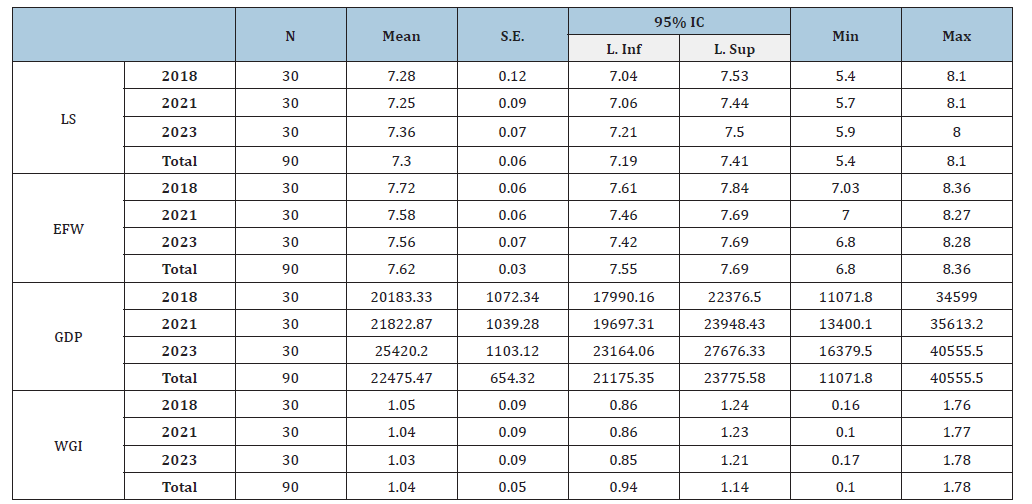
Notes: N = sample size; S.E. = standard error; LL/UL = lower/upper limits of 95% confidence intervals
Moderated mediation econometric estimates
Table 3:Moderated mediation regression results for Life Satisfaction (Hayes Model 14).
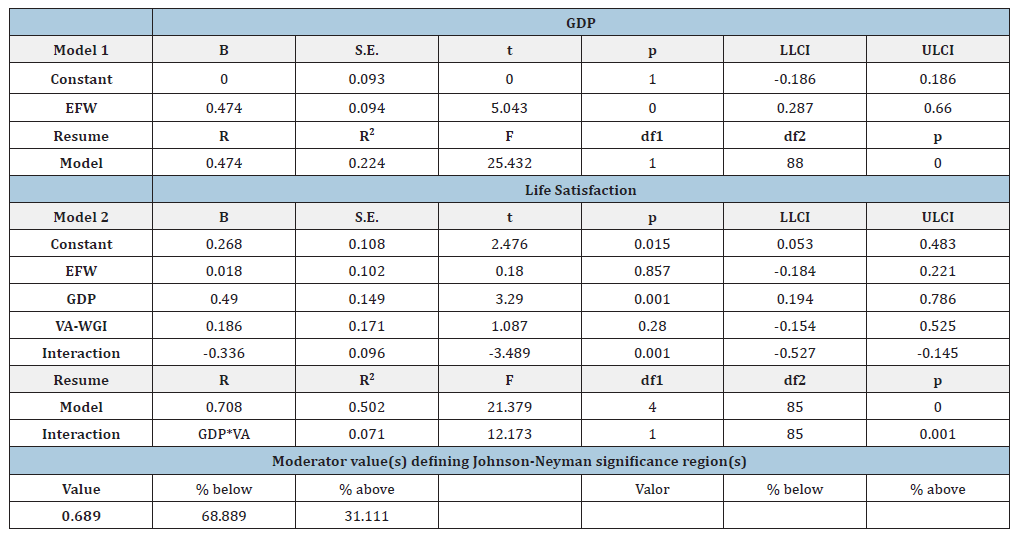
Notes: *p < 0.05, **p < 0.01, ***p < 0.001. All variables are standardized. LLCI/ULCI = Lower/Upper limit of 95% confidence interval.
Table 3 reports the econometric estimates for the moderated mediation model (Hayes Model 14).
Mediator model (GDP): Model 1 evaluates the material transmission path. Economic Freedom (EFW) exerts a powerful, positive, and statistically significant effect on GDP per capita (B = 0.4744, t = 5.043, p < 0.001), explaining 22.43% of the variance in material output (R² = 0.2243, F(1, 88) = 25.432, p < 0.001). This provides definitive empirical verification for Hypothesis 1 (H1).
Outcome model (Life Satisfaction): Model 2 estimates subjective well-being determination. The overall model exhibits strong explanatory power, accounting for 50.19% of the total variance in life satisfaction (R² = 0.5019, F(4, 85) = 21.379, p < 0.001). Three critical findings emerge:
A. Insignificance of direct economic freedom effect: The direct coefficient of EFW on life satisfaction is statistically indistinguishable from zero (B = 0.0185, t = 0.180, p = 0.8575; 95% CI: [-0.184, 0.221]). This confirms full mediation, indicating that market deregulation has no direct non-material effect on life satisfaction.
B. Positive base effect of growth: Material income (GDP) exerts a positive baseline effect on life satisfaction (B = 0.4900, t = 3.290, p = 0.0015), validating Hypothesis 2 (H2).
C. Significant negative moderation: The interaction term between GDP and Governance (GDP × VA-WGI) is negative and highly significant (B = -0.3359, t = -3.489, p = 0.0008), contributing a net 7.12% increase in explained variance (ΔR² = 0.0712, F = 12.173, p = 0.0008). This negative coefficient confirms that the marginal well-being dividend of GDP growth decreases systematically as democratic governance quality increases, providing empirical support for Hypothesis 4 (H4).
Conditional indirect effects and moderated mediation index
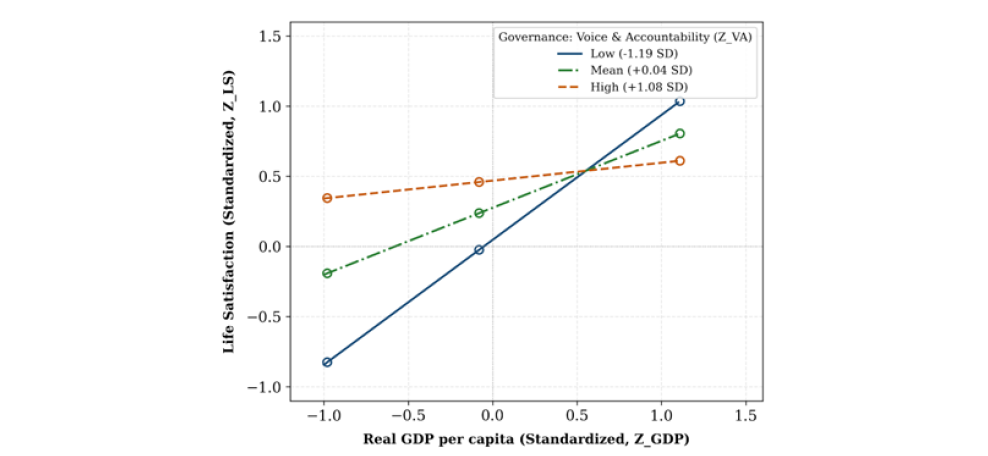
Because the effect of GDP on subjective well-being is moderated by institutional governance, the indirect effect of economic freedom is inherently conditional. Table 4 presents conditional indirect effects calculated across standard benchmark levels of the moderator (-1 SD, Mean, +1 SD). Under low governance standards (-1.191 SD), the indirect transmission of economic freedom through GDP growth is large, positive, and statistically significant (Indirect Effect = 0.8906; 95% CI: [0.436, 1.344]). In intermediate governance environments (+0.036 SD), this indirect effect is halved but remains statistically significant (Indirect Effect = 0.4777; 95% CI: [0.184, 0.770]), validating Hypothesis 3 (H3). However, in nations with high institutional quality (+1.084 SD), the indirect effect collapses and crosses zero (Indirect Effect = 0.1251; 95% CI: [-0.139, 0.391], p = 0.349). To confirm this conditional architecture, we compute the Index of Moderated Mediation: Index = a · b₃ = (0.4744) × (-0.3359) = -0.1593 (Boot S.E. = 0.0573; 95% Bootstrap CI: [-0.2784, -0.0541]). Because zero falls entirely outside the bootstrap confidence interval, we confirm that governance quality systematically conditions the indirect transmission mechanism, fully supporting Hypothesis 5 (H5) (Figure 1).
Table 4:Conditional indirect effects of economic freedom on life satisfaction at moderator benchmark levels.

Notes: Index of Moderated Mediation = -0.1593 (95% CI: [-0.2784, -0.0541]). Bootstrap resamples = 5,000. ns = not statistically significant.
Figure 1:Conditional effect of the focal predictor (LS) at values of the moderator.
Johnson–Neyman significance regions
To avoid arbitrary benchmark cutoffs, the Johnson–Neyman technique was applied to trace conditional marginal effects across the complete continuum of governance quality (Table 5). The analysis reveals a definitive critical threshold at VA-WGI = 0.689 (Z-score). For governance scores below 0.689-comprising 68.89% of the European panel-economic growth exerts a positive and statistically significant marginal impact on life satisfaction (p < 0.05). However, once governance quality exceeds this critical value (31.11% of observations), the marginal well-being dividend of GDP growth becomes statistically indistinguishable from zero (p > 0.05). This confirms the material saturation ceiling in highly institutionalized democracies (Figure 2).
Figure 2:Johnson-Neyman plot for the conditional effect of GDPpc on life satisfaction as a function of accountability.
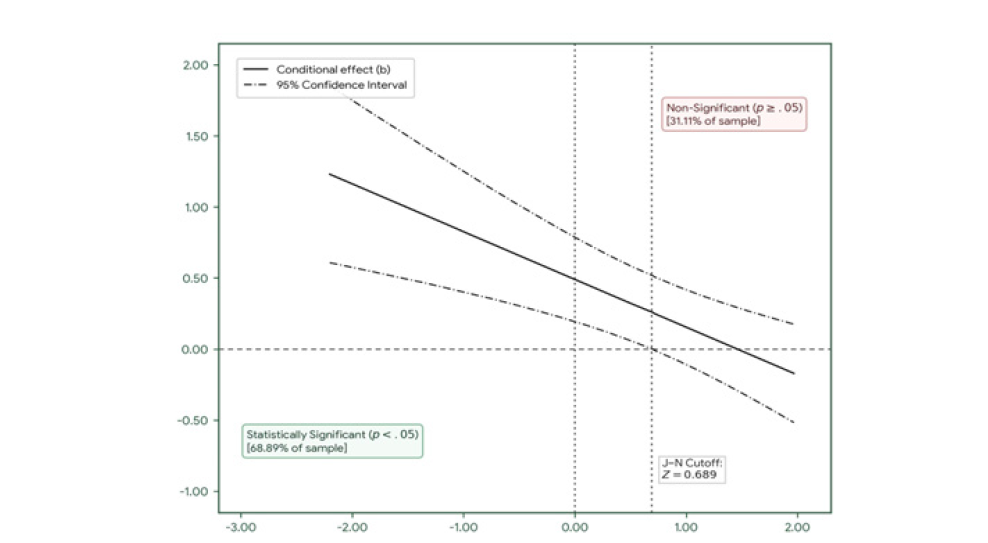
Table 5:Conditional marginal effects of GDP on life satisfaction across governance quality continuum (Johnson–Neyman Grid).
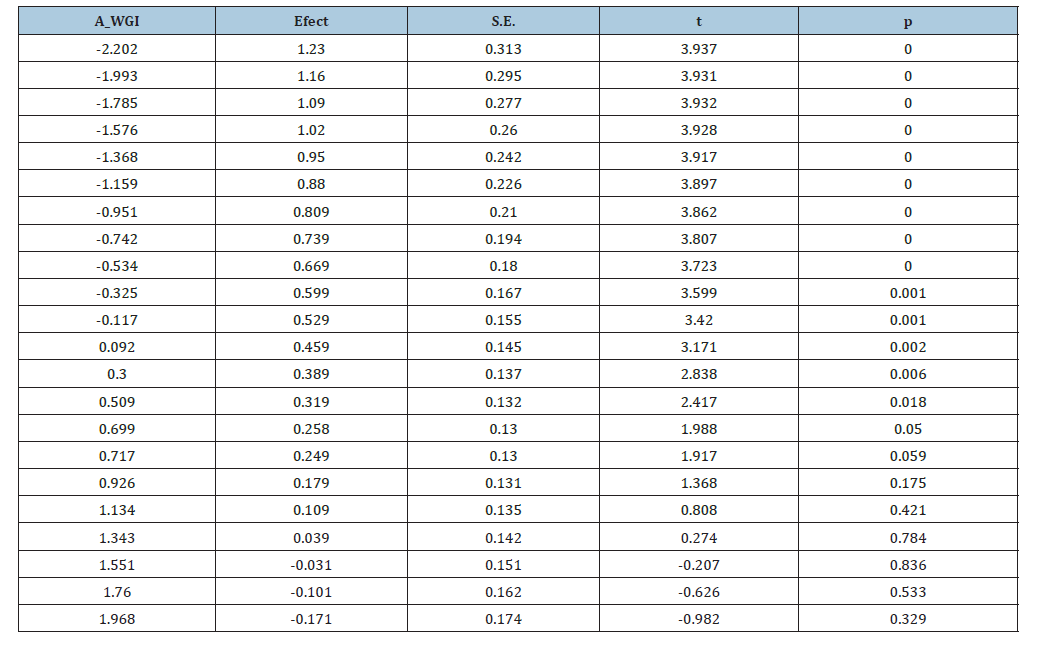
Notes: *Critical Johnson-Neyman value = 0.689 (68.89% of observations below, 31.11% above). Confidence level = 95%.
Discussion
The empirical findings derived from the conditional process model (Hayes [6]) significantly advance the understanding of how market institutions and public governance jointly configure subjective well-being in Europe. By confronting our hypotheses with empirical evidence, this study integrates core institutional economics with the economics of subjective well-being. First, the results validate that economic freedom (Gwartney et al. [23]) operates as a primary upstream determinant of material output, confirming Hypothesis 1 (H1). This strong positive impact on per capita GDP aligns with orthodox institutional economics, which posits that open markets, legal security, and enforceable property rights reduce transaction costs and foster macroeconomic efficiency [24,5]. However, the critical insight emerges from the absence of a direct statistically significant effect of economic freedom on life satisfaction (B = 0.0185, p = 0.8575). This finding contradicts the public choice proposition that market deregulation possesses intrinsic, direct welfare value (Nikolaev [15]), corroborating instead the purely instrumental thesis of market institutions [16,12]. Economic freedom does not automatically elevate collective psychological well-being unless it successfully translates into tangible material development, confirming full mediation through GDP per capita [9].
The core theoretical contribution of this study lies in demonstrating that this material transmission mechanism is non-linearly conditioned by the underlying institutional architecture. The conditional process estimates and the Johnson–Neyman technique reveal a negative moderating effect exerted by democratic accountability (Voice and Accountability; [7]). This provides nuanced empirical support for Hypotheses H4 and H5: the well-being dividend derived from economic growth is neither universal nor static, but diminishes systematically as democratic governance matures. In institutional contexts characterized by low or intermediate governance standards (accounting for 68.89% of the sample, VA-WGI ≤ 0.689), material income expansion exerts a robust and significant effect on life satisfaction. In these economies, increments in GDP per capita remain vital for expanding essential social capabilities, financing critical public infrastructure, and addressing structural deficiencies [19]. However, once countries cross the critical Johnson– Neyman threshold, the well-being effect of economic growth vanishes completely.
This complete decoupling between GDP per capita and life satisfaction among the top 31.11% of institutional observations provides crucial empirical validation for the diminishing marginal utility of income in advanced societies [13,11]. In European societies characterized by exemplary governance and high democratic accountability, citizen demands transition from quantitative material accumulation toward qualitative and post-materialist goods [17]. In these environments, institutional certainty, generalized social trust, and the efficient provision of intangible public goods [18,21] become the true drivers of quality of life, neutralizing the capacity of aggregate material growth to yield additional happiness. Ultimately, this asymmetric behavior provides foundational empirical backing for the ‘Beyond GDP’ paradigm [1-3]. By demonstrating that public governance acts as a saturation factor that attenuates the growth-welfare nexus, this study highlights the limitations of policy frameworks exclusively centered on maximizing material output in mature economies. The optimization of social well-being in Europe does not necessitate further aggregate economic stimulation, but rather a strategic reallocation of public efforts toward the qualitative consolidation of democratic institutions, civil participation, and public accountability [25-27].
Conclusion and Policy Implications
This paper investigated the structural relationships between economic freedom, economic growth, governance quality, and subjective well-being across 30 European countries during 2018– 2023. By deploying a moderated mediation framework (Hayes Model 14), we demonstrated that while economic freedom drives material prosperity, its well-being dividends are entirely mediated by GDP per capita and strongly moderated by institutional governance. Our findings deliver key policy implications for European and national policymakers. For economies operating below the critical governance threshold, market-liberalizing reforms paired with growth-oriented policies remain effective instruments for enhancing life satisfaction. Conversely, for nations with highly mature democratic institutions, continuing to prioritize GDP growth as the primary policy objective yields negligible well-being gains. In these advanced contexts, public policy must shift toward strengthening institutional integrity, participatory democracy, environmental sustainability, and social equity.
References
- OECD (2023) How’s life? 2023: Measuring well-being. OECD Publishing, France.
- Stiglitz JE, Fitoussi JP, Durand M (2022) Measuring what counts: The global movement for well-being. The New Press, USA.
- Stiglitz JE, Sen A, Fitoussi JP (2009) Report by the commission on the measurement of economic performance and social progress, p.291.
- Gwartney J, Lawson R, Hall J, Murphy R (2023) Economic freedom of the world: 2023 annual report. Fraser Institute.
- North DC (1990) Institutions, institutional change and economic performance. Cambridge University Press, UK.
- Hayes AF (2024) Introduction to mediation, moderation, and conditional process analysis: A regression-based approach (4th edn), Guilford Press, New York, USA.
- Kaufmann D, Kraay A (2024) Worldwide Governance Indicators (WGI) project. World Bank.
- De Haan J, Sturm JE, Zandberg E (2021) The impact of economic freedom on economic growth: A sustainability perspective. Journal of Institutional Economics 17(4): 589-605.
- Hall JC, Lawson RA (2023) Economic freedom as an upstream determinant of macroeconomic performance: A review of the recent literature. Journal of Economic Surveys 37(2): 411-435.
- Berggren N, Bjørnskov C (2022) Economic freedom, culture, and growth. European Journal of Political Economy 73: 102120.
- Graafland J (2022) Economic freedom and life satisfaction: A mediated moderation analysis. International Journal of Social Economics 49(8): 1145-1163.
- Spruk R, Kešeljević A (2020) Institutional origins of subjective well-being: Estimating the direct and indirect effects of economic freedom. Applied Research in Quality of Life 15(3): 671-705.
- Bjørnskov C (2021) Economic freedom and the quality of life. Journal of Institutional Economics 17(3): 453-469.
- Radcliff B (2020) The political economy of human happiness. Annual Review of Political Science 23: 221-235.
- Nikolaev B, Bennett DL (2022) Institutions, economic freedom, and human flourishing. Small Business Economics 58(2): 735-758.
- Gehring K (2021) Who benefits from economic freedom? Disentangling the direct and indirect effects on subjective well-being. World Development 139: 105315.
- Clark AE, Flèche S, Layard R, Powdthavee N, Ward G (2023) Well-being, inequality and institutions in advanced economies. In World Happiness Report 2023. Sustainable Development Solutions Network, pp. 123-145.
- Helliwell JF, Layard R, Sachs JD, De Neve JE, Aknin LB, et al. (2024) World happiness report 2024. Sustainable development solutions network.
- Eurofound (2022) Quality of life in the EU: Trends and institutional challenges. Publications Office of the European Union.
- UNDP (2024) Human development report 2023/2024: Breaking the gridlock: Reimagining cooperation in a polarized world. United Nations Development Programme.
- Helliwell JF, Huang H (2021) New evidence on trust and well-being. Annual Review of Economics 13: 21-46.
- Eurostat (2025) Subjective well-being indicators: Overall life satisfaction dataset. European Commission.
- Gwartney J, Lawson R, Hall J, Murphy R (2025) Economic freedom of the world: 2025 annual report. Fraser Institute.
- Acemoglu D, Robinson JA (2012) Why nations fail: The origins of power, prosperity, and poverty. Crown Business, USA, p.529.
- Al-Fadhli S, Al-Zeaud H, Al-Amir M (2024) Economic freedom and macroeconomic performance: Fresh evidence from panel data. Journal of Institutional Economics 20(1): 45-63.
- Lawson R, Murphy R, Powell B (2024) Institutional quality, economic freedom, and economic growth in the European Union. World Development 174: 106421.
- World Bank (2024) World Development Report 2024: The Middle-Income Trap. World Bank.
© 2026 Juan Cándido Gómez Gallego. This is an open access article distributed under the terms of the Creative Commons Attribution License , which permits unrestricted use, distribution, and build upon your work non-commercially.
Editor In Chief







.jpg)































Signup for Newsletter

Quick Links
 Editorial Board Registrations
 Submit your Article
 Best Paper of the Volume
 Reprints
 Refer a Friend
 Advertise With Us
Our Recent Edition

.jpg)



Top Editors




.jpg)

















.bmp)
.jpg)
.png)
.jpg)













.jpg)






.png)

.png)




.png)




Financial Support

Sponsors

Latest e-Books

Latest Video

 a Creative Commons Attribution 4.0 International License. Based on a work at www.crimsonpublishers.com.
Best viewed in
a Creative Commons Attribution 4.0 International License. Based on a work at www.crimsonpublishers.com.
Best viewed in 
 | Above IE 9.0 version