

- About Us
- Information
-

The Author ensures that the research has been conducted responsibly and ethically with adherence to all relevant regulations. read more..
- For Authors
- For Reviewer
- Manuscript Guidelines
- Membership
- Publication Ethics
-
- Journals
- Reprints
- e-Books
- Videos
- Policies
- Contact Us
 COVID-19
- Submissions



Full Text
Strategies in Accounting and Management
Cognitive Biases in Strategic Decision- Making Processes: A Decision Architecture Model for Senior Executives
Mesut Atasever*
Department of Logistics Management, Faculty of Applied Sciences, Uşak University, Türkiye
*Corresponding author:Mesut Atasever, Department of Logistics Management, Faculty of Applied Sciences, Uşak University, Türkiye
Submission:June 13, 2026;Published: July 22, 2026

ISSN:2770-6648Volume6 Issue 3
Abstract
This study systematically examines the effects of cognitive biases experienced by senior executives in strategic decision-making processes on organizational performance and presents a unique “Strategic Decision Architecture Model” (SDAM) aimed at minimizing these biases. In contrast to the “rational manager” assumption of traditional management theories, the behavioral economics literature highlights the framing effect, status quo bias, overconfidence, and confirmation bias as systematic cognitive traps into which businesses fall. A qualitative model was developed by synthesizing the theoretical framework, ranging from Kahneman [1] Prospect Theory to Thaler [2] choice architecture concept, with the empirical findings in TÜSİAD’s [3] “Sector-Based Applications of Behavioral Economics” report. The results show that structural nudges and default option designs integrated into the decision architecture are powerful mechanisms for reducing strategic errors. SDAM consists of four pillars: default option design, framing optimization, cognitive auditor role, and visual cognitive scorecard, and offers practical tools applicable at the level of top management boards.
Keywords: Cognitive bias; Strategic decision-making; Choice architecture; Nudging; Status quo bias; Overconfidence; Decision architecture
Introduction
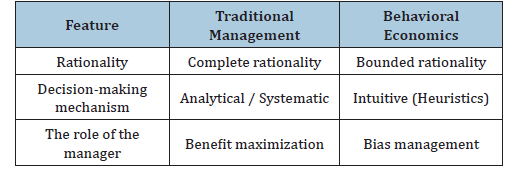
Traditional strategic management literature has for many years been built upon the assumption that managers are “homo economicus,” actors who possess complete information, are rational, and aim for utility maximization. This paradigm has formed the cornerstone of normative approaches such as Porter’s [4] competitive forces model and Ansoff’s [5] strategic planning frameworks. However, the concept of “bounded rationality” introduced by Herbert Simon [6] has fundamentally challenged this paradigm by revealing the limitations of the human mind’s cognitive capacity. In today’s business world, where strategic decisions are made amidst uncertainty, time pressure, and high competition, it has become inevitable for decision-makers to resort to psychological heuristics [7]. While these heuristics can be functional tools in some cases, they often pave the way for systematic errors, or cognitive biases. Daniel Kahneman [1] Nobel Prize-winning work empirically demonstrated how individuals’ decisions are shaped by systematic cognitive biases rather than rational grounds. Schwenk [8] states that at the strategic management level, these biases are the primary source of not only individual but also organizational strategic errors. Finkelstein [9] have shown that managers’ cognitive profiles significantly influence a firm’s strategic choices. TÜSİAD’s [3] “Sector-Based Applications of Behavioral Economics” report supports this with empirical findings, demonstrating that these cognitive mechanisms are decisive not only in individual consumer behavior but also in corporate processes such as finance, energy, health, and education. This study aims to provide managers with a structural model for managing their cognitive biases by combining the “nudge” strategies of behavioral economics with the strategic management literature. The main argument of the study is that managing cognitive biases left to individual self-discipline is insufficient; an effective solution is only possible by redesigning decision-making processes at the architectural level. Table 1 below summarizes the key differences between the traditional management approach and the behavioral economics approach.
Table 1:Key differences between traditional management approach and behavioral economics approach.
Conceptual Framework and Literature Review
Classification of cognitive biases
Behavioral economics’ contribution to the strategic management literature is primarily embodied in Kahneman’s [10] “System 1 – System 2” dual process model. System 1 represents fast, automatic, and emotional processes, while System 2 represents slow, analytical, and conscious thinking. Although System 2 is expected to come into play in strategic decision-making processes, time pressure, information overload, and the emotional climate push decision-makers towards System 1. The most common and costly cognitive biases in the context of strategic decision-making are as follows:
Status quo bias: Cognitive resistance to abandoning the current strategy or situation. The TÜSİAD [3] report shows that this bias causes corporate inertia; in an experiment conducted in Germany on the preference for renewable energy, it was found that when the alternative offering was changed, 68% of consumers preferred renewable energy, whereas this rate dropped to 41% when the status quo was maintained.
Framing effect: The way the decision is presented directly changes the manager’s perception of risk. Kahneman [10] classic experiments proved that presenting the same information in different frameworks radically transforms preferences. In a corporate context, presenting strategic options from a “losses” or “gains” perspective can decisively influence board decisions.
Overconfidence Bias: The systematic underestimation of risks by managers due to their excessive confidence in their own knowledge, abilities, and foresight. Malmendier [11] showed that overconfident CEOs overestimate their firm’s stock value, leading to suboptimal investment decisions.
Confirmation bias: The tendency to prioritize information that supports existing beliefs and ignore conflicting information. In strategic processes, this bias leads to selective interpretation of market research and underestimation of competitive threats.
Anchoring: The tendency to overemphasize the initial information or numerical value obtained. This can create significant deviations in budget negotiations, merger and acquisition valuations, and pricing decisions.
Loss aversion: According to Kahneman [10] prospect theory, individuals perceive losses as approximately twice as severe as equivalent gains. This asymmetry can lead managers to be overly risk-averse or to blindly commit to losing projects (“sunk cost fallacy”).
Strategic consequences of cognitive biases
Cognitive biases translate into tangible and measurable strategic errors at the corporate level. Lovallo [12] revealed that company managers, trapped by an inside view in investment projects, ignore external reference points; as a result, they systematically underestimate project costs and durations. This phenomenon has been conceptualized as the “planning fallacy.” Hayward [13] found a statistically significant relationship between CEOs’ overconfidence levels and company acquisitions made at high premiums that ultimately fail. Similarly, Staw [14] showed that decision-makers continue to allocate resources to failing projects because otherwise they would have to admit their previous mistakes. This phenomenon is described as “escalation of commitment.” TÜSİAD’s [3] report empirically documents how these mechanisms are reflected in investor behavior in the financial sector. According to the data in the report, investors make suboptimal portfolio decisions, guided by cognitive mechanisms such as familiarity bias, uncertainty avoidance, overconfidence, and illusion of control. This finding clearly reveals how biases at the individual level are transferred to institutional decision-making processes.
Nudge theory and choice architecture
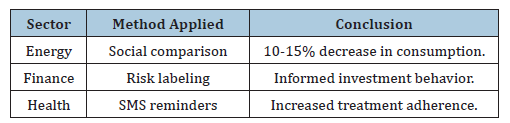
The concept of “nudge,” developed by Thaler [2], refers to choice architecture interventions that enable individuals to behave in a predictable and beneficial direction without prohibiting any option or drastically altering economic incentives. This approach adopts the principle of “libertarian paternalism” instead of paternalistic repression; it optimizes the decision framework while preserving a free choice environment for individuals. TÜSİAD’s [8] report presents the sectoral applications of this theory with rich empirical findings. In the energy sector, the power application, which allows households to compare their electricity consumption with that of their neighbors, has provided an average energy saving of over 2% per household. In the finance sector, the Save More Tomorrow program developed by Thaler [15] increased employees’ retirement savings rates from 3.3% to 13.6%. In the healthcare sector, defining organ donation as the default option increased the participation rate from 4-27% to 90%. Table 2 summarizes the sectoral implications of behavioral interventions according to the TÜSİAD [3] report. The common denominator of these findings is that prohibition or high economic incentives are not necessary for behavioral change; cleverly designed choice frameworks are often sufficient. Adapting this principle to institutional decision-making processes forms the fundamental theoretical basis of the Strategic Decision Architecture Model (SDAM).
Table 2:Sectoral implications of behavioral ınterventions according to the TÜSİAD [3] report.
Strategic Decision Architecture Model (SDAM)
Theoretical foundations of the model
SDAM rests on three fundamental theoretical foundations. First, Kahneman’s [10] dual-process theory: balancing System 1 automatic decisions by allowing System 2 intervention. Second, Thaler [2] choice architecture approach: designing the decision environment in a bias-reducing manner. Third, Schwenk’s [8] analysis of strategic simplification processes: conceptually framing how cognitive biases transform into organizational errors in boardrooms. The model’s distinguishing feature is that it chooses the architecture of the process -rather than individual cognitive capacity -as the point of intervention. This approach aligns with the common logic in successful nudging applications observed in TÜSİAD’s [3] report: designing an environment that makes the right decision “easier” rather than forcing individuals to make “better” decisions.
The four pillars of the model
Table 3 summarizes the four components of the Strategic Decision Architecture Model (SDAM), the targeted bias, implementation mechanism, and expected output of each component.
Table 3:Components of the Strategic Decision Architecture Model (SDAM).
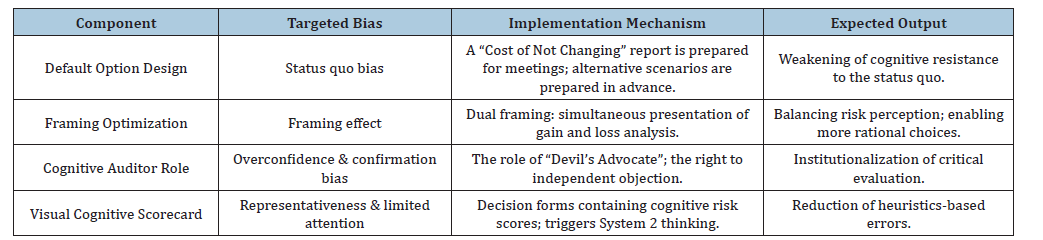
Default option design: This component directly addresses status quo bias. In traditional management meetings, continuing the current strategy is implicitly the default option. SDAM reverses this mechanism by ensuring that a “cost of not changing” report is the first item on the agenda at every strategic meeting. In the default option experiments documented in TÜSİAD’s [3] report, it was observed that when individuals were automatically placed in an alternative position, their behavior changed radically.
Framing optimization: This requires presenting each strategic option simultaneously from both a gain and a loss perspective. Kahneman [1] prospect theory shows that loss framing encourages decision-makers to take risks, while gain framing triggers risk aversion. To balance this asymmetry, each board presentation should be structured in a dual-column format under the headings “Potential Gain Analysis” and “Potential Loss Analysis.”
Cognitive auditor role: This involves assigning a rotating “Cognitive Auditor” role on the board of directors to counteract approval bias and groupthink. This role, used by companies such as Intel, Amazon, and Bridgewater Associates, is inspired by “devil’s advocate” and “dialectical inquiry” techniques applied in various forms in corporate decision-making processes. The auditor’s task is not to support any particular option, but to systematically question the weakest assumptions underlying each option.
Visual cognitive scorecard: This component targets limited attention and representativeness bias. System 2 activation is encouraged through a standardized form that visualizes cognitive risk factors for each strategic issue on the decision agenda. TÜSİAD’s [3] report on energy-labeling experiments has shown that the way information is presented (alphabetical/numerical, short/longterm cost) significantly affects decision quality. The same principle can be applied to corporate scorecard design.
Model implementation process
The integration of SDAM into the corporate structure should be carried out in three stages. In the first stage, a cognitive review of existing decision-making processes should be conducted, in which past strategic decisions are retrospectively analyzed in terms of which bias mechanisms were at play. In the second stage, meeting design and agenda structure should be redesigned based on SDAM components. In the third stage, after a trial period, the effectiveness of the model should be evaluated by measuring the quality and variety of decisions. The critical success factor in this process is that top management adopts the model not as a “control mechanism” but as a “capacity-building tool.” A finding highlighted in TÜSİAD’s [3] report is important at this point: the success of behavioral interventions depends largely on the cultural readiness of the implementation environment.
Discussion
Comparison of SDAM with existing approaches
Current approaches proposed to improve the quality of strategic decision-making can generally be categorized into two groups: individual capacity building (awareness training, mindfulness practices) and process structuring (scenario analysis, worst-case planning). Both approaches have limitations. Individual training is insufficient to create a consistent and lasting effect on cognitive biases; empirical evidence shows that bias training is particularly difficult to transfer to real decision-making situations under pressure [16]. SDAM offers a different response to this limitation: making the process independent of individual cognitive capacity. This approach aligns with the common logic of successful nudging practices documented in TÜSİAD’s [3] report. In these practices, individuals are not forced to “make better decisions”; instead, an environment is designed in which the right decision becomes more accessible.
Organizational culture and implementation challenges
One of the most critical obstacles to implementing SDAM is organizational culture. As Pfeffer [17] observed, organizational hierarchies often contain a structural resistance to questioning the decisions of senior managers. The Cognitive Auditor role directly confronts this cultural barrier; therefore, the organizational authority of the role must be explicitly legitimized by top management. On the other hand, the risk of bureaucracy and procedural overload cannot be ignored. The integration of SDAM components into meeting processes may be perceived as an unnecessary burden, especially in large and multi-layered organizations. To minimize this risk, the mandatory and optional components of the model should be separated; in the initial stage, full SDAM implementation should be reserved for high-risk strategic decisions.
Sectoral adaptations
TÜSİAD’s [3] report clearly shows that behavioral interventions vary from sector to sector. Loss aversion and overconfidence biases are prominent in the finance sector, while social norm effects and status quo bias are decisive in the energy sector. These findings indicate that SDAM should also be adapted according to the sectoral context. For example, status quo bias may be less pronounced in the technology sector due to rapid change dynamics, whereas in sectors such as heavy industry or finance, escalation of commitment and sunk cost fallacy may become more dominant. These differences necessitate that SDAM be designed not as a universal template, but as a framework sensitive to the sectoral risk profile.
Conclusion and Recommendations
This study argues that strategic management is fundamentally a matter of “decision architecture.” Managers are not cognitively flawed; however, their cognitive capacities make them susceptible to systematic biases in complex and uncertain environments. Management systems that ignore this fact will continue to harbor competitive weaknesses. SDAM provides a structural response to this systemic inadequacy. The originality of the model lies in its focus on process design rather than individual self-discipline. Supported by the findings of TÜSİAD’s [3] report, this approach aims to bring the successes of behavioral economics at the individual level to the board level by transferring the principles of choice architecture to corporate decision-making processes. The main policy recommendations stemming from this study can be summarized as follows: first, companies should formally incorporate cognitive risk assessment steps into their board of directors’ bylaws; second, bias-awareness modules should be included in senior management training programs; and third, cognitive risk assessment components should be used as mandatory checklists in major corporate merger, acquisition, and strategy revision decisions. Future research should empirically test this model in high-risk and uncertain contexts such as the defense industry, technology startups, and the public sector. Given Turkey’s level of corporate governance maturity and cultural variables, qualitative and quantitative research is needed to adapt the model to the local context [18]..
References
- Kahneman D, Tversky A (1979) Prospect theory: An analysis of decision under risk. Econometrica 47(2): 263-291.
- Thaler RH, Sunstein CR (2008) Nudge: Improving decisions about health, wealth, and happiness. Yale University Press, UK.
- TÜSİAD (2025) Sector-based applications of behavioral economics.
- Porter ME (1980) Competitive strategy: Techniques for analyzing industries and competitors. Free Press.
- Ansoff HI (1965) Corporate strategy. McGraw-Hill, USA.
- Simon HA (1957) Models of man: Social and rational. Wiley.
- Redmond M (2017) Bounded rationality and decision-making in organizations. Organizational Behavior Classics.
- Schwenk CR (1984) Cognitive simplification processes in strategic decision-making. Strategic Management Journal 5(2): 111-128.
- Finkelstein S, Hambrick DC (1996) Strategic leadership: Top executives and their effects on organizations. West Publishing, USA.
- Kahneman D (2011) Thinking, fast and slow. Farrar, Straus and Giroux, USA.
- Malmendier U, Tate G (2005) CEO overconfidence and corporate investment. Journal of Finance 60(6): 2661-2700.
- Lovallo D, Kahneman D (2003) Delusions of success: How optimism undermines executives’ decisions. Harv Bus Rev 81(7): 56-63.
- Hayward MLA, Hambrick DC (1997) Strategic leadership: Top executives and their effects on organizations. Administrative Science Quarterly 42(1): 103-127.
- Staw BM (1981) The escalation of commitment to a course of action. Academy of Management Review 6(4): 577-587.
- Thaler RH, Benartzi S (2004) Save more tomorrow: Using behavioral economics to increase employee saving. Journal of Political Economy 112(S1): S164-S187.
- Soll JB, Milkman KL, Payne JW (2015) Outsmart your own biases. Harvard Business Review 93(5): 64-71.
- Pfeffer J, Sutton RI (2006) Hard facts, dangerous half-truths and total nonsense: Profiting from evidence-based management. Harvard Business School Press, USA.
- Tversky A, Kahneman D (1986) Rational choice and the framing of decisions. Journal of Business 59(4): S251-S278.
© 2026 Mesut Atasever. This is an open access article distributed under the terms of the Creative Commons Attribution License , which permits unrestricted use, distribution, and build upon your work non-commercially.
Editor In Chief







.jpg)































Signup for Newsletter

Quick Links
 Editorial Board Registrations
 Submit your Article
 Best Paper of the Volume
 Reprints
 Refer a Friend
 Advertise With Us
Our Recent Edition

.jpg)



Top Editors




.jpg)

















.bmp)
.jpg)
.png)
.jpg)













.jpg)






.png)

.png)




.png)




Financial Support

Sponsors

Latest e-Books

Latest Video

 a Creative Commons Attribution 4.0 International License. Based on a work at www.crimsonpublishers.com.
Best viewed in
a Creative Commons Attribution 4.0 International License. Based on a work at www.crimsonpublishers.com.
Best viewed in 
 | Above IE 9.0 version