

- About Us
- Information
-

The Author ensures that the research has been conducted responsibly and ethically with adherence to all relevant regulations. read more..
- For Authors
- For Reviewer
- Manuscript Guidelines
- Membership
- Publication Ethics
-
- Journals
- Reprints
- e-Books
- Videos
- Policies
- Contact Us
 COVID-19
- Submissions



Full Text
Strategies in Accounting and Management
Emotional Framing and Language Influence on Task Interpretation in Crowdsourced Software Engineering: Implications for Information Systems Design
Tian Xiao*
University of Edinburgh, Suzhou Industrial Park, Suzhou, Jiangsu 215000, China
*Corresponding author:Tian Xiao, University of Edinburgh, Suzhou Industrial Park, Suzhou, Jiangsu 215000, China
Submission:June 17, 2026;Published: June 24, 2026

ISSN:2770-6648Volume6 Issue 2
Abstract
Unmanned Aerial Vehicles (UAVs), commonly known as drones, have emerged as transformative This study examines how language and emotional framing influence developers’ understanding of task instructions in a multilingual crowdsourcing environment. Although previous research has shown that native languages offer advantages in emotional processing, little is currently known about how this effect extends to the interpretation of professional tasks. This study conducted two experiments with Chinese-English bilingual participants. Two experiments were conducted with Mandarin–English bilingual participants. Experiment 1 investigated language effects (Mandarin vs. English) on perceived responsibility and risk. Results showed a non-significant overall effect, but a tendency for stronger perceived intensity in the first language. Experiment 2 examined emotional framing (negative vs. positive wording), revealing that negatively framed task descriptions significantly increased perceived responsibility and risk, while positive framing reduced perceived intensity. This effect was consistent across language groups. These findings suggest that emotional framing has a stronger and more robust influence than language on task interpretation. The study highlights the importance of linguistic design in crowdsourced software platforms, where subtle wording differences may affect developers’ understanding of responsibility and risk.
Keywords: Emotional framing; Language effects; Task interpretation; Bilingual processing; Crowdsourced software development
Abbreviations: ANOVA: Analysis of Variance; HCI: Human-Computer Interaction
Introduction
Language has been shown to have a significant impact on cognitive processes, personality formation, and task-related perception [1]. It is widely accepted that emotionally charged words are more memorable and tend to elicit stronger cognitive and affective responses than neutral words [1]. Anooshian and Hertel (1994) conducted an experiment on English–Spanish bilinguals to investigate whether emotional words carry the same intensity across different languages. Since then, a growing body of research has suggested that emotionally charged words are often perceived as more intense in an individual’s first language, with influencing factors including age of acquisition, language proficiency, and retrieval context. In software engineering contexts, task descriptions play a critical role in shaping developers’ understanding of requirements and responsibilities (Storey et al. 2020). In crowdsourcing platforms, where communication is primarily text-based, subtle linguistic differences may significantly influence task interpretation (Mao et al. 2017). While prior studies mainly focus on memory and emotional processing, less attention has been paid to how emotionally charged language influences decision-making and task interpretation in professional contexts, particularly in digital work environments. In recent years, programmer crowdsourcing platforms and shared IT talent pools have become increasingly prevalent, where developers rely heavily on written task specifications to understand requirements, risks, and responsibilities. In such contexts, emotionally loaded terms, such as “responsibility,” “liability,” and “breach” may function as affective cues that shape developers’ perception of task risk, obligation, and urgency.
However, it remains unclear whether bilingual developers interpret these terms differently when presented in their first language versus a second language (e.g., Chinese vs. English). Given that emotional resonance is often stronger in the first language, developers may exhibit higher sensitivity to risk-related terms when reading task descriptions in their native language. Most existing studies have been conducted in languages using Western alphabetic systems. Comparatively fewer studies have examined how these effects manifest in Chinese, which employs an ideographic writing system. Chinese characters often encode semantic meaning visually and structurally, and the language contains features such as homophones and semantically compositional characters. For example, the character “好” (meaning “good”) combines “女” (female) and “子” (child), reflecting embedded cultural and semantic associations. These features may further influence how emotionally charged terms are processed and interpreted. Therefore, the present study aims to investigate how language (Chinese vs. English) influences developers’ sensitivity to emotionally charged terms in task specifications within programmer crowdsourcing platforms. Specifically, this study examines how terms related to responsibility and contractual risk (e.g., “responsibility,” “breach”) affect developers’ perception of task requirements, obligations, and risks. By situating language-dependent processing within a professional software engineering context, this study contributes to a deeper understanding of how linguistic and emotional cues shape task interpretation in multilingual digital work environments. Recent research continues to demonstrate that language context influences emotional processing and decision-making across domains, highlighting the relevance of these effects in modern digital and professional environments [2].
Materials and Methods
Emotionally charged words are often perceived as more intense in an individual’s first language. This raises the question of whether developers exhibit different levels of sensitivity to such terms when task specifications are presented in a first versus a second language. The present study applies language-dependent processing to a professional context, namely programmer crowdsourcing platforms, where developers rely on written task descriptions to interpret requirements, responsibilities, and risks. Emotionally loaded terms (e.g., “responsibility,” “liability,” “breach”) may function as affective cues that shape task interpretation. This study investigates how Mandarin–English bilingual participants evaluate task descriptions presented in either language, measuring perceived responsibility, risk, and task seriousness. It is hypothesized that (H1) participants will show higher sensitivity to responsibilityand risk-related terms in their first language (Mandarin), and (H2) negatively framed terms will increase perceived risk and obligation, with stronger effects in the first language.
Experiment 1
Method: A between-subjects experimental design was employed to examine the effects of language and emotional framing on task perception. The study was conducted online using Qualtrics, and participants were randomly assigned to experimental conditions.
Participants: The final sample consisted of 60 Mandarin– English bilingual participants (30 female, 30 male; Mage = 23.38, SD = 2.50). All participants were native Mandarin speakers with high proficiency in English.
Materials and measures: The study used task specification scenarios designed to resemble those found on programmer crowdsourcing platforms (e.g., bug fixing, feature implementation). Two language conditions were included (Mandarin vs. English), with semantically equivalent task descriptions. Task descriptions incorporated emotionally charged terms related to responsibility and contractual risk (e.g., “responsibility,” “breach,” “penalty”). Emotional framing was manipulated to create two conditions: a negative (high-risk) condition and a neutral condition. Participants evaluated each task using a 7-point Likert scale on three dimensions: perceived responsibility, perceived risk, and perceived task seriousness. All responses were treated as continuous variables. Language (Mandarin vs. English) and emotional framing (negative vs. neutral) were coded as independent variables.
Procedure: Participants accessed the study via a web link or QR code and provided informed consent before participation. Each participant completed the questionnaire in a single language condition. They were then presented with a series of task scenarios and asked to evaluate each one based on responsibility, risk, and consequences.
The order of task presentation was counterbalanced to control for order effects. A brief practice session was included to familiarize participants with the task format. Demographic information was collected at the end of the study.
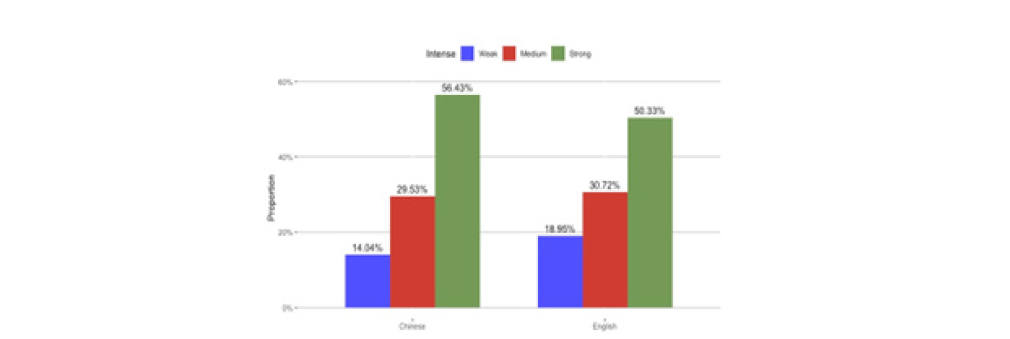
Results: The present study examined whether language influences participants’ sensitivity to emotionally charged task specifications. As shown in Figure 1, participants reported a higher proportion of high perceived intensity responses in the Mandarin condition (56.43%) compared to the English condition (50.33%), while low-intensity responses were more frequent in the English condition (18.95%) than in Mandarin (14.04%). Medium responses were comparable across conditions. A chi-square test of independence indicated no significant association between language condition and response distribution, χ²(2, N = 573) = 2.42, p >.05. However, a Z-test for proportions showed that the proportion of high-intensity responses was significantly higher in the Mandarin condition than in the English condition (p<.05). Overall, although no significant overall association was observed, the results suggest a tendency for increased sensitivity to emotionally charged task descriptions when presented in the first language. This discrepancy suggests that localized differences may exist even when overall distributions are not statistically significant.
Figure 1:Proportion of weak, medium, and strong perceived intensity across language conditions in Experiment 1.
Discussion
The present study examined whether language influences bilingual individuals’ sensitivity to emotionally charged terms in task specifications. Although no significant overall association was found, the observed pattern was consistent with the hypothesis: participants showed a higher proportion of high-intensity responses in the Mandarin condition, suggesting increased sensitivity in the first language. These findings extend previous research on language-dependent emotional processing, which suggests that second-language use reduces emotional resonance and alters decision-making patterns (Circi et al., 2021; Purpuri et al. [2]). Previous studies have shown that emotional expressions are more intense in a first language (Dewaele 2004; Harris et al. [3]), and the current results suggest that this effect may also influence how task requirements, responsibility, and risk are interpreted in digital work environments. Importantly, this study contributes to the literature by examining Chinese–English bilinguals using an ideographic writing system, suggesting that language-dependent emotional effects are not limited to alphabetic languages. From a practical perspective, the findings highlight the importance of linguistic design in programmer crowdsourcing platforms. Developers may underestimate risks when tasks are presented in a second language, consistent with evidence that foreign language use can reduce sensitivity to emotional cues and increase risktaking tendencies [4,5]. Several limitations should be noted, including the relatively small sample size and the lack of control over participants’ programming experience. Future research could incorporate larger samples, professional developers, and additional factors such as language proficiency. Overall, the results suggest that language influences sensitivity to emotionally charged task descriptions, with stronger effects observed in the first language.
Experiment 2
The second experiment examined the effect of emotional framing on participants’ interpretation of task specifications, focusing on perceived responsibility and risk. It was hypothesized that (H1) negatively framed task descriptions (e.g., involving breach or penalties) would increase perceived responsibility and risk, and (H2) positively framed descriptions would reduce perceived intensity, with potential variation across language conditions.
Method: A between-subjects experimental design was employed to examine the effects of emotional framing and language on task perception. The study was conducted online using Qualtrics, and participants were randomly assigned to experimental conditions.
Participants: The same sample of participants from Experiment 1 was used in Experiment 2. The final sample consisted of 60 Mandarin–English bilingual participants (30 female, 30 male; Mage = 23.38, SD = 2.50). All participants were native Mandarin speakers with high proficiency in English. All participants were native Mandarin speakers with high proficiency in English. Participants were aged between 18 and 30.
Materials and measures: The materials were adapted from Experiment 1, using task specification scenarios resembling those found on programmer crowdsourcing platforms. Emotional framing was manipulated by introducing two conditions: negative framing and positive framing. In the negative condition, task descriptions emphasized responsibility, penalties, and contractual risks, whereas in the positive condition, descriptions highlighted successful outcomes and minimized risk-related language. All task descriptions were presented in both Mandarin and English, with semantic equivalence maintained across languages. Participants evaluated each task using a 7-point Likert scale on three dimensions: perceived responsibility, perceived risk, and perceived task seriousness. For descriptive analysis, responses were categorized into negative (1–3), neutral (4), and positive (5– 7) groups. Emotional framing (negative vs. positive) and language condition were coded as independent variables, and responses were treated as continuous variables.
Procedure: Participants accessed the study via a web link or QR code and provided informed consent before participation. Each participant completed the questionnaire in a single language condition. Participants were presented with a series of task scenarios varying in emotional framing and were asked to evaluate each scenario in terms of responsibility, risk, and consequences. The order of task presentation was counterbalanced to control for order effects. A brief practice session was included to familiarize participants with the task format. Demographic information was collected at the end of the study [6-20].
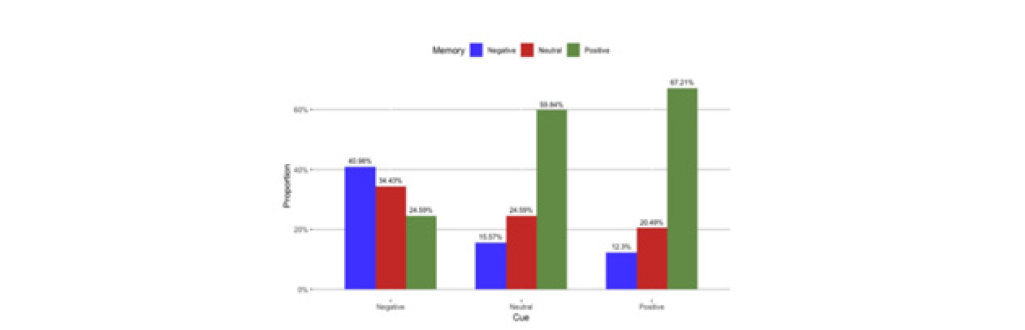
Results: The present experiment examined the effect of emotional framing on task perception. As shown in Figure 2, negatively framed task descriptions were associated with a higher proportion of negative evaluations (40.98%), whereas positively framed descriptions led to a substantially higher proportion of positive evaluations (67.21%). Neutral framing produced a more balanced response distribution. Perceived evaluations were categorized based on participants’ Likert scale responses, where ratings of 1–3 were classified as negative evaluations, 4 as neutral, and 5–7 as positive evaluations. Figure 3 shows that this pattern was consistent across participants. Negatively framed tasks elicited more negative evaluations, while positively framed tasks resulted in more positive evaluations (bilingual: 69.44%; monolingual: 64%), indicating a strong effect of emotional framing regardless of language background. Chi-square tests of independence revealed no significant association between language group and response distribution (all ps>.05), suggesting that language background did not significantly moderate the effect of framing. Similarly, a 2 × 2 × 2 ANOVA showed no significant main or interaction effects (ps > .05). Overall, the results indicate that emotional framing strongly influences task perception, whereas language and participant group do not significantly alter this effect.
Figure 2:Distribution of perceived evaluations across negative, neutral, and positive task framing conditions.
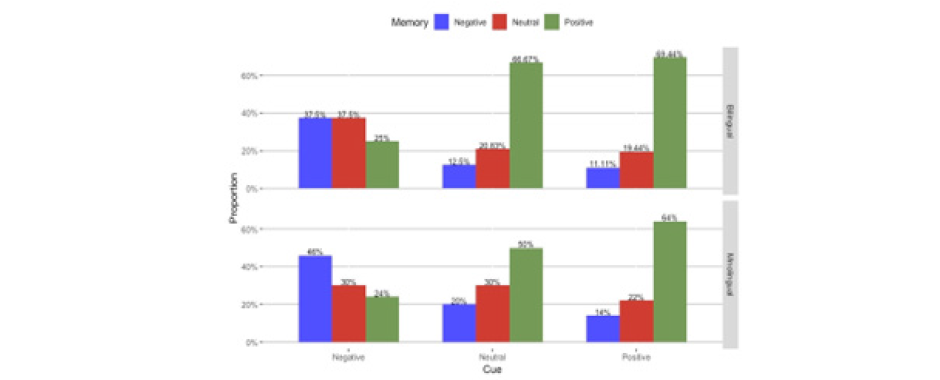
Figure 3:Comparison of perceived evaluations across participants under different emotional framing conditions.
Results and Discussion
Taken together, the results of the two experiments suggest that emotional framing exerts a more consistent and robust influence on task interpretation than language. While language showed a tendency to affect sensitivity to emotionally charged terms, its overall impact was limited compared to framing effects. These findings indicate that affective cues embedded in task descriptions play a critical role in shaping developers’ perception of responsibility and risk. In multilingual environments, emotional framing appears to directly guide interpretation, whereas language primarily modulates the intensity of these perceptions. This highlights the importance of considering both linguistic and emotional dimensions when designing task communication in global software collaboration contexts [21-32].
Conclusion
This study demonstrates that both language and emotional framing influence the interpretation of task specifications, with emotional framing showing a stronger and more consistent effect. From a practical perspective, the findings provide important implications for the design of programmer crowdsourcing platforms. First, platform designers should carefully consider the use of emotionally charged language, particularly in multilingual contexts. For example, the use of strongly negative terms (e.g., “breach,” “penalty”) in Chinese task descriptions may amplify perceived risk and responsibility, potentially discouraging participation or increasing perceived task burden. Second, platforms could provide language customization options, allowing bilingual developers to switch between languages when interpreting task requirements, thereby reducing misinterpretation and improving clarity. Despite these contributions, several limitations should be acknowledged. The sample consisted primarily of young participants with academic or student backgrounds, which may limit the generalizability of the findings to professional software developers. Additionally, participants’ actual experience with real-world crowdsourcing platforms was not strictly controlled. Future research should replicate these findings with professional developers and more diverse demographic groups, as well as examine how these effects manifest in real task environments. Overall, the study highlights the importance of linguistic design in multilingual task communication and suggests that both language and emotional framing should be carefully considered to improve task clarity, risk perception, and developer engagement.
Acknowledgement
Not applicable.
Conflict of Interest
The author declares no conflict of interest.
References
- Marian V, Kaushanskaya M (2005) Autobiographical memory and language in bicultural bilinguals. In Proceedings of the 4th International Symposium on Bilingualism.
- Purpuri S, Vasta N, Filippi R, Wei L, Mulatti C (2025) Does language shape the way we think? A review of the foreign language effect across domains. International Journal of Bilingualism 29(1): 269-291.
- Harris CL, Ayçiçeği A, Gleason JB (2003) Taboo words and reprimands elicit greater autonomic reactivity in a first language than in a second language. Applied Psycholinguistics 24(4): 561-579.
- Muda R, Niszczota P, Hamerski D, Białek M (2025) Using a foreign language increases risk‐taking in prenatal testing decisions but not due to attenuated emotional responses. Journal of Behavioral Decision Making 38(2): e70016.
- Hu Z, Navarrete E (2025) Understanding the impact of foreign language on social norms through lies. Bilingualism: Language and Cognition 28(1): 257-271.
- Hayakawa SL, Costa A, Foucart A, Keysar B (2016) Using a foreign language changes our choices. Trends Cogn Sci 20(11): 791-793.
- Hespos SJ, Spelke ES (2004) Conceptual precursors to language. Nature 430(6998): 453-456.
- Huang Y (2023) The impact of sentiment in crowdsourced software tasks. IEEE Software 40(2): 45-52.
- Kahneman D (2011) Thinking, fast and slow. Farrar, Straus and Giroux, USA.
- Kaur K (2020) Emotional factors in software development decision-making. Empirical Software Engineering 25: 1234-1256.
- Keysar B, Hayakawa SL, An SG (2012) The foreign-language effect: Thinking in a foreign tongue reduces decision biases. Psychol Sci 23(6): 661-668.
- Kyriakou A, Foucart A, Mavrou I (2023) Moral judgements in a foreign language: Expressing emotions and justifying decisions. International Journal of Bilingualism 27(6): 978-995.
- Lerner JS, Li Y, Valdesolo P, Kassam KS (2015) Emotion and decision making. Annual Review of Psychology 66: 799-823.
- Loftus EF, Palmer JC (1974) Reconstruction of Automobile Destruction: An example of the interaction between language and memory. Journal of Verbal Learning and Verbal Behavior 13(5): 585-589.
- Matsumoto A, Stanny C (2006) Language-dependent access to task-related perception in Japanese-English bilinguals and US monolinguals. Memory 14(3): 378-390.
- Marian V, Neisser U (2000) Language-dependent recall of autobiographical memories. J Exp Psychol Gen 129(3): 361-368.
- Marian V, Fausey CM (2006) Language-dependent memory in bilingual learning. Applied Cognitive Psychology 20(8): 1025-1047.
- McGeoch JA (1932) Forgetting and the law of disuse. Psychological Review 39(4): 352-370.
- Melton AW (1963) Implications of short-term memory for a general theory of memory. Journal of Verbal Learning and Verbal Behavior 2(1): 1-21.
- Pederson E, Kita S, Danziger E, Levinson S, Wilkins D, et al. (1998) Semantic typology and spatial conceptualization. Language 74(3): 557-589.
- Pinker S, Alan P (1994) Regular and irregular morphology and the psychological status of rules of grammar. Studies in Language Companion Series 321.
- Ross M, Xun WQE, Wilson AE (2002) Language and the bicultural self. Personality and Social Psychology Bulletin 28(8): 1040-1050.
- Schrauf RW, Rubin DC (1998) Bilingual autobiographical memory in older adult immigrants: A test of cognitive explanations of the reminiscence bump and the linguistic encoding of memories. Journal of Memory and Language 39(3): 437-457.
- Schrauf RW (2000) Bilingual autobiographical memory: Experimental studies and clinical cases. Culture & Psychology 6(4): 387-417.
- Tulving E (1979) Relation between encoding specificity and levels of processing. Levels of Processing in Human Memory (1st edn), pp. 1-24.
- Tulving E, Osler S (1968) Effectiveness of retrieval cues in memory for words. Journal of Experimental Psychology 77(4): 593-601.
- Tulving E, Pearlstone Z (1966) Availability versus accessibility of information in memory for words. Journal of Verbal Learning and Verbal Behavior 5(4): 381-391.
- Tulving E, Thomson DM (1973) Encoding specificity and retrieval processes in episodic memory. Psychological Review 80(5): 352-373.
- Waxman SR, Braun I (2005) Consistent (but not variable) names as invitations to form object categories: New evidence from 12-month-old infants. Cognition 95(3): B59-B68.
- Whorf BL, John BC (1956) Language, thought and reality: Selected writings of Carroll JB (Ed,).
- Yavuz M, Küntay AC, Brouwer S (2024) The effect of foreign language and psychological distance on moral judgment in Turkish-English bilinguals. Bilingualism: Language and cognition 27(3): 447-459.
- Zhang H (2020) Understanding task context in software development. IEEE Transactions on Software Engineering.
© 2026 Tian Xiao. This is an open access article distributed under the terms of the Creative Commons Attribution License , which permits unrestricted use, distribution, and build upon your work non-commercially.
Editor In Chief







.jpg)































Signup for Newsletter

Quick Links
 Editorial Board Registrations
 Submit your Article
 Best Paper of the Volume
 Reprints
 Refer a Friend
 Advertise With Us
Our Recent Edition

.jpg)



Top Editors




.jpg)

















.bmp)
.jpg)
.png)
.jpg)













.jpg)






.png)

.png)




.png)




Financial Support

Sponsors

Latest e-Books

Latest Video

 a Creative Commons Attribution 4.0 International License. Based on a work at www.crimsonpublishers.com.
Best viewed in
a Creative Commons Attribution 4.0 International License. Based on a work at www.crimsonpublishers.com.
Best viewed in 
 | Above IE 9.0 version