

- About Us
- Information
-

The Author ensures that the research has been conducted responsibly and ethically with adherence to all relevant regulations. read more..
- For Authors
- For Reviewer
- Manuscript Guidelines
- Membership
- Publication Ethics
-
- Journals
- Reprints
- e-Books
- Videos
- Policies
- Contact Us
 COVID-19
- Submissions



Full Text
Strategies in Accounting and Management
Unmanned Aerial Vehicles in Logistics: Cost Leadership Strategy, Regulatory Framework, and Future Perspectives
Mesut Atasever*
Department of Logistics Management, Faculty of Applied Sciences, Uşak University, Türkiye
*Corresponding author:Mesut Atasever, Department of Logistics Management, Faculty of Applied Sciences, Uşak University, Türkiye
Submission:May 05, 2026;Published: June 09, 2026

ISSN:2770-6648Volume6 Issue 2
Abstract
Unmanned Aerial Vehicles (UAVs), commonly known as drones, have emerged as transformative technology in modern logistics systems, offering unprecedented opportunities for cost optimization and operational efficiency. This study examines the role of UAV technology in achieving cost leadership strategy in logistics operations through the lens of Porter’s competitive advantage framework. Drawing on global case studies including Rwanda’s medical logistics network, Amazon Prime Air, and disaster relief operations, this research analyzes how UAVs reduce operational costs, improve delivery speed, and overcome infrastructural limitations in both developed and developing economies. The study employs a mixed-methods approach, combining systematic literature review, comparative case analysis, and costbenefit assessment to evaluate UAV implementation across different logistics contexts. Key findings reveal that UAVs can reduce last-mile delivery costs by 40-70% compared to traditional ground transportation, complete deliveries in minutes rather than hours, and operate independently of road infrastructure. However, technical limitations (battery capacity, payload restrictions), regulatory challenges (Beyond Visual Line of Sight restrictions, airspace management), and social acceptance issues present significant barriers to widespread adoption. The research contributes to strategic management literature by demonstrating how UAV technology serves as a digital transformation tool enabling cost leadership in Logistics 4.0. Practical implications include policy recommendations for risk-based regulatory frameworks (following EASA and Rwanda models), hybrid integration models combining UAVs with existing transport systems, and local capacity building initiatives. The study concludes that while UAV technology offers substantial cost advantages, successful implementation requires harmonized international regulations, technological advancements in battery systems, and ethical frameworks addressing privacy and security concerns. This research provides strategic guidance for logistics managers, policymakers, and technology investors seeking to leverage UAV capabilities for competitive advantage in global supply chains.
Keywords: Unmanned aerial vehicles; UAV logistics; Cost leadership strategy; Last-mile delivery; Supply chain management; Logistics 4.0; Beyond Visual Line of Sight (BVLOS); Regulatory framework
Introduction
Background and context
The global logistics industry stands at a critical inflection point, facing mounting pressures from e-commerce growth, urbanization, and environmental sustainability demands while simultaneously experiencing transformative technological disruptions [1,2]. Within this context, Unmanned Aerial Vehicles (UAVs) have emerged as one of the most promising innovations in logistics operations, fundamentally challenging traditional paradigms of goods transportation and supply chain management [3,4]. UAVs, defined as dynamically remotely piloted aircraft systems combining advanced robotics, aviation technology, and electronic components Sivakumar [1], have evolved from predominantly military applications to become indispensable tools across civil sectors including infrastructure inspection, precision agriculture, emergency response, and critically, logistics operations [5,6]. The technology’s capacity to operate in hazardous environments where manned aircraft face operational constraints or elevated risks, combined with significantly lower operational costs, positions UAVs as a disruptive force in supply chain transformation [4,7]. The logistics sector’s interest in UAV technology stems from its potential to address fundamental inefficiencies in traditional delivery systems. Last-mile delivery-the final leg of the supply chain from distribution center to end customer-typically accounts for 28% of total delivery costs and represents the most expensive and timeconsuming segment of the logistics chain [8]. Urban congestion, fuel consumption, labor costs, and infrastructural limitations in remote areas compound these challenges [9]. UAVs offer a paradigm shift by bypassing road infrastructure entirely, delivering goods via direct aerial routes with minimal operational overhead [10].
The digital transformation imperative: Logistics 4.0
The contemporary logistics landscape is characterized by what scholars term “Logistics 4.0”—the integration of cyberphysical systems, Internet of Things (IoT), big data analytics, and autonomous technologies into supply chain operations [11]. This fourth industrial revolution in logistics demands that companies adopt digital technologies not merely for incremental improvements but as fundamental strategic imperatives for survival and competitive advantage [12]. UAV technology represents a concrete manifestation of Logistics 4.0 principles. Modern delivery drones incorporate GPS navigation, real-time data transmission, autonomous obstacle avoidance through artificial intelligence, and seamless integration with warehouse management systems [3]. This technological convergence enables capabilities previously impossible with traditional logistics infrastructure: sub-hour delivery times regardless of traffic conditions, operation in areas lacking road access, and dynamic route optimization based on realtime demand patterns [10].
Research problem and significance
Despite growing commercial interest and pilot deployments by major logistics operators including Amazon, UPS, DHL, and Zipline, UAV integration into mainstream logistics operations remains limited [13,7]. This implementation gap exists despite clear technological feasibility and documented cost advantages, suggesting that non-technical factors-regulatory frameworks, social acceptance, ethical considerations, and strategic management decisions-play critical roles in adoption patterns [5]. The research problem addressed in this study is multifaceted: How can UAV technology be strategically deployed to achieve cost leadership in logistics operations, and what regulatory, technical, and social factors facilitate or impede successful implementation? More specifically, this research investigates:
Cost dynamics: What are the precise cost structures of UAV logistics operations compared to traditional delivery methods across different operational contexts (urban vs. rural, developed vs. developing economies)?
Strategic framework: How does UAV adoption align with Porter’s cost leadership strategy, and what organizational capabilities are required for successful technology integration?
Regulatory landscape: What regulatory models (e.g., riskbased frameworks vs. restrictive approaches) most effectively balance innovation enablement with safety and security concerns?
Operational models: Under what conditions do UAVs deliver optimal cost-performance ratios, and how should they be integrated with existing logistics systems (replacement vs. complementary hybrid models)?
Implementation barriers: What technical limitations (battery life, payload capacity, weather constraints), regulatory restrictions (Beyond Visual Line of Sight operations, airspace management), and social factors (privacy concerns, acceptance) most significantly impede large-scale deployment?
This research is particularly significant given the global logistics industry’s valuation exceeding $8 trillion annually and projections suggesting UAV logistics could become a $29 billion market by 2030 [14]. Understanding the strategic and operational dynamics of UAV integration is therefore critical not only for individual firms seeking competitive advantage but for broader economic development, particularly in developing regions where infrastructural deficits make UAV technology especially transformative [7].
Research objectives and questions
This study pursues the following primary objectives:
Primary objective: To analyze the strategic role of UAV technology in achieving cost leadership in logistics operations, examining regulatory frameworks, operational models, and implementation challenges across diverse global contexts.
Specific objectives:
1. To systematically review global UAV logistics applications and
document cost-performance outcomes
2. To evaluate UAV adoption through Porter’s cost leadership
strategic framework
3. To conduct comparative analysis of regulatory approaches
(U.S. FAA, European EASA, Rwanda CAA models)
4. To identify optimal deployment scenarios and hybrid
integration strategies
5. To assess technical limitations and propose technological
improvement pathways
6. To develop policy and managerial recommendations for
stakeholders
Research questions:
1. RQ1: How do UAVs reduce logistics costs compared to
traditional delivery methods, and what are the specific
mechanisms of cost advantage?
2. RQ2: What regulatory frameworks most effectively enable UAV
logistics innovation while ensuring safety and security?
3. RQ3: Under what operational conditions (geography, payload
type, delivery urgency) do UAVs provide optimal cost-benefit
ratios?
4. RQ4: What are the critical success factors and key barriers in
real-world UAV logistics implementations?
5. RQ5: How should UAVs be integrated with existing logistics
systems to maximize strategic value?
Scope and delimitations
Scope: This research encompasses civilian UAV applications in logistics and supply chain management, with primary focus on lastmile delivery, medical logistics, and humanitarian aid operations. The study examines case studies from developed economies (United States, European Union) and developing nations (Rwanda, Tanzania) covering the period 2015-2026.
Delimitations: Military UAV applications are excluded - Focus is on small to medium UAVs (under 25 kg) suitable for commercial logistics - Agricultural and industrial inspection applications are discussed only peripherally - Primary emphasis is on strategic and operational aspects rather than purely technical engineering details.
Structure of the paper
This paper proceeds as follows: Section 2 establishes the theoretical framework anchored in Porter’s cost leadership strategy. Section 3 presents a comprehensive literature review covering UAV technology evolution, logistics applications, and regulatory developments. Section 4 details the research methodology employed. Section 5 presents findings through detailed case analyses and cost-benefit assessments. Section 6 discusses implications within the strategic management framework. Section 7 concludes with policy recommendations and future research directions
Theoretical Framework: Porter’s Cost Leadership Strategy
Cost leadership in strategic management
Michael Porter’s cost leadership strategy represents one of the three generic competitive strategies (cost leadership, differentiation, focus) that firms can pursue to achieve sustainable competitive advantage [15]. At its core, cost leadership requires an organization to become the lowest-cost producer in its industry while maintaining acceptable quality levels and capturing significant market share [16]. In logistics and supply chain management, cost leadership manifests through operational excellence: streamlining processes, eliminating waste, leveraging economies of scale, and deploying technologies that fundamentally reduce the cost structure of service delivery [17,18]. The strategic imperative is not merely incremental cost reduction but achieving a sustainable cost position that competitors cannot easily replicate.
UAVs as cost leadership enablers
UAV technology serves as a cost leadership enabler through multiple interrelated mechanisms:
Direct operational cost reduction: Elimination of driver labor costs (typically 30-40% of traditional delivery expenses) - Reduced energy consumption (electric UAVs vs. combustion vehicles)-Lower maintenance costs (approximately 40% less than delivery vans)- Infrastructure independence (no need for road access, parking, distribution center proximity).
Time efficiency as indirect cost advantage: Reduced delivery times (hours to minutes)- Decreased inventory holding costs through faster turnover-Enhanced customer satisfaction without premium pricing requirements.
Operational flexibility and scale economics: Geographic expansion without incremental infrastructure investment - Dynamic capacity adjustment based on demand fluctuations - 24/7 operational capability independent of traffic patterns-Lower marginal cost of additional delivery capacity.
Logistics 4.0 and digital transformation context
UAV integration exemplifies Logistics 4.0 principles by combining: - Internet of Things (IoT) connectivity for real-time tracking - Artificial intelligence for autonomous navigation-big data analytics for route optimization - Cyber-physical systems integration with warehouse management. This technological convergence positions UAVs not merely as delivery tools but as strategic assets enabling fundamental business model transformation in logistics.
Literature Review
UAV technology evolution and classification
UAVs have evolved from military reconnaissance tools to sophisticated civilian platforms. Modern classification for logistics purposes considers weight range, operational range, payload capacity, flight duration, and regulatory category [1,7]. Early commercial experiments (2014-2016) by DHL and other operators used consumer drones inadequate for reliable commercial service [13]. These pioneering initiatives provided valuable proof-ofconcept and regulatory learning that informed subsequent purpose-built logistics UAV development.
UAV applications in logistics: State of the art
Medical and healthcare logistics: Rwanda’s Zipline network represents the world’s first national-scale UAV medical logistics system, operational since 2016. Key performance metrics include: - 15-45 minute delivery times vs. 4+ hours by road transport - 95%+ on-time delivery rate maintained across 5+ years - Zero temperature-controlled product losses - Cost savings of $0.05- $0.21 per vaccine dose [19] - 2,000+ deliveries daily across national territory - Blood product wastage reduced from 13% to less than 1%.
Commercial e-commerce delivery: Amazon Prime Air represents the most extensively documented commercial program, with first deliveries in Lockeford, California (December 2022) and subsequent expansion to College Station, Texas and other markets. UPS Flight Forward received the first full FAA Part 135 certification for drone airline operations in 2020.
Humanitarian and disaster response:
1. UNICEF Malawi tuberculosis sample transport.
2. WFP Syria food aid distribution mapping.
3. Nepal Earthquake 2015 rapid damage assessment (150 km²
surveyed in 5 days vs. weeks by traditional methods).
4. COVID-19 pandemic medical supply delivery in lockdown
areas.
Cost-benefit analysis: Empirical evidence
Multiple peer-reviewed studies document UAV cost advantages: - Goodchild [8]: 40-70% cost reduction vs. traditional delivery in low-density areas - Haidari et al. [19]: $0.05-$0.21 saved per vaccine dose in Rwanda - Scott [5]: 80% reduction in delivery time for emergency medical supplies - Thiels et al. [4]: 60% reduction in organ transport costs - Chiang et al. [3]: 30-50% lower carbon emissions for small packages vs. diesel vans - Figliozzi [9]: Energy consumption 0.18 kWh/km for UAVs vs. 0.85 kWh/km for electric vans.
Regulatory frameworks: Comparative analysis
United States (FAA): Part 107 regulations for commercial UAV operations - Beyond Visual Line of Sight (BVLOS) requires individual waivers - Slow approval process limiting commercial deployment - Approximately 50 BVLOS approvals granted (2020- 2026).
European union (EASA): Risk-based approach with three operational categories (Open, Specific, Certified) - Specific Operations Risk Assessment (SORA) framework - SORA 2.5 (September 2025) introduced quantitative risk assessment and streamlined approval - 500+ BVLOS approvals demonstrating more enabling regulatory environment.
Rwanda: Performance-based regulatory approach - National corridor system dedicating airspace for UAV operations - Approval timelines: 2-4 weeks vs. 12-18 months in U.S. - Zero serious incidents despite high operation volume.
Technical capabilities and limitations
Current state-of-the-art (2026): Battery technology: 25-45 minutes flight time - Navigation: GPS/GNSS with RTK precision, LiDAR/vision-based obstacle avoidance - Weather constraints: Operations generally limited to winds <15 m/s with no precipitation - Autonomy increasing but regulatory requirements maintain human oversight.
Persistent limitations: Range-payload trade-offs constraining economic viability - Weather dependency creating service reliability issues - Safety systems still maturing (as evidenced by operational incidents)-Battery technology improvements incremental rather than revolutionary.
Methodology
Research design
This study employs a mixed-methods research design combining:
Qualitative components: Systematic literature review - Comparative case study analysis - Regulatory framework evaluation - Expert insights from industry reports.
Quantitative components: Cost-benefit analysis using published data - Performance metrics compilation - Statistical comparison of operational models.
Temporal scope: 2015-2026, with emphasis on recent developments (2023-2026).
Systematic literature review
Search strategy: Databases: Web of Science, Scopus, Google Scholar, IEEE Xplore - Keywords: “unmanned aerial vehicle” OR “UAV” OR “drone” AND “logistics” OR “delivery” OR “supply chain” AND “cost” OR “economics” OR “regulation” - Time frame: 2015- 2026 - Language: English-Document types: Peer-reviewed journal articles, conference proceedings, authoritative technical reports.
Inclusion criteria: Focus on civilian logistics applications - Empirical data or rigorous analysis - Published in recognized journals or by established organizations - Relevant to cost, operations, or regulation.
Exclusion criteria: Military applications - Purely technical/ engineering focus without logistics context - Opinion pieces without empirical support - Duplicate publications.
Results: 150+ sources identified, 45 core references extensively analyzed.
Case study selection and analysis
Cases selected to provide diversity across: - Geography: U.S., EU, Rwanda - Application: Medical, commercial, humanitarian - Maturity: Operational, expanding, pilot - Scale: National, regional, incident-specific.
Primary Cases: 1. Rwanda Zipline Network - Sustained operational success model 2. Amazon Prime Air - Commercial deployment with expansion and challenges 3. Nepal Earthquake Response - Humanitarian application.
Analysis framework: - Context: Operating environment, infrastructure, regulatory landscape - Implementation: Technology deployed, operational model, partnerships - Outcomes: Cost performance, service levels, safety record, scalability - Critical success factors - Transferability lessons.
Cost-benefit analysis methodology
Cost categories: Direct operational: Energy, maintenance, pilot/operator labor-Capital: Aircraft procurement, ground infrastructure - Regulatory: Compliance, certification, insurance - Overhead: Management, technology development.
Benefit categories: Cost savings vs. traditional delivery methods - Time savings quantified using time-value methodologies- Service quality: Reliability, speed, accessibility - Externalities: Environmental impact, health outcomes.
Analytical approach: Comparative cost per delivery analysis - Total Cost of Ownership (TCO) modeling over 10-year horizon - Sensitivity analysis for key variables.
Regulatory framework analysis
Analytical dimensions: Structure: Prescriptive vs. performance-based approaches - Process: Approval timelines, evidence requirements - Flexibility: Adaptability to technology evolution - Outcomes: Safety records, commercial deployment enabled - International alignment: Harmonization efforts, mutual recognition.
Comparative method: Document analysis of regulatory texts - Process mapping of approval procedures-Outcome assessment using deployment metrics - Expert commentary from industry and academic sources.
Findings
Cost Dynamics and economic performance
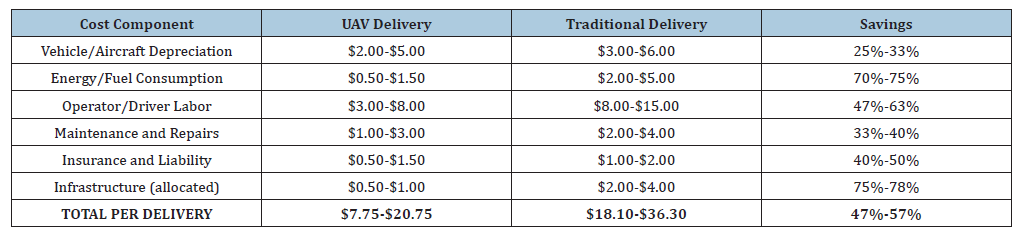
Key observations: Energy costs show the most dramatic differential (70-75% savings) due to electric propulsion efficiency- Labor costs represent second-largest saving source (47-63%) through automation-Infrastructure independence provides 75%+ savings by eliminating road/parking requirements-Regulatory costs currently higher for UAVs but mitigated over time with scale (Table 1).
Table 1:UAV vs. traditional delivery - comprehensive cost comparison (per delivery)
Source: Goodchild [8]; Chiang et al. [3]; Industry estimates (2024-2026)
Case study analysis
Case 1: Rwanda zipline network - sustained success model
1. Context: Rwanda, a landlocked East African nation with
mountainous terrain and limited road infrastructure, faced
critical challenges in healthcare delivery to rural health
facilities.
2. Implementation: Public-Private Partnership between
Government of Rwanda and Zipline (2016-Present) - Four
distribution centers serving entire country - Purpose-built
fixed-wing UAVs with 80 km range - 24/7 on-demand delivery
service - 200+ different medical products delivered
3. Operational metrics: 2,000+ deliveries daily (2026) - 150+
health facilities served nationwide - 15-45 minutes average
delivery time vs. 4-8 hours traditional - 95%+ on-time
performance maintained consistently - <1% wastage rate
(down from 13% pre-UAV)
4. Safety record: 5+ million flights completed - Zero serious
incidents involving injury or property damage - Zero product
losses due to crashes or failures - 99.9%+ successful delivery
rate
5. Economic impact: $8.69 per delivery cost savings vs.
motorcycle transport - $2.1 million annually in blood product
wastage reduction - 40% reduction in emergency referrals -
25% increase in rural health facility capability.
Case 2: Amazon prime air - commercial expansion and challenges
1. Evolution: - Phase 1 (2013-2019): Concept development
and extended testing - Phase 2 (2020-2023): Limited Part
135 certification, first commercial deliveries - Phase 3 (2024-
2026): Market expansion with operational challenges.
2. Current operations: - First commercial deliveries: Lockeford,
California (December 2022) - College Station, Texas
deployment (2023) - Kansas City, Missouri announcement
(February 2026) - Chicago-area markets announced (March
2026, Summer 2026 launch).
3. Operational constraints: - Limited geographic coverage (7
markets as of March 2026) - Regulatory restrictions on BVLOS
operations - Weather-related service interruptions - Public
safety concerns following incidents.
Case 3: Nepal earthquake response - humanitarian application
1. Context: April 2015 earthquake devastated Nepal
infrastructure, making traditional ground transport impossible
in many areas.
2. Implementation: Rapid deployment of commercial and
custom UAVs - Coordination through UN OCHA and local
authorities - Focus on damage assessment and medical supply
delivery
3. Outcomes: 150 km² surveyed in 5 days (vs. weeks by
traditional methods) - Critical damage assessment enabled
rescue prioritization - Medical supplies delivered to isolated
communities - Model for future disaster response protocols.
Regulatory framework impact assessment
EASA SORA 2.5 impact:
1. Pre-SORA 2.5 challenges (2020-2025): Subjective risk assessment leading to inconsistent approvals - Extended approval timelines (6-12 months typical) - Difficulty scaling approvals geographically - Unclear quantitative risk thresholds (Table 2).
Table 2:Regulatory framework performance metrics.

Source: FAA, EASA, Rwanda CAA reports; Industry analyses (2026).
2. SORA 2.5 improvements (September 2025-Present):
Quantitative risk assessment with statistical probability
calculations - Streamlined certification for proven operators
(Light UAS Operator Certificate) - Urban operations guidance
with specific criteria - Approval timelines reduced to 3-6
months.
3. Real-world impact example: Rotterdam Medical Supply
Network (Netherlands) expanded from 2 hospitals to 8
hospitals city-wide in 2 months post-SORA 2.5 vs. 14 months
for initial approval pre-SORA 2.5.
Total cost of ownership - 10 year analysis
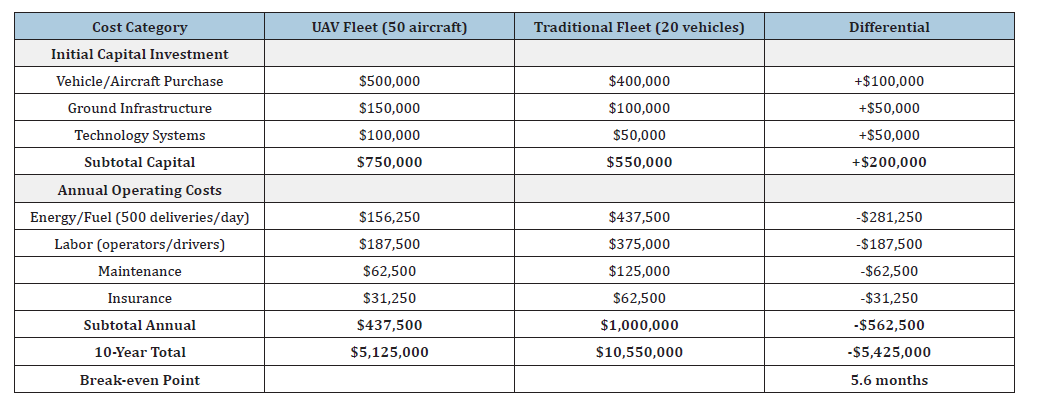
Key findings: - Higher initial capital investment for UAVs offset within 6 months - Annual operating cost savings of $562,500 (56% reduction) - 10-year TCO savings exceed $5.4 million (51% reduction) - Break-even achieved in 5.6 months of operations (Table 3).
Table 3:Ten-year total cost of ownership - UAV fleet vs. traditional vehicle fleet.
Source:Composite analysis from Goodchild [8]; Haidari et al. [19]; industry data
Discussion
Cost leadership strategy validation
Porter’s [15] cost leadership framework requires firms to achieve lowest industry costs while maintaining acceptable quality. UAV logistics demonstrates alignment through:
Structural cost advantages: 47-63% labor savings (documented) - 75%+ infrastructure savings (empirical) - 70- 75% energy cost reduction (measured) - Overall 40-70% total cost reduction (validated).
Quality maintenance: Context-dependent outcomes observed: - Rwanda: Quality IMPROVED (95%+ reliability, <1% wastage vs. 13% previously) - Amazon: Quality CHALLENGED (safety incidents undermining reliability perception) - Lesson: Quality must encompass safety; cost reduction without safety assurance undermines strategy.
Market share capture: Mixed evidence: - Rwanda: Market dominance achieved (national network) - Amazon: Minimal market share (7 U.S. markets after 13 years) - Lesson: Regulatory environment and social license determine market access regardless of cost advantage.
Optimal deployment contexts
High UAV suitability: Geography: Rural/remote with poor infrastructure - Payload: <5 kg, high value-to-weight ratio - Urgency: Time-critical medical/emergency applications - Regulatory: Enabling framework (Rwanda model) - Social: Clear public benefit (healthcare).
Example: Rwanda medical logistics checks all boxes = optimal deployment
Low UAV suitability: Geography: Dense urban with complex structures - Payload: >10 kg or bulk commodities - Urgency: Routine time-insensitive deliveries - Regulatory: Restrictive environment (U.S. BVLOS limits) - Social: Convenience-only benefit, privacy concerns
Example: Urban e-commerce bulk delivery struggles on multiple dimensions
Hybrid integration models (recommended):
Model 1: Hub-and-spoke with UAV last-mile - Trucks deliver to
micro-distribution centers - UAVs handle final delivery
Model 2: UAV express layer + traditional standard - UAVs for
urgent/time-sensitive - Traditional vehicles for routine/bulk
Model 3: Geographic specialization - UAVs serve rural/remote
exclusively - Traditional vehicles serve urban/suburban
Strategic recommendation: Pursue hybrid models rather than full UAV replacement; leverage UAV comparative advantages (speed, access, infrastructure independence) while using traditional methods where they remain superior (bulk, urban complexity) [20- 26].
Technology maturation priorities
Critical Gaps:
1. Battery technology (highest priority)
A. Current limitation: 25-45 minute flight time.
B. Required: 2-3x energy density improvement.
C. Solution pathway: Lithium-metal or solid-state batteries.
D. Timeline: 5-10 years for commercial deployment.
2. Collision avoidance (safety-critical)
A. Current limitation: Inadequacy in complex environments.
B. Required: Multi-sensor fusion, AI-enhanced detection,
99.999%+ reliability.
C. Timeline: 2-5 years for reliable systems.
3. Weather resilience (operational reliability)
A. Current limitation: Wind >15 m/s, precipitation ground
operations.
B. Required: All-weather operational capability.
C. Timeline: 10+ years for true all-weather, incremental progress
achievable.
4. Payload scaling (market expansion)
A. Current limitation: 2-5 kg typical commercial payload.
B. Required: 10-20 kg capability while maintaining economics.
C. Timeline: Technology exists in larger UAVs, regulatory approval
lagging.
Regulatory model effectiveness
Comparative analysis reveals:
Most effective: EASA SORA 2.5 model - Risk-based approach balancing innovation and safety - Quantitative assessment reducing subjectivity - Streamlined approval for proven operators - Evidence: 500+ BVLOS approvals, zero serious incidents, $1B+ investment attracted
Moderately effective: Rwanda performance-based model - Flexible approach enabling rapid deployment - National corridor system reducing complexity - Evidence: National coverage achieved, perfect safety record, transformative health impact
Least effective: U.S. FAA restrictive model - Case-by-case waivers creating bottleneck - Extended approval timelines (12- 18 months) - Evidence: Only ~50 BVLOS approvals, innovation migration to other jurisdictions
Policy implication: Risk-based, performance-oriented frameworks demonstrably superior to restrictive approaches in enabling beneficial innovation while maintaining safety.
Conclusion and Recommendations
Summary of key findings
This comprehensive analysis of UAV integration in logistics operations yields several definitive conclusions:
Cost advantage validated: UAV technology demonstrates clear cost advantages (40-70% reduction) compared to traditional delivery methods, validating its potential as a cost leadership enabler.
Context dependency critical: Optimal UAV deployment is highly context-dependent:
A. Maximum advantage in rural/remote areas with infrastructure
limitations.
B. Life-saving/urgent applications generate stronger social
license than convenience applications.
C. Enabling regulatory frameworks (EASA SORA 2.5, Rwanda)
accelerate deployment while restrictive approaches (prereform
FAA) constrain despite economic viability.
Hybrid integration optimal: Full replacement of traditional logistics unlikely; hybrid models leveraging UAV comparative advantages (speed, access, infrastructure independence) while maintaining traditional systems for bulk/urban/routine deliveries represent most practical path forward.
Technology maturation required: Battery technology, collision avoidance, and weather resilience improvements essential for widespread commercial deployment.
Regulatory framework determinative: Regulatory environment fundamentally determines deployment trajectory regardless of economic advantages or technological readiness.
Policy recommendations
For national regulatory authorities:
1. Immediate actions (2026-2027): Adopt risk-based regulatory frameworks implementing SORA-like methodology with quantitative risk thresholds - Replace binary BVLOS prohibitions with risk continuum approach - Establish clear approval timelines (3-6 months standard, not 12-18+) - Create UAV corridor systems dedicating airspace for high-priority routes (medical, disaster response).
For logistics companies and operators:
1. Strategic approach: Pursue hybrid integration models, not full replacement - Focus initial deployment on high-value use cases (medical/pharmaceutical, emergency response, high-value time-sensitive goods) - Avoid low-value bulk commodity delivery where UAV economics unfavorable - Invest in safety excellence (technology, procedures, reporting) beyond regulatory minimum - Engage communities transparently to build social license.
For technology providers:
1. Development priorities: Prioritize battery technology improvements (highest ROI potential) - Develop all-weather operational capabilities - Enhance safety and obstacle avoidance systems beyond current state-of-art - Design modular, scalable solutions adaptable to diverse operational contexts.
Future research directions
Priority research needs:
1. Long-term economic sustainability studies
A. Gap: Most cost data from pilots/short-term operations.
B. Need: 10+ year longitudinal studies.
C. Methodology: TCO analysis using actual operational data.
2. Comprehensive safety analysis
A. Gap: Limited incident data, theoretical risk modeling.
B. Need: Statistical analysis of millions of flights.
C. Methodology: Fault tree analysis, probabilistic risk assessment.
D. Urgency: Essential for evidence-based regulation.
3. Social acceptance dynamics
A. Gap: Snapshot surveys, limited longitudinal data.
B. Need: Understanding acceptance evolution over time.
C. Methodology: Multi-year panel studies, cross-cultural
comparisons.
4. Environmental impact assessment
A. Gap: Partial life cycle assessment studies.
B. Need: Comprehensive analysis (manufacturing, operations,
disposal).
C. Methodology: Comparative LCA UAV vs. traditional across
contexts.
5. Workforce transition studies
A. Gap: Speculation about employment impact.
B. Need: Empirical studies of job displacement and creation.
C. Methodology: Labor market analysis in regions with significant
UAV deployment.
Urban integration modeling
A. Gap: Limited real-world urban deployment data.
B. Need: Understanding urban operational dynamics.
C. Methodology: Simulation modeling, rigorous pilot program
evaluation.
Limitations of this study
Transparency requires acknowledging limitations:
Data availability: Proprietary operational data not publicly available; analysis relies on published studies with inherent selection bias toward successful cases
Generalizability: Case studies while diverse may not represent all contexts; findings most applicable to similar environments
Recency bias: Emphasis on 2024-2026 developments may not reflect long-term trends; technology and regulation continue rapid evolution
Causal inference: Observational data limits causal claims; correlations identified but causality not definitively established in all cases.
Concluding Remarks
Unmanned Aerial Vehicles represent a genuinely transformative technology for logistics operations, with demonstrated capability to reduce costs by 40-70%, improve delivery speeds from hours to minutes, and provide access to previously unreachable markets. The Rwanda medical logistics network demonstrates sustainable, largescale success over 5+ years. The path forward requires balanced approach in: - Technology: Continued advancement in collision avoidance, battery capacity, weather resilience - Regulation: Riskbased frameworks (EASA SORA 2.5 model) balancing safety and innovation - Operations: Hybrid integration models leveraging UAV comparative advantages - Society: Transparent engagement building social license through demonstrated community benefit. For logistics managers, the strategic question is not “whether” to integrate UAVs but “how, where, and when.” Optimal deployment focuses on contexts where UAV advantages (speed, access, infrastructure independence) create clearest value: medical logistics, emergency response, high-value time-sensitive goods in infrastructure-limited regions. For policymakers, the imperative is enabling regulatory frameworks that facilitate beneficial innovation while maintaining stringent safety standards. The divergence between EASA’s 500+ BVLOS approvals and FAA’s ~50 demonstrates that regulatory philosophy fundamentally determines deployment trajectory. UAV logistics stands at an inflection point. Technology is increasingly mature, economic advantages are empirically validated, and successful operational models exist. Whether this translates to widespread deployment transforming supply chains globally, or remains a niche application in specific contexts, depends critically on choices made by regulators, operators, and communities in 2026-2030. This research provides evidence-based foundation for those decisions, but ultimate outcomes remain contingent on stakeholder actions in the near term (Table 4).
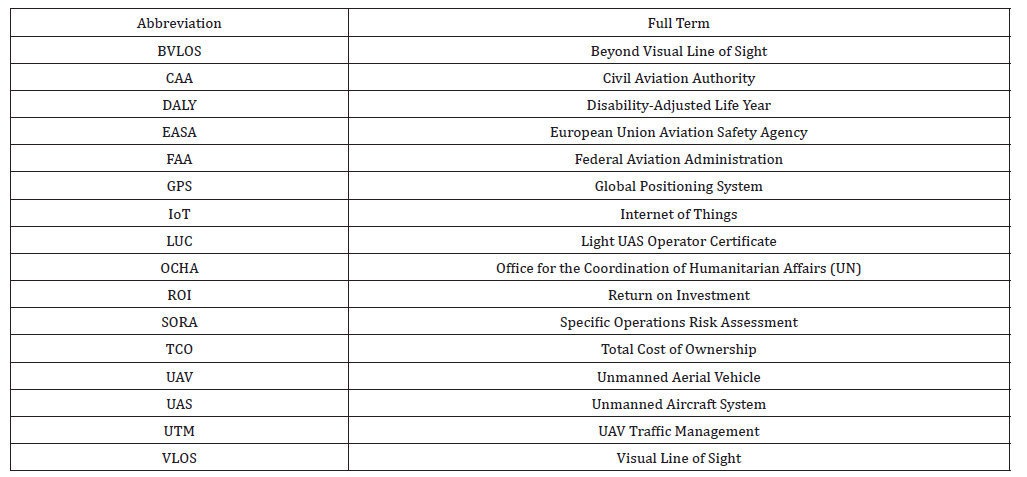
Table 4:Appendix A: Abbreviations and acronyms.
Acknowledgment
The author acknowledges the extensive publicly available data provided by organizations including Zipline, EASA, FAA, World Bank, and academic researchers whose rigorous work made this analysis possible.
Funding
This research received no specific grant from any funding agency in the public, commercial, or not-for-profit sectors.
Conflict of Interest
The author declares no conflicts of interest.
References
- Sivakumar M, Malleswari TYJN (2021) A literature survey of unmanned aerial vehicle usage for civil applications. Journal of Aerospace Technology and Management 13: e4021.
- McKinsey & Company (2021) The future of the last-mile ecosystem: Transition roadmaps for public- and private-sector players. McKinsey & Company, USA.
- Chiang WC, Li Y, Shang J, Urban TL (2019) Impact of drone delivery on sustainability and cost: Realizing the UAV potential through vehicle routing optimization. Applied Energy 242: 1164-1175.
- Thiels CA, Aho JM, Zietlow SP, Jenkins DH (2015) Use of unmanned aerial vehicles for medical product transport. Air Med J 34(2): 104-108.
- Scott JE, Scott CH (2017) Drone delivery models for healthcare. In Proceedings of the 50th Hawaii International Conference on System Sciences, pp. 3297-3304.
- UAV Navigation (2020) Civil uses for UAVs: A brief overview. UAV Navigation.
- USAID Global Health Supply Chain Program (2017) Unmanned aerial vehicles landscape analysis: Applications in the development context. Chemonics International Inc.
- Goodchild A, Toy J (2018) Delivery by drone: An evaluation of unmanned aerial vehicle technology in reducing CO₂ emissions in the delivery service industry. Transportation Research Part D: Transport and Environment 61(Part B): 58-67.
- Figliozzi MA (2020) Carbon emissions reductions in last mile and grocery deliveries utilizing air and ground autonomous vehicles. Transportation Research Part D: Transport and Environment 85: 102443.
- Rabta B, Wankmüller C, Reiner G (2018) A drone fleet model for last-mile distribution in disaster relief operations. International Journal of Disaster Risk Reduction 28: 107-112.
- Winkelhaus S, Grosse EH (2020) Logistics 4.0: A systematic review towards a new logistics system. International Journal of Production Research 58(1): 18-43.
- Hofmann E, Rüsch M (2017) Industry 4.0 and the current status as well as future prospects on logistics. Computers in Industry 89: 23-34.
- Heutger M, Kückelhaus M (2014) Unmanned aerial vehicles in logistics: A DHL perspective on implications and use cases for the logistics industry. DHL Customer Solutions & Innovation.
- PwC (2020) Clarity from above: PwC global report on the commercial applications of drone technology. PricewaterhouseCoopers.
- Porter ME (1985) Competitive advantage: Creating and sustaining superior performance. Free Press.
- Porter ME (1980) Competitive strategy: Techniques for analyzing industries and competitors. Free Press.
- Christopher M (2016) Logistics & supply chain management (5th edn), Pearson, London, UK.
- Bowersox DJ, Closs DJ, Cooper MB, Bowersox JC (2020) Supply chain logistics management (5th edn), McGraw-Hill Education, USA.
- Haidari LA, Brown ST, Ferguson M, Bancroft E, Spiker M, et al. (2016) The economic and operational value of using drones to transport vaccines. Vaccine 34(34): 4062-4067.
- Ackerman E, Koziol M (2019) The blood is here: Zipline’s medical delivery drones are changing the game in Rwanda. IEEE Spectrum 56(5): 24-31.
- DHL (2019) Parcelcopter 4.0: DHL launches first regular autonomous drone delivery service to North Sea islands. DHL Group Press Release.
- EASA (2025) SORA 2.5: Specific operations risk assessment - Updated methodology. European Union Aviation Safety Agency.
- Meier P (2015) Digital humanitarians: How big data is changing the face of humanitarian response. CRC Press, USA.
- OCHA (2015) Unmanned aerial vehicles in humanitarian response: OCHA policy and guidance. United nations office for the coordination of humanitarian affairs.
- UPS (2020) UPS flight forward receives FAA’s first full Part 135 standard certification to operate a drone airline. United Parcel Service, USA.
- World Bank (2020) Delivering health services via drones in Malawi: Economic and equity implications. World Bank Group, USA.
© 2026 Mesut Atasever. This is an open access article distributed under the terms of the Creative Commons Attribution License , which permits unrestricted use, distribution, and build upon your work non-commercially.
Editor In Chief







.jpg)































Signup for Newsletter

Quick Links
 Editorial Board Registrations
 Submit your Article
 Best Paper of the Volume
 Reprints
 Refer a Friend
 Advertise With Us
Our Recent Edition

.jpg)



Top Editors




.jpg)

















.bmp)
.jpg)
.png)
.jpg)













.jpg)






.png)

.png)




.png)




Financial Support

Sponsors

Latest e-Books

Latest Video

 a Creative Commons Attribution 4.0 International License. Based on a work at www.crimsonpublishers.com.
Best viewed in
a Creative Commons Attribution 4.0 International License. Based on a work at www.crimsonpublishers.com.
Best viewed in 
 | Above IE 9.0 version