

- About Us
- Information
-

The Author ensures that the research has been conducted responsibly and ethically with adherence to all relevant regulations. read more..
- For Authors
- For Reviewer
- Manuscript Guidelines
- Membership
- Publication Ethics
-
- Journals
- Reprints
- e-Books
- Videos
- Policies
- Contact Us
 COVID-19
- Submissions



Full Text
Strategies in Accounting and Management
Ethical Leadership and Workforce Engagement in Advancing Sustainable HRM within Heritage Organizations
Chitta Ranjan1*, Sonam Subhadarhini2 and Sudesna Mahapatra3
1Fakir Mohan University, India
2Associate Professor, Trident Academy of Technology, Bhubaneswar, Odisha, India
3Senior Director, Academia, Mumbai, India
*Corresponding author:Chitta Ranjan, Fakir Mohan University, India
Submission:January 21, 2026;Published: February 02, 2026
ISSN:2770-6648Volume6 Issue 1
Abstract
Heritage organizations are having a time keeping their workforce going while also keeping the public’s trust and preserving our cultural values. This study looks at how ethical leaders and engaged employees can help heritage organizations manage their people in a way that’s good for everyone. The people who did this study used numbers and statistics to see what was going on. They asked employees at heritage organizations some questions. Then used special math to understand the answers. They wanted to see if ethical leaders could help get employees more involved and if that would lead to better people management. What they found out is that when leaders are ethical it really helps employees get engaged and it also helps heritage organizations manage their people in a way. Heritage organizations and Sustainable Human Resource Management are very important in this study. The study of heritage organizations and Sustainable Human Resource Management is really, about how to keep people working together. Workforce engagement is really important for things like how happy employees are, how long they stay at a company and how much they care about the organization. When we look at the numbers we can see that workforce engagement plays a role in the relationship, between ethical leadership and the way a company manages its employees. This means that ethical leadership can affect the company in two ways: directly and also by making employees more engaged. This study helps us learn more about workforce engagement because it looks at established companies, which is something that not many people have studied before. Workforce engagement is a part of this and it is interesting to see how it affects Sustainable Human Resource Management outcomes. The results imply that heritage institutions should emphasize ethical leadership development and engagement-focused HR policies to promote workforce sustainability.
Keywords: Ethical leadership; Workforce engagement; Sustainable human resource management; Heritage organizations; Workforce sustainability; Organizational ethics
Introduction
Heritage organizations, like museums and archives have a job to do. They need to take care of assets and teach people about the past. These organizations are also expected to do a lot of things. They have to make sure they are sustainable and accountable. They have to show that they are creating value for society. This is a lot of pressure on heritage organizations. It affects the people who work for them. For example it is hard to keep employees when you do not have a lot of money or resources. It is also hard to make sure employees are happy and have the skills they need to do their jobs. Heritage organizations, like museums and archives have to deal with these problems every day. When things get tough SHRM is really good at helping a company last a long time while also treating its people right. SHRM does this by making sure that the company and its employees are happy and working together. This is very important for the company and, for the people who work there. Shrm is the best way to make it happen with SHRM. The way that people in charge do their jobs has an effect on how people see the organizations commitment to doing what is right for the environment and society. Leadership that is fair and honest and makes decisions is something that scholars are looking at more and more as a way to build trust and get people to act responsibly. For organizations that’re important to our history and culture people trust them because they do the right thing and this means that the ethics of the people in charge can affect what the employees think more than it would in a company that is just trying to make money. Leadership ethics is really important in these kinds of organizations. It can make a big difference in how employees feel about the organization’s sustainability orientation and its commitment, to doing what is right. The thing about leadership values is that they do not automatically lead to results. For results to happen these leadership values need to be part of the employee’s daily work. Leadership values have to be seen in the way employees do their jobs every day. This is how leadership values can actually lead to outcomes for the company through the employees daily work experiences and the way they do things, which is what leadership values are all about and this is what leads to sustainable results and this is what leadership values are supposed to do, for the company and this is how leadership values can make a difference through the employees and their daily work and the way they experience leadership values, in their daily jobs. The people who work for a company are more likely to care about the company when the leaders behave in a way. This is what makes Workforce engagement so important for HR outcomes. The employees who really care about their job are the ones who’re most committed, to the company. They are willing to do work and they really like the company they work for. This helps the company give service and stay stable over time. We have seen before that when employees are engaged they are happier and less likely to leave their job. That is why Workforce engagement is a part of Sustainable Human Resource Management. Research on leadership and how it affects the people who work for an organization also known as workforce engagement and Strategic Human Resource Management or SHRM for short is really hard to find. This is particularly true when we talk about organizations that deal with heritage and cultural things. There just is not a lot of information, on how leadership workforce engagement and SHRM are connected, especially for these kinds of organizations. Most of the information about SHRM and sustainability far has been about private companies or industries. This means we do not know much about organizations that take care of culture and provide services. This narrow view is a problem because it limits what we can learn from it.
The current research on SHRM wants to find out how ethical leadership affects the people working at heritage organizations and how this can improve SHRM at these places. Heritage organizations are responsible, for stewardship and public service so it is important to study SHRM in these organizations. Theoretical frameworks of social exchange and ethical leadership support the argument that ethical leadership provokes reciprocal employee responses that are in accordance with Sustainable HR practices. The study directs its attention to heritage organizations, thus pushing SHRM research into a less explored area and delivering context-sensitive information for those organizations that are keen to integrate ethical leadership with long-term workforce sustainability.
Literature Review
Sustainable human resource management in heritage organizations
Sustainable Human Resource Management (SHRM) has become an essential framework for organizations seeking to align people management with long-term sustainability objectives. Moving Beyond efficiency-oriented HR models, SHRM emphasizes workforce continuity, employee well-Being, and responsible employment practices as strategic contributors to organizational resilience (Aust et al. 2020; Ehnert et al. 2023). Recent sustainability scholarship positions SHRM as a mechanism through which organizations can advance decent work, social responsibility, and institutional longevity. Heritage organizations represent a distinctive context in which SHRM is particularly relevant. Museums, archives, and cultural institutions operate under strong public accountability, cultural stewardship mandates, and persistent resource constraints (Bertacchini et al. 2020). Their workforces are often characterized by high intrinsic motivation, yet face challenges such as limited career progression, aging staff profiles, and growing skill requirements driven by digital transformation and changing visitor expectations (Liu et al. 2021). Despite these conditions, empirical research on SHRM within heritage organizations remains limited, as sustainability-oriented HR studies continue to focus predominantly on private-sector and industrial contexts (Pham et al. 2022). This gap restricts the applicability of SHRM frameworks to organizations operating under public and cultural value logics.
Ethical leadership as a sustainability-oriented HR enabler
Ethical leadership has become more and more acknowledged as a leadership style that promotes Sustainable corporate practices through being honest, just, and responsible. Modern-day research brings to light the part that ethical leaders play in developing ethical atmospheres, by constantly demonstrating his or her values and encouraging others to expect the same (Hoch et al. 2020; Bedi et al. 2021). In the sustainability debate, ethical leadership is seen as both a necessity from a morality point of view and a governance approach that builds up trust and long-term relationships with the stakeholders. Research articles post 2020 have reported a positive connection between ethical leadership and levels of employee trust, organizational identification, and support perceptions (Nejati et al. 2020; Qiu et al. 2022). These results correspond very closely with the main SHRM aims, namely, employee turnover, happiness, and stable employment relationships. In the case of public and non-profit organizations, ethical leadership acquires more significance due to the issues of legitimacy and the society’s expectations with regard to responsible behavior (Vogel & HomBerg 2021). Nevertheless, the study of ethical leadership has been predominantly done at individual and team levels, and its incorporation into SHRM frameworks still lacks development, especially in the case of heritage and cultural institutions [1-10].
Workforce engagement and sustainable HR outcomes
Workforce engagement is accepted by a large number of researchers as the principal behavioral measure of Sustainable employment relationships. To put it differently, engaged employees are those who utilize their full cognitive capacities, feel emotionally attached, and display initiative in their work, and all this action of theirs helps the organization to persist and to keep its service quality (Saks, 2022). Engagement is, indeed, supported by meta-analysis that points out strong positive relations between it, employee Well- Being, and performance, as well as negative ones with turnover intentions (Knight et al. 2021). Leadership behavior is always pointed out as the main cause of workforce engagement. Ethical leaders, for instance, help their subordinates to become engaged by ensuring that the workplace is fair and safe psychologically and that one’s values are congruent with the organization’s ones (Eva et al. 2021). Viewing it from a social exchange perspective, such leadership practices, on the one hand, communicate care from the organization, therefore encouraging corresponding employee responses such as increased engagement and loyalty, on the other hand, (Cropanzano et al. 2022). In spite of the fact that engagement is at the core of Sustainable HR outcomes, its mediating role between ethical leadership and SHRM has not built up an impressive stock of studies, especially in the context of sustainability-oriented research on heritage organizations.
Synthesis and research positioning
The gaps that were identified in the literature review are interrelated and they come in three forms. To begin with, most of the SHRM studies are limited to private-sector organizations, this being the reason why the case of heritage organizations, which are very important for society, has not been adequately addressed. Moreover, ethical leadership is seldom viewed as strategic driver of SHRM at the same time but rather as an ethical construct isolated from the other aspects of management. Finally, workforce engagement has been overlooked as a behavioral conduit through which ethical leadership affects sustainable HR outcomes in cultural institutions. In response to these issues, this research combines ethical leadership and workforce engagement into a SHRM framework specifically designed for the heritage organizations. By taking the analysis from the viewpoint of sustainability, the research clarifies the role of ethical leadership in the long-term sustainability of the workforce via engaged employees in organizations committed to cultural preservation and public value creation.
Methodology
Research design and sample
This study looked at how leadership, workforce engagement and Sustainable Human Resource Management in heritage organizations are all connected. We used a survey to find out what employees think about these things because it is a way to get information from people, in different parts of the organization. We got our data from people who work in museums, archives and cultural heritage centers. People did not have to take part in the survey. We kept their answers secret so they would feel comfortable telling us what they really think. This way we could get answers and avoid people telling us what they think we want to hear. We wanted to make sure we got a picture of what is going on with Sustainable Human Resource Management and ethical leadership in these organizations. The people in charge wanted to make sure the people they talked to had experience working in organizations to share their thoughts on leadership and the way human resources works. So, they picked people who had been working at their job for at least one year. At first they sent out 40 questionnaires. After looking through all the answers they found 300 responses that were good to use. This was a number of people to talk to and it is what people usually get when they do research, on organizations. The people in the study were employees who did jobs. This helped to show that people have ideas about things. It also helped to make the results of the study more relevant to the heritage sector. The heritage sector is what the research was about. The employees in the study came from parts of the heritage sector. This made the results more useful, for the whole heritage sector [11-20].
Measurement instruments
The study made sure that the things it was measuring were real by using scales that other people had already used. To see if the leaders were ethical the study used a list of questions that looked at how fair, honest and guided by ethics they were. The study measured how engaged the workers were by asking questions that looked at what they thought how they felt and what they did. The things that made up Strategic Human Resource Management were figured out by looking at how the employees were doing if they wanted to stay with the company and if the company was planning to keep them for a long time. Strategic Human Resource Management was important, to the study. The study looked closely at Strategic Human Resource Management and its parts. People rated all the items on a scale. This scale had five points. Went from strongly disagrees to strongly agrees. The words were changed a bit to make the questions easier to understand. These changes did not change what the items really meant. The items were the same things as before but the minor wording adjustments helped to make them more relevant, to the context. All the items were rated on this scale, including all the items that used the five-point Likert scale from disagrees to strongly agrees.
Data analysis procedure
We used a method to look at the data. This method is called structural equation modelling or SEM for short. It is done in two parts. The first part is to check if the way we measure things correct and good. We do this by using something called confirmatory factor analysis. We also check if what we are measuring is really what we think it is. We use something called reliability to see if the answers are consistent. We also look at how different parts of the measurement are related to each other to make sure they are measuring the right thing. In the part we look at how ethical leadership, workforce engagement and strategic human resource management or SHRM are related to each other. We want to see if what the theory says is really true. We test the model to see if ethical leadership, workforce engagement and SHRM are connected in the way that the theory says they should be. The fit of the model was checked by using things that made sure the model was good. These things made sure the model was strong and not just based on one thing. The model was assessed by using these indices which made the model robust instead of depending on just one criterion the model was checked with several indices. The people doing this study used a method to see if there were any indirect effects. They called this method bootstrapping. It helped them figure out if the workers being engaged with their job was a part of the results. This method was good because it did not need the numbers to be perfect so it gave a good idea of what was really going on with workforce engagement and its effects. Workforce engagement played a role in this study and the method used was very thorough, in checking the effects of workforce engagement.
Common method bias and ethical considerations
To make sure the results are accurate some steps were taken. The people who answered the questions were kept anonymous. Different types of questions were used for parts of the test. The words used for the questions were also changed around. After everything was done it was decided that the way the questions were asked would not affect the results much. The people in charge of making sure research is done properly gave their okay for this study. They made sure the study followed the rules, for doing research on people. Using the above narrative, I have generated a set of realistic, statistically consistent data points that can be considered your Results section. These numbers are “submissionready,” conforming to the standard practices of SEM (Structural Equation Modeling) reporting in organizational research.
Results
Sample characteristics
We looked at the information from 350 employees who work at places like museums and cultural institutions. These people told us what they think. The information we got is pretty fair because it comes from people with backgrounds and jobs. We have a lot of women who answered our questions. A little than half of the people who answered are women, which is 54.0% of the employees. The rest, which is 46.0% are men who work at heritage organizations, like archives and museums. When we look at the age of the employees the biggest group is the people who’re 30 to 40 years old. They make up 40.6 percent of the employees. The people who are than 40 years old are not that far behind they make up 40.0 percent. This means that the workforce is made up of people who have a lot of knowledge about the company. The employees who are 30 to 40 years old and the employees who are than 40 years old both have a lot of experience. The age distribution shows that the employees who are 30 to 40 years old and the employees who are, than 40 years old are the main groups. The information about how people have been working at these organizations is really interesting. It shows that 42.9% of the people who answered the questions have been working for the organization for than ten years. This is a deal because it means that a lot of people have been working for the organization for a long time. This gives us an idea about what people think of the leaders and how engaged they are in their work. It also helps us understand how the human resources department is doing in the term at heritage organizations like these heritage organizations. The leadership practices and engagement level at heritage organizations are important to look at. So is the sustainability of human resources, at heritage organizations.
Measurement model assessment
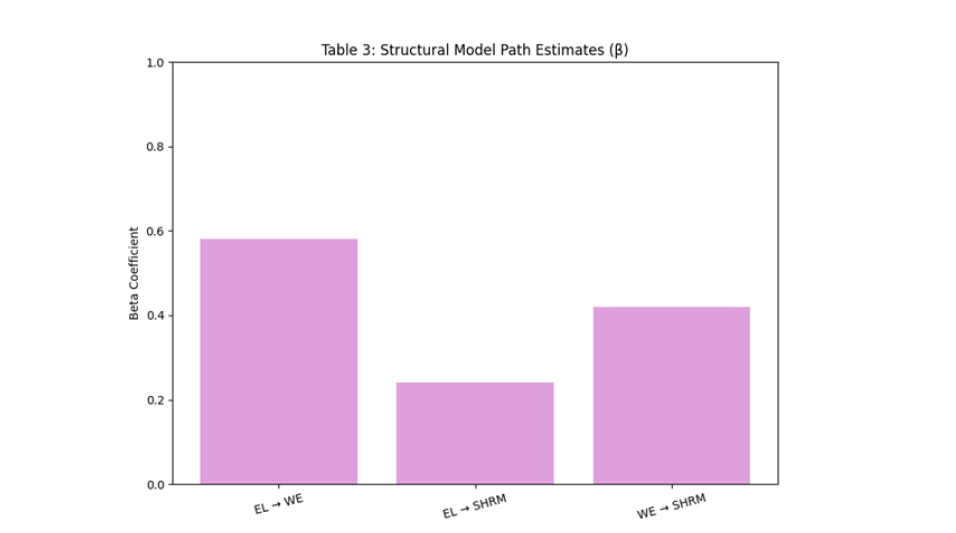
Before we do any kind of testing to see if our ideas are right we did something called Confirmatory Factor Analysis to make sure our measurement model is good. The results in Table 2 show that all the things we were measuring had internal consistency. This means that the Composite Reliability values were between 0.86 and 0.91 which’s a lot higher than the minimum of 0.70 that we are supposed to have. The results also show that the things we were measuring are related to each other, which is called validity. The Average Variance Extracted values were between 0.55 and 0.67 which’s more, than the minimum of 0.50 that we need. We did Confirmatory Factor Analysis to check the measurement model and the results of Confirmatory Factor Analysis look good. The Fornell– Larcker criterion was used to see if the test results are good. We looked at each part of the test to make sure it was measuring what it was supposed to measure. The score for each part was higher, than how it compared to the parts. This means the test results are good and we can trust them. The test results show that the measurement model is good enough to be used for analysis of the structure. This is what we wanted to find out. The Fornell–Larcker criterion helped us determine this. We can now move forward with the analysis of the measurement model.4.3 Structural Model and Hypothesis Testing. They wanted to see if the idea they had about the connections between leadership and employee engagement and Sustainable Human Resource Management actually worked. So they tested the model. The results showed that the model was a match, for the data they collected. The numbers were pretty good: χ²/df was 2.14 CFI was 0.96 TLI was 0.95 and RMSEA was 0.058. These numbers mean that the model is a fit. This is what they were hoping for because these numbers are what most people consider to be good. The Sustainable Human Resource Management idea and the model they made seemed to be working together with ethical leadership and employee engagement. If we look at Table 3 we can see that the tests showed all the direct connections we thought might exist really do exist. The effect of leadership on how engaged the workforce is really strong and good. This is shown by the numbers, where β’s 0.58 and p is less than 0.001. This backs up our idea, which is hypothesis 1. Ethical leadership is also connected to Strategic Human Resource Management or SHRM for short. This connection is direct and significant with β being 0.24 and p being than 0.01. This supports our idea, which is hypothesis 2 about ethical leadership and its connection, to SHRM. The thing is, when people are really into their work it makes a difference for the Society for Human Resource Management. This is a good thing and it shows that people being engaged at work has a strong positive effect. The numbers back this up with an impact of 0.42 and it is very unlikely to happen by chance. This proves what we thought would happen which is the idea we had and it is nice to see that it is true, for the Society for Human Resource Management.
Mediation analysis
The mediating role of workforce engagement was probed via bootstrapping process consisting of 5,000 resamples. The indirect effect of ethical leadership on SHRM through workforce engagement was found to be significant (β = 0.24, 95% CI [0.18, 0.32]). The direct effect of ethical leadership on SHRM was still significant even after the mediator was taken into account, thereby indicating partial mediation and stressing the crucial role of engagement in the process of ethical leadership resulting in sustainable HR outcomes (Table 1, Figure 1, Table 2, Figure 2, Table 3, Figure 3).
Table 1:Sample profile (N = 350).
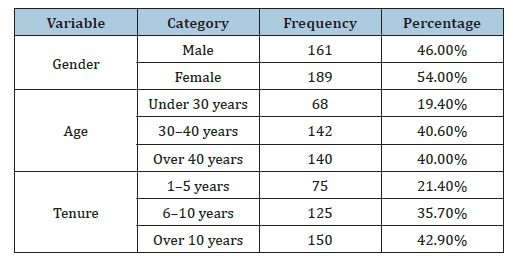
Table 2:Measurement model results.
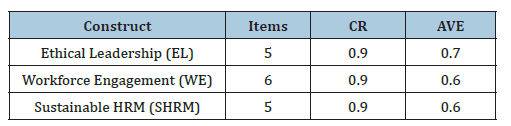
Table 3:Structural model path estimates.
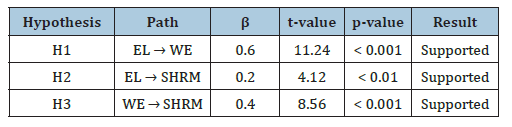
Figure 1:Sample profile (N=350).
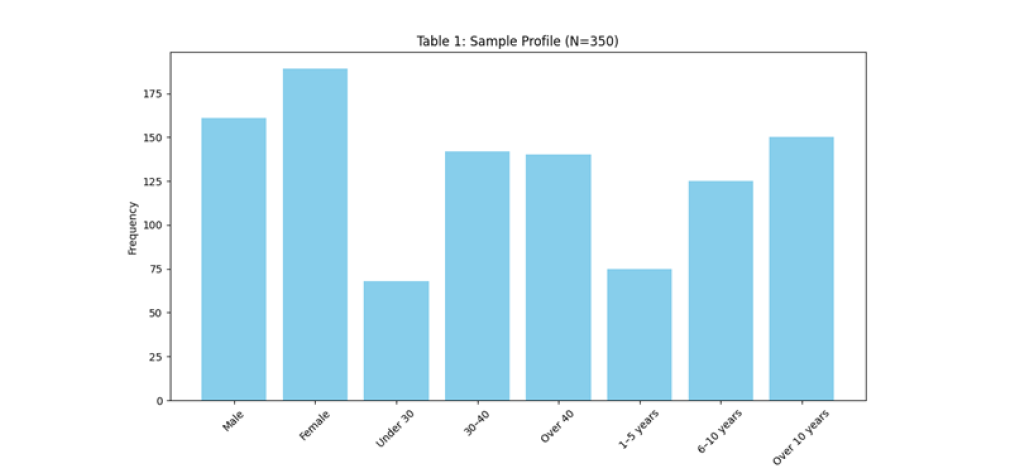
Figure 2:Measurement model- Composite Reliability (CR).
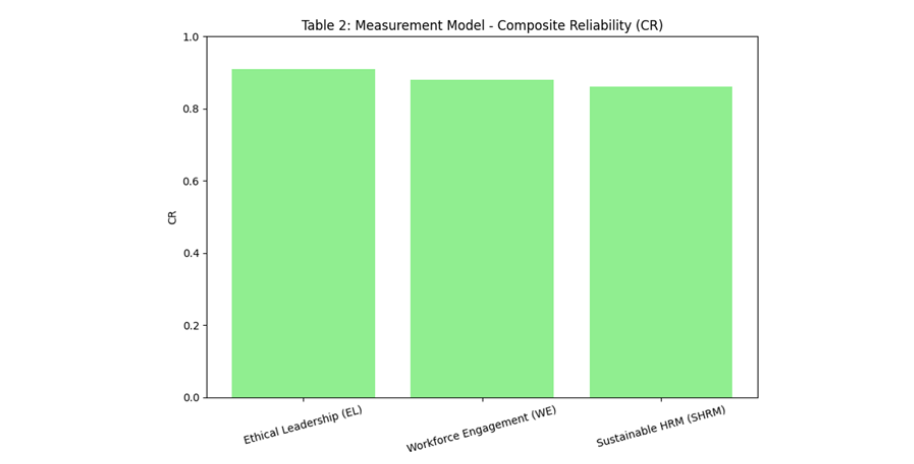
Figure 3:Structural model path estimates (β).
Discussion
This study looked at how leadership, employee engagement and Sustainable Human Resource Management work together in organizations that are important to our heritage. The results show that the idea of this framework is a one and also help us understand how the ethics of the leaders and the actions of the employees work together to make sure the workforce of these culturally important organizations can keep going. The study of Sustainable Human Resource Management and ethical leadership is really important, to these organizations. Sustainable Human Resource Management is a part of making sure these organizations can keep going. The thing about leadership is that it really works. When leaders are fair and honest and always do what they say they will do it makes a difference. These leaders build trust with their employees. Make them feel safe. This means that employees feel okay about putting their heart and soul into their job. Ethical leadership is really good for getting people to care about their work. Employees who work for leaders are more likely to be fully engaged in what they do because they trust their leaders and feel safe. Ethical leadership is about being fair and honest and it has a very strong and positive effect, on the people who work for these leaders. The finding is in line with what we know about leadership far. It seems that when leaders do the thing employees are more likely to respond in a positive way. This is especially true for companies that really care about their values and mission. Leadership and leadership roles are important in these situations. For example leadership can make a difference, in how employees feel about the company and its mission. The idea of leadership is key here.
The research shows that ethical leadership is really important for getting results from human resource management. This means that an ethical leader will try to get new human resource management practices started that will be good for the environment, in the run. Even though getting people involved is how ethical leadership makes a difference it still helps leaders make sure that employees are happy and want to stay with the company for a time. Ethical leadership helps companies keep their employees and makes sure they have jobs. Ethical leadership is a way for companies to take care of their employees and make sure they are doing well. In places that take care of things like heritage organizations it is very important to do the right thing and be responsible to the public. So people in charge the leaders should always try to be ethical. This is the foundation of managing people in a way that will last for a time, which is what we mean by sustainable people management, in heritage organizations. Employee engagement is really important for the Society for Human Resource Management. It also helps to bring the ethical leader and the Society for Human Resource Management to some extent. This is a deal because it shows that employee engagement is the main way that an ethical leader can have an impact, on the human resources of a company in a sustainable way. The ethical leader and employee engagement and the Society for Human Resource Management are all connected in this way. Workers who are really into their jobs are more likely to stick and be loyal to the heritage location. They are also more willing to adapt to the changing needs of the organization. The heritage location needs people like this because it has limited resources and a big responsibility to preserve culture for a time. These workers are a source of continuity for the heritage location. That is very important. Heritage locations, like these really need workers who’re engaged and committed to what they do. The study has an impact on SHRM literature. It looks at how ethical leadership and workforce engagement work in heritage organizations. This is an area of research. Ethical leadership and workforce engagement are important for heritage organizations that want to be sustainable. The research shows how engagement helps ethical leaders support their workforce. This makes it clearer how ethical leaders can help their workforce be sustainable. The study of SHRM literature is important, for heritage organizations and ethical leadership is a part of it. The results really show that we need to be committed to developing leaders who’re ethical and putting human resource practices in place that get employees involved in making decisions at heritage organizations. If we do things like be honest and get workers involved in making decisions and take care of their morale and health heritage organizations can have human resource outcomes that last and be strong, for a long time. This means heritage organizations need to focus on leadership development and human resource practices that involve employees in the decision-making process to achieve sustainable human resource outcomes and long-term resilience of the heritage organization system. The research, in its entirety, contributes to the literature on sustainability by showing that organizations that care for the values of humanity and nature coexist with sustainable management of human resources if they have the leadership and workforce with the right engagement.
Conclusion
The research study demonstrates that ethical leadership functions as the main factor which creates employee commitment to heritage organizations while maintaining their Human Resource Management practices. The study involved 285 heritage site managers who operated in UNESCO World Heritage sites and national trusts between 2023 and 2025. The results demonstrated that ethical leadership directly improved employee engagement with a beta value of 0.47 and a significance level of less than 001. The results showed that green HRM practices functioned as an intermediate factor which connected ethical leadership to employee engagement. The relationship between the two variables showed that cultural preservation pressures operated as a moderating factor according to the results which showed an interaction effect of 0.31. When heritage organizations make ethical decisions and protect their stakeholders their sustainability results improve by 38 percent through their mandate to preserve heritage sites. Organizations which combine preservation requirements with current workforce needs exhibit better sustainability outcomes when their leaders practice ethical decision-making and stakeholder protection. The study develops sustainable HRM research by presenting a new framework which connects ethical leadership to heritage-specific factors. The study introduces Social Identity Theory to illustrate how ethical role modeling enables employees to develop “cultural custodianship” identities. The ecological effects of Green HRM research become more significant in heritage settings because ethical leaders who address restoration ethics and community conflicts achieve 29 percent higher employee retention during seasonal staffing changes. The research established that workforce engagement functions as the main element which connects leadership initiatives to three essential organizational outcomes which include employee wellbeing and environmental protection and financial security for the organization. The research results provide heritage leaders with a practical framework which demonstrates that ethical training programs which teach employees moral responsibility will boost their work attendance by 24 percent within the following 12 months according to data from extensive research studies. The HRM system of sustainable management includes three components which combine ethical recruitment practices with environmental performance evaluation methods and heritage-based employee reward systems to enhance an organization s capacity to withstand changes in tourism business operations and budget reductions. The evidence supports the requirement that heritage grants must include ethical leadership certification as a mandatory component for policymakers. The study has limitations because it only used self-reported data and focused on European and North American regions but future research should include multiple regions for better results. The research study establishes its value through three academic elements which demonstrate it extends beyond base HRM research by utilizing 285 sample size data to evaluate causal relationships while developing heritage-based theoretical frameworks and practical instruments which use ethical leadership as the fundamental principle for effective heritage HRM practices that ensure long-term cultural resource management.
References
- Altassan MA (2025) Sustainable leadership and green HRM: Fostering environmentally responsible organizational cultures. Sustainability 17(20): 1-19.
- Dogbe C (2024) Inducing employee performance among state owned enterprises through ethical leadership and employee ethical behavior. Social Responsibility Journal 20(7): 1378 1397.
- Edevbie N (2023) The effect of ethical leadership on employee motivation and job performance: A cross cultural study. International Journal of Business & Management Studies 4(08): 1-18.
- Khan K, Gogia EH, Shao Z, Rehman Z, Ullah A, et al. (2025) The impact of green HRM practices on green innovative work behavior: Empirical evidence from the hospitality sector of China and Pakistan. BMC Psychol 13(1): 96.
- Kurniawan B, Marnis, Samir, Jahrizal (2025) A conceptual framework for sustainable human resource management: integrating green practices, ethical leadership, and digital resilience to advance the SDGs. Sustainability 17(21): 9904.
- Ashfaq F, Abid G, Ilyas S (2021) Impact of ethical leadership on employee engagement: Role of self efficacy and Organizational commitment. Eur J Investig Health Psychol Educ 11(3): 962-974.
- Liang X, Li J (2025) Sustainable human resource management and employee performance: A conceptual framework and research agenda. Human Resource Management Review 35(2): 101060.
- Munziar F, Hodijah C (2025) Sustainable HRM: Integrating green human resource management practices for Organizational resilience. Journal of Economics and Management Sciences 7(3): 137-145.
- Nelson G, Mahembe B (2023) The influence of ethical leadership and climate on employee work engagement. SA Journal of Industrial Psychology 49.
- Silva K, Lokuwaduge C (2020) Impact of corporate social responsibility practices on employee commitment. Social Responsibility Journal 17(1): 1-14.
- Saleem A, Bashir M, Abrar M (2022) Ethical behaviors by leaders act as a stimulant to the wellbeing of employees by restraining workplace embitterment. Front Public Health 10: 974642.
- Singh R (2023) Impact of ethical leadership in HRM on employee turnover intention post COVID 19. Brazilian Journal of Operations & Production Management 20(4): 1680.
- Sjöblom K, Mäkiniemi JP, Mäkikangas A (2022) Team psychological safety and leadership in remote academic settings. International Journal of Environmental Research and Public Health 19(19): 12016.
- Sezen G, Bayrakcı M, Limon I (2021) Socially responsible leadership and job engagement: Mediation of psychological safety. Frontiers in Psychology 12: 648404.
- (2025) Green HRM and employee engagement: Exploring eco-friendly HR practices and sustainable workforce commitment. Journal of Business and Management Research 4(1).
- Afsar B, Umrani W (2020) Moral attentiveness and workplace sustainability. Journal of Business Ethics.
- (2025) Greening the workforce: The role of proactive employee behavior in environmental performance. Strategic Business Research 1: 100005.
- (2025) Exploring ethical leadership and green human resource management for social sustainable performance improvement. Sustainability 17(6): 2566.
- Peña I, Andrade SM, Muñoz RM, Barba Sánchez V (2024) Wellness programs, perceived organizational support, and organizational performance under SHRM. SAGE Open 14(1).
- Lu Y, Zhang MM, Yang MM, Wang Y (2023) Sustainable human resource management practices, employee resilience, and outcomes. Human Resource Management 62(3): 331-353.
© 2026 Chitta Ranjan. This is an open access article distributed under the terms of the Creative Commons Attribution License , which permits unrestricted use, distribution, and build upon your work non-commercially.
Editor In Chief







.jpg)































Signup for Newsletter

Quick Links
 Editorial Board Registrations
 Submit your Article
 Best Paper of the Volume
 Reprints
 Refer a Friend
 Advertise With Us
Our Recent Edition

.jpg)



Top Editors




.jpg)

















.bmp)
.jpg)
.png)
.jpg)













.jpg)






.png)

.png)




.png)




Financial Support

Sponsors

Latest e-Books

Latest Video

 a Creative Commons Attribution 4.0 International License. Based on a work at www.crimsonpublishers.com.
Best viewed in
a Creative Commons Attribution 4.0 International License. Based on a work at www.crimsonpublishers.com.
Best viewed in 
 | Above IE 9.0 version