

- About Us
- Information
-

The Author ensures that the research has been conducted responsibly and ethically with adherence to all relevant regulations. read more..
- For Authors
- For Reviewer
- Manuscript Guidelines
- Membership
- Publication Ethics
-
- Journals
- Reprints
- e-Books
- Videos
- Policies
- Contact Us
 COVID-19
- Submissions



Full Text
Research in Pediatrics & Neonatology
Outbreak of Mycoplasma Pneumoniae Respiratory Infections. Epidemiological Trends in a Tertiary Hospital in Athens: A 6-Year Experience
Angeliki Syggelou1*, Natalia Syrimi1, Evdoxia Valavani1, Danai Ktena1, Alma Sulaj1, George Kalogeras2, Maria Tabouratzi2, Despoina Maritsi1, Ioanna Georgaki1, Theoklis Zaoutis1 and Maria Tsolia1
12nd Department of Pediatrics, National and Kapodistrian University of Athens, ‘P&A Kyriakou’ Children’s Hospital, Greece
2Department of Microbiology, ‘P&A Kyriakou’ Children’s Hospital, Greece
*Corresponding author: Angeliki Syggelou, 2nd Department of Pediatrics, National and Kapodistrian University of Athens, ‘P&A Kyriakou’ Children’s Hospital, Thivon & Levadeias, 11527, Athens, Greece
Submission: September 08, 2026; Published: September 16, 2026

ISSN: 2577-9200 Volume9 Issue1
Abstract
Introduction: Mycoplasma pneumoniae (Mp) is a common cause of respiratory tract infections, with
Community Acquired Pneumonia (CAP) being the most frequent manifestation. Since April 2023 a major
resurgence of Mp infections has been reported worldwide.
Methods: This study was conducted in a tertiary Pediatric Hospital in Athens. All patients aged 0-16 years
admitted with acute respiratory infection caused by Mp between January 2019 and November 2024 were
retrospectively recorded and their demographic data and clinical characteristics were documented. Mp
infection was confirmed using a molecular respiratory panel (BioFire FilmArray®) of nasopharyngeal
specimens.
Result: During the six-year study period, a total of 46 patients with confirmed Mp respiratory infections
were recorded. A significant rise in Mp infections was detected in 2024, beginning in March and peaking in
May. Thirty-nine pediatric patients, with a median age of 10 years, were diagnosed with Mp infection during
2024, revealing a statistically significant increase in Mp positivity rate compared to the period 2019-2023
(2.28% in 2024 vs 0.58% in 2019-2023). Most patients (82%) presented with CAP, while extrapulmonary
manifestations were observed in 5% of patients. Coinfections were identified in 11 patients (28%). No
statistically significant differences in patient characteristics were found between the two periods.
Conclusion: Our data reveal an ongoing outbreak of Mp cases within the community, consistent with global
trends, and underlines the importance of national surveillance and heightened vigilance of clinicians to
ensure the prompt diagnosis and treatment of these infections.
What is already known on the subject
A. Mycoplasma pneumoniae (Mp) is a common cause of community-acquired pneumonia
(CAP), especially in children.
B. Periodic epidemics of Mp occur every few years, and a global resurgence has been
noted since April 2023.
C. Surveillance data on Mp trends have been limited in many regions, including Greece.
What this study adds
a) This study demonstrates a marked and statistically significant increase in Mp infections
among children in Greece during 2024.
b) A notable rate of coinfections (28%) was observed during the recent outbreak.
c) No significant differences were found in patient
characteristics and disease morbidity during the outbreak,
compared with previous seasons.
How this study might affect research, practice, or policy
A. This study emphasizes the need for continuous national
surveillance systems to detect emerging Mp outbreaks early.
B. It highlights the importance of clinician awareness and
diagnostic preparedness during periods of increased Mp
activity.
Introduction
Mycoplasma pneumoniae is a well-known cause of upper respiratory tract infections and CAP, especially in children 5-15 years of age [1]. Although Mp infections occur sporadically throughout the year, widespread community outbreaks may appear as successive epidemics every few years (3-7 years) [2]. The number of cases observed worldwide decreased markedly during the pandemic, due to the implementation of non-pharmacological interventions. However, although the resurgence of most respiratory pathogens was gradually observed from 2021, the incidence of Mp remained particularly low until April 2023, when a major resurgence of cases was reported worldwide. This study aims at describing the epidemiological trends of Mp respiratory infections diagnosed in a tertiary hospital in Athens during January 1, 2019-November 20, 2024 and performing comparative descriptive analysis of the admitted cases.
Materials and Methods
All cases of patients 0-16 years of age admitted with Severe Acute Respiratory Infection (SARI) due to Mp from January 1, 2019 until November 20, 2024 were retrospectively reviewed. Demographic data and clinical characteristics of admitted patients were recorded in a database. Routine performance of molecular methods for detection of Mp in cases with SARI is a standard practice in our settings, thus allowing Mp detection in patients with compatible symptoms. Multiplex PCR using Bio fire Respiratory panel in nasopharyngeal swab specimens was applied and statistical analysis in confirmed Mp cases was performed. Ethical approval was obtained from the Ethics Review Board of the hospital Scientific Committee of our Hospital (No:333/18.7.24). Patients or the public were not involved in the design, or conduct, or reporting, or dissemination plans of our research.
Result
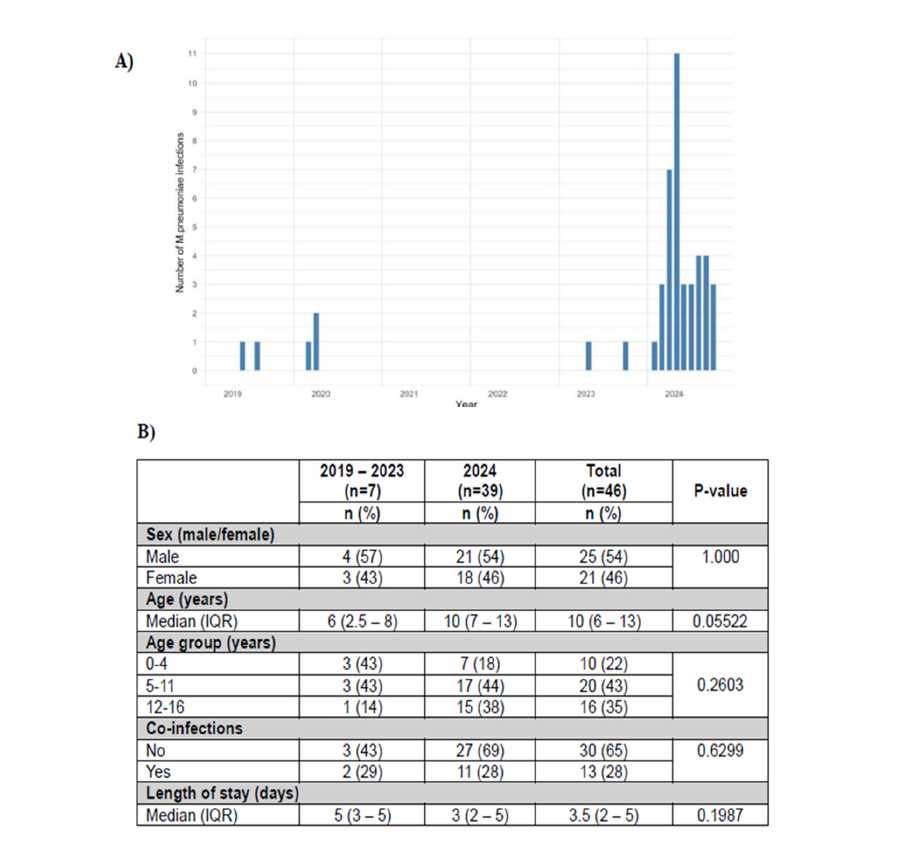
Overall, 2,926 specimens were tested for Mp, as part of the diagnosis of SARI during the last 6-year period and 46 patients had a confirmed Mp respiratory infection. Seven patients were detected in the pre-COVID period, while no cases were reported during pandemic. Since March 2024, a steep rise in Mp respiratory infections was observed. In total, 39 pediatric patients (median age 10 years, IQR: 6-13) were diagnosed with Mp infection during 2024 (Figure 1A) and this increase was statistically significant compared to previous season (2.28% in 2024 vs 0.58% in 2019- 2023, p=0.0004673). In the current outbreak, all patients were admitted due to SARI: Three exhibited Upper Respiratory Tract Infection (URTI), 14 patients had Lower Respiratory Tract Infection (LRTI) and 18 patients displayed both. Two patients presented with LRTI and extrapulmonary manifestations, both with symptoms related to mild gastroenteritis. Data are missing for two patients. Twenty-four patients required supplemental oxygen and 4 out of 24 patients were supported with High-Flow Nasal Cannula (HFNC). No patients were admitted to ICU. The median length of stay was 3 days (IQR: 2-5). Eleven patients had co-infections: 4 cases with human rhinovirus/enterovirus, 3 with adenovirus, one with human metapneumovirus, one with influenza B, one with SARSCOV- 2, and one with rhinovirus/enterovirus and SARS-COV-2. No statistically significant differences in age and sex distribution as well as morbidity were identified between 2024 and 2019-2023 cases (Figure 1B).
Figure 1: A) Mp infections during 2019-2024 (n=46). B) Demographic and clinical characteristics of Mp cases in two periods, 2019-2023 vs 2024 (n=32).
Discussion
The increase of Mp infection cases observed in our center is in line with observations from surveillance networks throughout Europe and Asia, where detection of the first epidemic sign was observed during the last months of 2023 with a peak in early 2024. According to the European Centre for Disease Prevention and Control (ECDC), an increase in incidence of respiratory infections caused by Mp has been observed in six European countries during the 2023/24 season, mostly among children and adolescents [3]. A recent global study showed the same tendency in several countries; with the increase most pronounced in some northern and central European countries [4-6]. Similarly, the World Health Organization (WHO) on November 2023 released a statement regarding reported clusters of pneumonia in children in northern China, which was later attributed to Mp. In our center, 46 patients were admitted due to Mp infection between 2019-2024, with 39 out of 46 admissions reported in 2024, starting in March 2024 and peaking in June 2024, marking a statistically significant increase in Mp infection rate. Consistent with current data, the most susceptible age group was school-age children also in our study. No statistically significant differences in age and gender distribution of Mp were detected and no increased morbidity was notifiable throughout this 6-year period.
There are several theories in the literature on the pathogenic mechanisms of this outbreak. First, non-pharmacological interventions during COVID-19 pandemic had a negative impact on Mp circulation, as observed with all respiratory pathogens. During this period, our center reports no Mp cases. In 2022, although most restrictive measures were lifted in our country, detection of Mp infection is still non-existent in our settings and remains in low rate in 2023, indicating low levels of Mp circulation in the community. This is in agreement with other studies, confirming the delayed resurgence of Mp in the post pandemic period, compared to other respiratory pathogens that immediately started circulating after easing of pandemic’s restrictions. Moreover, current data show that Mp co-infection with other respiratory pathogens, especially with viruses may lead to a longer duration of fever, severe pneumonia, and poor response to the stepwise treatment of Mp infection. In our study, the most common coinfected viruses were human rhinovirus and adenovirus, data consistent with similar reports in the literature. Although resistance to macrolides is largely discussed in recent reports, with high notifiable rates in Asia, this rate remains low in Europe. Unfortunately, no data from our center can be displayed on that issue. Our study is subject to several limitations. Firstly, we report data from a single center, yet a large tertiary pediatric hospital in Greece. Moreover, these data are observational findings collected retrospectively from medical records increasing the possibility of bias. Similar to many countries, no surveillance data on Mp infections are available in Greece, leading to limited available information regarding true incidence in the community and retrospective detection data. As a result, assumptions on epidemiological data should be made with caution.
Conclusion
In conclusion, a sharp increase in Mp respiratory infections was reported in our center, starting in March 2024, with higher infection rate compared to previous years. Our data demonstrate an ongoing outbreak of Mp cases in the community, following the global trends. Continuous monitoring of this outbreak will enlighten pathogenesis aspects and enhance Mp surveillance data, that are extremely limited worldwide.
Authors’ Contributions
MTs, AnS, NS: conceptualized and designed the report. AnS, EV: wrote the original draft. DK, AlS: collected the data from medical records and EV: performed the statistical analysis. GK: processed Filmarray results and provided the data from the microbiology lab. All authors contributed to interpretation of the data, revised the article critically, reviewed and edited the article.
References
- Meyer Sauteur PM, Beeton ML, Uldum SA, Bossuyt N, Vermeulen M, et al. (2022) Mycoplasma pneumoniae detections before and during the COVID-19 pandemic: Results of a global survey, 2017 to 2021. Euro Surveill 27(19): 2100746.
- Meyer Sauteur PM, Beeton ML, European Society of Clinical Microbiology and Infectious Diseases (ESCMID) Study Group for Mycoplasma and Chlamydia Infections (ESGMAC), The ESGMAC Mycoplasma pneumoniae Surveillance (MAPS) Study Group (2024) Mycoplasma pneumoniae: Delayed re-emergence after COVID-19 pandemic restrictions. Lancet Microbe 5(2): e100-e101.
- European Centre for Disease Prevention and Control (ECDC) (2024) Communicable disease threats report; Week 48, 26 November-2 December 2023.
- Nordholm AC, Søborg B, Jokelainen P, Moller KL, Sorensen LF, et al. (2024) Mycoplasma pneumoniae epidemic in Denmark, October to December 2023. Euro Surveill 29(2): 2300707.
- Urbieta AD, Barbeito Castiñeiras G, Rivero Calle I, Seco JP, Tenreiro CR, et al. (2024) Mycoplasma pneumoniae at the rise not only in China: Rapid increase of mycoplasma pneumoniae cases also in Spain. Emerg Microbes Infect 13(1): 2332680.
- Edouard S, Boughammoura H, Colson P, Scola BL, Fournier PE, et al. (2024) Large-scale outbreak of Mycoplasma pneumoniae infection, Marseille, France, 2023-2024. Emerg Infect Dis 30(7): 1481-1484.
© 2026 Angeliki Syggelou. This is an open access article distributed under the terms of the Creative Commons Attribution License , which permits unrestricted use, distribution, and build upon your work non-commercially.
Editor In Chief







.jpg)































Signup for Newsletter

Quick Links
 Editorial Board Registrations
 Submit your Article
 Best Paper of the Volume
 Reprints
 Refer a Friend
 Advertise With Us
Our Recent Edition

.jpg)



Top Editors




.jpg)

















.bmp)
.jpg)
.png)
.jpg)













.jpg)






.png)

.png)




.png)




Financial Support

Sponsors

Latest e-Books

Latest Video

 a Creative Commons Attribution 4.0 International License. Based on a work at www.crimsonpublishers.com.
Best viewed in
a Creative Commons Attribution 4.0 International License. Based on a work at www.crimsonpublishers.com.
Best viewed in 
 | Above IE 9.0 version