

- About Us
- Information
-

The Author ensures that the research has been conducted responsibly and ethically with adherence to all relevant regulations. read more..
- For Authors
- For Reviewer
- Manuscript Guidelines
- Membership
- Publication Ethics
-
- Journals
- Reprints
- e-Books
- Videos
- Policies
- Contact Us
 COVID-19
- Submissions



Full Text
Research in Pediatrics & Neonatology
The Clinical and Molecular Spectrum of SCN1A-Related Epilepsy in a Hong Kong Pediatric Cohort
MLY Yau1, ELW Fung1 and SC Chong1,2*
1Department of Pediatrics, The Chinese University of Hong Kong, Hong Kong SAR, China
2Joint Baylor-CUHK Centre of Medical Genetics, The Chinese University of Hong Kong, China
*Corresponding author: SC Chong, Department of Pediatrics, the Chinese University of Hong Kong, Hong Kong SAR, China
Submission: July 06, 2026; Published: July 21, 2026

ISSN: 2577-9200 Volume8 Issue5
Abstract
Background: Pathogenic variants in SCN1A, encoding the Nav1.1 sodium channel, underlie a spectrum of
epilepsy syndromes ranging from genetic epilepsy with febrile seizures plus (GEFS+) to Dravet Syndrome
(DS). Genotype-phenotype correlations, particularly between loss-and gain-of-function variants, have
important therapeutic implications. Asian cohort data remain comparatively limited.
Methods: We conducted a retrospective review of 12 unrelated patients with SCN1A-related epilepsy
managed at a Hong Kong tertiary center. Clinical, genetic, and treatment data were collected. Variants
were classified as missense, truncating or 2q24 deletions. Outcomes including age at seizure onset, Drug-
Resistant Epilepsy (DRE), and neurodevelopmental impairment were compared between groups.
Result: The cohort comprised 12 patients (75% female), with a median seizure onset of 8.8 months. Dravet
syndrome was diagnosed in 83%. Median diagnostic interval was 1.89 years, with longest delays of 23 years
in the pre-next-generation sequencing era after seizure onset. Variants included 8 missense (67%) and 2
intragenic truncating (16.7%) and 2 copy number variants (CNVs) (16.7%). DRE was observed in 67%,
with a median of 4.5 anti-seizure medications trialed. CNVs were associated with earlier seizure onset and
more severe learning disability compared intragenic variants. Sodium channel blockers were used prior
to genetic diagnosis in four patients, with seizure exacerbation in most cases. Two cases were maternally
inherited, and one demonstrated post-zygotic mosaicism.
Conclusion: In this Hong Kong cohort, CNV variants with continuous gene deletions with SCN1A involved
were associated with earlier seizure onset and more severe neurodevelopmental outcomes compared
to other variants. Early molecular diagnosis is critical to guide precision therapy, avoid contraindicated
medications, and inform genetic counseling. Larger regional studies are warranted to refine genotypephenotype
correlations.
Keywords:SCN1A protein; Dravet syndrome; Epilepsy; Genetic; Drug resistance; Epilepsy
Introduction
The voltage-gated sodium channel alpha subunit 1 (SCN1A) gene was first identified in 2000 [1] as an epilepsy-associated gene in two families with Generalized Epilepsy with Febrile Seizure Plus (GEFS+). Loss of Function (LoF) of voltage-gated sodium channel 1.1 (Nav1.1), which is preferentially expressed in central nervous system, selectively impairs GABAergic inhibitory neurons, and thereby lowers seizure threshold [2]. The SCN1A gene is located on chromosome 2q24.3 and includes 29 exons. The alpha-subunits contain large, single-chain polypeptides organized in four homologous domains (DI to DIV), where each domain contains six transmembrane segments (S1 to S6) [2,3]. S1 to S4 forms the voltage-sensing domains which regulate channel opening upon membrane depolarization [2]. S4 serves as the voltage sensor, which during depolarization, leads to opening of the sodium channel pore [3]. The pore domain is formed by S5 and S6 and the extracellular connecting pore-loops (P-loops). Different phenotypes associated with SCN1A disease causing variants have been described, which forms a continuum from genetic epilepsy with febrile seizure plus (GEFS+) to Dravet Syndrome at the more severe end [4]. Other diverse epilepsy phenotypes include idiopathic generalized epilepsy, myoclonic astatic epilepsy, infantile spasm, Lennox-Gastaut syndrome [4] and migratory partial seizures of infancy (MPSI) [5]. Non-epilepsy phenotypes include hemiplegic migraine and autistic spectrum disorder [5].
Dravet Syndrome is characterized by fever-triggered status epilepticus with prolonged, hemi-clonic and generalized tonicclonic seizures during the first year of life [5]. Patients are usually developmentally normal prior to seizure onset but will experience developmental regression in the second year of life [5,6]. Precise genotype-phenotype correlations have important therapeutic implications, as sodium-channel blockers are contraindicated in Dravet Syndrome with LoF mechanism [7]; whereas their use should be encouraged in phenotypes with Gain-of-Function (GoF) effect. Phenotypes associated with GoF of Nav1.1 Include Neonatal Developmental and Epileptic Encephalopathy with Movement Disorder and Arthrogryposis (NDEEMA) and Early Infantile Developmental and Epileptic Encephalopathy and Movement Disorder (EIDEE and MD) [8]. Specific treatment algorithms with dedicated agents, such as stiripentol and fenfluramine, are available for patients with Dravet Syndrome [9], along with promising gene-targeted therapies [10]. Early molecular diagnosis has direct management implications. Asian data, although growing, remain more limited than Western series. We therefore describe an updated Hong Kong SCN1A cohort, focusing on the phenotypic impact of missense versus truncating and Copy Number Variant (CNV) variants on age at seizure onset and drug-refractoriness.
Materials and Methods
Participants
We conducted a retrospective review of all consecutively identified individuals with SCN1A pathogenic variants with epilepsy at a university affiliated tertiary hospital in Hong Kong SAR, China, between 2015 and 2025. This study has been approved by Joint CUHK-NTEC Clinical Research Ethics Committee (CREC Ref No: 2024.009).
Data collection
Patient demographics were collected through electronic medical records including age of seizure onset, seizure characteristics, history of status epilepticus, neurodevelopmental co-morbidities and outcomes. Genetic variables included variant type, cDNA and predicted protein change, channel-domain location, inheritance, and ACMG pathogenicity classification [11]. Treatment variables included drug resistant epilepsy (DRE) status [12], number of Anti-Seizure Medications (ASM)s ever trialed, current ASM, and follow-up duration. Developmental outcomes are measured by Developmental Quotient or Intelligence Quotient (DQ/ IQ) where standardized measures were selected based on patient’s age and abilities. Griffiths Scales of Child Development (GDMS) [13] and Wechsler Intelligence Scale for Children (WISC-IV) [14] for patients from six years and above. They are dichotomized with DQ/IQ levels into borderline 71-85; mild: 51-70; moderate: 35-50; severe < 35.
Genotype grouping
Variants were dichotomized into missense, truncating (frameshift, canonical splice-site) and CNVs with multigene deletions.
Statistical analysis
Continuous variables are summarized as median (range) and compared with the Krustal Wallis test; categorical variables as counts (percentages) and compared with Fisher exact test. A p value <0.05 was considered statistically significant.
Result
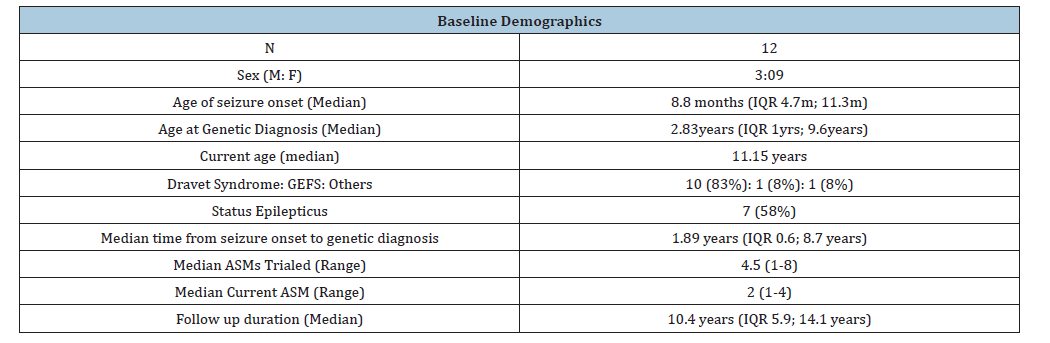
Twelve unrelated patients (three males and nine females; age range 4-24 years) were identified. Patients were stratified by variant class into missense (n=8), truncating (frameshift and splice-site; n=2), and CNV (n=2). Median seizure onset was 8.75 months (Interquartile Range [IQR] 4.7-11.3 months). Age at seizure onset was earliest in the CNV group (median 4.4 months, range 4.0-4.8), compared with the truncating (median 9.5 months, range 6.1-12.8) and missense groups (median 10.3 months, range 3.0- 16.1). Diagnoses comprised Dravet syndrome in 10 patients (83%), generalized epilepsy with febrile seizures plus (GEFS+) in one (8%), and complex myoclonic epilepsy in 1 (8%). Developmental delay preceded seizure onset in two patients (17%) (Table 1).
Table 1: Baseline demographics.
Seizure onset and diagnostic delay
The median time from seizure onset to genetic diagnosis was 1.89 years (IQR 0.6 to 8.7 years). For cases with seizure onset prior to next generation sequencing testing widely available in public settings in 2018, molecular diagnosis confirming SCN1A variants with Dravet Syndrome was available at 8.6 years (P4); 9 years (P10); 15.2 years (P8) and 23 years (P19) from seizure onset.
Genotype analysis
Variants comprised 8 missense (67%), 1 splice-site, 1 frameshift, and 2 large deletions involving SCN1A and contiguous sodium-channel genes (SCN2A/SCN3A/SCN9A). Inheritance was de novo in 7 patients (58%), maternally inherited in 2 and one mosaic (P10) with variant allele frequency 21% in blood tested. In two cases, parental testing was not performed as parents opted out. By ACMG classification [11], 5 were pathogenic and 7 likely pathogenic (Table 2 & Table 3).
Table 2: Individual patient genotype and key phenotypes.
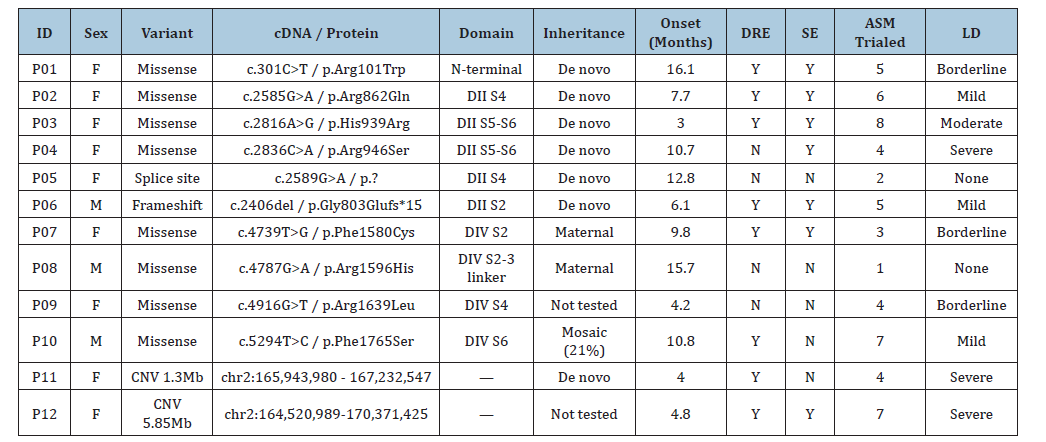
CNV: Copy Number Variants; DRE: Drug Resistant Epilepsy; SE: Status Epilepticus; ASM: Anti-Seizure Medications; LD: Learning Disability.
Table 3: Missense versus truncating and CNV variants.
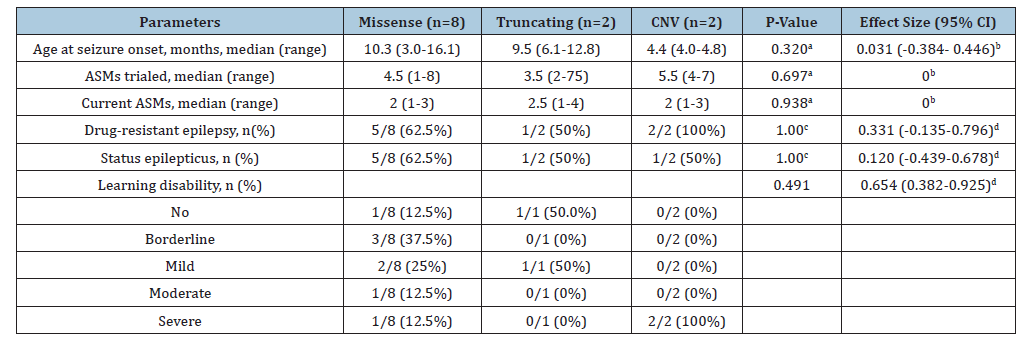
a. Kruskal-Walli’s test
b. A nonparametric bootstrap resampling with 1000 replications was performed to obtain 95% confidence intervals for
eta-squared.
c. Fisher-exact test
d. A nonparametric bootstrap resampling with 1000 replications was performed to obtain 95% confidence intervals for
Cramer’s V.
Treatment and drug refractoriness
Eight patients (67%) met criteria for DRE. Patients had trialed a median of 4.5 ASMs (range 1-8) and were on a median of 2 current ASMs (range 1-4). Valproate and clobazam were the most frequently used agents, and DS-specific agents including stiripentol (n=3) and fenfluramine (n=2) featured in the more refractory patients. Four patients had sodium channel blocker use prior the genetic result was known with three documenting seizures worsening and withdrawal of medication. No patient is on concurrent sodium channel blocker therapy at present. Five were on adjunctive therapies for epilepsy including modified Atkin’s diet and neuromodulator therapy.
Follow up and management
Patients were followed up for a mean of 10.9 years +/- 5.8 years (SD). All patients are on anti-seizure medications.
Discussion
Haploinsufficiency of SCN1A gene, encoding voltage gated sodium channel Nav1.1, is the predominant mechanism underlying Dravet Syndrome [3]. In heterozygote SCN1a knockout mice models, impaired GABAergic firing in hippocampal interneurons lowers the seizure threshold [3]. A key finding in this cohort is that patients with CNV deletions had earlier seizure onset (median 4.4 months, range 4.0-4.8) and more severe learning disability than those with intragenic missense (10.3 months, range 3.0-16.1) or truncating variants (9.5 months, range 6.1-12.8), with both 2q24 SCN genecluster deletion cases showing the most severe developmental delay. We emphasize, however, given the small number of cases with two cases in each truncating and CNV groups, the association can only be inferred, rather than demonstrating statistically. This is in line with Lim et al. [15] suggesting an earlier onset at 2-3 months and a more adverse cognitive outcome for patients with large deletions encompassing SCN1A. Davidson et al. [16] described 43 patients with 2q24 SCN-cluster deletions with dysmorphic features including ear abnormalities (58%), microcephaly (56%), brachy syndactyly (51%) and cleft palate (40%) that were not seen in intragenic SCN1A variants. The complex phenotypes seen are plausibly compounded by effect of neighboring genes: HOXD3 to HOXD13 deletions with limb anomalies [15,16]; CMYA3 with cardiomyopathy [16] and COBLL1, DLX1 and CHN1 [16] with neurodevelopment. For contiguous gene deletions, other codeleted voltage gated sodium channels (SCN2A, SCN3A, SCN9A can also contribute. SCN2A gene has been associated with a range of epilepsy presentations including GEFS+, epileptic spasm, Ohtahara syndrome and developmental and epileptic encephalopathy [16,17]. Functional studies showed that the mutant Nav1.2 channels exert a dominant-negative effect, rather than LoF effect as the epileptogenic basis for DS [18].
In our cohort, missense variants mostly affect the pore domain at S5 to S6 or the S4 voltage sensor, whereas truncating variants were distributed throughout the different domains. This is concordant with the enrichment analysis by Brunklaus et al. [19] suggesting variants across S5-6 pre-loop regions predominantly caused LoF, whereas variants over voltage sensing domains can demonstrate LoF, GoF or mixed effects. Variants affecting the inactivation gates (DIII-DIV S4-S5 and DIV S6) will cause GoF effects [19,20]. Functionally predicting LoF versus GoF has direct therapeutic implications, though our numbers are too small to test genotype-phenotype function and treatment effect relationships directly. As genetic testing becomes more accessible, earlier diagnosis with phenotypic prediction can aid prognostication and treatment choice. In pre-NGS era, our local cohort showed a marked delay with genetic testing performed 8 to 23 years after initial seizure presentation. The longest diagnostic delay occurred after patient transitioned into adult service, where the underlying cause of epilepsy was re-evaluated and genetic testing was decided. It is suggested that the need for genetic testing should be re-considered for patients with unexplained early onset epilepsy during transition planning. Earlier genetic testing would likely have prevented sodium channel blockers use in four of our patients in the pre-NGS era. For Dravet syndrome, the International League Against Epilepsy (ILAE) in 2022 [9] recommends valproate as first line therapy, followed by clobazam as both act on GABA receptors which is functionally impaired in patients with LoF effect on Nav1.1. Disease specific ASM, Fenfluramine and stiripentol, are established as adjunctive second line therapies [21]. Gene modulation therapies through anti-sense oligonucleotides and adeno-associated virus vector 9 (AAV9) have emerged as promising potential disease modifying agents [21].
Inheritance and genetic counselling
Two variants were maternally inherited. In P08, mother had Idiopathic Genetic Epilepsy (IGE) with late seizure onset at twenty years old, and a strong family history of epilepsy. She had seizure worsening after her usual ASM was replaced by sodium channel blockers due to possible teratogenic concern. This argues a lower genetic testing threshold in late onset individuals with IGE if they had seizure exacerbation after sodium channel blockers, and a family history of epilepsy. This carries reproductive counselling implications, as offspring can manifest a more severe phenotype compared with other affected family members. P10 had postzygotic mosaicism with variant allele frequency 21% in blood. It is notable that a subset of patients initially classified as de novo, were subsequently found to have parental mosaicism on deep sequencing [22].
This study has certain limitations. First, the small sample size (n=12), with only two patients in each truncating and CNV subgroups limits the robustness of statistical inference, the phenotype-genotype patterns described particularly the more severe phenotype in patients with CNV and domain distribution of missense variants, can only be inferred from the small number of individuals included, rather than reaching statistical significance, which needs validation from larger cohorts. Secondly, incomplete parental testing, limit relative risk interpretation to other family members. Third, noncoding regions of SCN1A gene and complex structural rearrangement were not analyzed in this study, limiting cases being undetected by current methodology.
Conclusion
These findings suggest the prognostic value of variant classification combined with onset age, highlighting the counselling importance of mosaicism, and support the clinical benefit of early genetic diagnosis. A larger, prospective, multi-center Greater Bay Area cohort is warranted to test these observations.
Author Contributions
All authors contributed to the concept or design, drafting of the manuscript, acquisition of data, analysis or interpretation of data, and critical revision of the manuscript for important intellectual content. All authors had full access to the data, contributed to the study, approved the final version for publication, and take responsibility for its accuracy and integrity.
References
- Escayg A, MacDonald BT, Meisler MH, Baulac S, Huberfeld G, et al. (2000) Mutations of SCN1A, encoding a neuronal sodium channel in two families with GEFS+2. Nat Genet 24(4): 343-345.
- Catterall WA (2012) Voltage-gated sodium channels at 60: Structure, function and pathophysiology. J Physiol 590(11): 2577-2589.
- Yu FH, Catterall WA (2003) Overview of the voltage-gated sodium channel family. Genome Biol 4(3): 207.
- Gambardella A, Marini C (2009) Clinical spectrum of SCN1A mutations. Epilepsia 5: 20-23.
- Scheffer IE, Nabbout R (2019) SCN1A-related phenotypes: Epilepsy and beyond. Epilepsia 3: S17-S24.
- Li W, Schneider AL, Scheffer IE (2021) Defining Dravet syndrome: An essential pre-requisite for precision medicine trials. Epilepsia 62(9): 2205-2217.
- Strzelczyk A, Schubert-Bast S (2022) A practical guide to the treatment of Dravet syndrome with anti-seizure medication. CNS Drugs 36(3): 217-237.
- Brunklaus A, Brünger T, Feng T, Fons C, Lehikoinen A, et al. (2022) The gain of function SCN1A disorder spectrum: Novel epilepsy phenotypes and therapeutic implications. Brain 145(11): 3816-3831.
- Wirrell EC, Hood V, Knupp KG, Meskis MA, Nabbout R, et al. (2022) International consensus on diagnosis and management of Dravet syndrome. Epilepsia 63(7): 1761-1777.
- Balestrini S, Scheffer IE (2026) Ameliorating seizures in Dravet syndrome: A review of newly approved and investigational drugs, RNA and gene-based therapies. CNS Drugs 40(4): 535-548.
- Richards S, Aziz N, Bale S, Bick D, Das S, et al. (2015) Standards and guidelines for the interpretation of sequence variants: A joint consensus recommendation of the American College of Medical Genetics and Genomics and the Association for Molecular Pathology. Genet Med 17(5): 405-424.
- Kwan P, Arzimanoglou A, Berg AT, Brodie MJ, Allen Hauser W, et al. (2010) Definition of drug-resistant epilepsy: Consensus proposal by the ad hoc Task Force of the ILAE commission on therapeutic strategies. Epilepsia 51(6): 1069-1077.
- Tso WWY, Wong VCN, Xia X, Faragher B, Li M, et al. (2018) The Griffiths Development Scales-Chinese (GDS-C): A cross-cultural comparison of developmental trajectories between Chinese and British children. Child Care Health Dev 44(3): 378-383.
- Needelman H, Schnoes CJ, Ellis CR (2006) The new WISC-IV. J Dev Behav Pediatr 27(2): 127-128.
- Lim BC, Hwang H, Kim H, Chae JH, Choi J, et al. (2015) Epilepsy phenotype associated with a chromosome 2q24.3 deletion involving SCN1A: Migrating partial seizures of infancy or atypical Dravet syndrome? Epilepsy Res 109: 34-39.
- Davidsson J, Collin A, Olsson ME, Lundgren J, Soller M (2008) Deletion of the SCN gene cluster on 2q24.4 is associated with severe epilepsy: An array-based genotype-phenotype correlation and a comprehensive review of previously published cases. Epilepsy Res 81(1): 69-79.
- Madia F, Striano P, Gennaro E, Malacarne M, Paravidino R, et al. (2006) Cryptic chromosome deletions involving SCN1A in severe myoclonic epilepsy of infancy. Neurology 67(7): 1230-1235.
- Kamiya K, Kaneda M, Sugawara T, Mazaki E, Okamura N, et al. (2004) A nonsense mutation of the sodium channel gene SCN2A in a patient with intractable epilepsy and mental decline. J Neurosci 24(11): 2690-2698.
- Brunklaus A, Feng T, Brünger T, Perez-Palma E, Heyne H, et al. (2022) Gene variant effects across sodium channelopathies predict function and guide precision therapy. Brain 145(12): 4275-4286.
- Gallagher D, Pérez-Palma E, Bruenger T, Ghanty I, Brilstra E, et al. (2024) Genotype-phenotype associations in 1018 individuals with SCN1A-related epilepsies. Epilepsia 65(4): 1046-1059.
- Vasquez A, Wirrell EC (2025) State-of-the-art management of Dravet syndrome. Dev Med Child Neurol 67(12): 1527-1535.
- Xu X, Yang X, Wu Q, Liu A, Yang X, et al. (2015) Amplicon resequencing identified parental mosaicism for approximately 10% of "de novo" SCN1A mutations in children with Dravet syndrome. Hum Mutat 36(9): 861-872.
© 2025 SC Chong. This is an open access article distributed under the terms of the Creative Commons Attribution License , which permits unrestricted use, distribution, and build upon your work non-commercially.
Editor In Chief







.jpg)































Signup for Newsletter

Quick Links
 Editorial Board Registrations
 Submit your Article
 Best Paper of the Volume
 Reprints
 Refer a Friend
 Advertise With Us
Our Recent Edition

.jpg)



Top Editors




.jpg)

















.bmp)
.jpg)
.png)
.jpg)













.jpg)






.png)

.png)




.png)




Financial Support

Sponsors

Latest e-Books

Latest Video

 a Creative Commons Attribution 4.0 International License. Based on a work at www.crimsonpublishers.com.
Best viewed in
a Creative Commons Attribution 4.0 International License. Based on a work at www.crimsonpublishers.com.
Best viewed in 
 | Above IE 9.0 version