

- About Us
- Information
-

The Author ensures that the research has been conducted responsibly and ethically with adherence to all relevant regulations. read more..
- For Authors
- For Reviewer
- Manuscript Guidelines
- Membership
- Publication Ethics
-
- Journals
- Reprints
- e-Books
- Videos
- Policies
- Contact Us
 COVID-19
- Submissions



Full Text
Research in Pediatrics & Neonatology
Case Report: Still’s Disease in an 11-Month-Old Child
Halyna Bulak1*, Yana Dolynna2 and Olha Pavelko3
1Associate Professor, Department of Pediatrics and Medical Genetics, 1st Territorial Medical Union of Lviv, a separate subdivision “St. Nicholas Hospital”, Danylo Halytsky Lviv National Medical University, Ukraine
2Head of the Pediatrics Center, 1st Territorial Medical Union of Lviv, a separate subdivision “St. Nicholas Hospital”, Lviv, Ukraine
3Danylo Halytsky Lviv National Medical University, Ukraine
*Corresponding author: Halyna Bulak, Associate Professor, Department of Pediatrics and Medical Genetics, 1st Territorial Medical Union of Lviv, Danylo Halytsky Lviv National Medical University, Ukraine
Submission: April 20, 2026; Published: May 26, 2026
ISSN: 2577-9200 Volume8 Issue4
Abstract
Systemic Juvenile Idiopathic Arthritis (sJIA, Still’s disease) in children was first described by George Frederick
Still in 1896 in Great Britain. In 1971 E.G. Bywaters identified and described in detail the adult form-the
so-called adult-onset Still’s disease. This was an important step in distinguishing between children’s and
adults’ manifestations of the disease, and since then the world literature has clearly differentiated juvenile
and adult forms, although modern recommendations (EULAR/PReS 2024) treat them as a single spectrum-
Still’s disease.
sJIA is a rare systemic inflammatory disease, diagnosed based on clinical signs and supported by laboratory
and instrumental findings; it remains a diagnosis of exclusion. In the treatment strategy for sJIA, nonsteroidal
anti‑inflammatory drugs and glucocorticosteroids are widely used for anti‑inflammatory, antipyretic and
analgesic purposes. Recent clinical trials have shown positive results in the use of new pharmacotherapeutic
agents, such as monoclonal antibodies and anti-interleukin drugs. The optimal therapeutic strategy is the early
use of interleukins (IL-1 or IL-6 inhibitors) in combination with glucocorticoids and immunosuppressants
(e.g., cyclosporine A, methotrexate) in severe cases or in Macrophage Activation Syndrome (MAS).
The prognosis of sJIA varies among different children: some patients recover completely after a certain
time, some have a relapsing course with alternating periods of exacerbation and remission, and about half
of the patients have a long‑term course of the disease. This article presents a clinical case of sJIA in an
eleven‑month‑old child.
Keywords:Still’s syndrome; Systemic juvenile idiopathic arthritis; Rash; Fever; Systemic inflammatory response syndrome
Abbreviations: JIA: Juvenile Idiopathic Arthritis; sJIA: Systemic Juvenile Idiopathic Arthritis; SIRS: Systemic Inflammatory Response Syndrome; MAS: Macrophage Activation Syndrome; CRP: C-Reactive Protein; BMP: Bone Marrow Punctate; ANA: Antinuclear Antibodies; CMV: Cytomegalovirus; EBV: Epstein-Barr Virus
Introduction
sJIA is characterized by an erythematous salmon-colored skin rash, arthritis, and remitting fever with a sharp rise in body temperature to 39 °C and an equally sharp drop. In most patients, the disease manifests itself with the appearance of a characteristic spotted or maculopapular rash that appears with fever, can migrate, and is typically non-pruritic. Arthritis can occur weeks, months, or even years after the onset of the disease and affect different groups of joints. The disease belongs to the group of autoinflammatory diseases, where the activation of innate immunity and excessive production of cytokines (IL-1β, IL-1) play a key role. This explains the systemic manifestations (fever, rash, serositis) and high ferritin. Although the causes of sJIA are not known for certain, recent reviews (EULAR/PReS 2024, Nature Reviews Rheumatology 2024) highlight several key points: there is a genetic predisposition, associations with certain HLA alleles (e.g., HLA-B17, HLA-B35, HLA-DR2) have been identified, and viral and bacterial infections or other environmental factors that trigger abnormal activation of innate immunity may be the trigger [1].
ILAR (2001) provides classification criteria requiring arthritis for research purposes, whereas EULAR/PReS (2024) offers modern diagnostic and therapeutic frameworks that allow systemic onset without arthritis and emphasize early recognition of MAS. According to the 2024 EULAR/PReS recommendations, therapy for Systemic Juvenile Idiopathic Arthritis (sJIA) relies on biologics targeting IL‑1 and IL‑6, with glucocorticoids reserved for short courses or pulse therapy to rapidly control systemic inflammation [2].
Management of MAS requires intensive combined immunosuppression, and current strategies aim not only at symptom relief but at achieving complete remission. sJIA remains difficult to diagnose, particularly in children under one year of age. In this age group, sJIA is rare and may present atypically, with features that overlap with Macrophage Activation Syndrome (MAS) or sepsis [3].
Case Presentation
A female patient A. was admitted to the Separate Subdivision “St. Nicholas Hospital” of the First Territorial Medical Union of Lviv at the age of 11 months and 15 days. The child was born from first pregnancy, first delivery with a birth weight of 3400g and a length of 51cm. No diseases were observed during the neonatal period. The child had not received routine vaccinations. According to the mother, the allergic history is unremarkable, and there had been no contact with infectious diseases during the past 21 days. The father has a family history of idiopathic urticaria, and the uncle (mother’s brother) has synovitis of the ankle joint of unknown genesis. The history includes ARIs, atopic dermatitis, and surgery for acute lymphadenitis [4].
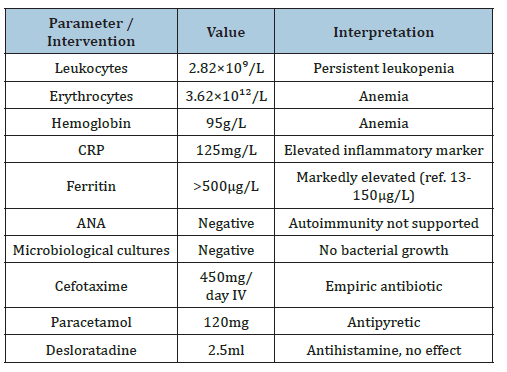
At the time of admission, a fever lasting for 3 days was noted, and there was a macular rash on the skin of the face, trunk and extremities, which appeared with fever; hyperemia and swelling of the left ankle joint were also noted. In the emergency department, the patient was examined by a surgeon and a preliminary diagnosis was made: “ARI. Arthritis of the left ankle joint. Osteomyelitis?”. The child was hospitalized in a pediatric department for further diagnosis and treatment. At admission, laboratory tests revealed persistent leukopenia, which persisted over time, anemia, and elevated inflammatory markers. Microbiological cultures and ANA were negative, while ferritin was markedly increased [5]. Initial therapy included cefotaxime, paracetamol, and desloratadine, but no clinical improvement was observed. The rash correlated with episodes of hyperthermia (Table 1).
Table 1: Laboratory findings and initial treatment.
An X-ray examination of the left ankle joint was performed (Figure 1) to exclude structural lesions, which showed no structural bone changes.
Figure 1: X-ray of the left ankle joint.
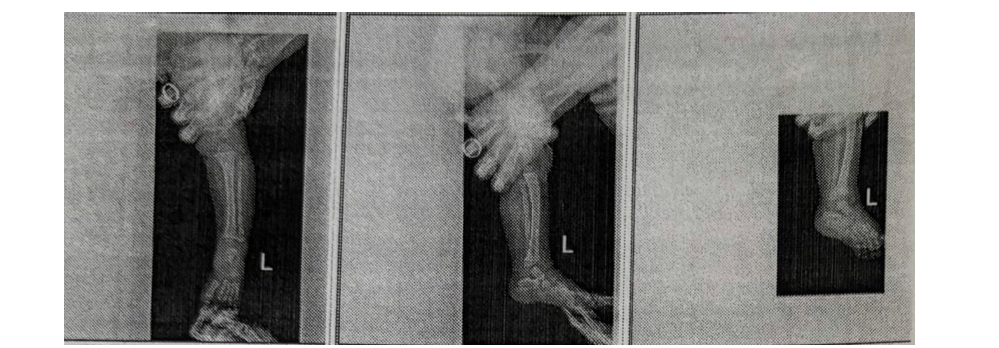
This description emphasizes the absence of pathology and shows that in Still’s disease in the early stages, radiological changes may be absent, and the clinical manifestations (fever, arthritis, systemic features) comes to the forefront. On the second day of treatment, the patient was referred for ultrasound examinations of the internal organs and the musculoskeletal system. During ultrasound of the abdominal cavity, the following changes were detected: the liver was enlarged due to the right lobe to 78mm, the contours were smooth and well-defined, the parenchyma was homogeneous, fine-grained, echogenicity was normal, v. portae was not dilated; the spleen was enlarged to 77×29mm, homogeneous, the contours were smooth and well-defined, no masses were detected, the splenic vein was not dilated-ultrasound signs of pronounced hepatosplenomegaly [6].
Ultrasound of the left ankle joint revealed a layer of fluid up to 1.5mm along the flexors and extensors, the bone contours were clear, even, signs of soft tissue edema, which was interpreted as synovitis of the left ankle joint. Since there were no radiological changes, ultrasound of the ankle joints allowed us to detect early signs of inflammation, making this method more sensitive in the initial stages of the disease. Ultrasound of the lungs revealed signs of subpleural consolidations in the right lung (R2 segment) measuring 8.2×4.2mm and 4.5×3.4mm. According to the literature, subpleural consolidations are more characteristic of infections, but in sJIA with MAS they may occur as part of systemic inflammation.
Echocardiography was performed on the fourth day of treatment due to marked anxiety and a heart rate of 160 beats/ min, measurements of the heart chambers, ejection fraction and valve characteristics were within normal limits, a trivial amount of fluid was detected in the pericardial cavity around all walls up to 1.7mm in diastole. The study was repeated during follow-up on the ninth day of the child’s hospitalization, and no abnormalities were detected. Follow-up echocardiography was recommended [7].
Despite treatment, the leukocyte count continued to decrease to 2.61×10⁹/L, the erythrocyte count decreased to 3.2×10¹²/L, hemoglobin to 82g/L, hematocrit to 25%, and platelet count to 78×10⁹/L, the content of band neutrophils was increased, the CRP increased to 297mg/l. ESR was 63mm/h. The procalcitonin index was determined by the immunofluorescence method and the value of 15 ng/ml was obtained, consistent with severe systemic inflammation.
Although a procalcitonin level of 15ng/ml is typically associated with bacterial sepsis, in systemic juvenile idiopathic arthritis (sJIA) complicated by Macrophage Activation Syndrome (MAS) such elevation may reflect severe systemic inflammation rather than infection. This interpretation is supported by the absence of microbiological evidence of sepsis and by the constellation of clinical features (fever, serositis, arthritis, hepatosplenomegaly) together with laboratory findings (markedly elevated ferritin, CRP, cytopenia). While procalcitonin>10ng/ml is unusual in sJIA, case reports and pediatric rheumatology reviews have documented that MAS can occasionally present with such values, underscoring the importance of integrating laboratory data with clinical context rather than relying on a single biomarker [4,8,9].
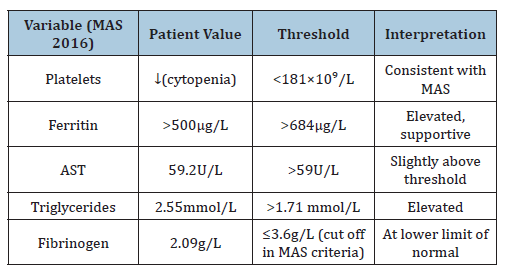
In applying the 2016 MAS classification criteria to this case, several abnormalities were identified that support the consideration of MAS. The patient exhibited cytopenias, markedly elevated ferritin, increased AST, and hypertriglyceridemia. Fibrinogen was measured at 2.09g/L, which corresponds to the lower limit of the reference interval (2.0-4.0g/L) and therefore did not fulfill the criterion for hypofibrinogenemia. Although not all variables were abnormal, the presence of multiple supportive findings indicates partial fulfillment of the MAS criteria and reinforces the clinical suspicion of MAS in this patient (Table 2).
Table 2: MAS 2016 classification criteria [10] and patient values.
In the absence of routine childhood vaccinations, infectious diseases were systematically excluded in the differential diagnosis. Virological assays for SARS‑CoV‑2 and HIV were negative, which diminished the probability of an infectious etiology and, together with the laboratory abnormalities, favored the diagnosis of sJIA/ MAS. The child developed fever spikes up to 39.4 °C every 8 hours, despite antibacterial therapy. Macular rash on the skin of the face, upper and lower extremities, abdomen and trunk appeared with an increase in temperature. Considering the increase in CRP (125- 150-167-297) and procalcitonin over time (0.68-15), as well as the antibiotic history (cefotaxime for 3 days), cefotaxime was replaced with Polycef (cefepime) at a dose of 50mg/kg/day three times daily [10].
Since the prescribed treatment did not produce the desired effect, a multidisciplinary consultation was convened, involving an immunologist and a hematologist. Based on the medical history and examination findings, the following conditions were suspected: hemoblastosis, early-stage systemic juvenile idiopathic arthritis, parvovirus B19 infection, and hemophagocytic lymphohistiocytosis. According to the conclusions of the commission members, it was decided to perform a bone marrow puncture, repeat the complete blood count and coagulogram after the puncture, consider a skin biopsy to confirm or exclude histiocytosis, and conduct contrastenhanced CT screening after obtaining the results of the bone marrow puncture and IgG antibodies to Parvovirus B19, CMV, and EBV.
Further virological testing was conducted to refine the infectious differential diagnosis. Venous blood was taken to determine IgM and IgG antibodies to parvovirus B19, but the results of the study were negative. In addition, IgM and IgG to cytomegalovirus were not detected, antibodies to the capsid antigen and nuclear antigen of Epstein-Barr virus were also not detected. These results further reduced the likelihood of an infectious etiology. A bone marrow aspiration was performed on the same day. According to the results of the BMP, the bone marrow punctate preparations from the left iliac bone were normocellular with expansion and slight rejuvenation of the myeloid lineage, preservation of the megakaryocytic lineage and the marked reduction of the erythroid lineage, the blast content was 2%, dyspoiesis was not pronounced, hemophagocytosis was not detected, and anaplastic cells were not detected. Bone marrow aspirates from the right iliac bone were markedly hypercellular, with expansion of the myeloid lineage and predominance of immature forms (increased proportions of neutrophilic promyelocytes and myelocytes with a relative decrease in segmented neutrophils), preservation of the megakaryocytic lineage and sharp narrowing of the erythron, the blast content is 2%, dyspoiesis is not pronounced, single macrophages in a state of fatty dystrophy were found, without signs of hemophagocytosis, anaplastic cells were not found. No data for acute leukemia or histiocytosis were found in the provided preparations. Findings were consistent with erythroid aplasia. The findings suggest transient inflammatory bone marrow suppression, evidently linked to severe systemic inflammation (sJIA/MAS). Since HLH is an important diagnostic counterpart of MAS, we considered it in the context of differential diagnosis [11].
However, the absence of HLH‑specific features-such as hemophagocytosis in bone marrow and progressive pancytopeniatogether with the clinical context of sJIA, supported the interpretation of MAS rather than HLH. This distinction highlights the importance of systematically evaluating HLH when assessing MAS in pediatric patients. Following the BMP results, by decision of the medical council, intravenous prednisolone was added to the treatment dose of 3mg/kg/day divided into 3 equal doses for 3 days, followed by 2mg/kg/day and infusion therapy (20-100mL/ kg) was administered.
From the ninth day of treatment, leukocytosis began to increase compensatorily in the general blood test to 13×109/L and thrombocytosis to 457×109/L. The indicators that were determined during the coagulogram were within normal limits. From the tenth day of treatment, the procalcitonin indicator in dynamics decreased. Deficiency anemia of moderate severity persisted. Given the prolonged symptoms, a rheumatologist consultation was conducted. At the time of examination, the patient was afebrile and showed no signs of arthritis. Based on the medical history, the patient had a fever up to febrile figures (39 °C) persisting for two weeks, there was arthritis of the left ankle joint, confirmed by ultrasound and manifested by pain, swelling and limitation of movements, a characteristic maculopapular rash, which according to the anamnesis occurred and worsened with an increase in temperature [12].
Therefore, considering the patient’s symptoms, laboratory and instrumental examinations, as well as the exclusion of cytomegalovirus, EBV, parvovirus B19 infection, the absence of ANA, the exclusion of oncohematological disease in bone marrow examination together with a positive response to glucocorticosteroid therapy, the diagnosis was established: “Systemic juvenile idiopathic arthritis (fever, rash, arthritis of the ankle and foot, increased ferritin level). Systemic inflammatory response syndrome (SIRS) of non-infectious origin without acute organ failure. Anemia, unspecified”. The diagnosis of sJIA (Still’s disease) meets the criteria of ILAR, 2001 and EULAR PReS, Still’s disease (2024 EULAR/PReS recommendations for the diagnosis and management of Still’s disease, comprising systemic juvenile idiopathic arthritis and adult-onset Still’s disease Bruno Fautrel). The decrease in leukocytes and platelets at the onset of the disease was atypical, which can be explained by the development of macrophage activation syndrome manifestations at this time (according to the classification criteria of MAS, 2016). The oral use of methylprednisolone at a dose of 1-1.4mg/kg per day, divided into 3 equal doses, was recommended [13].
Diagnostic evaluation was primarily guided by the EULAR/PReS 2024 recommendations, with ILAR 2001 criteria cited for historical classification context. Long‑term management considerations included gradual tapering of corticosteroids, initiation of biologic therapy, and close monitoring for MAS relapse. Although IL‑1 and IL‑6 inhibitors are recommended by international guidelines and are used in specialized centers in Ukraine, they were not administered in our hospital due to limited availability and high cost. The patient was therefore referred to a pediatric rheumatologist at a specialized institution for further follow‑up and consideration of biologic therapy. Medium‑ and long‑term outcome data, including relapse rates and success of corticosteroid tapering, were not available, as the patient’s ongoing management was transferred to the specialized center. These limitations reflect the real‑world constraints of non‑specialized hospitals in Ukraine, where biologic therapy and structured long‑term monitoring are accessible only in referral institutions.
Thus, after the treatment with cefotaxime 450mg twice daily followed by cefepime 450mg three daily, paracetamol 120mg, intravenous infusion therapy with 0.9% sodium chloride solution combined with prednisolone 3mg/kg/day followed by 2mg/kg/ day, and oral methylprednisolone 1.3mg/kg/day both administered in three divided doses, the patient was discharged after 16 days of hospitalization in improved condition. Resolution of the macular rash was observed, the skin over the left ankle joint was not hyperemic, the edema of the left ankle joint regressed. Follow-up by a pediatric rheumatologist and hematologist was recommended.
Conclusion
Still’s syndrome (systemic juvenile idiopathic arthritis) is a rare but clinically significant systemic inflammatory disease characterized by a wide spectrum of clinical manifestations, the absence of specific diagnostic markers and, accordingly, challenges in timely diagnosis. This necessitates a comprehensive approach and careful exclusion of other pathologies, particularly infections and oncology. The importance of research on sJIA lies in the need for early detection of the disease and timely prescription of pathogenetically targeted therapy, which allows controlling the course of the disease, preventing of complications and improving the patients’ quality of life.
This clinical case demonstrates a particular relevance in documenting an MAS-like presentation that mimics sepsis in an 11-month-old child, which can obscure recognition and adds practical perspective to the limited literature on very early onset of the disease.
References
- Cimaz R, Scheven AV, Hofer M (2012) Systemic-onset juvenile idiopathic arthritis: The changing life of a rare disease. Swiss Med Wkly 142: w13582.
- Erkens R, Esteban Y, Towe C, Schulert G, Vastert S (2021) Pathogenesis and treatment of refractory disease courses in systemic juvenile idiopathic arthritis: Refractory arthritis, recurrent macrophage activation syndrome and chronic lung disease. Rheum Dis Clin N Am 47 (4): 585-606.
- Fautrel B, Mitrovic S, Matteis AD, Sara B, Jordi A, et al. (2024) Matteis AD, Sara B, Jordi AEULAR/PReS recommendations for the diagnosis and management of still's disease, comprising systemic juvenile idiopathic arthritis and adult-onset Still's disease. Annals of the Rheumatic Diseases 83(12): 1614-1627.
- Grom AA, Horne A, De Benedetti F (2020) Macrophage activation syndrome in systemic juvenile idiopathic arthritis: Diagnostic challenges and emerging biomarkers. Arthritis Rheumatol 72(11): 1960‑1971.
- Gurion R, Lehman TJA, Moorthy LN (2012) Systemic arthritis in children: A review of clinical presentation and treatment. Int J Inflam 2012: 271569.
- Henderson LA, Cron RQ (2020) Macrophage activation syndrome and secondary hemophagocytic lymphohistiocytosis in childhood inflammatory disorders: Diagnosis and management. Paediatr Drugs 22(1): 29-44.
- Alberto M, Angelo R, Tadej A, Michael WB, Burgos-Vargas R, et al. (2019) Toward new classification criteria for juvenile idiopathic arthritis: First steps, pediatric rheumatology international trials organization international consensus. J Rheumatol 46(2): 190-197.
- Vogl T, Tenbrock K, Schaper J (2019) Procalcitonin as a marker of systemic inflammation in autoinflammatory diseases. J Clin Lab Anal 33(5): e22852.
- Petty RE, Southwood TR, Manners P, Baum J, Glass DN, et al. (2004) International league of associations for rheumatology classification of juvenile idiopathic arthritis: Second revision, edmonton, 2001. J Rheumatol 31(2): 390-392.
- Ravelli A, Minoia F, Davì S (2024) EULAR/PReS recommendations for the management of Still’s disease. Ann Rheum Dis 83(2): e1‑e12.
- Ruscitti P, Cantarini L, Nigrovic PA, McGonagle D, Giacomelli R (2024) Recent advances and evolving concepts in Still’s disease. Nature Reviews Rheumatology 20(2): 116-132.
- Twynam-Perkins E, Martin N, McLellan K (2025) Pharmacological and non-pharmacological treatments for refractory paediatric Still’s disease: A scoping review. Rheumatology Advances in Practice (Oxford Academic) 9(4): rkaf123.
- Vastert SJ, Jamilloux Y, Quartier P, Sven OL, Osterling K, et al. (2019) Anakinra in children and adults with Still’s disease. Rheumatology (Oxford) 58(Suppl 6): vi9-vi22.
© 2025 Halyna Bulak. This is an open access article distributed under the terms of the Creative Commons Attribution License , which permits unrestricted use, distribution, and build upon your work non-commercially.
Editor In Chief







.jpg)































Signup for Newsletter

Quick Links
 Editorial Board Registrations
 Submit your Article
 Best Paper of the Volume
 Reprints
 Refer a Friend
 Advertise With Us
Our Recent Edition

.jpg)



Top Editors




.jpg)

















.bmp)
.jpg)
.png)
.jpg)













.jpg)






.png)

.png)




.png)




Financial Support

Sponsors

Latest e-Books

Latest Video

 a Creative Commons Attribution 4.0 International License. Based on a work at www.crimsonpublishers.com.
Best viewed in
a Creative Commons Attribution 4.0 International License. Based on a work at www.crimsonpublishers.com.
Best viewed in 
 | Above IE 9.0 version