

- About Us
- Information
-

The Author ensures that the research has been conducted responsibly and ethically with adherence to all relevant regulations. read more..
- For Authors
- For Reviewer
- Manuscript Guidelines
- Membership
- Publication Ethics
-
- Journals
- Reprints
- e-Books
- Videos
- Policies
- Contact Us
 COVID-19
- Submissions



Full Text
Research in Pediatrics & Neonatology
Persistent Cutaneous Rash - A Rare Case of Pityriasis Lichenoides et Varioliformis Acuta (PLEVA)
Margarida Moreno Fernandes1*, Ana Sofia Nunes1, Sara Sousa Fernandes1, Ines Eiras1, Luciana Abelha1, Mariana Nobre1, Mariana Bastos Gomes1, Vera Teixeira2 and Pedro Marinho1
1Pediatrics Department, Local Health Unit of Alto Minho (ULSAM), Portugal
2Dermatology Department, Local Health Unit of Alto Minho (ULSAM), Portugal
*Corresponding author: Margarida Moreno Fernandes, Pediatrics Department, Local Health Unit of Alto Minho (ULSAM), Portugal
Submission: November 28, 2025; Published: December 22, 2025
ISSN: 2577-9200 Volume8 Issue4
Abstract
Pityriasis Lichenoides et Varioliformis Acuta (PLEVA) is a rare and benign dermatosis characterized by a generalized polymorphous eruption that begins as reddish-brown macules and papules that evolve to vesicular, necrotic, purpuric, and crusty lesions. We present a 10-year-old boy with a four-week history of a progressively worsening pruritic rash. Laboratory studies were unremarkable. Dermatology evaluation established the diagnosis clinically, and spontaneous resolution occurred within 2.5 months. This case highlights the importance of recognizing PLEVA in children to avoid unnecessary investigations and support accurate diagnosis and management.
Keywords:Pityriasis lichenoides; Pediatric dermatology; Exanthema; Case report
Case Presentation
History of present illness
We report the case of a 10-year-old previously healthy boy who presented to the Emergency Department with a four-week history of a progressively worsening pruritic cutaneous rash. The eruption initially appeared on the trunk and subsequently spread to the arms, legs, face, and cervical and retroauricular regions. After approximately two weeks, crusty and hemorrhagic lesions began to appear. No associated systemic symptoms were reported. There was no relevant epidemiological context. The patient had a history of varicella infection at the age of two years.
Physical examination
Figure 1: Cutaneous rash with reddish macules and papules.
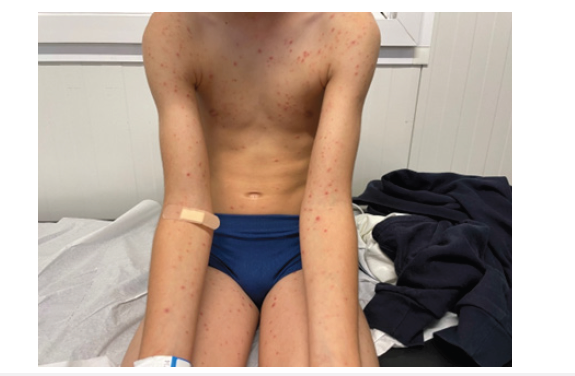
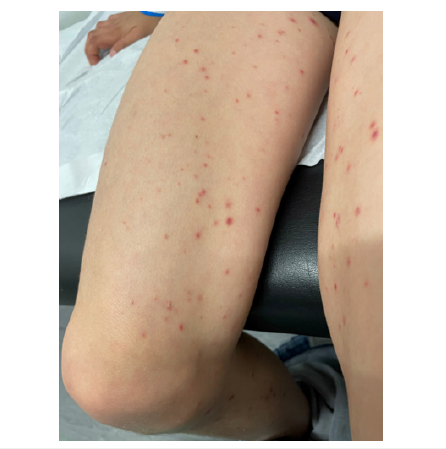
Physical examination revealed a generalized and symmetric polymorphous eruption composed of reddish macules and papules, with areas of crusting and hemorrhagic lesions, involving the trunk, extremities, face, and cervical regions (Figures 1&2). No mucosal involvement was observed.
Figure 2: Cutaneous rash with crusty and hemorrhagic lesions in the legs.
Diagnostic work-up
Given the initial suspicion of hemorrhagic chickenpox, laboratory investigations were performed. Complete blood count showed hemoglobin 13.3g/dL, leukocytes 7240/μL, neutrophils 3100/μL, lymphocytes 3200/μL, and platelets 283,000/μL. Biochemical analysis revealed glucose 91mg/dL, blood urea nitrogen 39mg/dL, creatinine 0.55mg/dL, alkaline phosphatase 234U/L, aspartate transaminase 36U/L, alanine aminotransferase 21U/L, gamma-glutamyl transferase 15U/L, with normal albumin and total protein levels. C-reactive protein was within normal range (0.17mg/dL), and coagulation studies showed no abnormalities. Varicella-zoster virus serology demonstrated negative IgM and positive IgG, consistent with previous infection. The negative varicella-zoster virus IgM, together with the prolonged course of the eruption and absence of systemic symptoms, helped rule out the initial suspicion of hemorrhagic chickenpox.
Treatment and follow-up
The patient had previously been treated with oral antihistamines and an adequate course of topical corticosteroids, without clinical improvement. He was referred for dermatology evaluation, and the diagnosis of Pityriasis Lichenoides et Varioliformis Acuta (PLEVA) was established clinically by a dermatologist based on the characteristic morphology, distribution, and evolution of the lesions. Given the highly characteristic clinical presentation and benign course, a skin biopsy was deemed unnecessary.
Ultraviolet B phototherapy was initially considered due to the persistence of lesions; however, approximately 2.5 months after onset, the lesions began to resolve spontaneously, and phototherapy was not initiated. Complete resolution was observed on follow-up without the need for specific treatment.
Discussion
Pityriasis Lichenoides et Varioliformis Acuta (PLEVA) is a rare and benign dermatosis characterized by a polymorphous eruption that begins as 2-3mm oval reddish-brown macules and papules that evolve to vesicular, necrotic, purpuric, and crusty lesions. It can resolve with or without varioliform scars. The most common sites are the trunk, legs, and arms but lesions may also be generalized. The face, scalp, palms, and soles can be involved to a lesser degree. It is more frequent in the first 10 years of life. Sometimes this rash can be associated with low fever and constitutional symptoms, but these are usually absent or mild. Pruritus is usually mild or absent in PLEVA, although it can be present, as observed in this case. Most cases show spontaneous resolution in weeks to months. PLEVA may also follow a remitting-relapsing course, with episodes lasting from weeks to years before complete resolution [1].
The pathophysiological mechanism is thought to be related to an abnormal immune response to antigenic triggers, such as infection, drugs, or vaccines. Several cases are preceded by upper respiratory viral infection. The most consistent proposed mechanism in literature relates to a clonal infiltration of T CD8+ cells with associated benign lymphoproliferation [1].
Differential diagnosis to consider include chickenpox, lymphomatoid papulosis, infectious exanthems, arthropod bite reaction, cutaneous small vessel vasculitis, drug eruptions, guttate psoriasis, pityriasis rosea, Gianotti-Crosti syndrome, lichen planus, secondary syphilis and febrile ulceronecrotic Mucha- Habermann Disease. The differential diagnosis with chickenpox is important, as it is a very common pediatric disease, especially when the lesions take longer than usual to disappear. Systemic symptoms as fever and malaise are common and intense pruritus is typical. Lymphomatoid papulosis is characterized by chronic and prolonged course of recurrent papulonodular lesions, some of which ulcerated, but usually persisting longer than in PLEVA and with presence of CD30+ large cells, unlike in PLEVA. Arthropod bite reactions are pruritic, erythematous papules or vesicles with central punctum with intense pruritus, unlike PLEVA. The lesions are usually confined to exposed skin areas like face and limbs, whereas PLEVA is generalized. Cutaneous small vessel vasculitis should also be considered in the differentials, causing a palpable symmetrical and dependent distribution purpura in the lower extremities which may be accompanied by arthralgia, hematuria and abdominal pain. Histopathology reveals leukocytoclastic vasculitis with fibrinoid necrosis of vessel walls. Drug eruptions present as symmetrical morbilliform lesions appearing 1-3 weeks after drug exposure. They typically show eosinophils on histology, in contrast to PLEVA [2].
Although PLEVA is usually a clinical diagnosis, dermatology consultation is recommended, and a skin biopsy may be considered in atypical or ambiguous cases [1,2].
Most cases resolve without treatment, as this disease often follows a self-limited course. Topical corticosteroids are often used as first line symptomatic treatment, though with scarce scientific evidence of the benefit as this recommendation is based on case series and retrospective reviews and not in randomized controlled trials. Phototherapy with Ultraviolet B light (UVB) can be used to accelerate recovery. Treatment can also include some systemic antibiotics, such as erythromycin, azithromycin or tetracyclines until resolution, because of their anti-inflammatory action. Antihistamines can be used to decrease pruritus [3-5].
Although PLEVA is not exceedingly rare, its ability to mimic common pediatric exanthems such as chickenpox makes early recognition clinically relevant, particularly to avoid unnecessary investigations and treatments.
Key Clinical Insights
A. Pityriasis Lichenoides et Varioliformis Acuta (PLEVA) is
a rare and benign dermatosis, whose recognition helps avoid
unnecessary investigations.
B. PLEVA is a polymorphous eruption that may mimic
chickenpox but takes longer than usual to resolve.
C. The diagnosis is clinical, and dermatology consultation
may be helpful.
D. Most cases resolve without any treatment.
E. Topical corticosteroids or oral antihistamines are valuable
symptomatic treatment options, although UVB phototherapy is
considered the most effective treatment.
References
- Ellerbroek V, Hamm H (2016) Pityriasis lichenoides et varioliformis acuta: Remission with hypopigmentation. J Pediatr 176: 211-211.
- Teklehaimanot F, Gade A, Rubenstein R (2023) Pityriasis Lichenoides Et Varioliformis Acuta (PLEVA). StatPearls Publishing, Florida, USA.
- Hernández EM, García LNE, Contreras MG, Gómez AV, Reyes GAS (2023) Acute lichenoid and varioliform pityriasis in a pediatric patient. Boletín Médico Del Hospital Infantil De México 80(2): 144-151.
- Geller L, Antonov NK, Lauren CT, Morel KD, Garzon MC (2015) Pityriasis lichenoides in childhood: Review of clinical presentation and treatment options. Pediatr Dermatol 32(5): 579-592.
- Paller A, Mancini AJ, Hurwitz S (2011) Hurwitz clinical pediatric dermatology. (4th edn), Elsevier Saunders, New York. USA.
© 2025 Margarida Moreno Fernandes. This is an open access article distributed under the terms of the Creative Commons Attribution License , which permits unrestricted use, distribution, and build upon your work non-commercially.
Editor In Chief







.jpg)































Signup for Newsletter

Quick Links
 Editorial Board Registrations
 Submit your Article
 Best Paper of the Volume
 Reprints
 Refer a Friend
 Advertise With Us
Our Recent Edition

.jpg)



Top Editors




.jpg)

















.bmp)
.jpg)
.png)
.jpg)













.jpg)






.png)

.png)




.png)




Financial Support

Sponsors

Latest e-Books

Latest Video

 a Creative Commons Attribution 4.0 International License. Based on a work at www.crimsonpublishers.com.
Best viewed in
a Creative Commons Attribution 4.0 International License. Based on a work at www.crimsonpublishers.com.
Best viewed in 
 | Above IE 9.0 version