

- About Us
- Information
-

The Author ensures that the research has been conducted responsibly and ethically with adherence to all relevant regulations. read more..
- For Authors
- For Reviewer
- Manuscript Guidelines
- Membership
- Publication Ethics
-
- Journals
- Reprints
- e-Books
- Videos
- Policies
- Contact Us
 COVID-19
- Submissions



Full Text
Research & Investigations in Sports Medicine
Effects of a Biosignaling Patch on Pain Pressure Threshold After Lower Body Weightlifting in Collegiate Baseball Players
S Andrew Cage*
The University of Texas at Tyler, USA
*Corresponding author:S Andrew Cage, The University of Texas at Tyler, USA
Submission: April 28, 2026;Published: May 13, 2026

ISSN: 2577-1914 Volume11 Issue 4
Abstract
Musculoskeletal pain and inflammation commonly occur following high-intensity resistance exercise and may negatively impact athletic performance, recovery and availability. Consequently, there is increasing interest in non-invasive interventions aimed at mitigating post-exercise pain and improving recovery outcomes. Scalar wave technology has been proposed as a novel modality with potential effects on cellular communication and inflammatory processes; however, empirical evidence supporting its efficacy in athletic populations remains limited. Therefore, the purpose of this study was to determine whether the application of a biosignaling patch designed to produce scalar waves would increase Pain Pressure Threshold (PPT) following a lower body workout in collegiate baseball players compared to a sham condition. Forty-seven NCAA Division II baseball players (age = 21±2 years) were randomly assigned to receive either a programmed scalar wave patch or a sham patch. Following a standardized lower extremity weightlifting session, PPT measurements were obtained at the musculotendinous junction of the gastrocnemius and Achilles tendon using a digital force gauge. Patches were applied immediately after post-workout measurements and participants returned 24 hours later for repeat PPT assessment. Paired samples t-tests assessed within-group differences, while independent samples t-tests evaluated between-group differences (p < .05). Participants in the programmed patch group demonstrated a significant increase in PPT at 24 hours (4.85±2.28 lbs, p < .001), whereas the sham group exhibited a significant decrease (-0.95±1.99 lbs, p = .032). Between-group analysis revealed significantly greater PPT values in the programmed patch group compared to the sham group at 24 hours (p = .037). These findings suggest that the scalar wave-producing patch may reduce post-exercise muscle tenderness and modulate pain sensitivity. This modality may represent a practical, non-invasive adjunct for recovery in athletic populations, although further research is needed to confirm these effects and clarify underlying mechanisms.
Introduction
Musculoskeletal pain and inflammation are common consequences of high-intensity training in competitive athletes, particularly following resistance exercises [1-3]. These responses, while often transient, can negatively impact subsequent performance, recovery and overall athlete availability [4,5]. Additionally, pain has been shown to have negative impacts on cognitive performances [6]. As a result, considerable attention has been directed toward interventions aimed at mitigating musculoskeletal pain associated with exercise and improving recovery outcomes. Traditional approaches, including physical therapeutic modalities, nutritional supplementation and pharmacological management, have demonstrated varying levels of effectiveness, but each carries inherent limitations related to practicality, compliance or potential side effects [7-10].
In recent years, alternative and adjunctive modalities have emerged with the goal of enhancing recovery through non-invasive means. One such modality involves the use of scalar wave technology. Scalar waves, also referred to as longitudinal waves, are theorized to differ from conventional electromagnetic waves in their non-Hertzian properties and potential ability to interact with biological systems at the cellular level [11,12]. Proponents suggest that these waves may influence cellular communication, reduce inflammation and promote overall tissue recovery, although empirical evidence supporting these claims remains limited and the underlying mechanisms are not yet fully understood [11,12]. Given the increasing interest in energy-based therapies, there is a need to critically evaluate their effectiveness within applied athletic populations.
Despite growing theoretical support, there is a paucity of original research examining the effects of scalar wave interventions on objective measures of pain and recovery in athletic settings [11,12]. Pain Pressure Threshold (PPT) has been established as a reliable and quantifiable measure of localized pain sensitivity and has been widely utilized to assess the effectiveness of recovery interventions for musculoskeletal pain [13-15]. Evaluating changes in PPT provides insight into an intervention’s ability to modulate nociceptive responses and improve tolerance to mechanical pressure.
Therefore, the purpose of this study was to determine whether the application of a scalar wave-producing patch would result in increased pain pressure threshold following a lower body workout in collegiate baseball players, as compared to a sham patch that was not programmed to produce scalar waves.
Methods
Participants
Participants in this study were recruited through announcements made during team meetings. A total of 47 collegiate baseball players (Age = 21±2 years, Height = 72.6±3.1 inches, Weight = 199.1±12.3) from an NCAA Division II university were enrolled in this study. All subjects were informed of this study’s purpose and consent was obtained. Participants were then randomly allocated into one of two groups, with one group receiving programmed biosignaling patches and one group receiving sham patches that were not programmed to achieve biosignaling.
Data collection procedures
Table 1: Lower extremity weightlifting session.
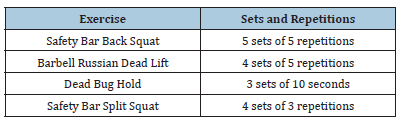
Lower extremity weightlifting session: As part of their normal organized team activities, participants took part in a lower extremity weightlifting session. The organization standard for lifting focused on using velocity-based training. During workouts, all weightlifting implements were connected to a device containing a linear transducer (Vitruve VBT, Vitruve, Móstoles, Madrid). The device measured linear acceleration of the weightlifting implement, providing a value in meters per second. Participants were instructed to use enough resistance to provide a challenge, but not so much resistance to where they could not move the weightlifting implement at the desired rate of acceleration. As such, the amount of weight lifted was individualized and specific to the participants’ ability to move the weight during the specific session. A list of the exercises is included in Table 1.
Pain pressure threshold
Within 15-minutes of their lower extremity weightlifting session, each participant had pain pressure threshold measurements taken at the musculotendinous junction of the gastrocnemius and the Achilles tendon. Measurements were taken approximately 15 to 20cm from the apex of the calcaneus using a digital force gauge (S-500 Digital Force Gauge, Beslands, London, UK). Participants were instructed to inform the investigator when they felt that the discomfort from the gauge reached a 2 out of 10 subjectively. Measures were taken twice, with the average used for data analysis.
Approximately 24 hours after the application of the patches, pain pressure threshold measurements were taken at the same site on participants. Measurement procedures were repeated, with measures being taken twice and the average being used for data analysis.
Intervention
After post-weightlifting pain pressure threshold measurements were taken, a scalar wave patch using biosignaling technology (BioSync, LLC, Clarence Center, New York, in collaboration with Scaling Partners, Clarence Center, New York) was applied to the measurement site. Participants were instructed to go about their activities of daily living as normal, with the only instructions being to not vigorously wash the area of the calf where the patch was. Upon the return for repeated measures at 24-hours postapplication, the patch was removed so pain pressure threshold measurements could be taken.
Data analysis
Relevant data was transferred to and analysed using a commercially available statistics software package (SPSS Version 28, IBM, Armonk, NY). A total of 47 participants were included in data analysis. A paired samples t-test was performed to assess difference in changes in pain pressure threshold measurements at the musculotendinous junction of the gastrocnemius and Achilles tendon before and 24-hours after patch application within groups. An independent samples t-test was performed to assess differences between groups. Significance was set a p < .05 a priori.
Results
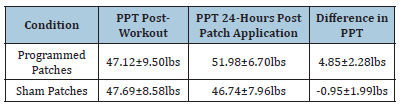
Measures of central tendency and differences in pain pressure threshold after 24-hours of wearing either the programmed or sham patch are presented in Table 2. Participants wearing the programmed patch exhibited a significant increase in pain pressure threshold after wearing the patch at 24-hours (4.85±2.28 lbs, p < .001). Participants wearing the sham patch exhibited a significant decrease in pain pressure threshold after wearing the patch at 24-hours (-0.95±1.99lbs, p = .032). Between groups, participants wearing the programmed patch exhibited a significantly higher pain pressure threshold than participants wearing the sham patch at 24-hours (p = .037). In this study, participants wearing the programmed patch for 24-hours after a lower extremity weightlifting session exhibited less muscular tenderness than participants wearing a sham patch for 24-hours post weightlifting session.
Table 2:Measures of central tendency and differences in Pain Pressure Threshold (PPT).
Discussion
The primary finding of this study was that the application of a biosignaling patch resulted in a significant increase in pain pressure threshold following a lower body weightlifting session in collegiate baseball players. Conversely, participants receiving a sham patch demonstrated a decrease in pain pressure threshold over the same time period. Between-group comparisons indicated that participants wearing the programmed patch exhibited significantly greater pain pressure threshold values at 24 hours post-exercise compared to those wearing the sham patch. These findings suggest that the biosignaling patch may have had a meaningful effect on modulating post-exercise muscle tenderness.
The increase in pain pressure threshold observed in the programmed patch group may indicate a reduction in localized nociceptive sensitivity at the musculotendinous junction of the gastrocnemius and Achilles tendon. Given that exercise-induced muscle soreness is commonly associated with microtrauma, inflammation and subsequent sensitization of nociceptors, interventions that attenuate these responses may improve a patient’s tolerance to mechanical pressure and perceived discomfort. In contrast, the decrease in pain pressure threshold observed in the sham group is consistent with the expected physiological response to Delayed Onset Muscle Soreness (DOMS), which typically peaks within 24 to 48 hours following exercise [1]. As such, the divergence in responses between groups may suggest that the programmed patch altered the typical trajectory of postexercise soreness.
The mechanisms underlying the observed effects remain unclear but may be considered within the theoretical framework of scalar wave technology. Scalar waves have been proposed to interact with biological systems at the cellular level, potentially influencing cellular communication, inflammatory processes and tissue recovery [1,2]. While these mechanisms have not been definitively established, it is possible that the application of a biosignaling patch may have contributed to modulation of local inflammatory responses or altered nociceptive signaling pathways. However, given the limited empirical evidence supporting these mechanisms, these interpretations should be approached with caution.
From a clinical perspective, the findings of this study may have practical implications for athletic populations. The ability to reduce post-exercise pain sensitivity without the use of pharmacological interventions or more time-intensive recovery modalities may be advantageous in settings where rapid recovery is prioritized. A passive, non-invasive intervention such as a wearable patch may also improve compliance compared to traditional recovery strategies. If supported by further research, this modality could represent a useful adjunct within a comprehensive recovery program.
Several limitations should be considered when interpreting the results of this study. First, the study was conducted within a single population of collegiate baseball players, which may limit the generalizability of the findings to other athletic populations or levels of competition. Second, while pain pressure threshold is a valid and reliable measure of localized pain sensitivity, it does not capture other important aspects of recovery such as functional performance or perceived soreness. Additionally, the study design did not control for all potential external variables that may influence recovery, such as sleep, nutrition or prior training load. Finally, the mechanisms associated with scalar wave technology remain largely theoretical, and the study did not directly assess physiological changes related to inflammation or tissue healing.
Future research should aim to replicate these findings in larger and more diverse populations, while also incorporating additional outcome measures such as functional performance, subjective soreness and biomarkers of inflammation. Further investigation into the physiological mechanisms underlying scalar wave and other biosignaling interventions is also warranted to better understand their potential role in recovery and pain modulation.
In conclusion, the application of a biosignaling patch designed to produce scalar waves following a lower body weightlifting session resulted in a significant increase in pain pressure threshold compared to a sham condition in collegiate baseball players. These findings suggest that this modality may have potential as a noninvasive intervention for reducing post-exercise pain sensitivity, although further research is needed to confirm these effects and elucidate the underlying mechanisms.
References
- Cheng L, Wang K, He BX, Yan Y (2022) Effect of vertical vibration stimulation at different frequencies on delayed muscle soreness in athletes: A randomized trial. Frontiers in Public Health 10: 980454.
- Kjaer M, Petersen J, Dunweber MR, Andersen JL, Engebretsen L, et al. (2025) Dilemma in the treatment of sports injuries in athletes: Tendon overuse, muscle strain and tendon rupture. Scandinavian Journal of Medicine & Science in Sports 35(2): e70026.
- Ansari S, Sharma S (2025) Isometric back extensor endurance and chronic low back pain in university athletes: A cross-sectional study. Journal of Sport Rehabilitation 34(6): 638-643.
- Das R, Jhajharia B, Ciocan VC, Sharma A, Majumdar I (2022) Myofascial trigger points and its influence on athletic performance: A review. NeuroQuantology 20(19): 467-483.
- Fullen B, Morloin B, Linton SJ, Roomes D, Griensven JV, et al. (2022) Management of chronic low back pain and impact on patients’ personal and professional lives: Results from an international patient survey. Pain Practice 22(4): 463-477.
- Silvestrini N, Corradi-Dell’Acqua C (2022) The impact of pain on subsequent effort and cognitive performance. Journal of Psychophysiology 37(2): 67-78.
- Roberts BM, Sczuorski CE, Caldwell AR, Zeppetelli DJ, Smith NI, et al. (2024) NSAIDs do not prevent exercise-induced performance deficits or alleviate muscle soreness: A placebo-controlled randomized, double-blinded, cross-over study. Journal of Science and Medicine in Sport 27(5): 287-292.
- O’Connor E, Mundel T, Barnes MJ (2022) Nutritional compounds to improve post-exercise recovery. Nutrients 14(23): 5069.
- Miranda JP, Figueiredo RC, Saragiotto B, Oliveira VC (2026) Effectiveness of cryotherapy on pain intensity, range of motion, swelling and function in the postoperative care of musculoskeletal disorders: A systematic review and meta-analysis of randomised controlled trials. British Journal of Sports Medicine 60(6): 440-449.
- Carvalho MT, Pinheiro VH, Alberton CL (2024) Effectiveness of neuromuscular electrical stimulation training combined with exercise on patient-reported outcomes measures in people with knee osteoarthritis: A systematic review and meta-analysis. Physiotherapy Research International 29(1): e2062.
- Zohuri B (2025) Scalar wave harnessing vibrational energy and wellness. Journal of Current Trends in Clinical Case Reports 6(1): 1-6.
- Pula B (2023) Exploring the potential of scalar waves in medicine and healing. Fluid Mech Open Acc 10(5): 307.
- Stausholm MB, Bjordal JM, Moe-Nilssen R, Naterstad I (2023) Pain pressure threshold algometry in knee osteoarthritis: Intra- and inter-rater reliability. Physiotherapy Theory and Practice 39(3): 615-622.
- Suzuki H, Tahara S, Mitsuda M, Izumi H, Ikeda S, et al. (2022) Current concept of quantitative sensory testing and pain threshold in neck/shoulder and low back pain. Healthcare 10(8): 1465.
- Cage SA, Trail LE, Galbraith RM, Cox C, Warner BJ (2023) Effect of cupping therapy on muscle tenderness in collegiate baseball players compared to sham treatment: A randomized, single-blinded trial. Journal of Sports Medicine and Allied Health Sciences 8(4).
© 2026 S Andrew Cage. This is an open access article distributed under the terms of the Creative Commons Attribution License , which permits unrestricted use, distribution, and build upon your work non-commercially.
Editor In Chief







.jpg)































Signup for Newsletter

Quick Links
 Editorial Board Registrations
 Submit your Article
 Best Paper of the Volume
 Reprints
 Refer a Friend
 Advertise With Us
Our Recent Edition

.jpg)



Top Editors




.jpg)

















.bmp)
.jpg)
.png)
.jpg)













.jpg)






.png)

.png)




.png)




Financial Support

Sponsors

Latest e-Books

Latest Video

 a Creative Commons Attribution 4.0 International License. Based on a work at www.crimsonpublishers.com.
Best viewed in
a Creative Commons Attribution 4.0 International License. Based on a work at www.crimsonpublishers.com.
Best viewed in 
 | Above IE 9.0 version