

- About Us
- Information
-

The Author ensures that the research has been conducted responsibly and ethically with adherence to all relevant regulations. read more..
- For Authors
- For Reviewer
- Manuscript Guidelines
- Membership
- Publication Ethics
-
- Journals
- Reprints
- e-Books
- Videos
- Policies
- Contact Us
 COVID-19
- Submissions



Full Text
Research & Development in Material Science
Effect of Temperature and Defects on Mechanical Properties of Cubic Metals via Embedded Atom Method: A Review
Ranjeet Singh*, Bhupendra Kumar Chikara and Vikram Singh
Department of Physics, Dr. Bhimrao Ambedkar University, India
*Corresponding author:
Ranjeet Singh, Department of Physics, Dr. Bhimrao Ambedkar University, Agra, Uttar Pradesh, India
Submission: August 25, 2026;Published: September 18, 2026

ISSN: 2576-8840 Volume 23 Issue 2
Abstract
The mechanical properties of cubic metals are strongly influenced by temperature and the presence of lattice defects, which play a critical role in determining their structural stability and performance. This review focuses on the application of the Embedded Atom Method (EAM) to investigate the effects of temperature variation and defects such as vacancies, dislocations and grain boundaries on Face-Cantered Cubic (FCC) and Body-Cantered Cubic (BCC) metals. EAM-based simulations provide atomistic insights into changes in elastic constants, yield strength and deformation mechanisms under different thermal conditions. The study highlights how increasing temperature generally reduces strength and stiffness, while defects significantly alter plastic behaviour and failure mechanisms. Furthermore, the review discusses recent advancements in computational modelling techniques for accurately predicting material behaviour. This work in the result emphasizes the importance of combining temperature effects and defect analysis to better understand and design cubic metals for advanced engineering applications.indings indicate that conventional grey cast iron phase diagrams may not describe all stages of cooling.
Keywords: Embedded Atom Method (EAM); Cubic metals; Mechanical properties; Temperature effects; Crystal defects; Atomistic simulation
List of abbreviations: ρ (Rho): Electron Density; φ (Phi): Pair Potential; EAM: Embedded Atom Method; FCC: Face-Centered Cubic; BCC: Body-Centered Cubic; MD: Molecular Dynamics; TEM: Transmission Electron Microscopy; DFT: Density Functional Theory; HV: Vickers Hardness; σ_y: Yield Strength; ρ: Electron Density; φ: Pair Potential
Introduction
Cubic metals, particularly Face-Centered Cubic (FCC) and Body-Centered Cubic (BCC) structures, are widely used in engineering applications due to their excellent mechanical properties such as strength, ductility and toughness [1]. Understanding how these properties are influenced by external and internal factors is essential for improving material performance in real-world conditions. Among these factors, temperature and crystal defects play a crucial role in determining the mechanical behavior of metals at the atomic level. Temperature significantly affects atomic vibrations, diffusion processes and phase stability in cubic metals. As temperature increases, atomic mobility also increases, which can lead to a reduction in yield strength, elastic modulus and structural stability. On the other hand, defects such as vacancies, dislocations and grain boundaries act as stress concentrators and influence deformation mechanisms, including slip and dislocation motion. These defects can either strengthen or weaken the material depending on their nature, density and distribution [2].
The Embedded Atom Method (EAM) has emerged as a powerful computational tool for studying the mechanical properties of metals at the atomistic scale. It enables accurate modeling of interatomic interactions and delivers detailed insights into how temperature and defects influence material behavior. By combining temperature-dependent simulations with defect analysis, researchers can predict mechanical responses more effectively [3]. This review aims to explore recent developments in this field, highlighting the role of EAM in advancing the understanding of cubic metals under varying conditions [4].
Historical Background
The study of mechanical properties of metals has evolved significantly over the past century, beginning with classical continuum theories and experimental observations. Early research focused on macroscopic behaviour but lacked insight into atomicscale mechanisms [5]. With the development of crystallography in the early 20th century, scientists identified cubic crystal structures such as Face-Cantered Cubic (FCC) and Body-Cantered Cubic (BCC), which helped explain deformation and slip systems in metals.
The introduction of computational methods in the late 20th century marked a major advancement. In particular, the Embedded Atom Method (EAM), developed in the 1980s, provided a reliable approach to model interatomic interactions in metallic systems. This method enabled researchers to simulate the effects of temperature and defects such as vacancies and dislocations on mechanical behaviour at the atomic level [6]. In this time improvements in computational power and simulation techniques have made EAM a widely used tool for studying and predicting the properties of cubic metals.
The present work reviews the influence of temperature and crystal defects on the mechanical properties of cubic metals using the Embedded Atom Method (EAM). It focuses on analysing how variations in temperature and the presence of defects such as vacancies, dislocations and grain boundaries affect properties like strength, elasticity and deformation behaviour in FCC and BCC metals. The review compiles recent research findings and highlights the effectiveness of EAM simulations in providing atomistic-level understanding of material responses under different conditions [7].
For future work, there is significant scope to enhance the accuracy of simulations by integrating EAM with advanced computational techniques such as machine learning and multiscale modelling. Further studies can explore complex defect interactions, alloy systems and extreme environmental conditions like high pressure and irradiation [8]. Additionally, simulation validation of simulation results will be crucial for developing more reliable models and designing high-performance materials for advanced technological applications.
Embedded Atom Method (EAM) and atomistic simulation
The Embedded Atom Method (EAM) is a widely used computational approach for modelling the behaviour of metallic systems at the atomic scale. It is based on the concept that the total energy of a metal is not only determined by pairwise atomic interactions but also by the embedding energy, which depends on the local electron density surrounding each atom [9]. This makes EAM particularly suitable for simulating metallic bonding, where electron clouds are shared among atoms.
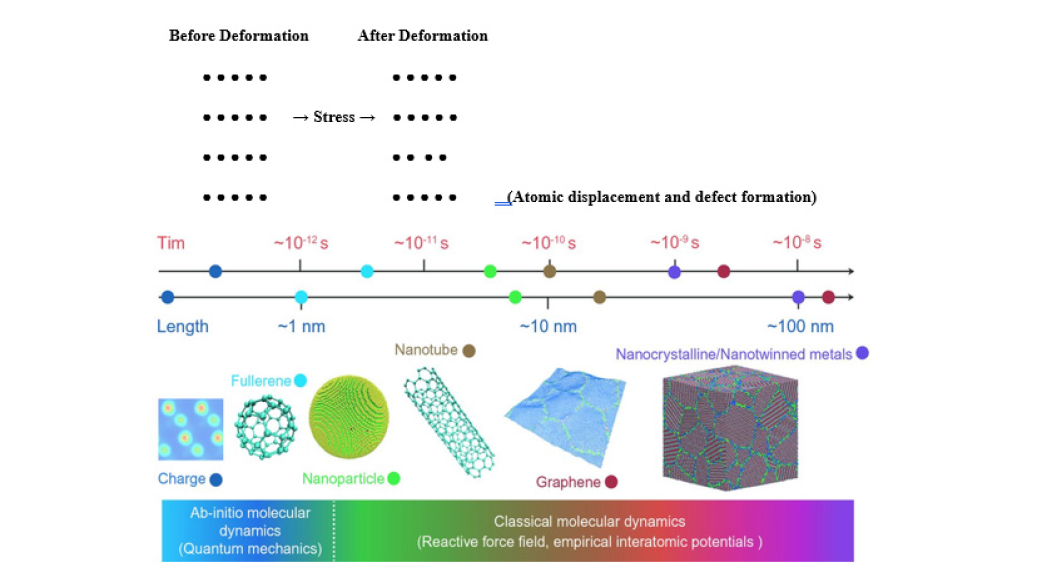
Atomistic simulation using EAM enables researchers to study the mechanical and physical properties of materials by tracking the motion and interaction of individual atoms under various conditions such as temperature, pressure and applied stress. It provides detailed insights into microscopic phenomena like dislocation movement, crack propagation and phase transformations, which are difficult to observe experimentally [10].
EAM has been successfully applied to Face-Cantered Cubic (FCC) and Body-Cantered Cubic (BCC) metals, helping to predict properties such as elastic constants, surface energy and defect formation energy [11]. With advancements in computational power atomistic simulations have become an essential tool in materials science, allowing accurate prediction and design of advanced materials for engineering applications (Table 1, [12,13]; Table 2, [14]; Figure 1, [15]; Figure 2, [16]; Figure 3, [17]).
Table 1:Components of Embedded Atom Method (EAM) with example values.

Table 2:Advantages of EAM in atomistic simulation (with typical values).

Figure 1:Schematic of embedded atom method concept [15].
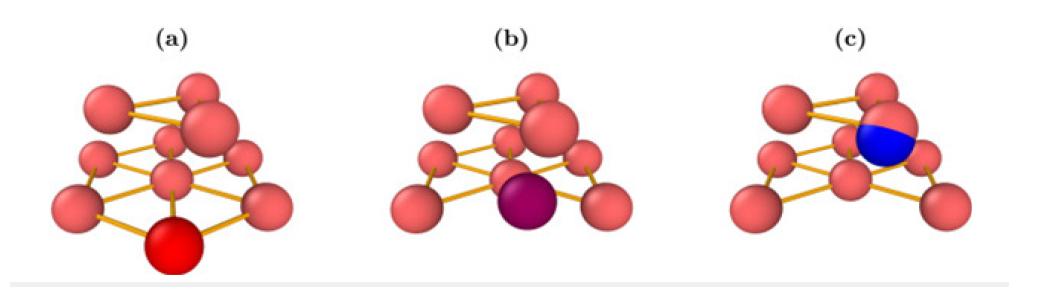
Figure 2:Atomistic simulation representation.
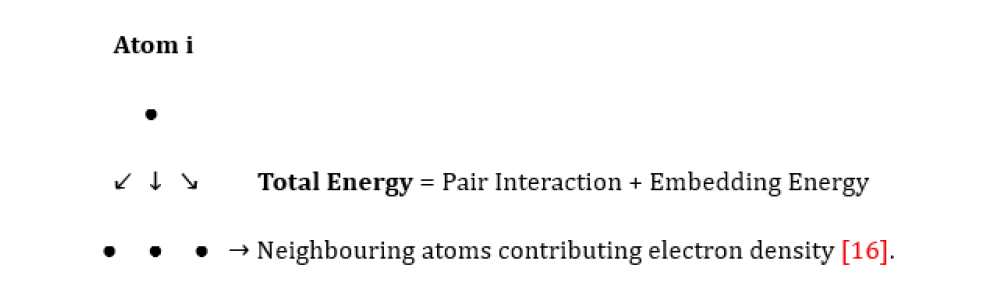
Figure 3:Schematic illustration of atomistic modelling strategies. Representative length and time scales for AIMD and CMD simulations are indicated along the axes [17]. Some typical nanostructured materials (such as fullerene, nanoparticle, nanotube, graphene and nanocrystalline/nano twinned metals) are showed as illustrative examples for different characteristic length and time scales accessible in atomistic modelling.
Cubic metals and their mechanical properties
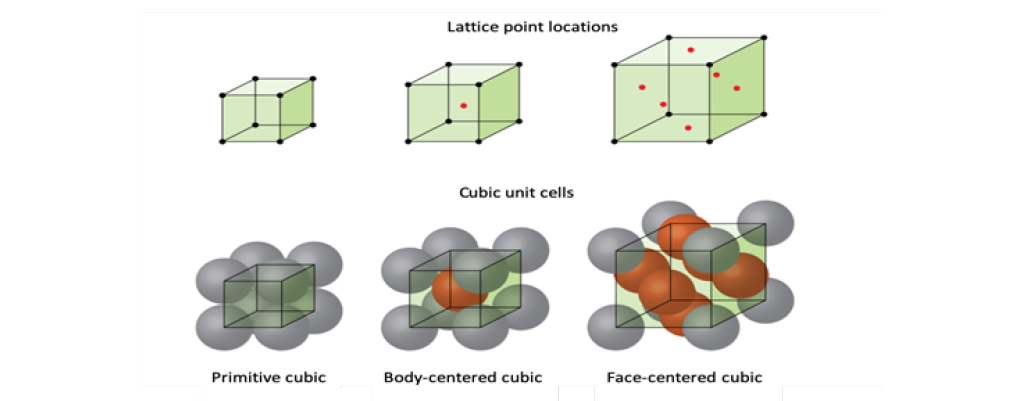
Cubic metals, including Face-Cantered Cubic (FCC) and Body- Cantered Cubic (BCC) structures, are widely used in engineering due to their excellent mechanical properties. FCC metals, such as copper (Cu), aluminium (Al) and nickel (Ni) are known for high ductility, good toughness and moderate strength. In contrast, BCC metals, such as iron (Fe), chromium (Cr) and tungsten (W), generally have higher strength but lower ductility at room temperature [18]. The mechanical properties of cubic metals, including elastic modulus, yield strength, hardness and tensile strength, are influenced by factors such as crystal structure, temperature, and the presence of defects. Understanding these properties at the atomic level allows engineers and scientists to design metals with tailored characteristics for specific applications [19].
Atomistic simulations, especially using the Embedded Atom Method (EAM), help analyse these mechanical properties under different conditions. These simulations can predict how atoms move under stress, the formation of dislocations and the effect of grain boundaries on strength. This knowledge is crucial for designing high-performance materials for aerospace, automotive and structural applications [20]; (Table 3, [21,22]; Figure 4, [23]).
Table 3:Mechanical properties of selected cubic metals.

Figure 4:Schematic of Cubic Metal Structures [23].
Temperature effects and crystal defects
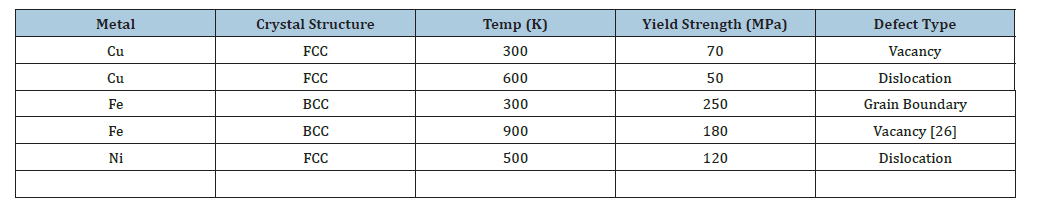
The mechanical behavior of cubic metals is highly influenced by temperature and the presence of crystal defects. As temperature increases, atomic vibrations intensify, which generally reduces elastic modulus, yield strength and hardness. High temperatures can also promote dislocation movement, grain boundary sliding and even phase transformations, which may lead to softening of the metal. Crystal defects, including vacancies, dislocations and grain boundaries, significantly alter mechanical properties [24]. Vacancies create stress concentrations dislocations enable plastic deformation and grain boundaries can either strengthen or weaken the metal depending on their size and distribution. The interaction of temperature and defects is critical in determining a metal’s overall mechanical response. Atomistic simulations using the Embedded Atom Method (EAM) allow detailed study of these effects, providing quantitative predictions of how metals behave under combined thermal and defect influences [25]; (Table 4, [26]).
Table 4:Effect of temperature and defects on cubic metal properties.
Yield Strength (MPa)
|
| Fe (BCC) 300K
| ●
| Fe (BCC) 900K
| ●
| Cu (FCC) 300K
| ●
| Cu (FCC) 600K
| ●
|-------------------------> Temperature / Defect Type
This schematic shows how increasing temperature and different defect types reduce the yield strength of cubic metals [27].
The Figure 5 shows the effect of temperature and defects on yield strength of cubic metals. As temperature rises from 300K to 900K, both Fe (BCC) and Cu (FCC) exhibit reduced yield strength. Defects like vacancies and dislocations further lower strength, highlighting the combined influence of thermal and structural factors on mechanical performance [28].
Figure 5:Temperature and defect effects on metal strength.
Results
The present review demonstrates that the mechanical response of cubic metals is strongly governed by the combined effects of temperature and crystal defects. The Embedded Atom Method (EAM) provides an effective atomistic framework for investigating these effects by incorporating both pairwise atomic interactions and the embedding energy associated with the local electron density. This formulation enables the prediction of structural and mechanical responses at the atomic scale, particularly for Face- Centered Cubic (FCC) and Body-Centered Cubic (BCC) metallic systems. The reviewed results indicate a clear temperaturedependent degradation of mechanical strength and stiffness. With increasing temperature, enhanced atomic vibrations and increased atomic mobility reduce the resistance of the crystal lattice to deformation. Consequently, elastic modules yield strength and hardness generally decrease at elevated temperatures. The reported data show that the yield strength of Fe with a BCC structure decrease from approximately 250MPa at 300K to 180MPa at 900K. Similarly, Cu with an FCC structure exhibits a reduction in yield strength from approximately 70MPa at 300K to 50MPa at 600K. These observations confirm the thermally activated nature of plastic deformation in cubic metals.
Crystal defects were also found to exert a substantial influence on mechanical performance. Vacancies generate local lattice distortions and stress concentrations, whereas dislocations act as primary carriers of plastic deformation through their motion along crystallographic slip systems. Grain boundaries modify the local atomic environment and can either enhance or reduce mechanical strength depending on their structural configuration, density and distribution. The interaction between defects and thermal activation is particularly important because elevated temperature facilitates defect mobility, dislocation glide, grain-boundary migration and other deformation mechanisms.
The comparative analysis of FCC and BCC metals further indicates that crystal structure plays a decisive role in determining mechanical behaviors. FCC metals such as Cu, Al and Ni generally exhibit higher ductility and toughness, whereas BCC metals such as Fe and W demonstrate comparatively higher strength and stiffness, particularly under suitable temperature conditions. The reported elastic modulus values range from approximately 70GPa for Al to 400GPa for W, demonstrating the significant influence of atomic bonding and crystal structure on elastic response. EAM-based atomistic simulations provide quantitative insights into elastic deformation, defect formation, dislocation behaviors, thermal softening, and strength degradation. The method is therefore highly suitable for analyzing coupled thermal-defect effects that are difficult to resolve through conventional macroscopic approaches.
Conclusion
The present review establishes that temperature and crystal defects are critical controlling parameters for the mechanical properties of cubic metals. Increasing temperature generally promotes atomic vibrations and defect mobility, resulting in a reduction in elastic stiffness, yield strength and hardness. At the same time, vacancies, dislocations and grain boundaries introduce local structural heterogeneities that substantially modify deformation and failure mechanisms. The Embedded Atom Method offers a robust atomistic approach for capturing these complex interactions because it accounts for the many-body nature of metallic bonding through electron-density-dependent embedding energy. Its application to FCC and BCC metals enables detailed analysis of temperature-dependent mechanical behaviors and defect-mediated plasticity. The combined influence of thermal effects and lattice imperfections is therefore essential for reliable prediction of mechanical performance under realistic service conditions. The findings suggest that EAM-based simulations can support the design and optimization of high-performance metallic materials for aerospace, automotive, structural and other advanced engineering applications. Future research should focus on coupling EAM with molecular dynamics, machine-learning-based interatomic potentials, multiscale modelling and experimentally validated computational frameworks. Particular attention should be given to complex defect interactions, alloying effects, highpressure environments, irradiation damage, and extreme thermal conditions. Such integrated approaches can improve the predictive capability of atomistic modelling and contribute to the development of defect-tolerant, thermally stable and mechanically optimized cubic metallic materials.
References
- Murray SD, Stephen MF, Michael IB (1993) The embedded-atom method: a review of theory and applications. Materials Science Reports 9(7-8): 251-310.
- Sébastien G (2015) Mechanical, thermal and physical properties of Mg Ca compounds in the framework of the modified embedded-atom method. Journal of the Mechanical Behavior of Biomedical Materials 42: 88-99.
- Rajasekaran G, Prarthana N, Avinash P (2016) Effect of point and line defects on mechanical and thermal properties of graphene: a review. Critical Reviews in Solid State and Materials Sciences 41(1): 47-71.
- Ovid'Ko IA, Sheinerman AG (2016) Mechanical properties of nano twinned metals: a review. Reviews on Advanced Materials Science 44: 1-25.
- Liang Z, Cheng L, Kiet T (2016) A review on atomistic simulation of grain boundary behaviors in face-centered cubic metals. Computational Materials Science 118: 180-191.
- Won-Seok K, Blazej G, Jörg N (2015) Development and application of a Ni-Ti interatomic potential with high predictive accuracy of the martensitic phase transition. Physical Review B 92(13): 134107.
- Zamanzade M, Afrooz B, Christian M (2016) A review on the properties of iron aluminide intermetallics. Crystals 6(1): 10.
- Rajesh K, Avinash P (2016) Atomistic modeling of BN nanofillers for mechanical and thermal properties: a review. Nanoscale 8(1): 22-49.
- Zhang T, Xiaoyan L, Huajian G (2015) Fracture of graphene: a review. International Journal of Fracture 196(1): 1-31.
- Hieu HP, Benzerga AA, Tahir C (2015) Hydrogen segregation in palladium and the combined effects of temperature and defects on mechanical properties. Condensed Matter, Materials Science.
- Zhenlan F, Bueken B, De Vos DE, Fischer RA (2015) Defect‐engineered metal-organic frameworks. Angewandte Chemie International Edition 54(25): 7234-7254.
- Cody AD, Penghui C, Sara EF, Alejandro VF, Alexei AM, et al. (2016) Bridging the gap to mesoscale radiation materials science with transient grating spectroscopy. Physical Review B 94(21): 214106.
- Kirmanidou Y, Sidira M, Drosou ME, Bennani V, Bakopoulou A, et al. (2016) New Ti‐alloys and surface modifications to improve the mechanical properties and the biological response to orthopedic and dental implants: A review. BioMed Research International 2016(1): 2908570.
- Yi-Shen L, Mrovec M, Vitek V (2016) Bond-order potential for magnetic body-centered-cubic iron and its transferability. Physical Review B 93(21): 214107.
- Maarten DJ, Liang Q, David LO, Axel W, Mark A (2016) Calculations of planar defect energies in substitutional alloys using the special-quasirandom-structure approach. Physical Review B 93(9): 094101.
- Körner C (2016) Additive manufacturing of metallic components by selective electron beam melting a review. International Materials Reviews 61(5): 361-377.
- Shi X, Chen L, Uher C (2016) Recent advances in high-performance bulk thermoelectric materials. International Materials Reviews 61(6): 379-415.
- Alexander R, Marinica MC, Proville L, Willaime F, Arakawa K, et al. (2016) Ab initio scaling laws for the formation energy of nanosized interstitial defect clusters in iron, tungsten, and vanadium. Physical Review B 94(2): 024103.
- Tomoaki N, Tomotsugu S (2015) Atomistic mechanisms of intermittent plasticity in metals: Dislocation avalanches and defect cluster pinning. Physical Review E 91(2): 022401.
- Peter B, Alexander K, Daniel S, Philipp B, Johannes R, et al. (2015) Classical interaction potentials for diverse materials from ab initio data: a review of potfit. Modelling and Simulation in Materials Science and Engineering 23(7): 074002.
- Taira O, Yingjuan Y, Junichi H, Mitsuhiro I, Katsuyuki S (2016) Effects of stacking fault energy on defect formation process in face-centered cubic metals. Philosophical Magazine 96(15): 1579-1597.
- Michael ST, Robert KR, Peter BW, Philip CD, Gopal BV, et al. (2016) Solute segregation and deviation from bulk thermodynamics at nanoscale crystalline defects. Science Advances 2(12): e1601796.
- Young-Kwang K, Woo-Sang J, Byeong-Joo L (2015) Modified embedded-atom method interatomic potentials for the Ni-Co binary and the Ni-Al-Co ternary systems. Modelling and Simulation in Materials Science and Engineering 23(5): 055004.
- Granberg F, Nordlund K, Mohammad WU, Jin K, Lu C, et al. (2016) Mechanism of radiation damage reduction in equitoxic multicomponent single-phase alloys. Physical Review Letters 116(13): 135504.
- Wenbo L, Yanzhou J, Pengkang T, Hang Z, Chaohui H, et al. (2016) Irradiation induced microstructure evolution in nanostructured materials: a review. Materials 9(2): 105.
- Benjamin B, Mark A, Peter H, Grønbech-Jensen N (2016) Effect of strain and temperature on the threshold displacement energy in body-centered cubic iron. Journal of Nuclear Materials 474: 113-119.
- Chandkiram G, Jarin J, Amarendra G, Jitendra R, Robert V (2016) Zirconia based dental ceramics: structure, mechanical properties, biocompatibility and applications. Dalton Transactions 45(48): 19194-19215.
- Wan-Jian Y, Ji-Hui Y, Joongoo K, Yanfa Y, Su-Huai W (2015) Halide perovskite materials for solar cells: a theoretical review. Journal of Materials Chemistry A 3(17): 8926-8942.
© 2026 © Ranjeet Singh. This is an open access article distributed under the terms of the Creative Commons Attribution License , which permits unrestricted use, distribution, and build upon your work non-commercially.
Editor In Chief







.jpg)































Signup for Newsletter

Quick Links
 Editorial Board Registrations
 Submit your Article
 Best Paper of the Volume
 Reprints
 Refer a Friend
 Advertise With Us
Our Recent Edition

.jpg)



Top Editors




.jpg)

















.bmp)
.jpg)
.png)
.jpg)













.jpg)






.png)

.png)




.png)




Financial Support

Sponsors

Latest e-Books

Latest Video

 a Creative Commons Attribution 4.0 International License. Based on a work at www.crimsonpublishers.com.
Best viewed in
a Creative Commons Attribution 4.0 International License. Based on a work at www.crimsonpublishers.com.
Best viewed in 
 | Above IE 9.0 version