

- About Us
- Information
-

The Author ensures that the research has been conducted responsibly and ethically with adherence to all relevant regulations. read more..
- For Authors
- For Reviewer
- Manuscript Guidelines
- Membership
- Publication Ethics
-
- Journals
- Reprints
- e-Books
- Videos
- Policies
- Contact Us
 COVID-19
- Submissions



Full Text
Research & Development in Material Science
Amorphous Against Crystalline in High-Entropy Alloys
Swe-Kai Chen*
Professor, National Tsing Hua University, 101 Kuang Fu Rd. Sec. II, Hsinchu 30043, Taiwan
*Corresponding author:Swe-Kai Chen, Professor, National Tsing Hua University, 101 Kuang Fu Rd. Sec. II, Hsinchu 30043, Taiwan
Submission: August 18, 2026;Published: September 01, 2026

ISSN: 2576-8840 Volume 23 Issue 2
Abstract
Amorphous (A) and High-Multicomponent (HMC) or High-Entropy (HE) alloys are from discussion of thermal kinetics and thermodynamics. The S-Z kinetic curves and an Entropy-Enthalpy (EE)-plane elucidate formation of amorphous and HMC or HE alloys, respectively. A Pseudo-Unitary Lattice (PUL) explains the most properties of HEAs. The role of number of components in both A and HMC alloys is also mentioned shortly.
Opinion
Amorphous Alloys (AAs) which have no conventional crystalline structures are strictly a kind of liquid-phase solid materials. Without grain boundaries, they own good corrosion resistance in most industrious applications. They are products of thermal kinetic processes instead of thermodynamical ones. Their structure remained amorphous after producing is controlled by the nose time in kinetic curves during cooling. The longer the nose time the larger the size of the products. Usually, the kinetic curves contain an S-Z shaped curve with the upper portion of S curve and the bottom portion of Z curve in its simplest form. The whole compound curves in the plane of temperature and time coordinates contain a series of producing % crystalline curves usually from the beginning detectable 1% to the finishing 99% stages. When a cooling process across the plane falls in the left-hand side of the 1% kinetic curve till the room temperature the product is amorphous, while that falls to the right-hand side of the 99% curve, the product is crystalline. There are empirical rules like Inoue’s rule which tell the numbers of alloy components greater than or equal to three with small, medium, and large atomic sizes, there being much chance to manufacturing large useful amorphous alloys.
However, empirical rules for large sized amorphous alloys do not indicate the number of alloy components should be, but just emphasize the existence of three kinds (rather than number of components) of their atomic sizes have the close relationship to the lengthening of the kinetic nose time necessary to produce the amorphous. Critical cooling rate for the formation of amorphous phase is crucial in this aspect.
Although the large multicomponent alloys (MCAs, now also known as high-entropy alloys, HEAs) have been demonstrated as Crystalline Solid Solutions (CSSs) which give the desired toughness properties of alloy materials, the early developing thinking in MCAs was to design a series of AAs [1]. The aspects of consideration in designing and manufacturing of MCAs and AAs respectively are largely different from each other. MCAs are thermodynamic crystalline phases, while AAs are kinetic amorphous ones. A simple model, entropy energy-to-enthalpy diagram (EED) in Figure 1, for designing the production of CSSs in MCAs has been developed [2,3].
Figure 1:An entropy energy TΔS vs. ΔH diagram for elucidating the enlarged solubility of components in a multicomponent alloy.
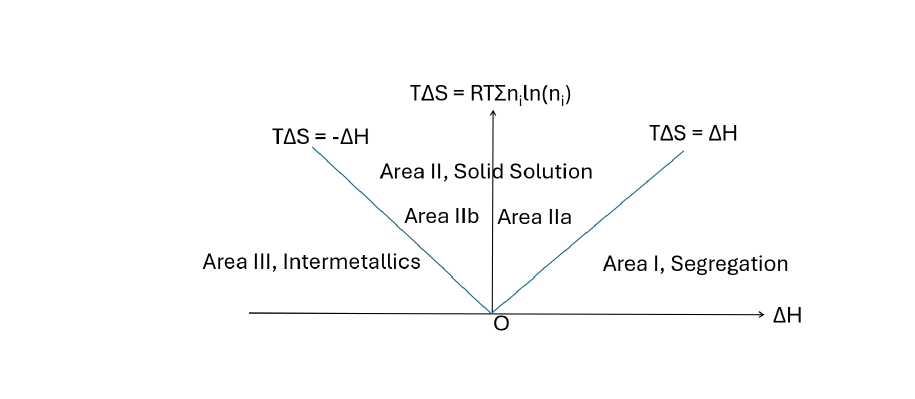
EED contains a whole horizontal enthalpy (ΔH) and an upper
half longitudinal entropy-energy (TΔS) coordinates in the upper
half coordinate plane (Figure 1). The plane is derived from the
thermodynamic Gibbs function (ΔG) that contains a chemical heat
function of enthalpy and a minus physical entropy term, gives
the famous equation of ΔG=ΔH-TΔS. The reason for choosing the
upper half TΔS is due to the positive term itself by the second
law of thermodynamics. At low temperatures T and low ΔS, this
physical term is usually neglected as compared with the enthalpy
term. One knows that reactions before and after with positive,
zero, and negative values of ΔH respectively stand for reluctant,
reversible, and spontaneous processes, meaning that one should
add energy to a reaction or not in order to guarantee a process
to be forward. In general, the condition for a reversible process
is ΔG=ΔH-TΔS = 0. If constructs a TΔS-ΔH plane, then one has two
areas in the first quadrant, one satisfies ΔH>TΔS>0, designated as
Area 1, the other ΔH
Some words to the properties of crystalline phases in HEAs are given here. Experiments show the phases are commonly body- & face-centered cubic (BCC & FCC), and hexagonal close-packed (HCP) structures with smaller X-ray Diffractometry (XRD) peaks as compared to those of the conventional one- or less-principalcomponent alloys. A concept of Pseudo-Unitary Lattice (PUL), which consists of all component elements in a single lattice, has been proposed to explain the so-called four (three plus one) effects of sluggish diffusion, largely distortion, and cocktail effect in HEAs due to a multicomponent atom-accompanied diffusion, possible large sized difference of component atoms in the single lattice, and composed components in the characteristic single lattice, respectively, as well as the high solubility high-entropy effect just discussed above. Much mechanical, electrochemical, and physical properties as well as electrical, magnetic, superconductive, thin film, hydrogen absorption and desorption properties have been explosively explored [3,4]. By the way, from the results of Fermi energy detection, HEAs are metallic [4].
References
- Swe-Kai Chen (2012) Electrochemical passive properties of AlxCoCrFeNi (x = 0, 0.25, 0.50, 1.00) high-entropy alloys in sulfuric acids. In: Shih H (Ed.), Corrosion Resistance, InTech, Croatia, pp. 133-156.
- (a) Swe-Kai Chen (2005) Materials technology Hsinchu Conference between two Tsing Hua Universities across Beijing and Hsinchu. (b) Swe-Kai Chen, Po-Han Lee, Chuang-Hsiung Lin (2017) AlCoCrFeNiTi and its equal-molar five-component alloys in a metal mixological enthalpy-entropy plane. Quarterly Physics Review 3(1): 1-28.
- Yih-Farn Kao, Swe-Kai Chen, Jen-Faur Sheu, Jiun-Ting Lin, Wei-En Lin, et al. (2010) International Journal of Hydrogen Energy 35: 9046-9059.
- Hsuan-Ping Chou, Yee-Shyi Chang, Swe-Kai Chen, Jien-Wei Yeh (2009) Microstructure, thermophysical and electrical properties in AlCoCrFeNi (0≤x≤2) high-entropy alloys. Materials Science and Engineering B 163: 184-189.
© 2026 © Swe-Kai Chen. This is an open access article distributed under the terms of the Creative Commons Attribution License , which permits unrestricted use, distribution, and build upon your work non-commercially.
Editor In Chief







.jpg)































Signup for Newsletter

Quick Links
 Editorial Board Registrations
 Submit your Article
 Best Paper of the Volume
 Reprints
 Refer a Friend
 Advertise With Us
Our Recent Edition

.jpg)



Top Editors




.jpg)

















.bmp)
.jpg)
.png)
.jpg)













.jpg)






.png)

.png)




.png)




Financial Support

Sponsors

Latest e-Books

Latest Video

 a Creative Commons Attribution 4.0 International License. Based on a work at www.crimsonpublishers.com.
Best viewed in
a Creative Commons Attribution 4.0 International License. Based on a work at www.crimsonpublishers.com.
Best viewed in 
 | Above IE 9.0 version