

- About Us
- Information
-

The Author ensures that the research has been conducted responsibly and ethically with adherence to all relevant regulations. read more..
- For Authors
- For Reviewer
- Manuscript Guidelines
- Membership
- Publication Ethics
-
- Journals
- Reprints
- e-Books
- Videos
- Policies
- Contact Us
 COVID-19
- Submissions



Full Text
Research & Development in Material Science
Impact of Current Densities on Zn-Fe Alloy Electro Deposit from Acetate Electrolytic Bath
Selvaraju V1 and Thangaraj V2*
1 Puratchi Thalaivi Amma Government Arts and Science college, India
2 Department of Chemistry, University College of Engineering, BIT Campus, Anna University, India
*Corresponding author:Thangaraj V, Department of Chemistry, University College of Engineering, BIT Campus, Anna University, India
Submission: June 22, 2026;Published: July 13, 2026

ISSN: 2576-8840 Volume 23 Issue 1
Abstract
The alloy electrodeposit of zinc with iron alloy on mild steel under various current density ranges from 1.0A/dm2 to 5.0A/dm2 using acetate electrolytic bath. The composition of the iron and corrosion resistance of the alloy electrodeposit was influenced by current densities. The corrosion rate of the Zn-Fe alloy deposit was observed using potentiodynamic Tafel polarization, Electrochemical Impedance Spectroscopy (EIS) in 3.5% NaCl solution at room temperature. It confirms that the Zn-Fe alloy deposit obtained at optimized current density 4.0A/dm2 shown the lowest corrosion rate value 9.42mpy. The plate-like morphology of the deposit was observed at optimized current density by a Scanning Electron Microscope (SEM). X-ray Diffraction (XRD) analysis and EDAX confirm the presence of high intensity (103) plane and iron composition in the Zn-Fe alloy deposit at optimized current density is 4.0A/dm2.
Keywords: Alloy electrodeposit; Corrosion rate; Current density; Mild steel
Introduction
Ferrous and its alloys possess prominent applications in all fields from the basic essential agricultural gadget to advanced types of materials production such as air crafts, automotive, railways, light, heavy machinery, shipping transportation, building, bridge construction, machines in daily life, architecture, structural applications, energy generation industry. It may not be possible to move ahead without ferrous metal and its alloys. As far as corrosion is the very important problem in the ferrous materials regarding the prolonged time of usage. Almost all metal and alloys are affected by corrosion due to nature and mode of preparation and its application environment [1-3]. Iron-based materials widely used in industries are severely affected by corrosion and cause several problems in the materials used in the industry. So, the protection of iron-based equipment is very crucial important [4]. Every year an enormous amount of money is spent in industry to replace damaged iron. Early the single metallic galvanized coating of zinc gives the corrosion resistance for iron-based materials, but the single metallic zinc coating exposed for a prolonged time at the severe environment hugely depleted from the coated surface of the ferrous substrate. So the protection of iron-based materials from the corrosion are important and also to meet this encountered problem the alloy electroplating of zinc with iron group metal (Ni, Co, Fe), are concentrated mostly due to the alloying of zinc with noble metal have industrial significance and increase the service life of sacrificial action of zinc [5].The current density controls the properties and chemical composition of Zn-Fe alloy electrodeposit and the composition of iron with less than one percentage is enough to get the desired functional properties than the single galvanized protection of zinc [6,7]. Alloying of zinc with iron group metals follow the anomalous mechanism that is less noble metal preferentially deposited than a more noble one. In Zn-Fe alloy deposit zinc preferentially deposited than iron which is noble one compared with zinc The corrosion rate of the deposit not only depending upon the plating parameters, it also influenced by the percentage composition of the noble element, phase and morphology of the alloy deposit on the substrate. Among zinc-iron group alloy, the Zn-Fe alloy deposit provides three times higher corrosion resistance when compared to pure zinc deposits due to the nature of Zn-Fe phase structure of the alloy formed [8]. Zn-Fe alloy electrodeposited from various electrolytic baths such as sulfate, cyanide, alkaline, and chloride baths but the Zn-Fe alloy deposit obtained from acetate bath was very limited. Zn-Fe alloy with 10-15 percentage of iron was reported from acidic sulfate and chloride bath and no report was found in acetate bath with less than 10% of iron in the deposit [9,10]. In these studies, the focus was given to develop a new electrolytic acetate bath for the deposition of Zn-Fe alloy deposit on the surface of substrate and the zinc-iron alloy electrodeposit considered as a promising costeffective materials compare to Zn-Ni alloy electrodeposit. Here the mild steel surface was modified by electrochemical deposition by using acetate electrolytic bath and all the bath parameters were optimized using the Hull cell experiment to get uniform and bright deposition. The morphology, composition, phase and corrosion resistance was characterized by SEM, EDX, XRD, and Potentiodynamic Tafel polarization technique and EIS.
Experimental
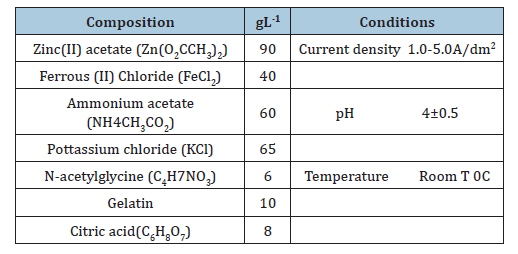
An electrolytic bath for Zn-Fe alloy deposition was optimized by using a standard 267ml Hull cell for 10 min at applied current density 1.0-5.0A/dm2 shown in Table 1. Prior to the plating the substrate was pre-polished mechanically by using sandpaper of 800, 1000, 1200 successive grits as well as the samples were degreased in acetone with soaked cotton for 30 seconds and followed by electrochemical cleaning for 2 min to ensure the presence of bright finish then clean water rinse, and finally dipped in 30% HCl for 60s to activate the substrate surface and followed by rinsing with double distilled water and immediately the substrate was immersed in a plating bath for alloy deposition using the pretreated substrate as a cathode and zinc as an anode at various current density was applied by using a DC regulated power supply, at room temperature.
Table 1:Bath composition of Zn-Fe alloy deposit.
Cathodic current efficiency (CCE) AND Throwing Power (TP)
A Haring-Blum cell was used to find out the throwing power of the solution at various current densities from 1.0A/dm2 to 5.0A/ dm2. The deposition was carried out for 10 min and two mild steel cathodes positioned at a distance ratio of 1:5 from the zinc anode were maintained for all current densities applied for the deposit. From the weight of the deposits obtained at the near and far cathodes, the Throwing Power (TP) was calculated using the Field’s formula presented in Eq.1 [11] by measuring the ratio of the differences in the distance and weight of the alloy deposited at the near and far cathode and the cathode current efficiency of the electrolyte was determined from the initial and final weight of the deposits using the Eq.2 [12].

Characterization techniques
The corrosion properties of the deposits were studied by means of Tafel extrapolation technique using potentiostat/galvanostat electrochemical analyzer and XRD measurement studies with a diffractometer BRUKER ECO D8 ADVANCE using monochromatized Cu Kα radiation. The surface texture of the deposited films was studied using a scanning electron microscope (Zeiss model) and the elemental composition was confirmed by EDX (OXFORD instrument).
Results and Discussion
Effect of current density and temperature
Figure 1(a) shows at high current density the percentage of iron in the deposit was increased compared to the deposit obtained at low current density. The deposit obtained at current density 4.0A/ dm2 have bright in nature and the deposit obtained with blistering in nature when increasing current density beyond 4.0A/dm2 due to increasing of iron percentage in the deposit which was resembled with the previous report of [13]. The electrolytic bath temperature also changes the quality of the deposit, from the Figure1(b) when the temperature have increased the percentage of iron content in deposit initially increased with bright nature up to 40 0C then decreased and the zinc content was increased it may be due to the rapid diffusion of zinc towards the cathode. The deposit was found to be dull at high temperature due to excess of Zn in the deposit.
Cathodic current efficiency and throwing power
From Figure 1(c) and Table 2 Cathodic Current Efficiency (CCE), throwing power and the percentage of iron in the deposit was increased with the current density up to 4.0A/dm2 and decrease with further increase of current densities due to the blistering and powdery deposits. The decrease in the current efficiency, throwing power and the percentage of iron content in the deposits at higher current density can be attributed to the hydrogen evolution reaction. Here, the ability of the solution for the uniform deposition is decreases and the brittleness of the deposit occurred at higher current density. The maximum throwing power and CCE were found to be 39.1% and 92.6% at the optimized current density of 4.0A/dm2.
Figure 1:Effect of (a) Current density on iron percentage (b)Temperature and (c) CCE and throwing power.
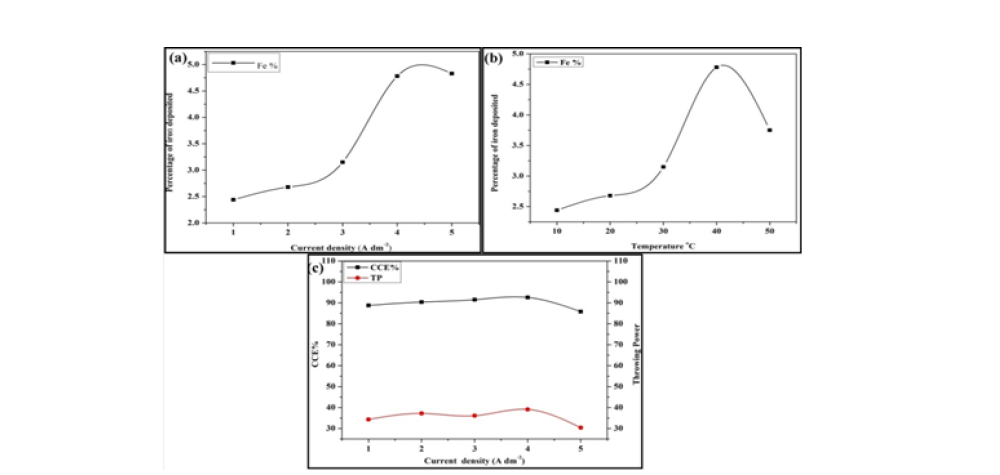
Table 2:Effect of Current density on Fe Percentage, CCE and TP of Zn-Fe deposit obtained at various current densities 1.0-5.0A/dm2.

Hardness studies
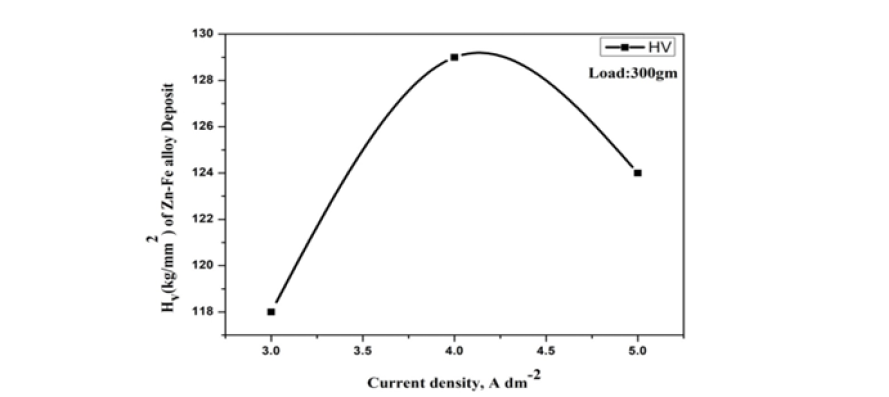
Hardness properties of Zn-Fe alloy deposits were studied to evaluate hardness of the coatings. Figure 2 shows the effect of hardness on Zn-Fe alloy electrodeposited on different current densities. The hardness of deposit was increased with the current density and it decreases at high current density due to the brittleness of the deposit.
Figure 2:Vickers hardness of the Zn-Fe alloy electrodeposit at Current density 3.0-5.0 A/dm2.
Corrosion behavior of the deposits
Figure 3a(a-f) shows the Tafel extrapolation and electrochemical impedance studies of Zn-Fe alloy deposition carried out in a 3.5% NaCl solution. It is seen from the Figure 3a that the potential was shifted more negatively than that of the bare steel of -0.942V which confirms that the deposited Zn-Fe alloys offer sacrificial protection and save the parent metal from the corrosion. The obtained results were a close resemblance to the studies of Bajat et al. [14]. From Table 3, it can be seen that the corrosion rate of the deposited Zn- Fe alloy was decreased with the increase of current density. Zn-Fe alloy deposited at 4.0A/dm2 offers good corrosion resistivity with the 4.78% of Fe in the deposit and it decreased with the increase of iron content in the deposit. High corrosion rate was observed at 5.0A/dm2 may be due to the hydrogen evolution with porosity nature of the deposit. The corrosion stability of the deposit not only depending on the plating parameters of the deposit is also influenced by the composition percentage of the noble element, phases and morphology formation of the alloy deposit on the substrate.
Figure 3:(a) Potentiodynamic Tafel polarization plot and (b) EIS of Zn-Fe alloy deposit.
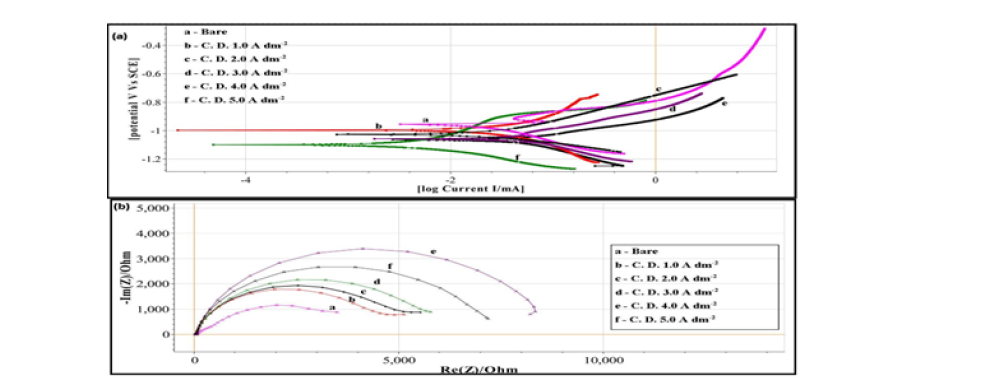
Table 3:Electrochemical corrosion data’s of Zn-Fe deposit obtained at different current densities.
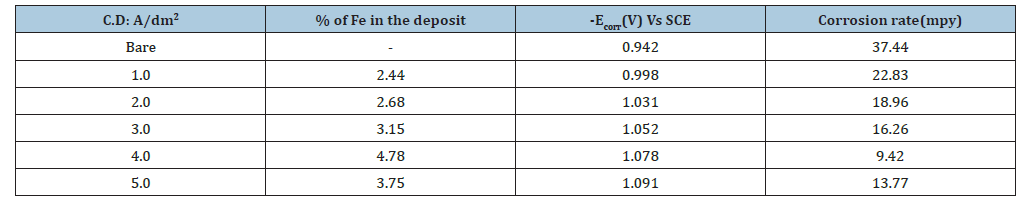
Corrosion potentials of all Zn-Fe alloys are very negative compared to the steel surface since there is only a little amount of Fe in an alloy. Zinc-iron alloy electrodeposits obtained at 4.0A/ dm2 shown better corrosion resistance with improved mechanical properties when compared to pure zinc coatings. EIS studies also confirmed that the Zn-Fe alloy deposited at 4.0A/dm2 shows better peak performances against corrosion which concluded as an optimized condition for the Zn-Fe alloy deposition 4.0A/dm2.
SEM, EDX and XRD Studies
The effect of different current densities on the morphology of the electrodeposited Zn-Fe alloys was studied and shown in Figure 4(a-c). It can be seen that the agglomeration of Zn-Fe grains and some crystalline structure were observed. It could be attributed to the gradual increase of iron content in the deposits with the increase of current density. Furthermore, the feather and flake like structure represent the different stages of Zn-Fe alloy deposit process. It may be concluded that when the percentage of iron content in deposit varied, the shape and structure of alloy deposit were also changed. All the structures reflected the high compactness of the deposit. Elemental analysis of Zn-Fe alloy deposits was carried out by EDX analysis shown in Figure 4(d-f).
Figure 4:SEM images (a-c) and EDX analysis (d-f) of the Zn-Fe alloy deposits.
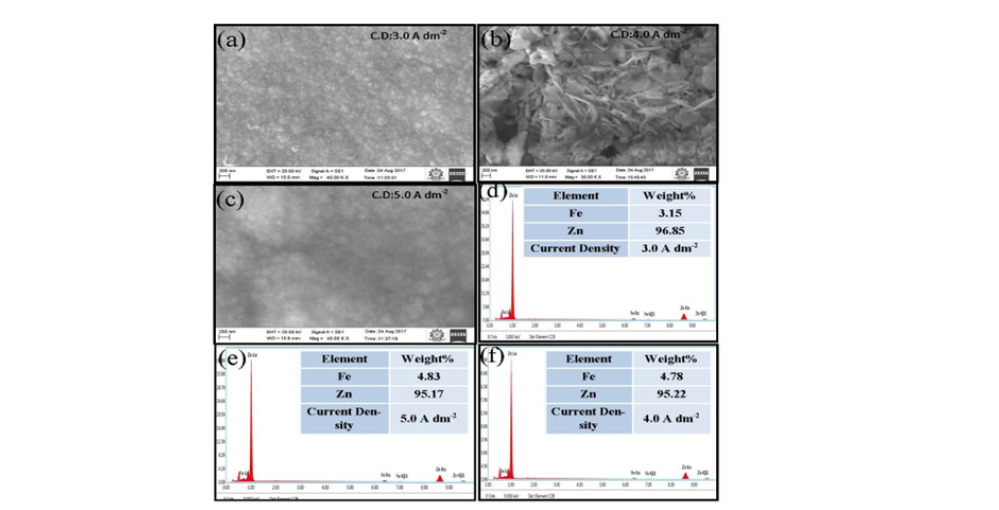
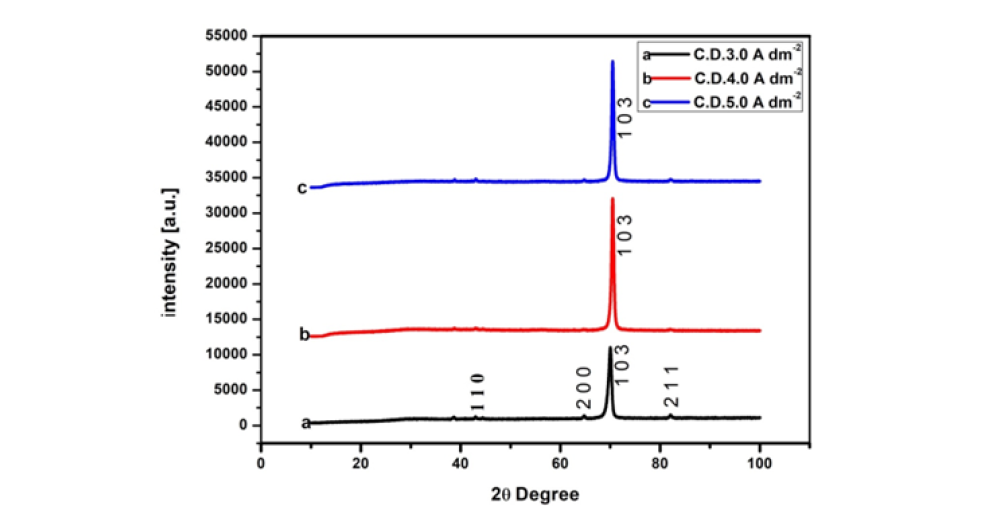
The weight percentage of Fe in the deposit increases with the current density and it is high in the case of alloy deposited at 5.0A/dm2. XRD pattern of Zn-Fe alloy deposits shown in Figure 5 indicates that the peak intensity of the Zn-Fe deposit increases with the current density and the deposit obtained at current density 4.0A/dm2 shows high-intensity peak corresponding to Zn with the preferred orientation of (103) which are matched with reference Pattern No. 00-045-1184. This is due to the unique phase structure of the alloy formed with lower iron content (<10% Fe). The entire XRD pattern shows the peak corresponding to the ‘η’ phase of Zn-Fe alloy deposition and results highly reflect the results of Kanagasabapathi et al. [15]. From measuring peak intensity and its corresponding full width half maximum (FWHM) value of XRD peak of Zn-Fe alloy deposit, the average crystallite size of Zn-Fe alloy is 189nm was calculated using Scherrer formula.
Figure 5:XRD analyses of the Zn-Fe alloy deposits.
Conclusion
The Zn-Fe alloy deposition was carried out at various current density ranges and kept the temperature, pH and all other bath parameters as constant. The deposit obtained at 4.0A/dm2 shows the bright deposition with 4.78% of iron in the deposit. The lowest corrosion rate of 9.42mpy with the highest corrosion resistance and a homogeneous, coherent with high intensity (103) orientation of single-phase Zn-Fe alloy deposit were obtained at optimized current density 4.0A/dm2 at room temperature. The average crystallite size of the deposit is 189nm was obtained. Zn-Fe alloys deposited at high current density appeared as non-uniform, brittle and powdered deposits around the edges of the samples. Furthermore, it is concluded that the Zn-Fe alloy deposited in acetate bath at 4.0A/dm2 is the best suitable alternative corrosion resistant alloy deposit for ferrous-based materials.
References
- Kosugi D, Hagio T, Kamimoto Y, Ichino R (2017) Effect of the addition of molybdenum on the structure and corrosion resistance of zinc - iron plating. Coatings 7: 235.
- Zhang Z, Leng WH, Li JF, Zhang JQ, Wang JM, Cao CN (2002) Cooperation behavior of iron and phosphorus in electrodeposition of zinc - iron - phosphorus coating. Materials Chemistry and Physics 77: 497-500.
- Gomez E, Pelaez E, Valles E (1999) Electrodeposition of zinc + iron alloys I. Analysis of the initial stages of the anomalous code position. Journal of Electroanalytical Chemistry 469: 139-149.
- Yu S, Liu L (2017) Zn-Fe and Zn-Fe-Y cementation coatings for enhancing corrosion resistance of steel. International Journal of Electrochemical Science 12: 4782-4794.
- Hegde AC, Venkatakrishna K, Eliaz N (2010) Electrodeposition of Zn-Ni, Zn-Fe and Zn-Ni-Fe alloys. Surface and Coatings Technology 205: 2031-2041.
- Panagopoulos CN, Georgion EP, Agathocleous PE, Giannakopoulos KI (2009) Mechanical behavior of Zn-Fe alloy coated mild steel. Material and Design 30: 4267-4272.
- Roshanghias A, Sohi MH (2012) The effects of pulse plating variables on morphology and corrosion behavior of Zn-Fe alloy coatings. Journal of Coatings Technology and Research 9: 215-218.
- Brenner A (1963) Electrodeposition of alloys. Academic Press, New York, USA 2: 194.
- Jensen JD, Critchlow GW, Gabe DR (1998) A study on zinc-iron alloy electrodeposition from a chloride-electrolyte. Transactions of the Institution of Metal Finishing 76: 187-191.
- Amirat S, Rehamnia R, Bordes M, Creus J (2011) Zn - Fe alloy electrodeposition from chloride bath: Influence of deposition parameters on coatings morphology and structure. Materials and Corrosion 64(4): 1-7.
- Ravindran V, Muralidharan VS (2007) Zinc-nickel alloy electrodeposition - influence of triethanolamine. Portugaliae Electrochimica Acta 25: 391-399.
- Shivakumara S, Manohar U, Arthoba Naik Y, Venkatesha TV (2007) Influence of additives on electrodeposition of bright Zn-Ni alloy on mild steel from acid sulphate bath. Bulletin of Materials Science 30: 455-462.
- Bhat R, Udaya BK, Hegde AC (2011) Optimization of deposition conditions for bright Zn - Fe coatings and its characterization. Protection of Metals and Physical Chemistry of Surfaces 47: 645-653.
- Bajat JB, Kovi VBMI, Maksimovi MD (2004) Electrochemical deposition and characterization of Zn - Fe alloys. Journal of the Serbian Chemical Society 69: 807-815.
- Kanagasabapathy M, Jayakrishnan S (2011) Textural and morphological studies on zinc-iron alloy electrodeposits. Journal of Chemical Sciences 123: 357-364.
© 2026 © Thangaraj V. This is an open access article distributed under the terms of the Creative Commons Attribution License , which permits unrestricted use, distribution, and build upon your work non-commercially.
Editor In Chief







.jpg)































Signup for Newsletter

Quick Links
 Editorial Board Registrations
 Submit your Article
 Best Paper of the Volume
 Reprints
 Refer a Friend
 Advertise With Us
Our Recent Edition

.jpg)



Top Editors




.jpg)

















.bmp)
.jpg)
.png)
.jpg)













.jpg)






.png)

.png)




.png)




Financial Support

Sponsors

Latest e-Books

Latest Video

 a Creative Commons Attribution 4.0 International License. Based on a work at www.crimsonpublishers.com.
Best viewed in
a Creative Commons Attribution 4.0 International License. Based on a work at www.crimsonpublishers.com.
Best viewed in 
 | Above IE 9.0 version