

- About Us
- Information
-

The Author ensures that the research has been conducted responsibly and ethically with adherence to all relevant regulations. read more..
- For Authors
- For Reviewer
- Manuscript Guidelines
- Membership
- Publication Ethics
-
- Journals
- Reprints
- e-Books
- Videos
- Policies
- Contact Us
 COVID-19
- Submissions



Full Text
Research & Development in Material Science
Ultraviolet and the Ozone Layer of the Atmosphere
Vadim V Gordienko1*, Lyudmila Ya Gordienko1, Yana A Goncharova2 and Viktor N Tarasov1
1 S.I. Subbotin Institute of Geophysics, National Academy of Sciences of Ukraine, Ukraine
2 V.K. Gusak Institute of Emergency and Reconstructive Surgery, National Academy of Medical Sciences of Ukraine, Ukraine
*Corresponding author:Vadim V Gordienko, S.I. Subbotin Institute of Geophysics, National Academy of Sciences of Ukraine, Kyiv, Ukraine
Submission: June 12, 2026;Published: July 08, 2026

ISSN: 2576-8840 Volume 23 Issue 1
Abstract
This study examines the formation of the ozone layer (OL) in the Earth’s atmosphere and the physical mechanisms governing the attenuation of ultraviolet (UV) radiation reaching the Earth’s surface. The analysis suggests that the contribution of stratospheric ozone to the reduction of short-wave solar radiation may be smaller than is commonly assumed, while acknowledging that ultraviolet radiation also exerts a range of beneficial biological effects. Ozone is produced under the action of solar ultraviolet radiation below the ionosphere through the dissociation of atmospheric oxygen molecules. Its longest lifetime corresponds to the minimum temperature zone, leading to ozone accumulation above the tropopause and the formation of the observed ozone layer. The total atmospheric ozone content is extremely small, on the order of 10⁻⁶ relative to the total mass of air, which constrains its overall contribution to ultraviolet absorption. In contrast, molecular scattering by air provides substantial attenuation of ultraviolet radiation, despite the lower energy exchange in scattering events compared with absorption. Ozone depletion is commonly attributed to reactions involving halogen-containing compounds of both anthropogenic and natural origin, as well as to interactions with hydrogen predominantly generated within the atmosphere. Variations in ozone layer thickness, including the seasonal formation of so-called “ozone holes,” are shown to be consistent with natural processes and do not imply enhanced ultraviolet exposure at the Earth’s surface. The effectiveness of current mitigation strategies aimed at stratospheric ozone preservation, therefore, warrants reassessment. At the same time, increases in ground-level ozone are clearly linked to industrial activity and urban air pollution. In many developed regions, concentrations of this toxic gas periodically exceed recommended exposure limits, underscoring the need for targeted measures to control tropospheric ozone.
Keywords: Ozone layer; Ultraviolet radiation; Oxygen; Hydrogen; Molecular scattering
Introduction
Ozone is a minor constituent of the Earth’s atmosphere, accounting for approximately 10⁻⁶-10⁻⁵% of its total volume. Its total mass is estimated at about 3×10⁹ tons, corresponding to only 0.64×10⁻⁶ of the atmospheric mass. Ozone is concentrated within a layer approximately 20km thick, with about 90% located in the stratosphere at altitudes between 10 and 50km. The maximum ozone concentration occurs at altitudes of 26-27km in the tropics, 20-21km in the midlatitudes, and 15-17km in the polar regions. The average lifetime of an ozone molecule in regions of maximum concentration is estimated to be 0.5-3 months.
The ionosphere is located well above the ozone layer. The lower boundary of the ionosphere defined as the region characterized by high concentrations of free electrons and ionization of atmospheric gases is generally considered to be at altitudes of approximately 50±5km above sea level. At these altitudes and above, the intensity of ultraviolet (UV) radiation, together with contributions from X-rays and cosmic rays, is sufficient to ionize not only oxygen but also nitrogen, hydrogen, carbon dioxide, and other atmospheric constituents. Ultraviolet radiation spans wavelengths from 100 to 400nm and is conventionally divided into three spectral regions: UV-A (320-400nm), UV-B (280-320nm; in some studies, the upper limit is given as 320±5nm), and UV-C (100-280nm). As solar radiation passes through the atmosphere, essentially all UV-C radiation and approximately 80-90% of UV-B radiation are absorbed. The atmosphere has a substantially weaker attenuating effect on UV-A radiation, which is primarily reduced near the Earth’s surface due to molecular scattering. As noted [1], “both scattering and absorption remove energy from a light beam… and the beam experiences attenuation. In a non-absorbing medium, scattering is the only attenuation process.”
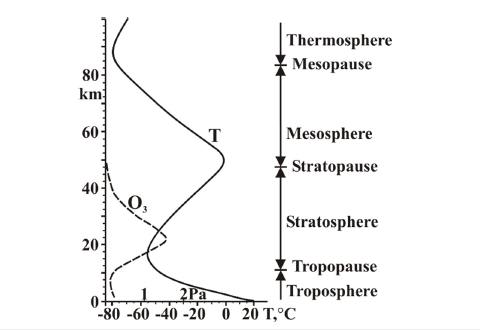
The concept that the ozone layer protects the Earth’s surface from solar ultraviolet radiation emerged in the early 1920s following the identification of a temperature increase in the stratosphere. G. M. B. Dobson suggested that this temperature anomaly was associated with the absorption of solar radiation by ozone [2]. However, observations indicate that the positive temperature anomaly is located primarily at altitudes of approximately 35- 55km, where ozone concentrations are extremely low, whereas the ozone layer itself is confined to the region of minimum atmospheric temperature [3]; (Figure 1).
Given the extremely low concentration of ozone, it is difficult to assume that it could significantly increase the temperature of the surrounding air, whose mass exceeds that of ozone by several orders of magnitude. This is consistent with the chemical instability of the O₃ molecule: at sufficiently high concentrations under normal conditions, ozone decomposes spontaneously within tens of minutes, converting to O₂ with the release of heat. Increasing temperature and decreasing pressure further accelerate this transition to the diatomic state [4]. The observed positive temperature anomaly is therefore more plausibly associated with dissociation and ionization processes affecting atmospheric molecules in the ionosphere and adjacent upper-atmospheric layers. The comparison shown in Figure 1 illustrates that a region responsible for absorbing the majority of UV radiation and undergoing anomalous heating cannot coincide with a zone of negative temperature anomaly.
Figure 1:Vertical temperature distribution 1Liou, 1984] and mean annual partial pressure of ozone at midlatitudes [3].
Despite these considerations, the protective role of the ozone layer has gradually become widely accepted. Extensive investigations of ozone have been conducted in many countries [5]. Long-term observations have documented a reduction in ozone content over Antarctica [2,5]. [6] reported a decrease of approximately 40% in ozone concentration based on measurements at the Halley Bay station and interpreted this phenomenon as evidence of a large-scale ozone depletion. They attributed the observed decrease primarily to anthropogenic pollution by chlorofluorocarbons. Subsequent observations have been widely cited as visual confirmation of this interpretation (Figure 2); [7].
Figure 2:Meridional distributions of ozone and chlorine oxide concentrations at an altitude of approximately 18km along the Antarctic Peninsula in 1987: (A) August 23-September 9; (B) September 16-23. Also shown are seasonal variations in mean daily ozone content at the South Pole in 1987 (C) [3] and September UV-B irradiance as a function of southern latitude (D) [7]. V denotes the axial region of the annular stratospheric polar vortex.
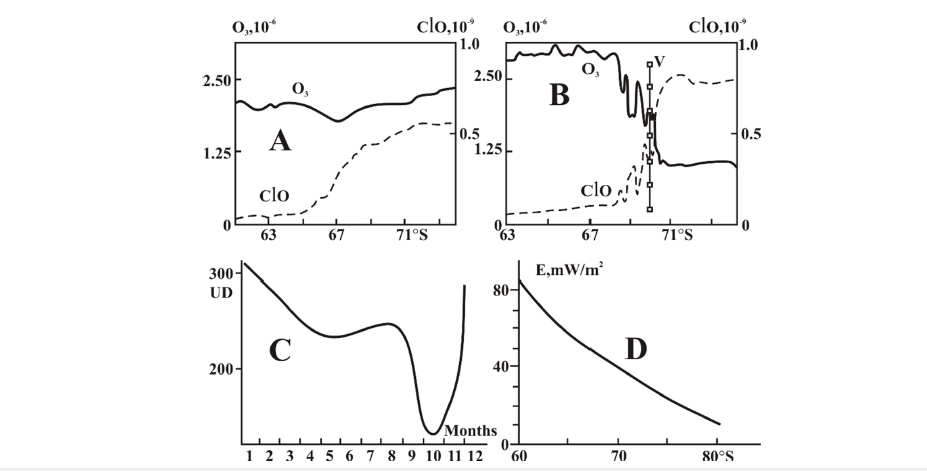
Figure 2A demonstrates that ozone concentrations may remain nearly unchanged despite a substantial increase in chlorine oxide concentration at the same altitude. In Figure 2B, anomalies in ozone and chlorine oxide appear to be correlated. However, it remains questionable whether a significant fraction of ozone molecules can be removed by chlorine monoxide particles that are three orders of magnitude less abundant, particularly under highly rarefied stratospheric conditions. Moreover, Figure 2B is often presented without noting that the sharp ozone decrease coincides spatially with the axial region of the annular stratospheric polar vortex, which inhibits ozone transport from surrounding regions after depletion during the polar night, when photochemical ozone production ceases due to the absence of solar radiation. Figure 2D further indicates that less ultraviolet radiation reaches the surface within the polar ozone “hole” than at lower latitudes beneath a more intense ozone layer. Near the pole, ozone is not replenished during the polar night because of the absence of UV radiation (Figure 2C). This combination of factors contributes to the formation of ozone minima. In contrast, in equatorial regions, where pronounced ozone holes are absent, and the average annual decrease does not exceed approximately 15%, the September UV-B irradiance reaches about 280mW m⁻², compared with only 30-40mW m⁻² beneath the Arctic ozone minimum.
These considerations highlight that the frequently stated thesis that “the ozone layer protects the Earth from deadly radiation” often neglects a quantitative evaluation of this protection under real atmospheric conditions, as well as the attenuation of UV radiation by other atmospheric gases whose concentrations are several orders of magnitude higher. Furthermore, if anthropogenic activity were the primary cause of ozone depletion, such effects would be manifest first in the Northern Hemisphere, where population density and industrial activity are greatest, rather than over the largely uninhabited Antarctic region. Alternative explanations, such as the hydrogen-based hypothesis [8], attribute ozone depletion to reactions involving geological hydrogen. However, this hypothesis also faces significant limitations.
Figure 3:Vertical distributions of ozone concentration [3] and molecular hydrogen concentration [10].
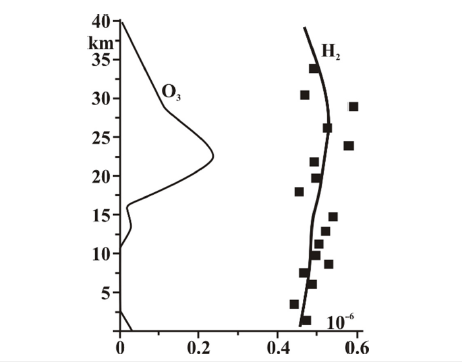
The atmospheric budget of molecular hydrogen (H₂) has been assessed in detail. The troposphere contains approximately 155±10 Tg (1Tg = 10¹²g) of hydrogen [9], with a renewal time of about two years and a flux into the stratosphere of approximately 2Tg yr⁻¹, balanced by a slightly smaller return flux. Geological hydrogen production is estimated at roughly 0.5Tg yr⁻¹, compared with an atmospheric production of about 77Tg yr⁻¹ [10]. A comparison of ozone and hydrogen distributions in the stratosphere (Figure 3) shows no discernible influence of prevailing hydrogen concentrations on ozone depletion.
Moreover, a substantial increase in stratospheric hydrogen concentrations appears highly improbable [11]. The hydrogen and halogen hypotheses of ozone depletion differ fundamentally in their temporal implications. Geological hydrogen has been produced throughout Earth’s history, whereas anthropogenic halogens entered the atmosphere only after the widespread use of industrial chemicals beginning in the mid-20th century. Another viewpoint attributes ozone depletion primarily to volcanic emissions of halogen-containing gases rather than anthropogenic sources, although this interpretation remains controversial.
Figure 4:Mean daily ground-level ozone concentrations in Minsk [5]. Horizontal lines indicate maximum permissible exposure limits.
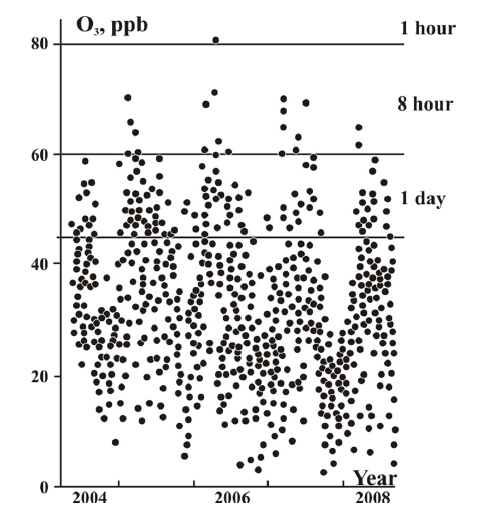
Finally, the biological effects of UV radiation and ozone warrant consideration because of their practical significance [3,5,7,12-14]. Although a substantial fraction of UV radiation reaches the Earth’s surface, it cannot be regarded as entirely harmful. UV-A radiation enhances plant productivity, while UV-B stimulates accelerated plant growth. In humans, UV exposure plays a beneficial role in vitamin D synthesis, promoting calcium accumulation and bone strength. Ultraviolet radiation is also applied therapeutically in the treatment of conditions such as rickets, psoriasis, eczema, and jaundice, although such treatments require careful medical supervision to balance potential benefits against risks. At the same time, excessive UV exposure has been shown to suppress immune responses, increasing susceptibility to certain infectious diseases. Studies comparing UV radiation levels with physiological response thresholds have established exposure guidelines for conditions in Ukraine (45-500 N). During the period from March to September, direct exposure is recommended to be limited to no more than three hours per day, including exposure through ordinary window glass. Chronic overexposure may lead to skin cancer and retinal damage. Ground-level ozone concentrations exceeding 8×10⁻⁸ are harmful to respiratory tissues in various organisms and are periodically observed during warm seasons, particularly at temperatures above 28 °C, in industrialized countries (Figure 4).
Pathological and anatomical studies of ozone poisoning reveal impaired blood coagulation and extensive pulmonary hemorrhage. The maximum allowable concentration of ozone in workplace air is set at 0.1mg m⁻³, approximately ten times the human olfactory threshold. When administered externally, enterally, or parenterally within therapeutic concentration ranges, ozone does not exhibit toxic effects on the human body.
The actual role of the ozone layer
Atmospheric ozone is formed as a result of solar ultraviolet radiation. More energetic UV photons ionize oxygen molecules and other atmospheric gases by removing an electron, whereas lowerenergy photons dissociate molecular oxygen into individual atoms. These atoms subsequently capture free electrons present in the atmosphere, forming negatively charged oxygen ions. Under the action of electrostatic forces, oppositely charged ions can attract each other, resulting in the formation of a neutral triatomic ozone molecule. Ozone formation occurs predominantly in atmospheric regions where UV-C radiation is present, that is, above the main ozone layer.
The vertical distribution of UV radiation intensity below the ionosphere for different wavelengths is shown schematically in Figure 5 (in smoothed form). Comparable distributions have been reported by various authors and exhibit only minor differences [2].
Figure 5:Absorption of ultraviolet radiation by the atmosphere [2], based on a scheme that assumes a dominant role of the ozone layer. The figure shows the spectral distribution of UV energy (in nm), averaged over the annual cycle and the Earth’s surface: (1) distribution in the upper atmosphere below the ionosphere; (2) distribution at the Earth’s surface (sea level); and (3) reduction of UV-B radiation attributed to absorption by the ozone layer.
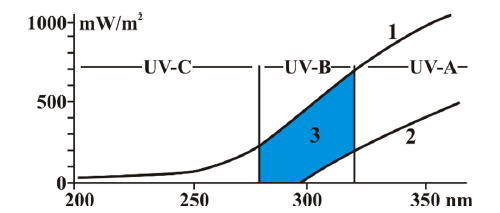
This frequently cited representation raises several questions. In particular, the attribution of UV-B attenuation entirely to ozone absorption is not self-evident. In the UV-A range, attenuation is caused by molecular scattering; it is unclear why this mechanism would cease to operate at slightly shorter wavelengths. Moreover, experimental data indicate that the absorption cross section of ozone decreases sharply within the UV-B range as wavelength increases [1].
Ionization of oxygen atoms requires UV radiation with wavelengths shorter than 100nm, whereas dissociation of molecular oxygen into individual atoms occurs at wavelengths shorter than approximately 243nm, corresponding to an energy expenditure of about 5.1eV. Consequently, ozone formation is possible over a broad altitude range extending from approximately 50-80km down to about 35km [15]. As noted [4], “molecular oxygen can dissociate under the influence of light or through collisions with electrons in an electric discharge… it is important to note that the reaction 3/2 O₂ → O₃ is endothermic, with an enthalpy of 142kJ mol⁻¹.” When expressed per molecule, this corresponds to an energy of 2.36×10⁻¹⁹J.
For a typical ozone column density of 300 Dobson units, the ozone layer contains approximately 8×10²² molecules per square meter of the Earth’s surface. The corresponding total stored energy is therefore about 1.9×10⁴J m⁻². This value is comparable to the UV energy required to dissociate the same number of ozone molecules, often interpreted as the “absorbed” energy. Estimates of ozone accumulation times reported in the literature vary widely, from several hours to several months. Under extreme conditions, such as at temperatures near -50 °C on ice surfaces, the minimum lifetime of an ozone molecule may be as short as approximately 1.2 hours [4], whereas in the absence of such contact, it is considerably longer. If ozone is produced in sufficient quantities above the main layer, its downward transport under conditions of descending atmospheric circulation cannot be excluded [16]. Given that an ozone molecule is approximately 1.6 times heavier than the mean air molecule, gravitational settling into the troposphere would be expected to occur relatively rapidly. However, observations indicate that a few kilometers below the center of the ozone layer, ozone concentrations are already negligible (Figure 1). Therefore, it is informative to consider observations of ozone persistence during the polar night, when photochemical production ceases, and replenishment by advection is minimal (conditions similar to those shown in Figure 2C). Reported estimates of the minimum persistence time under such conditions are on the order of two weeks [15].
Using these values, the maximum possible contribution of the ozone layer to UV absorption at the erythemal level can be estimated at approximately 10mW m⁻². The contribution of molecular scattering by ozone, given its actual atmospheric concentration, would be even smaller. The literature often cites strong ozone absorption in the Hartley band (220-290nm), identified under laboratory conditions [3]. However, UV radiation within this wavelength range does not penetrate below altitudes of approximately 34km [17], as it is absorbed at higher levels by molecular oxygen.
In the Schumann-Runge (170-200nm) and Herzberg (180- 240nm) bands, the dominant processes are the dissociation of oxygen molecules and electron detachment from atoms. These processes occur frequently, but only a small fraction of them contributes to ozone formation; the dominant effect is overall UV energy absorption by oxygen. In addition, nitrogen oxides, hydrogen, water vapor, and other atmospheric constituents significantly contribute to UV absorption at longer wavelengths [3]. As air density increases with decreasing altitude, attenuation due to molecular scattering becomes progressively more important.
The ozone layer is often assumed to absorb the majority of incoming UV-B radiation, on the order of 500-600mW m⁻². However, quantitative estimates indicate that it cannot account for such absorption levels. Detailed analyses of UV absorption in the atmosphere are [1] and [18]. Liou emphasized the dominant role of oxygen and nitrogen at wavelengths below 200nm and the pronounced influence of ozone between 200 and 300nm, attributing the latter primarily to the upper stratosphere and mesosphere. Friedman provided altitude-specific estimates for similar wavelength ranges and molecular species, placing the main ozone absorption region slightly below 40km.
This discrepancy is readily explained by historical limitations in observational data: at the time of these studies, the vertical structure of the ozone layer was not known with sufficient accuracy. It is now well established that only about 10% of the total ozone mass resides above 34km (Figure 1). Consequently, the overall contribution of the ozone layer to UV absorption at lower altitudes is limited. This conclusion, supported by simple quantitative estimates, has been noted previously by several authors [12,15,17]. Nevertheless, the potential danger associated with ozone layer depletion is widely recognized, leading to international agreements and the allocation of substantial financial resources amounting to billions of dollars to mitigate presumed risks.
Scattering of UV-B radiation by air
According to available data, at altitudes below 34km, solar radiation with wavelengths shorter than 280nm is absent. As shown in Figure 1, ozone concentrations at and above this altitude are negligible. Nevertheless, a substantial fraction of ultraviolet energy is attenuated. This attenuation may be partly attributed to scattering by air molecules, despite the fact that air density in the altitude range of 35-50km is approximately two orders of magnitude lower than below the ozone layer (0-20km). At wavelengths longer than 320nm, corresponding to the transition to the UV-A range, ozone effectively ceases to absorb radiation, as does molecular oxygen [3]. However, a pronounced reduction in UV energy from the upper atmosphere to the Earth’s surface persists up to wavelengths of approximately 400nm (Figure 5). This attenuation is most plausibly explained by molecular scattering. The magnitude of this effect increases with decreasing wavelength. As shown in Figure 5, the reduction in irradiance reaches approximately 66% at 360nm, 75% at 340nm, and 83% at 320nm. These observations confirm the conclusion [1] that the contribution of molecular scattering by air to UV attenuation increases as wavelength decreases. It is therefore reasonable to assume that this trend continues into the UV-B range.
Consequently, radiation with wavelengths slightly shorter than 300nm may fail to reach the Earth’s surface primarily due to scattering processes. In the wavelength interval from 300 to 280nm, the scattering effect increases by approximately 50% [15]. Taken together, these considerations suggest that molecular scattering alone may account for the observed attenuation of UV radiation from altitudes up to 34km.
A direct test of this hypothesis would require measurements of UV-B irradiance above and below the ozone layer. However, published experimental data is largely limited to the altitude range of 0-5km above sea level, with only rare exceptions [19-22]. In the relatively humid air of the Alps, UV-B irradiance increases on average by approximately 18% per 1000m of altitude up to elevations of 4-5km, with only minor discrepancies among studies. In the drier climate of the tropical Andes, this increase is approximately half as large. Numerous experiments have demonstrated that the enhancement of UV-B irradiance with altitude becomes more pronounced with increasing air humidity [23,24].
Considering that approximately 70% of the Earth’s surface is covered by oceans and that atmospheric water vapor concentrations are high in humid tropical regions, the alpine UV-B scattering coefficient at altitudes of several kilometers can be reasonably used to estimate the global mean increase in irradiance with altitude without significant overestimation. This conclusion is consistent with that of [19], who reported that “the high-altitude effect of global erythemal effective irradiation is 18% per 1000m.” Naturally, this effect should diminish with increasing altitude as air density decreases [24].
These data allow the following question to be formulated: to what extent does ground-level UV-B irradiance increase between sea level and altitudes of approximately 20-34km, corresponding to the lower boundary of the ozone layer? This can be conveniently evaluated in the wavelength range of 300-320nm, for which average annual global values of irradiance are available both in the upper atmosphere (approximately 570mW m⁻²) and at the Earth’s surface (approximately 110mW m⁻²; Figure 5). The surface value thus represents about 19% of the upper-atmospheric value.
Figure 6:Variation of air density with altitude above sea level [3].
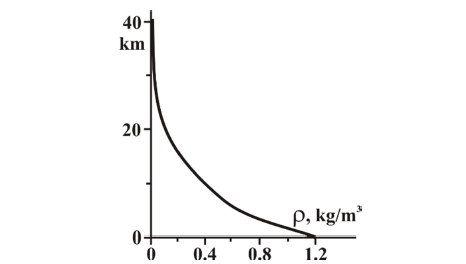
To estimate the vertical profile, the surface UV-B irradiance was adjusted, assuming an average increase of 18% per kilometer for the lowest 4km, as established experimentally, and accounting for the reduction in air density with altitude. The resulting estimates are shown in Figures 6 & 7.
Figure 7:Increase in UV-B irradiance with altitude. Crosses indicate estimates based on experimental data.
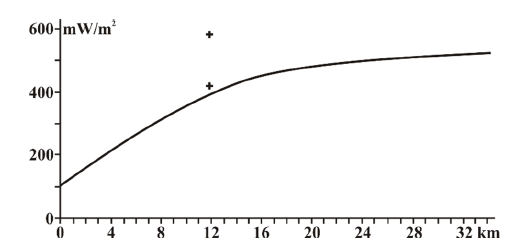
Although the calculations involve uncertainties, the fact that the estimated irradiance at an altitude of 34km differs from the observationally inferred value by only about 8% supports the assumption that attenuation traditionally attributed to the ozone layer can be largely explained by molecular scattering in air.
This conclusion is further supported by the limited high-altitude measurements available in the literature at an altitude of 12±0.5km [25,26]. These data were obtained during 11 long-duration NASA aircraft flights conducted at different times of day between airfields in the southern United States and over the Pacific Ocean. In the first study, carried out in August and October at a midlatitude of approximately 35° N, UV radiation in the wavelength range 200- 400nm was measured [25]. In the second study, conducted partly along the same flight paths, radiation in the range 310-1600nm was measured [26].
The first dataset is more informative for the present analysis. Figure 8 shows UV irradiance in the wavelength range 220-320nm at an altitude of 12km and a latitude of 35° N [25], recalculated to global annual mean values (Figures 9 & 10).
Figure 8:UV irradiance in the wavelength range 220-320 nm at an altitude of 12km and latitude 35° N [25], recalculated to global annual mean values.
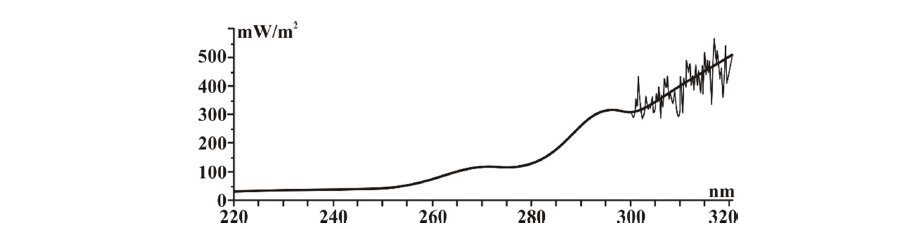
Figure 9:Comparison of August-October irradiance at 35° N with annual mean values [7].
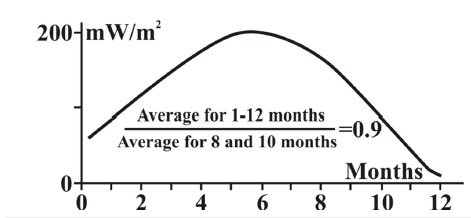
Figure 10:Comparison of irradiance at 35° N with global mean values [7].
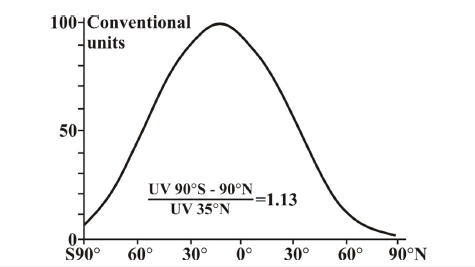
The average measured irradiance in the 300-320nm range is approximately 700mW m⁻². To obtain a daily mean value, nighttime periods without insolation must be taken into account. At this latitude in August and October, the duration of darkness is approximately 11 hours at the surface and about one hour shorter at 12km altitude. This yields a daily mean irradiance of approximately 405mW m⁻². According to Driscoll [7], the annual mean irradiance at 35° N is approximately 90% of the August- October value, resulting in an adjusted value of about 366mW m⁻² at 12km (Figure 9).
Recalculation to a global mean value yields approximately 417mW m⁻², which is in close agreement with the calculated profile (Figure 10).
For the second dataset [26], the average measured UV-B irradiance in the wavelength range 310-320nm is approximately 1000mW m⁻². Applying the same corrections as above yields an adjusted value of approximately 580mW m⁻². The difference between the two estimates reflects discrepancies in the original measurements. Preference may be given to the data of [26], who reported “excellent agreement … through a wavelength range of 300-1100nm, even though the instruments were optically and electronically dissimilar” (p. 345). If so, the experimental results closely match the UV-B irradiance shown in Figure 5, indicating that radiation levels typically attributed to the upper atmosphere are in fact observed below the ozone layer.
Overall, the derived UV-B irradiance values are suitable for comparison with the global averages shown in Figure 5 and demonstrate good agreement. While this analysis cannot replace a comprehensive experimental investigation of UV radiation across a broad range of altitudes, particularly below the ozone layer it provides independent support for the conclusion that the role of the ozone layer in shielding the Earth’s surface from UV radiation is minimal.
A separate consideration concerns the role of ozone in absorbing UV energy in the Hartley band (220-290nm). It has been stated that “the attenuation of solar radiation in the Earth’s atmosphere is determined by ozone absorption in the Hartley band” [3]. However, Figures 5 & 8 show that radiation in the range 220-250nm is already absent immediately below the ionosphere and, consequently, also at 12km altitude beneath the ozone layer. In the range 250- 290nm, the mean irradiance at 12km is approximately 100mW m⁻², compared with about 180mW m⁻² below the ionosphere. Yet the attenuation due to molecular scattering over the altitude interval from 12 to 34km (Figure 7) exceeds 100mW m⁻², leaving no discernible contribution attributable to ozone absorption.
Based on the two experimental datasets, the UV-B irradiance at wavelengths near 310nm can be estimated as 500±80mW m⁻², which is close to the value shown in Figure 5 (570mW m⁻²). An important feature of the analyses by [25] and [26] is that the measured radiation at 12km altitude appears to originate directly from the upper atmosphere, separated from the observation level only by a column of air. No distinct effect of the ozone layer is evident.
In contrast, attenuation due to the air itself is clearly observed, even though only about 20% of the atmospheric mass lies above 12km. To obtain comparable irradiance values throughout the day, substantial corrections must be applied to account for changes in solar zenith angle, which alter the atmospheric path length by up to a factor of six. After applying these corrections, the resulting spectral distribution of irradiance remains consistent with earlier measurements, with only minor variations, and shows no detectable influence of the ozone layer.
Conclusion
The data presented in this study allow a fundamentally different perspective on the role of the ozone layer and the associated perception of ultraviolet radiation as a major threat to the Earth’s surface. To a large extent, the prevailing concept of ozone-layer protection and its depletion is based on indirect evidence rather than on direct experimental verification of the vertical distribution of UV spectral composition and intensity across the ozone layer.
A decisive test of this concept would require systematic measurements of UV irradiance and spectral composition along a vertical atmospheric profile crossing the ozone layer. However, the authors were unable to identify published experimental datasets of this type. Given that substantial international resources have been devoted to the implementation of the Vienna Convention and the Montreal, London, and subsequent protocols [3], the absence of such direct experimental validation appears noteworthy.
In the absence of comprehensive vertical measurements, the present analysis necessarily relies on limited but diverse observational data. Nevertheless, the resulting estimates show internal consistency and good agreement with available global irradiance values. Within this framework, the results indicate that the ozone layer does not play a dominant role in shielding the Earth’s surface from solar ultraviolet radiation. Explanations emphasizing ozone absorption as the primary controlling factor appear less robust, as they rely largely on the acceptance of longstanding assumptions rather than on direct experimental testing.
At the same time, it should be emphasized that increases in ground-level ozone concentrations although negligible in a global context are clearly anthropogenic in origin, are spatially concentrated in industrial regions and large urban areas, and represent a well-documented toxic hazard. From this perspective, efforts aimed at reducing tropospheric ozone remain fully justified on environmental and public health grounds.
References
- Liou KN (1984) Fundamentals of radiation processes in the atmosphere. Gidrometeoizdat, Leningrad, p. 372.
- Khotuntsev Yu (2002) Ecology and environmental safety. Acalemy, Moscow, Russia, p. 480.
- Aleksandrov EL, Israel YuA, Karol IL, Khrgian AKh (1992) Earth’s ozone shield and its changes. Gidrometeoizdat, St. Petersburg, Russia, p. 288
- Lunin VV, Popovich MP, Tkachenko SN (1998) Physical chemistry of ozone. Moscow State University Press, Moscow, Russia, p. 480.
- Monitoring of the ozone layer. National environmental monitoring system of the Republic of Belarus: Observation results for 2013. Kuzmin SI (Ed.), (2014) BelNIC Ecology, Minsk, Belarus, pp: 190-199.
- Farman JC, Gardiner BG, Shanklin JD (1985) Large losses of total ozone in Antarctica reveal seasonal ClOx/NOx interaction. Nature 315: 207-210.
- Driscoll C (1992) Solar UV trends and distributions. National radiological protection board bulletin 137: 7-13.
- Syvorotkin VL (2013) Ozone methodology for studying hydrogen degassing of the Earth. Prostranstvo I Vremya 4(1).
- Pieterse G (2012) Modelling the global tropospheric molecular hydrogen cycle, Utrecht University, Netherlands, p. 198.
- Ehhalt DH, Rohwer F (2009) The tropospheric cycle of H2: A critical review. Tellus B: Chemical and Physical Meteorology 61(3): 500-535.
- Gordienko VV (2021) On the circulation of hydrogen in the atmosphere and the Earth’s crust. Geophysical Journal 43(5): 35-59.
- Druzyak NG (2020) How to prolong a fleeting life. Online book.
- (2005) Air quality criteria for ozone and related photochemical oxidants (second external review draft). National Service Center for Environmental Publications (NSCEP).
- (1994) Environmental Health Criteria 160. Ultraviolet radiation. World Health Organization, Geneva, Switzerland, p. 353.
- Golovchenko I, Druzyak N (1989) Does the ozone layer protect us? Chemistry and Life 1: 29-30.
- Volodin E, Mortikov E, Kostrykin S, Galin V, Lykosov V, et al. (2017) Simulation of modern climate with the new version of the INM RAS climate model. Izvestiya, Atmospheric and Oceanic Physics 53: 142-155.
- Chugunov NI (2010) The ozone layer and the myth of danger from space. Chemistry and Chemis 1: 247-252.
- Friedman H (1960) The Sun’s ionizing radiation. In: Ratcliffe J. (Ed.), Physics of the Upper Atmosphere. Academic Press, New York, USA, pp: 133-218.
- Ambach W, Blumthaler M, Anselm C (1994) Spectral measurements of the altitude effect of solar UV radiation in the Innsbruck area. Reports of the Natural Science-Medical Association of Innsbruck 81: 7-14.
- Blumthaler M, Ambach W, Rehwald W (1992) Solar UV-A and UV-B radiation fluxes at two Alpine stations at different altitudes. Theoretical and Applied Climatology 46: 39-44.
- Blumthaler M, Webb AR, Seckmeyer G, Bais A, Huber M, et al. (1994) Simultaneous spectroradiometry: A study of solar UV irradiance at two altitudes. Geophysical Research Letters 21(25): 2805-2808.
- Piazena H (1996) The effect of altitude upon the solar UV-B and UV-A irradiance in the tropical Chilean Andes. Solar Energy 57: 133-140.
- Seckmeyer G, Mayer B, Erb G, Bernhard G (1994) UV-B in Germany higher in 1993 than in 1992. Geophysical Research Letters 21(7): 577-580.
- Vasiliev AV, Melnikova IN (2002) Shortwave solar radiation in the Earth’s atmosphere: Calculations, measurements, interpretation. St. Petersburg State University Press, St. Petersburg, Russia, p. 400.
- Arvesen J, Griffin R, Pearson B (1969) Determination of extraterrestrial solar spectral irradiance from a research aircraft. Applied Optics 8(11): 2215-2232.
- Webb J, Duncan C, McIntosh R, Lester D (1970) Solar spectral irradiance measured from 11.58 km with a Leiss monochromator and a photoelectric filter radiometer. Applied Optics 9(2): 345-349.
© 2026 © Vadim V Gordienko. This is an open access article distributed under the terms of the Creative Commons Attribution License , which permits unrestricted use, distribution, and build upon your work non-commercially.
Editor In Chief






.jpg)






























Signup for Newsletter

Quick Links
 Editorial Board Registrations
 Submit your Article
 Best Paper of the Volume
 Reprints
 Refer a Friend
 Advertise With Us
Our Recent Edition

.jpg)


Top Editors




.jpg)

















.bmp)
.jpg)
.png)
.jpg)













.jpg)





.png)

.png)




.png)




Financial Support

Sponsors

Latest e-Books

Latest Video

 a Creative Commons Attribution 4.0 International License. Based on a work at www.crimsonpublishers.com.
Best viewed in
a Creative Commons Attribution 4.0 International License. Based on a work at www.crimsonpublishers.com.
Best viewed in 
 | Above IE 9.0 version