

- About Us
- Information
-

The Author ensures that the research has been conducted responsibly and ethically with adherence to all relevant regulations. read more..
- For Authors
- For Reviewer
- Manuscript Guidelines
- Membership
- Publication Ethics
-
- Journals
- Reprints
- e-Books
- Videos
- Policies
- Contact Us
 COVID-19
- Submissions



Full Text
Research & Development in Material Science
Artificial Intelligence in Materials Science: Accelerating Discovery and Design
Pavan Kumar Potuganti*
Department of Physics, VNR Vignana Jyothi Institute of Engineering and Technology, India
*Corresponding author:Pavan Kumar Potuganti, Department of Physics, VNR Vignana Jyothi Institute of Engineering and Technology, Hyderabad, Telangana, India
Submission: March 20, 2026; Published: March 31, 2026
ISSN: 2576-8840 Volume 22 Issue 4
Abstract
Artificial Intelligence (AI) is transforming the field of materials science by accelerating the discovery, design, and optimization of new materials. By combining Machine Learning (ML) techniques with physics-based approaches, AI supports tasks ranging from high-throughput screening to inverse material design, addressing critical challenges in areas such as energy, healthcare, and advanced manufacturing. This review outlines recent developments, core methods, and practical applications, particularly emphasizing their relevance to bioactive glasses and nanomaterials.
Introduction
Materials science has traditionally depended on empirical trial-and-error methods along with computationally demanding techniques such as Density Functional Theory (DFT). However, the enormous design space of materials estimated to include around 10100 possible compounds requires much more efficient strategies. Artificial intelligence (AI), leveraging tools like neural networks, generative models, and reinforcement learning, offers a solution by extracting patterns and insights from large datasets. Since the 2010, efforts such as the Materials Genome Initiative (MGI) have accelerated the integration of AI into this field, significantly shortening material discovery cycles from decades to just months. A notable example is Google DeepMind’s GNoME model, which identified approximately 2.2 million stable crystal structures in 2023, increasing the number of known materials by nearly ten times.
In the area of bioactive glasses and nanomaterials, AI has proven particularly effective in predicting key properties such as bioactivity, optical behavior, and mechanical strength directly from composition, thereby reducing the need for expensive and time-consuming experimental synthesis.
Core AI methodologies
AI applications in materials science encompass supervised, unsupervised, and generative approaches.
Machine learning for property prediction: Techniques such as graph neural networks (GNNs) and Convolutional Neural Networks (CNNs) represent crystal structures as graph-based systems, enabling accurate prediction of properties like band gaps and elastic moduli, often within a 5% error margin. For instance, the SchNet model applies continuous-filter convolutions to atomic environments to reliably estimate material energies.
Generative models: Methods including Variational Autoencoders (VAEs) and diffusion-based models are used to design new material structures. The Crystal Diffusion Variational Autoencoder (CDVAE), for example, can generate novel crystal configurations based on desired properties, achieving significant levels of structural novelty.
Active learning and bayesian optimization: These strategies iteratively improve model performance by focusing on highuncertainty regions in the data, allowing faster optimization of material compositions such as alloys compared to conventional grid-based searches.
Hybrid physics machine learning approaches: Models like ANI (Accurate Neural Network Interaction) integrate quantum mechanical accuracy with the efficiency of machine learning, facilitating large-scale molecular dynamics simulations of complex systems like glasses under realistic conditions. Recent multimodal AI fuses text, images, and spectra data, aiding characterization in UV-Vis spectroscopy or impedance studies.
Key applications
High-throughput screening: AI-driven platforms such as
Materials Project and AFLOW-ML enable the rapid evaluation
of vast numbers of material candidates. In the field of batteries,
these approaches have led to the discovery of lithium-ion cathode
materials with significantly improved capacities, demonstrating
notable performance gains.
Inverse materials design: Instead of starting from
composition, AI allows researchers to define target properties
such as enhanced bioactivity in glasses and then generates suitable
material compositions. In bioactive glass systems, machine learning
models trained on compositions like 45S5 can predict ion release
behavior, helping optimize SiO₂-CaO-P₂O₅ ratios for improved bone
regeneration.
Nanomaterials and thin films: Generative models such as
GANs are used to design nanostructured coatings with customized
optical properties, including specific refractive indices. In the
domain of quantum materials, AI techniques are also applied to
identify potential topological insulators relevant to advanced
information technologies.
Process optimization: Reinforcement learning methods are
increasingly employed to regulate synthesis conditions, such as
those in sol-gel processing of glasses. These approaches help finetune
parameters to reduce defects and enhance material quality
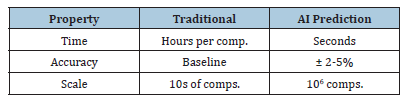
(Table 1).
Table 1:Difference between traditional and AI prediction.
Case Studies
A. Organic-inorganic perovskites: ML accelerated solar cell
efficiency from 3% to 25% by screening halides (Kdan et al.,
2020).
B. Bioactive glasses: A 2024 study used transformer-based
models on NMR/FTIR data to design Si-doped glasses with
50% faster apatite formation, relevant for your medical
applications.
C. Superalloys: Element AI optimized turbine blades, cutting
R&D costs by 40%.
Challenges and Future Directions
A major limitation in applying AI to materials science is the lack of comprehensive datasets, particularly for glasses and biomolecular systems, as most available data focuses on metals. This challenge can be partially addressed through transfer learning, where knowledge from pre-trained models such as MEGNet is adapted to new domains. Another important aspect is model interpretability; methods like SHAP help identify the influence of individual features for example, highlighting the role of CaO in governing glass dissolution behavior.
There are also ethical considerations, including biases in datasets that tend to prioritize widely available elements, which may lead to the neglect of more sustainable alternatives. Looking ahead, several emerging directions are shaping the field. Digital twins, or AI-powered virtual laboratories, can replicate real-time experiments and are particularly useful for applications like thinfilm research. Federated learning enables multiple research groups to collaboratively train models without directly sharing sensitive data. Additionally, the integration of quantum computing with AI is expected to advance the study of nanoscale quantum materials. According to industry projections, such as those from McKinsey, AI could contribute to the design of the majority of commercial materials by 2030 [1-3].
Conclusion
AI is shifting materials science from a largely observational discipline to one focused on design and creation, with significant impact on areas such as bioactive glasses and nanotechnology. Researchers, including those working within Hyderabad’s scientific ecosystem, can take advantage of open-source tools like Atom2Vec and PyMatGen to accelerate their work. Incorporating AI into spectroscopy analysis and synthesis processes can streamline research workflows, enabling quicker results, more publications, and improved prospects for securing funding.
References
- Merchant A, Batzner S, Schoenholz SS, Aykol M, Cheon G, et al. (2023) Scaling deep learning for materials discovery. Nature 624(7990): 80-85.
- Xie T, Grossman JC (2018) Crystal Graph CNNs. Phys Rev Lett 120: 145301.
- Court, Coley (2024) Generative models for glasses. Chem Mater.
© 2026 © Pavan Kumar Potuganti. This is an open access article distributed under the terms of the Creative Commons Attribution License , which permits unrestricted use, distribution, and build upon your work non-commercially.
Editor In Chief







.jpg)






























Signup for Newsletter

Quick Links
 Editorial Board Registrations
 Submit your Article
 Best Paper of the Volume
 Reprints
 Refer a Friend
 Advertise With Us
Our Recent Edition

.jpg)



Top Editors




.jpg)

















.bmp)
.jpg)
.png)
.jpg)













.jpg)






.png)

.png)




.png)




Financial Support

Sponsors

Latest e-Books

Latest Video

 a Creative Commons Attribution 4.0 International License. Based on a work at www.crimsonpublishers.com.
Best viewed in
a Creative Commons Attribution 4.0 International License. Based on a work at www.crimsonpublishers.com.
Best viewed in 
 | Above IE 9.0 version