

- About Us
- Information
-

The Author ensures that the research has been conducted responsibly and ethically with adherence to all relevant regulations. read more..
- For Authors
- For Reviewer
- Manuscript Guidelines
- Membership
- Publication Ethics
-
- Journals
- Reprints
- e-Books
- Videos
- Policies
- Contact Us
 COVID-19
- Submissions



Full Text
Research & Development in Material Science
Physical Bases of Nano
Stanislav Ordin*
Russian Academy of Sciences, Russia
*Corresponding author:Stanislav Ordin, Russian Academy of Sciences, Russia
Submission: June 25, 2025;Published: August 18, 2025

ISSN: 2576-8840 Volume 22 Issue 1
Abstract
The Feynman cellular automaton, implemented by NANO-technologies, is, in principle, an alternative to the von Neumann-Conway cellular automaton, which removed the thermodynamic BAN on the existence of LIFE itself. And NANO-technologies, in principle, with the help of NANO-mold, remove the BAN on the destruction of LIFE. Therefore, using NANO-technologies without UNDERSTANDING the Fundamental Laws of the NANO-scale is not only ineffective, but also extremely dangerous. And for now, they use a purely empirical approach, directed by bluff companies, such as the graphene one, to a waste of energy and resources. Whereas to build NANO-Physics, it is necessary to UNDERSTAND that it is the Borderline between Classical and Quantum Physics. At the same time, one should look for the NEW not in mystical changes of Fundamental Characteristics, which contradicts the adiabatic decomposition of energy, but in NANO-structuring, which leads to gigantic effects. And for this, there is a large experimental and theoretical reserve in the form of results of studies of midi-effects and natural and artificial superstructures, which simply needs to be Generalized and UNDERSTOOD.
Keywords:Adiabatic decomposition; Incommensurate and artificial structures; Measurability; Nano-physics
Mathematical Introduction
The first mention of the methods that would later be called NANO-technology is associated with the famous speech of Richard Feynman; “There’s Plenty of Room at the Bottom”, made by him in 1959 at the California Institute of Technology at the annual meeting of the American Physical Society. In it, Feynman intuitively used the Principle of Logarithmic Relativity and suggested that if a robot makes a robot 4 times smaller, and the reduced robot made at the first stage makes robots 4 times smaller, and those, similarly, 4 times smaller, and so on, then, in the end, it will be possible to mechanically move single atoms using a manipulator of the appropriate size. At least, such a process would not contradict the physical laws known to date (Figure 1).
Figure 1:Feynman cellular automaton implemented by NANO-Technologies.
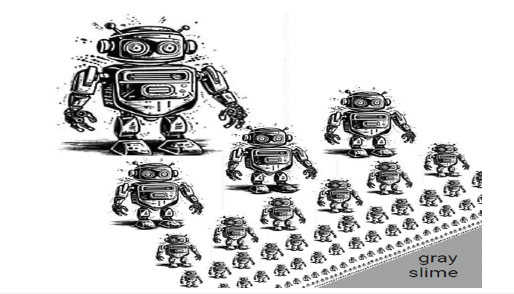
But, in the Principle of Logarithmic Relativity, leading to the alternation of partial and field descriptions of Nature, Feynman did not know at that time. Just as he did not know about the Physics of the Missing Scale, with its characteristic NANO-effects. MATHEMATICS teaches how to think correctly. But Abstract Mathematics both takes the mathematician away from LIFE (an example is Grisha Perelman), and itself, having broken away from the control of REALITY, takes away into the World of Fantasy. Thus, without listening to Einstein, who said: “Only some equations of Classical Mechanics allow rewriting in operator form”, Schrödinger, at the instigation of Niels Bohr, took Quantum Theory into the analysis of “Shadows” [1]. But the real Quantum Effects described by Planck (photon) and Einstein (phonon) were easily accepted by physicists and the question of their MEASURABILITY was not even raised – the Ban was given (actually by Bohr) on their UNDERSTANDING. Whereas it became possible to talk about the very existence of NANO-Effects only after the Local Entropy Production of Prigogine lifted the thermodynamic BAN on their existence (and at the same time lifted the BAN on the existence of LIFE). Whereas in the course of theoretical research of Feynman’s cellular automaton, hypothetical scenarios of the end of the world appeared, which assume that nano-robots will absorb all the biomass of the Earth, fulfilling their program of self-reproduction, the so-called “gray slime” or “gray goo”.
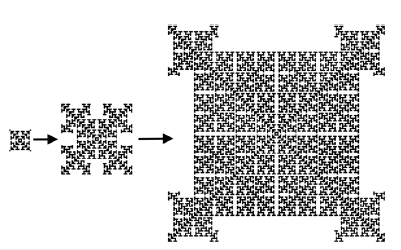
But even the purely mathematical “Game of LIFE” points to the incompleteness of Feynman’s mathematical scheme. If a robot of any level “takes it into its head to make others like itself, then repetitive but diverse associations will arise (Figure 2).
Figure 2:The ripe fruits of the African canarium (Canarium schweinfurthii).
Experimental and theoretical analysis of nano-effects
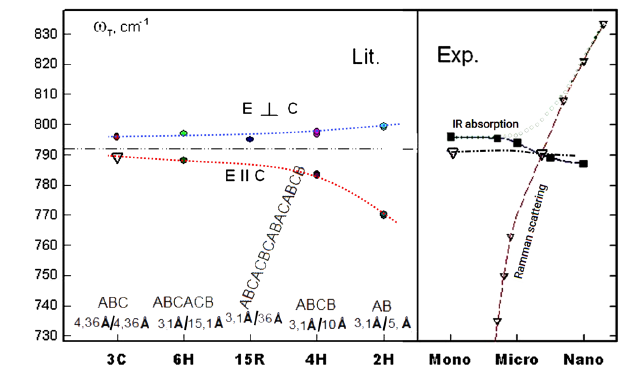
Experimental studies and theoretical analysis of Local THERMO-EMF not only removed the BAN and MEASURABILITY of Local Effects, but also allowed to return Thermoelectricity to the category of Fundamental Sciences [2-6]. and, thereby, increasing the PREDICTABILITY of Results, and reducing the risks of NANOtechnologies. And, conversely, allowed to raise Electronics to a new level - to THERMO-Electronics [7,8]. But a large number of studies on nano-objects and the technology of their production are based so far on PRIMITIVE Concepts, which justify the desired, passed off as reality - amendments to the used classical and quantum models are passed off as 100% effects. Whereas it was shown long ago in my work [9] that the change in the rigidity of atomic bonds is only a small amendment to it in macroscopic crystals (Figure 3).
Figure 3:Schematic representation of resonance frequencies. Left: frequencies of transverse optical phonons of single crystals of different SiC polytypes according to literature data, top for E perpendicular to the C axis, bottom for E parallel to the C axis (triangles – Romanov scattering). Right: Dependence of the frequency of the maximum of lattice IR absorption in massive samples on the particle size and their Romanov scattering (which gives a large spread due to diffraction of the exciting light wave).
In general, modern NANO-Science was not born out of nowhere. Resonances of electron waves were observed and studied on metal samples of micron size. And personally, under the guidance of the late professor Valentin Nikolaevich Bogomolov, I managed to create 6A metal threads - to introduce molten bismuth eutectic into angstrom channels of dehydrated mordenite back in 1975 (Figure 2).
We did not find the desired high-temperature superconductivity in 6A diameter threads, but we did register an increase in conductivity when these threads enter the dielectric matrix. True, as can be seen from the sharp decrease in the conductivity jump pressure (Figure 4) with increasing eutectic temperature, with increasing temperature not only does the eutectic fluidity increase, but the effective “Surface Tension” also decreases. And as was shown theoretically by Landau and experimentally in the works of V. N. Bogomolov, the macroscopic characteristic “Surface Tension” is applicable right down to the atomic scale. So, in a NANO-particle, internal atomic bonds are slightly compressed due to the “Surface Tension”, and the surface ones are slightly stretched, which is manifested in a slight shift in the frequency of lattice vibrations in polytypes along the C axis (Figure 3, left) and a slight shift in the frequency of the diffuse average peak of lattice absorption (Figure 3, right).
Figure 4:A jump in the electrical conductivity of dehydrated mordenite when liquid metal is introduced into its 6 A channels under pressure against the background of an increase in the electrical conductivity of the metal coating.

Figure 5:Lattice of concentration solitons with a moiré pattern of the crystal lattice between them and giant spatial dispersion in incommensurate quasicrystals of higher manganese silicide in the region of plasmon-phonon resonance.

So, you should not fall for the bluff (of graphenologists) about the possibility of changing the Basic standard Fundamental Characteristics of materials simply by reducing their dimensionality - this only leads to an exorbitant waste of energy and to the fact that increasingly “advanced” technologies and devices consume more and more energy. But we must look for and use NEW Fundamental Characteristics corresponding to the NANO scale, which also manifest themselves on the macroscopic scale. And this is exactly what is observed in disproportionate quasicrystals and artificial nanostructures. Close cooperation with technologist Ali Engalychev allowed us to obtain macroscopic perfect incommensurate quasicrystals of higher manganese silicide (HMS), modulated at the nano-level [10]. As shown in Figure 3, in HMS quasicrystals, as a result of the solid-phase transition along a non-Lifshitz star, a natural thermodynamic NANO-structure is formed (Figure 5).
The transformation of the labile silicon sublattice into sections with walls of concentration solitons, close in composition to monosilicide (Figure 4, left), which are incommensurate with the rigid manganese sublattice, is described by the Sine-Gordon equation (Figure 6, right). And the giant spatial dispersion arising in quasicrystals is itself an effect bordering on the optical and radio wave.
Figure 6:One-dimensionally incommensurate sublattices of higher manganese silicide.

Figure 7:Lattice oscillators of highly ordered samples of rhombohedral (a, c) and cubic (b) boron nitride and weakly ordered samples of hexagonal boron nitride (d).

Close cooperation with the technologist from God, Boris Nikolaevich Sharupin, allowed us to obtain perfect macroscopic quasicrystals of rhombohedral modifications of graphite and boron nitride [11]; Figure 7. All the effects discovered in the “ideal samples”, in contrast to the samples obtained with adhesive tape, not only refuted traditional ideas at the boundary between the macro and macro scales, but also led to clarification of a number of Fundamental issues of NANO-Physics [12,13]. This, in principle, prompted the transition from natural long-period structures to the creation of artificial semiconductor structures in which Local THERMO-EMF were discovered, determined by Prigogine’s Local Entropy Production. This allowed us to take a sober look at the UNDERSTANDING not only of the Missing Scale, but also of the seemingly well-studied Quantum Scale [14,15]. Thus, to describe the initial section of the volt-ampere characteristics of even nanoelements, the crude Richardson-Demscher formula is still used, which was obtained for macroscopic diffuse electron flows and to which a crude quantum-mechanical “justification” was given. But a strict quantum calculation taking into account the polarity of the electron energy in the p-n transition region actually removes the ban of mandatory (Figure 8) linearity of the initial section of the current-voltage characteristic [16].
Figure 8:For calculation of probability of spatial transition it is necessary to consider polarity of kinetic energy.
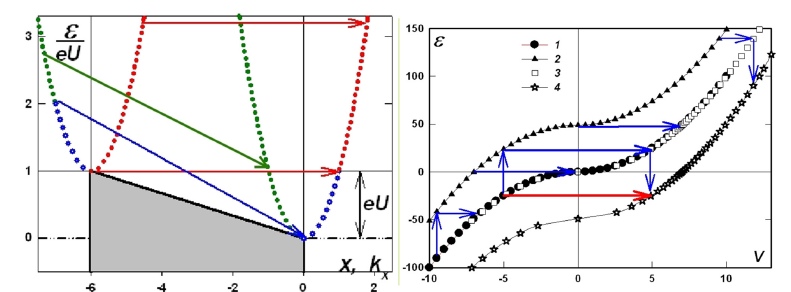
Figure 9:Change in the difference in electrical potentials of two isolated semiconductors (a) when they are brought into electrical contact: (b) - according to the traditional theory, taking into account the equality of only two Thermodynamic Forces, (c) - according to the extended Phenomenology taking into account the Temperature Force.

And with the fundamental consideration of the Temperature Force in equilibrium (Figure 9). And the emergence of giant Local Thermo-EMF (Figure 10), it is possible not only to correct the equilibrium state of the p-n junction (by removing the empirical fitting coefficients), but also to strictly calculate its thermionic nano-characteristics.
Figure 10:Elements imbalance energy in p-n junction: Consumption - «+», generation - «-».

References
- Stanislav O, Book: Foundations of Quantization. Jenny Stanford Publishing Pte Ltd, 2024, 494 рр, ISBN 978-981-5129-46-5 (Hardcover), ISBN 978-1-003-57061-5 (eBook). https://doi.org/10.1201/9781003570615
British library cataloguing-in-publication data, A catalogue record for this book is available from the British Library. https://www.routledge.com/Foundations-of-Quantization/Ordin/p/book/9789815129465
- Ordin SV, Wang WN (2011) Thermoelectric effects on micro and nano level. J Advances in Energy Research 9: 311-342.
- Ordin SV, Zhilyaev Yu V, Zelenin VV, Panteleev VN (2017) Local thermoelectric effects in wide-gap semiconductors. Semiconductors 51(7): 883-886.
- Ordin SV (2017) Refinement and supplement of phenomenology of thermoelectricity. American Journal of Modern Physics 6(5): 96-107.
- Ordin SV (2017) Cardinal increase in the efficiency of energy conversion based on local thermoelectric effects. International Journal of Advanced Research in Physical Science 4(12): 5-9.
- Ordin SV (2018) Anomalies in thermoelectricity and reality are local thermo-EMFs. GJSFR-A 18(2): 59-64.
- Stanislav Ordin (2024) Local THERMO-EMF and NANO-limits of Efficiency. Advanced Energy Conversion Materials 6(1): 1-9.
- Stanislav Ordin (2025) Keynote presentations: THERMOELECTRONIC EFFICIENCY. Global Conference on Material Science and Nanotechnology, IRIS Scientific Group, Theme: Emerging Trends and Breakthroughs in Material Science and Nanotechnology.
- Ordin SV, Sokolov IA (2005) Dimension effect in lattice absorption of silicon carbide, technical digest of the 7th international conference on optical technology, optical sensors and measuring techniques 30 May-1 June 2005 Nuremberg Exhibition Centre, OPTO2005 conference paper, Germany, pp. 121-124.
- Ordin SV (2011) Giant spatial dispersion in the region of plasmon-phonon interaction in one-dimensional- incommensurate crystal the higher silicide of manganese (HSM). In Benjamin J Fuentes (Edr.), Book: Optical lattices: Structures, atoms and solitons. Nova Sc Publ Inc pp. 101-130. Series: Lasers and electro-optics research and technology, physics research and technology, binding: hardcover, p. 241.
- Ordin SV. C & BN-foundation for atomic-crystalline orbitals. Global Journal of Science Frontier Research- Physics & Space Science (GJSFR-A) 18(5): 16-47.
- Stanislav Ordin (2025) Anti-Graphene. Open Access Journal of Physics and Science 2(1): 1-6.
- Stanislav Ordin (2025) Keynote presentations: ANTIGRAPHEN. Global conference on material science and nanotechnology, IRIS Scientific Group, Theme: Emerging Trends and Breakthroughs in Material Science and Nanotechnology.
- Ordin SV. Chaos - Imaginary Ostensibility - Orthogonality. Global Journal of Science Frontier Research - Physics & Space Science GJSFR-A 19(3): 49-58.
- Stanislav Ordin (2023) Non-schrödinger orbitals. J of Physics & Chemistry 1(1): 1-14.
Ordin S (2023) Non-Schrödinger orbitals. Journal of Advance Multidisciplinary Research 2(2): 14-21.
© 2025 © Stanislav Ordin. This is an open access article distributed under the terms of the Creative Commons Attribution License , which permits unrestricted use, distribution, and build upon your work non-commercially.
Editor In Chief







.jpg)































Signup for Newsletter

Quick Links
 Editorial Board Registrations
 Submit your Article
 Best Paper of the Volume
 Reprints
 Refer a Friend
 Advertise With Us
Our Recent Edition

.jpg)



Top Editors




.jpg)

















.bmp)
.jpg)
.png)
.jpg)













.jpg)






.png)

.png)




.png)




Financial Support

Sponsors

Latest e-Books

Latest Video

 a Creative Commons Attribution 4.0 International License. Based on a work at www.crimsonpublishers.com.
Best viewed in
a Creative Commons Attribution 4.0 International License. Based on a work at www.crimsonpublishers.com.
Best viewed in 
 | Above IE 9.0 version