

- About Us
- Information
-

The Author ensures that the research has been conducted responsibly and ethically with adherence to all relevant regulations. read more..
- For Authors
- For Reviewer
- Manuscript Guidelines
- Membership
- Publication Ethics
-
- Journals
- Reprints
- e-Books
- Videos
- Policies
- Contact Us
 COVID-19
- Submissions



Full Text
Research & Development in Material Science
Raman Spectra of GaP Grown from a Non-Stochiometric Ga Melt
Rainer Thomas*
Im Waldwinkel 8, D-14662 Friesack, Germany
*Corresponding author:Rainer Thomas, Im Waldwinkel 8, D-14662 Friesack, Germany
Submission: July 18, 2024;Published: July 30, 2024

ISSN: 2576-8840 Volume 20 Issue 4
Abstract
In this short contribution, we show the Raman spectra of gallium phosphide (GaP) grown from a non-stochiometric Ga melt. For comparison, we also used a GaP wafer with a (100) orientation produced using the Czochralski method. The characteristic first-order and second-order Raman bands of GaP grown from a non-stochiometric Ga melt are presented.
Introduction
Gallium phosphide (GaP) is a III-V semiconductor and crystallizes in the thermodynamically stable cubic zinc blende structure with the lattice constant a = 5.45Å and has an orange-red color. GaP melts at 1470 °C under a phosphorus pressure of 300 bar. Gallium phosphide has been used in the manufacture of low-cost red, orange, and green Light-Emitting Diodes (LEDs) with low to medium brightness since the 1960s. Hadamovsky [1] gives the principal properties of GaP and other III-V semiconductors and technologies for the production of this material.
Sample Material
Figure 1:GaP single crystal platelet grown from a non-stochiometric Ga melt (A-side).
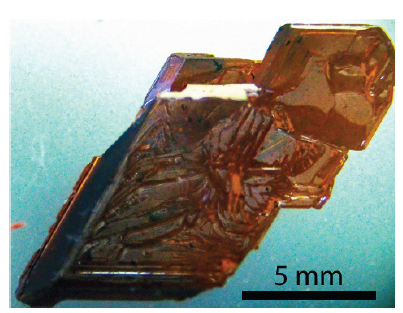
The GaP single crystals were grown from a non-stoichiometric gallium (Ga) melt. This melt is composed of semiconductor-pure gallium and 10% GaP powder each. The closed quartz glass ampulla was heated for 1 hour at 1150 °C and, after that, cooled with a velocity of 30 °C/hour. While doing so, lamellose single GaP crystals grow swimming on the Ga surface (Tirpitz et al. [2]) - Figure 1. The single crystal platelets have different-looking surfaces: smooth at the part that peeps out of the Ga-melt and rough on the underside. Traditionally, the shiny side is called the A- or Ga side, and the rough side is the B- or phosphorus side.
Methodology: Raman Spectroscopy
We use the Raman spectroscopy here to characterize GaP grown from a non-stochiometric Ga melt, which shows growth- and orientation-related differences. For the study of the GaP samples, we use the Raman spectrometer EnSpectr R532 combined with the Olympus BX43 microscope both for transmitted and reflected light and equipped with a rotating stage and polarizers (for parallel and perpendicular positions). Note here that the incident laser light is always polarized - in our case, N - S Tuschel [3]. Generally, we used an Olympus long-distance 40x objective lens for the studies. All measurements are the mean of 13 measurements taken in steps of 30° during azimuthal rotation.
As references, we applied a water-clear diamond crystal from Brazil (1331.63 ± 0.60cm-1 and a semiconductor-grade silicon single-crystal (520.70 ± 0.15cm-1). For this study, we generally used laser energies of ≤30mW on the sample for the studies.
Results
Generally, GaP crystallized from the non-stochiometric melt as lamellose single GaP crystals with (111) orientation. The prominent Raman bands of the A-side in the first order range are 364.1 ± 0.01cm-1 (n = 14 determinations) and 403.2 ± 0.1cm-1 (n = 14) - Figure 2.
Figure 2:First-order Raman spectrum of GaP from the non-stochiometric Ga melt (A-side).
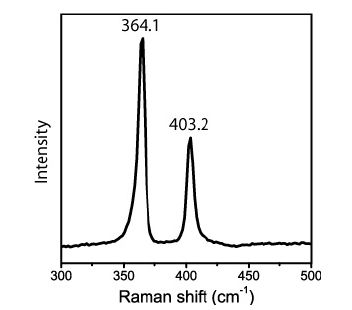
The Full Width at Half Maximum (FWHM) of both main Raman bands (363 and 403) is 6.40 ± 0.05 and 6.29 ± 0.06cm-1, respectively. The intensity ratio is constant: I(364)/I(403) = 2.32. Other bands are very weak. For the B-side, we have obtained 363.9 ± 0.13 and 403.5 ± 0.15cm-1 with the FWHM of 6.70 ± 0.06 and 7.49 ± 0.63cm-1 and intensity ratio I(364B)/I(403B) = 1.93. There are only minimal differences between both (111)-planes. The FWHM is a little bit larger for the B-side Raman bands.
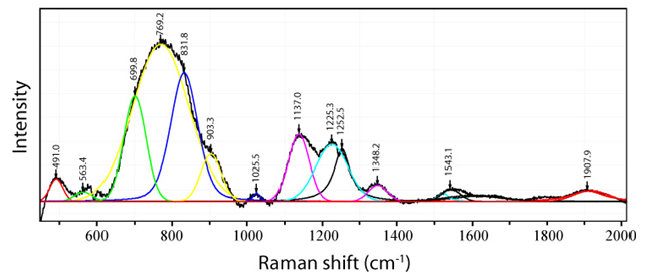
Opposite to the first-order range with only a tiny number of Raman lines, the second-order Raman bands, however, are numerous. Hobden and Russell (cited in Krishnan [4]) identified 17 peaks. In the case of GaP, crystallized from the non-stochiometric melt, we have found 12 relatively strong bands in the range of 450- 2000cm-1. Figure 3 gives an idea about lines in the second-order range. Generally, the intensity of these lines is significantly lower than the first-order Raman bands - about 10% from the 364cm-1 band.
Figure 3:Second-order Raman spectrum of GaP grown from the non-stochiometric Ga melt (A-side). The bands around 1200cm-1 are third-order Raman bands.
In Table 1, the primary data of the measured Raman spectrum of GaP from the non-stochiometric Ga melt are compiled (simplified) - mean of 13 measurements.
Table 1:Observed Raman band, modes, and relative intensities of GaP grown from the non-stochiometric Ga melt.
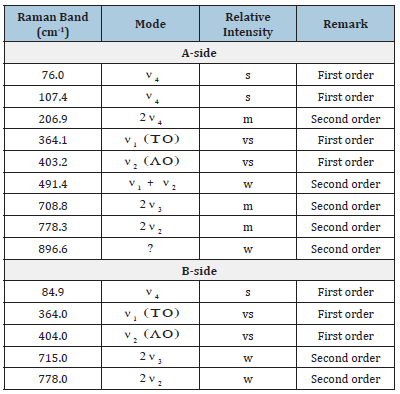
TO - Transverse Optical, LO - Longitudinal Optical, vs - very strong, s - strong, m - medium, w - weak.
Interpretation
(100) oriented GaP wafers grown by the Czochralski method show in the first-order range only one very strong Raman band at 405.5 ± 0.04cm-1 (n = 12). The other bands (73.0, 209.3, 364.6cm- 1) in the first-order range are very weak. Opposite to the Raman bands of the (111)-oriented GaP crystals, the prominent Raman bands in the second-order range are sharp: 718 ± 10.02 and 783.61 ± 0.94cm-1 with the FWHM of 17.19 ± 7.03 and 16.02 ± 0.94cm-1 respectively.
We see a strong dependence on the Raman fundamentals from the orientation of the GaP crystals: (111) vs. (100).
References
- Hadmovsky HF (1968) Semiconductor materials. VEB German publisher for basic industry, Leipzig, Germany, p.
- Tirpitz E, Schmidt H, Ehlers R, Möller E, Hänold G, et al. (1971) Homogeneity studies on gallium phosphide by autoradiography, final report on the innovator agreement, Stahnsdorf, p. 118.
- Tuschel D (2012) Raman crystallography, in theory and practice. Spectroscopy 27(3): 2-6.
- Krishnan RS, Krishnamurthy N (1965) The Raman spectrum of gallium phosphide. Le Journal de Physique 26(11): 630-633.
- Dobrovolsky A, Sukrittanon S, Kuang YJ, Tu CW, Chen WM (2014) Raman spectroscopy of GaP/GaNP core/shell nanowires. Applied Physics Letters 105: 193102-1-193102-5.
© 2024 Rainer Thomas. This is an open access article distributed under the terms of the Creative Commons Attribution License , which permits unrestricted use, distribution, and build upon your work non-commercially.
Editor In Chief







.jpg)































Signup for Newsletter

Quick Links
 Editorial Board Registrations
 Submit your Article
 Best Paper of the Volume
 Reprints
 Refer a Friend
 Advertise With Us
Our Recent Edition

.jpg)



Top Editors




.jpg)

















.bmp)
.jpg)
.png)
.jpg)













.jpg)






.png)

.png)




.png)




Financial Support

Sponsors

Latest e-Books

Latest Video

 a Creative Commons Attribution 4.0 International License. Based on a work at www.crimsonpublishers.com.
Best viewed in
a Creative Commons Attribution 4.0 International License. Based on a work at www.crimsonpublishers.com.
Best viewed in 
 | Above IE 9.0 version