

- About Us
- Information
-

The Author ensures that the research has been conducted responsibly and ethically with adherence to all relevant regulations. read more..
- For Authors
- For Reviewer
- Manuscript Guidelines
- Membership
- Publication Ethics
-
- Journals
- Reprints
- e-Books
- Videos
- Policies
- Contact Us
 COVID-19
- Submissions



Full Text
Polymer Science: Peer Review Journal
When Agreement Depends on the Model: Structural Representation Effects in Oligomer and Periodic DFT Calculations of Conjugated Polymers
Massimo Ottonelli*
Department of Chemistry and Industrial Chemistry, University of Genoa, Italy
*Corresponding author:Massimo Ottonelli, Department of Chemistry and Industrial Chemistry, University of Genoa, Via Dodecaneso 31 16146 Genoa, Italy
Submission: October 21, 2026;Published: October 28, 2026

ISSN: 2770-6613 Volume6 Issue 3
Abstract
Oligomer extrapolation and Periodic Boundary Condition (PBC) calculations are routinely used to predict the electronic properties of conjugated polymers, and their agreement is often taken as evidence of methodological reliability. We argue that such agreement is not determined by the electronic-structure method alone, because periodic calculations also embed structural assumptions regarding repeat-unit definition, conformational freedom, and model dimensionality. Using polythiophene as an illustrative example, we find that reasonable variations in these assumptions can produce changes in predicted electronic gaps comparable to those commonly interpreted as agreement between oligomeric and periodic approaches. In some cases, the periodic representation does not reproduce the structures approached by the oligomer series, and the predicted properties differ accordingly. This means that agreement between oligomeric and periodic calculations may be influenced by the choice of periodic model as much as by the underlying electronic-structure method. When oligomeric and periodic calculations do not agree, the reason can sometimes be quite straightforward: the two calculations are not describing exactly the same structure. In the present examples, the definition of the repeat unit, the conformational freedom allowed by the periodic model, and its dimensionality all affect the predicted properties and the comparison with oligomer-based estimates.
Keywords:Polythiophene; Density functional theory; Periodic boundary conditions; Model dependence
Introduction
Band-gap prediction remains one of the most common objectives of electronic-structure calculations on conjugated polymers and two complementary computational strategies are commonly employed. In the oligomer approach, finite chains are treated with standard molecular quantum-chemical methods and their properties are extrapolated towards the polymer limit [1-3]. In the periodic approach, the infinite material is described directly through a unit cell subject to periodic boundary conditions, and the electronic structure is obtained from the corresponding band dispersion [4]. Because these approaches originate from fundamentally different representations of the same system, comparisons between oligomer-based and periodic calculations have attracted considerable attention and have been reported for a wide range of conjugated polymers, including polythiophene and related systems [5-7]. Such comparisons are usually discussed in terms of chain length, exchangecorrelation treatment, and basis-set effects [1-7]. Yet even for a fixed electronic-structure method, the periodic representation of a polymer is not unique. Different choices of repeat unit, conformational freedom, and dimensionality can lead to different periodic models of the same material. These choices may influence the calculated electronic structure even when the electronic-structure methodology itself remains unchanged. In the present contribution, antiand syn-polythiophene conformations, denoted hereafter as trans- and cis-polythiophene, respectively, are used as illustrative examples to examine how periodic-model construction can affect the comparison between oligomer-based and periodic descriptions. The aim is not to provide a comprehensive discussion of the underlying computational results, which will be reported elsewhere, but rather to consider the methodological implications of these observations and their relevance to the interpretation of electronic-structure calculations on conjugated polymers.
Structural Representation and Oligomer-PBC Comparisons
The examples discussed below illustrate how the structural representation adopted in a periodic calculation can influence comparisons with oligomer-based estimates. All calculations were performed at the B3LYP/6-311G** level using the periodic implementation available in Gaussian 09 [8,9]. Throughout this work, band gaps are defined consistently as Kohn-Sham frontierorbital energy differences, corresponding to HOMO-LUMO gaps for oligomers and HOCO-LUCO gaps for periodic models. The focus of the present work is not the absolute prediction of band gaps, but the comparison of oligomeric and periodic descriptions within a common computational framework. Rather than seeking the most accurate gap value, the aim is to examine how different periodic representations affect the comparison between the two approaches. B3LYP was therefore chosen for consistency across the two approaches and because it provides reasonable geometries for polythiophene systems. Figure 1 summarizes the results obtained for several periodic representations of trans-polythiophene.
Figure 1:Calculated band gaps of trans-polythiophene obtained from different periodic representations at the B3LYP/6-311G** level. The vertical dotted line indicates the polymer-limit value obtained by linear extrapolation of oligomer HOMO-LUMO gaps up to the decamer (1.94eV). Values in parentheses indicate deviations from the extrapolated limit.
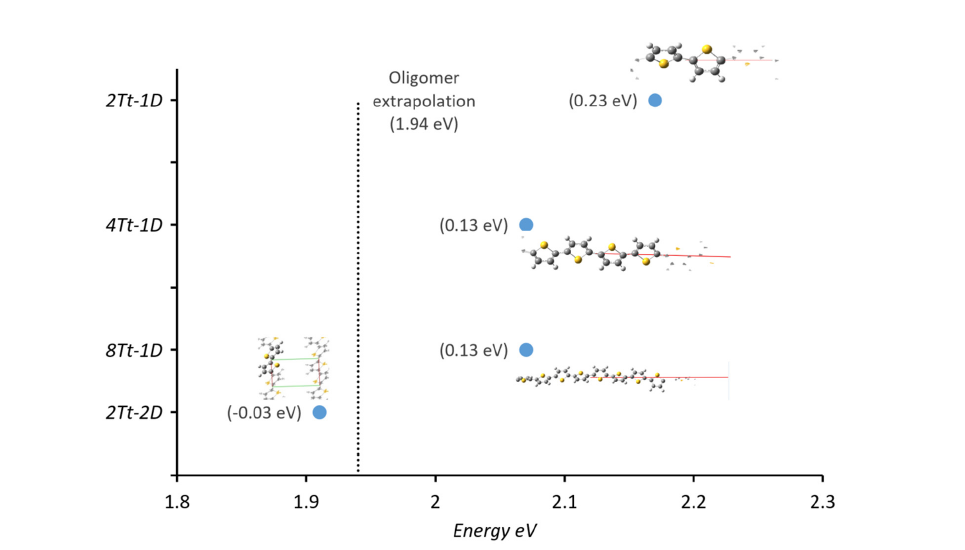
a) Repeat units: The influence of periodic-model construction is first illustrated by the choice of repeat unit. For trans-polythiophene, the calculated gap decreases from 2.17eV for a two-ring periodic representation (2Tt) to 2.07eV for the 4Tt model and remains unchanged for the larger 8Tt cell (Figure 1). The effect is relatively small and appears to converge rapidly. The only substantive difference between these calculations is the way the periodic cell is defined. The electronic-structure method, functional, and basis set are identical in all three calculations. What changes is the structural freedom allowed by the periodic representation. In the 2Tt model, a single inter-ring dihedral is optimized and repeated throughout the chain, whereas the 4Tt model allows three independent dihedrals. The smaller cell therefore represents a specific structural assumption rather than a purely technical choice. From this perspective, cell construction should be regarded as part of the physical model used to describe the polymer.
b) Conformational freedom: The anti/syn conformational problem provides a second example. In the oligomer series, the cis-polythiophene structures progressively evolve toward a helical backbone as chain length increases. By contrast, the corresponding one-repeat-unit periodic model converges to a nearly linear structure. As a consequence, the periodic gap (1.63eV) lies substantially below the extrapolated oligomer value (2.21eV). The comparison therefore involves structures that differ markedly in their conformational characteristics. The more planar periodic backbone would be expected to favor greater electronic delocalization and a smaller gap. The resulting difference in geometry provides a plausible explanation for the observed discrepancy. A periodic calculation based on a helical geometry derived from the dimer produces a considerably larger gap (2.96eV), suggesting that the conformational arrangement may play an important role. The significance of this result, however, would require further investigation using more realistic periodic models.
c) Dimensionality: A third example concerns dimensionality. Replacing the one-dimensional 2Tt representation with a twodimensional model derived from the experimental packing arrangement of oligothiophenes lowers the calculated gap from 2.17 to 1.91eV [10]. Interpreting the origin of this difference is not straightforward because dimensionality, intermolecular contacts, and structural relaxation all vary simultaneously. Regardless of their individual contributions, the result shows that extending the model beyond an isolated chain changes the predicted gap by approximately 0.26eV. Such behavior is consistent with previous studies highlighting the role of intermolecular interactions in conjugated-polymer electronic properties [11].
d) What does agreement mean? The examples above can be viewed in relation to the quantity typically used to assess agreement between oligomeric and periodic approaches. Relative to the extrapolated trans-polythiophene value of 1.94eV, the deviations are +0.23eV for the 2Tt cell, +0.13eV for the 4Tt cell, and -0.03eV for the 2D model. These differences arise from changes in the periodic representation, since the polymer, functional, and basis set remain unchanged. The resulting spread of about 0.26eV is comparable to the level of agreement that is often considered acceptable when different computational approaches are compared or when calculated and experimental gaps are discussed. Under these circumstances, the apparent quality of the agreement may depend not only on the electronic-structure method but also on the structural assumptions embedded in the periodic model. The cispolythiophene example illustrates a related point. The disagreement between oligomeric and periodic calculations is considerably larger, consistent with the fact that the two calculations correspond to different structural descriptions of the polymer. The oligomer series evolves toward a helical backbone, whereas the periodic model converges to a nearly linear arrangement. In this situation, interpreting the comparison independently of the underlying structural representation becomes difficult. The examples discussed above suggest that agreement is not determined by the computational method alone. It also depends on how the polymer is represented. In this context, repeat-unit definition, conformational freedom, and dimensionality become part of the comparison itself, rather than secondary details of its implementation.
Conclusion
Comparisons between oligomer extrapolation and periodic DFT calculations are often framed in terms of finite and infinite chain descriptions. The examples discussed here suggest that this perspective does not capture the whole picture. Repeat-unit definition, conformational freedom, and dimensionality can all influence the calculated gap and, consequently, the apparent level of agreement between oligomeric and periodic approaches. The main implication is methodological rather than computational. Agreement or disagreement between oligomer-based and periodic calculations cannot be interpreted independently of the structural assumptions embedded in the periodic model. In the examples considered here, changes in the periodic representation affect the comparison even when the electronic-structure method itself remains unchanged. These observations do not diminish the value of either oligomer extrapolation or periodic calculations. Rather, they highlight the importance of considering how the polymer is represented when the two approaches are compared. Greater attention to repeat-unit definition, conformational freedom, and dimensionality may help place apparent agreement, or disagreement, in its proper structural context.
Funding
This research received no external funding.
Data Availability Statement
The computational data underlying the examples discussed in this article are available from the author upon request.
References
- Hutchison GR, Zhao YJ, Delley B, Freeman AJ, Ratner MA, et al. (2003) Electronic structure of conducting polymers: Limitations of oligomer extrapolation approximations and effects of heteroatoms. Phys Rev B 68: 035204.
- Zade SS, Bendikov M (2006) From oligomers to polymer: convergence in the homo-lumo gaps of conjugated oligomers. Org Lett 8(23): 5243-5246.
- Zade SS, Zamoshchik N, Bendikov M (2011) From short conjugated oligomers to conjugated polymers: lessons from studies on long conjugated oligomers. Acc Chem Res 44(1): 14-24.
- Kudin KN, Scuseria GE (2000) Linear-scaling density-functional theory with gaussian orbitals and periodic boundary conditions: efficient evaluation of energy and forces via the fast multipole method. Phys Rev B 61(24): 16440-16453.
- Saporiti C, Tommasini M, Galimberti DR, Castiglioni C (2026) Bridging molecular and periodic models: A theoretical study of the spectroscopic properties of polythiophene. Photochem Spectrosc 2(2): 1.
- Zhang L, Yu M, Zhao H, Wang Y, Gao J (2013) Theoretical investigations on the electronic and optical characteristics of fused-ring homopolymers: Comparison of oligomer method and PBC-DFT method. Chem Phys Lett 570: 153-158.
- Pappenfus TM, Schmidt JA, Koehn RE, Alia JD (2011) PBC-DFT applied to donor-acceptor copolymers in organic solar cells: Comparisons between theoretical methods and experimental data. Macromolecules 44(7): 2354-2357.
- Frisch MJ (2009) Gaussian 09. Gaussian Inc, Wallingford, CT, USA.
- Lee C, Yang W, Parr RG (1988) Development of the colle-salvetti correlation-energy formula into a functional of the electron density. Phys Rev B 37(2): 785-789.
- Kiriy N, Kiriy A, Bocharova V, Stamm M, Richter S, et al. (2004) Conformation, molecular packing, and field-effect mobility of regioregular β,β′-dihexylsexithiophene. Chem Mater 16(23): 4757-4764.
- van der Horst JW, Bobbert PA, Michels MAJ, Brocks G, Kelly PJ (1999) Ab initio calculation of the electronic and optical excitations in polythiophene: effects of intra- and interchain screening. Phys Rev Lett 83: 4413-4416.
© 2026 Massimo Ottonelli. This is an open access article distributed under the terms of the Creative Commons Attribution License , which permits unrestricted use, distribution, and build upon your work non-commercially.
Editor In Chief







.jpg)































Signup for Newsletter

Quick Links
 Editorial Board Registrations
 Submit your Article
 Best Paper of the Volume
 Reprints
 Refer a Friend
 Advertise With Us
Our Recent Edition





Top Editors




.jpg)

















.bmp)
.jpg)
.png)
.jpg)













.jpg)






.png)

.png)




.png)




Financial Support

Sponsors

Latest e-Books

Latest Video

 a Creative Commons Attribution 4.0 International License. Based on a work at www.crimsonpublishers.com.
Best viewed in

 | Above IE 9.0 version