

- About Us
- Information
-

The Author ensures that the research has been conducted responsibly and ethically with adherence to all relevant regulations. read more..
- For Authors
- For Reviewer
- Manuscript Guidelines
- Membership
- Publication Ethics
-
- Journals
- Reprints
- e-Books
- Videos
- Policies
- Contact Us
 COVID-19
- Submissions



Full Text
Polymer Science: Peer Review Journal
Feather Keratin and Its Enzymatic Hydrolysate in XNBR Composites: Processing, Properties, and Biodegradation
Miroslawa Prochon*
Institute of Polymer and Dye Technology, Faculty of Chemistry, Łódź University of Technology, Poland
*Corresponding author:Miroslawa Prochon, Institute of Polymer and Dye Technology, Faculty of Chemistry, Łódź University of Technology, Poland
Submission: April 03, 2026;Published: May 08, 2026
ISSN: 2770-6613 Volume6 Issue 2
Abstract
Feather keratin, recovered from poultry-processing waste, is increasingly studied as a renewable platform for biodegradable materials because it combines waste valorization with a chemically versatile, sulfur-rich protein structure. This mini review summarizes recent progress in feather-keratin extraction, regeneration, and formulation, with emphasis on films, hydrogels, porous scaffolds, and hybrid composites. Particular attention is given to the incorporation of feather-derived keratin into elastomer matrices, where it can act as a bio-based filler that enhances mechanical performance (e.g., tensile strength and hardness), modifies crosslink density, and promotes biodegradation-related behavior. Despite extensive research on keratin-based materials, limited work has focused on the combined effects of native keratin and its enzymatic hydrolysates in XNBR systems, representing a clear research gap addressed in this study. The literature indicates that feather keratin is especially promising in composite systems, although moisture sensitivity and extraction-induced variability remain major limitations. Further research should focus on greener extraction routes, improved interfacial compatibility with polymer matrices, and scalable processing strategies for sustainable elastomer-based materials.
Keywords:Feather keratin; Biodegradable polymers; Protein-based materials; Elastomer composites; Bio-based fillers; Sustainable materials
Introduction
The search for lower-impact materials has increased interest in waste-derived polymers and bio-based functional additives. Feather keratin is particularly attractive because poultry feathers are generated in very large amounts and consist mainly of a durable, sulfur-rich protein that can be isolated and reprocessed into value-added materials [1-3]. Owing to the presence of amide, carboxyl, amino, and disulfide groups, keratin shows high potential for hydrogen bonding, crosslinking, blending, and interaction with mineral or polymeric fillers. Its low density, char-forming tendency, and compatibility with different extraction and regeneration routes make it suitable for films, porous scaffolds, sorbents, and biodegradable composites [1,2]. Previous studies have largely focused on keratin as a standalone material, with limited attention to enzymatic hydrolysates in elastomer matrices.
Feather keratin is typically obtained by reductive, alkaline, oxidative, or enzymatic treatment of the native feather structure, followed by regeneration or direct incorporation into polymer systems. The objective of this work is to evaluate the influence of native feather keratin and its enzymatic hydrolysate on mechanical, thermal, and biodegradation properties of XNBR composites. Among these approaches, enzymatic processing is especially attractive because it is milder and may preserve functional groups while producing hydrolysates with improved compatibility in multicomponent materials [1,2]. Recent studies show that feather keratin is most effective not as a standalone matrix, but as a multifunctional additive in hybrid systems, where it can contribute biodegradability, reinforcement, and interfacial functionality. Nevertheless, water sensitivity, variable processability, and limited stability under humid conditions remain important challenges [3- 5].
For this reason, feather keratin is increasingly investigated in reinforced elastomer systems, where it may improve both material performance and environmental profile. In this context, the presented studies address the incorporation of feather keratin in its native form and as an enzymatic hydrolysate into Carboxylate Acrylonitrile-Butadiene Rubber (XNBR), with the aim of improving continuous-phase stability and modifying the functional properties of the resulting biodegradable elastomer composites.
Representative Study of Feather-Keratin Composites: Methodology and Selected Results
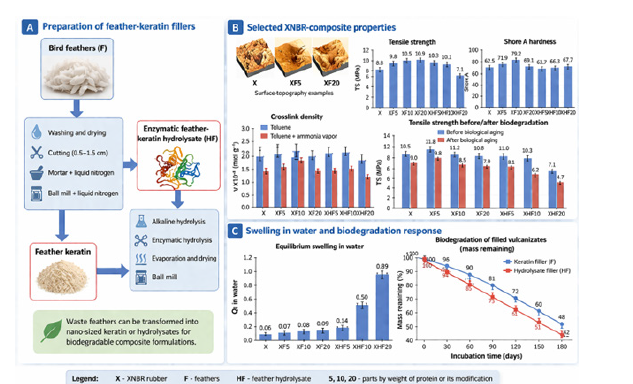
Figure 1 summarizes a representative study on XNBR-based composites filled with feather keratin and enzymatic featherkeratin hydrolysate. In this system, nano-sized native feather keratin and its enzymatic hydrolysate were introduced into Carboxylate Acrylonitrile-Butadiene Rubber (XNBR) as bio-based fillers in order to modify crosslinking, mechanical performance, swelling behavior, and biodegradation-related response. The presented results show that feather-derived fillers increased tensile strength at selected filler loadings, with an improvement of up to ~20% for compositions such as XF10 and XF20, indicating enhanced reinforcement efficiency affected tensile strength, hardness and crosslink density, with hardness showing a moderate increase, while excessive filler loading led to agglomeration and deterioration of mechanical properties and promoted greater susceptibility to water uptake and biodegradation, with the most favorable balance of properties observed for XF10, XF20, and XHF10. Surface topography of selected vulcanizates was examined by atomic force microscopy (AFM), which was used to assess the influence of filler incorporation on surface morphology and phase structure. The AFM analysis suggests improved dispersion of enzymatic hydrolysate compared to native keratin, likely due to its lower molecular weight; however, complementary SEM analysis would further confirm filler distribution and interfacial morphology. Crosslink density was evaluated from equilibrium swelling measurements in toluene and in toluene exposed to ammonia vapor. The observed changes in crosslink density may be attributed to interactions between keratin functional groups (–NH₂, –COOH) and XNBR, including hydrogen bonding and ionic interactions. Thermo-oxidative aging was carried out at 70 °C for 168h to assess changes in mechanical and visual stability, although additional thermal analysis (e.g., TGA or DSC) would provide deeper insight into thermal stability and degradation behavior of the composites. whereas biodegradation-related aging was performed in a climate chamber at 30 °C and 80% relative humidity. Enhanced biodegradation is associated with increased hydrophilicity of keratin-containing systems, facilitating water uptake and promoting microbial activity and hydrolytic degradation mechanisms. These results illustrate that feather-keratin-based fillers can act simultaneously as reinforcing agents, functional biobased modifiers, and components promoting the development of more sustainable elastomer composites. For improved reliability, future studies should include statistical analysis and error bars to assess the significance and reproducibility of the observed trends.
Figure 1:Summary of feather-keratin filler preparation and selected properties of XNBR-based composites. Panel A shows the preparation route for feather keratin and enzymatic feather-keratin hydrolysate; Panel B presents selected structure-property data of the composites; Panel C illustrates swelling behavior in water and biodegradation-related response. XF=feather keratin filler; XHF=enzymatic feather-keratin hydrolysate filler.
Conclusion
Feather keratin is a promising renewable protein for the development of biodegradable materials because it combines waste valorisation with broad possibilities for material design in hybrid polymer systems. The presented results confirm that the incorporation of native feather keratin and its enzymatic hydrolysate into an XNBR matrix can modify crosslink density, mechanical performance (including tensile strength and hardness) and susceptibility to biodegradation, which is closely related to increased hydrophilicity of keratin-containing systems, swelling behavior, and susceptibility to biodegradation. The study shows that feather-keratin-based fillers can act not only as reinforcing agents, but also as modifiers improving filler dispersion and interfacial compatibility through potential hydrogen bonding and ionic interactions with the XNBR matrix, but also as functional bio-based modifiers contributing to the development of more sustainable elastomer composites. Further work should focus on improving interfacial compatibility, moisture resistance, and the scalability of processing routes for practical applications. In addition, future studies should include detailed thermal analysis (e.g., TGA/DSC), advanced morphological characterization (e.g., SEM/AFM), and statistical evaluation of results to improve reliability, as well as further refinement of language clarity and data interpretation.
References
- Rouse JG, Van Dyke ME (2010) A review of keratin-based biomaterials for biomedical applications. Materials 3(2): 999-1014.
- Feroz S, Muhammad N, Ratnayake J, Dias G (2020) Keratin-based materials for biomedical applications. Bioact Mater 5(3): 496-509.
- Bhaskar R, Zo SM, Narayanan KB, Purohit SD, Gupta MK, et al. (2023) Recent development of protein-based biopolymers in food packaging applications: A review. Polym Test 124: 108097.
- Alashwal BY, Bala MS, Gupta A, Sharma S, Mishra P (2020) Improved properties of keratin-based bioplastic film blended with microcrystalline cellulose: a comparative analysis. J King Saud Univ Sci 32: 853-857.
- Santos MMF, Grisi CVB, Lima DAS, Florentino GIB, Ferreira VCdS, et al. (2024) Biodegradable and active film based on keratin and protein hydrolysate of free-range chicken feathers: structural and antioxidant properties. Food Biosci 62: 105048.
© 2026 Miroslawa Prochon. This is an open access article distributed under the terms of the Creative Commons Attribution License , which permits unrestricted use, distribution, and build upon your work non-commercially.
Editor In Chief







.jpg)































Signup for Newsletter

Quick Links
 Editorial Board Registrations
 Submit your Article
 Best Paper of the Volume
 Reprints
 Refer a Friend
 Advertise With Us
Our Recent Edition

.jpg)



Top Editors




.jpg)

















.bmp)
.jpg)
.png)
.jpg)













.jpg)






.png)

.png)




.png)




Financial Support

Sponsors

Latest e-Books

Latest Video

 a Creative Commons Attribution 4.0 International License. Based on a work at www.crimsonpublishers.com.
Best viewed in
a Creative Commons Attribution 4.0 International License. Based on a work at www.crimsonpublishers.com.
Best viewed in 
 | Above IE 9.0 version