

- About Us
- Information
-

The Author ensures that the research has been conducted responsibly and ethically with adherence to all relevant regulations. read more..
- For Authors
- For Reviewer
- Manuscript Guidelines
- Membership
- Publication Ethics
-
- Journals
- Reprints
- e-Books
- Videos
- Policies
- Contact Us
 COVID-19
- Submissions



Full Text
Perceptions in Reproductive Medicine
Study of the Degradation Process that can Occur in Male Condoms after their Expiration Date
Janete Duarte1*, Antonio Eugenio CC de Almeida2, Renata Gracie3 and Jislaine de Fatima Guilhermino4
1National Institute for Quality Control in Health, Brazil
2National Institute for Quality Control in Health, Brazil
3Institute of Scientific and Technological Communication and Information in Health, Brazil
4Fiverr is with us in Grosso da Sul, Brazil
*Corresponding author:Janete Duarte, National Institute for Quality Control in Health, Oswaldo Siraj Foundation Ap. 4365 Manguinhos-Rio de Janeiro, RJ 21041-900, Brazil
Submission: March 18, 2026; Published: March 26, 2026

ISSN: 2640-9666Volume6 Issue 3
Abstract
Background: As medical devices, mechanical contraceptives require regulation in terms of market
approval, efficacy, quality and fitness for purpose. The shelf life of condoms is fundamental to their
performance. In the case of rubber condoms, the degree of aging depends on several factors, including
the nature of the elastomer, the formulation (quantity and type of additives used), processing conditions,
design, product application and the environmental conditions to which the product will be subjected.
Methods: Three different batches of condoms from different manufacturers were evaluated after the
expiration date of each batch, in order to observe the changes that occur in the product. The condoms
analyzed were expired three to four years after the expiration date. Due to the insufficient number of
samples to perform all the necessary tests, it was possible to perform the test to determine the volumetric
capacity and burst pressure in each batch available for the study, as this test is used as an indicator of the
condom’s resistance, measuring the pressure and burst volume.
Results and Conclusion: The results categorically state that different condoms produced by different
manufacturers age and exhibit impaired performance over time. The results also indicate that the different
products degrade at different rates, with the burst volume appearing to reflect the degradation process
more sensitively.
Keywords:Male condoms; Degradation; Sanitary surveillance
Introduction
Aging is the degradation process that occurs in a polymeric material over a specific period of time, usually resulting in variations in its physical and/or chemical structure that compromise its durability, resulting in inadequate performance of its functions. In many applications, the durability or useful life of the artifact is critical. Therefore, it is important to understand the various degradation mechanisms in order to determine the material’s ability to maintain its properties when subjected to specific adverse conditions. In the case of rubbers, the degree of aging depends on several factors, including the nature of the elastomer, the formulation (quantity and type of additives used), the processing conditions, the design, the application of the product and the environmental conditions to which the product will be subjected [1,2]. In principle, all rubbers degrade when exposed to light. The incident energy of natural light, 2860 joules per einstein (energy associated with 6.02 x 10²³ photons), is much greater than the energy involved in typical carbon-carbon or carbon-hydrogen bonds, which is on the order of 800-1000 joules per mole. The two main aging processes in rubbers are oxidation and ozonolysis, accelerated by temperature. Oxidative degradation occurs slowly at lower temperatures and as the temperature increases, degradation intensifies [3].
The loss of physical properties when vulcanized rubber degrades through oxidation is due to the total or partial failure of the vulcanized network. This rupture can occur through scissions in the polymer chain (depolymerization) and/or scissions in crosslinks (recombination), which can promote the formation of intramolecular crosslinks, crosslinks with pendant groups and other factors, increasing crosslinking. The rupture of the polymer chain decreases viscosity, while the increase in the number of crosslinks makes the material more rigid. The combination of both phenomena results in the formation of microtears [4,5]. Metalcatalyzed oxidation is an important aspect in the manufacture of natural rubber latex condoms. Trace amounts (in ppm) of certain transition metals, mainly copper, manganese, cobalt and iron, are capable of breaking down hydroperoxides in a redox reaction, generating reactive peroxide radicals that propagate oxidation, causing aging to occur at low temperatures 1. The vulcanization system also influences the aging process. Typically, in vulcanized natural rubber, for every 600 carbon atoms in the polymer backbone, only one sulfur cross-link is formed after vulcanization, which maintains a high incidence of unsaturation in the polymer chain [6,5]. Antioxidants, both natural and synthetic, are essential additives for preventing oxidation reactions. The antioxidants used in condom formulations are called electron or hydrogen donors, chain-breaking donos [7,3]. As medical devices, mechanical contraceptives require regulation in terms of market approval, efficacy, quality and fitness for purpose. ISO 4074, Natural latex rubber condoms-Requirements and test methods, establishes all the criteria and methods for evaluating male condoms [8]. Male condoms available in Brazil, both nationals and imported, are compulsory certified and their production is governed by strict criteria, which cover aspects ranging from the quality of the latex to the specifications for primary packaging, consumption and transportation.
Study conducted on the aging of natural rubber condoms
showed three main processes:
A. oxidative degradation, which leads to a loss of tensile
properties, with little or no loss of deformation properties,
indicating defective or oxygen-permeable packaging and/or a
lack of antioxidants in the formulation.
B. post-curing, which promotes a decrease in deformation
capacity, making the material less elastic and more brittle, with
little or no decrease in tensile properties, suggesting that the
condom is well protected from oxidative deterioration.
C. localized deterioration, leading to a decrease in burst
pressure, with little or no decrease in tension and load at
rupture, which may indicate exposure to high temperatures,
deterioration in critical parts of the condom (base and
reservoir) and/or poor packaging [9].
The shelf life of a product generally refers to the time elapsed until the product is no longer suitable for its intended purpose. In temperate countries, the shelf life of condoms is usually five years, while in tropical countries, such as Brazil, manufacturers may reduce the shelf life to three Years [10]. Strictly speaking, this period can only be measured directly through clinical studies in use or through testing of the product as a whole. Most evaluations of the shelf life of rubber products consider performance measures, such as mechanical properties, specifying the minimum limit for the property studied. Tests are often conducted at high temperatures, subjecting the product to high stress conditions, then extrapolating the results to typically milder conditions of use. This technique is usually called accelerated testing [1]. Studies conducted by Tadele Mekuriya of the College of Health Sciences, Mizan Tepi University, Department of Pharmacy, Mizan Tefari, Ethiopia, in 2014, showed that condoms on the market have acceptable pressure and burst volume characteristics measured in Ethiopia. However, he observed slight inadequacy in the confirmation criteria for the burst volume of 18 L vs. 27 L and insufficiency in the consistency of the laboratory impermeability test in some batches of condoms on the market [11].
Methods
Three different batches of condoms from different manufacturers were evaluated after the expiration date of each batch, in order to observe the changes that occur in the product. The condoms analyzed expired three to four years after their expiration date. Due to the insufficient number of samples to perform all the necessary tests for observation, the chosen test was the determination of volumetric capacity and burst pressure, as it is a test historically used as an indicator of condom resistance, measuring the pressure and volume of burst. The main advantages are the almost complete evaluation of the product, the sensitivity to localized defects in the film, the possibility of correlating poor performance in the test with the degradation and aging of the condom, as well as with the burst rate during use..
Results
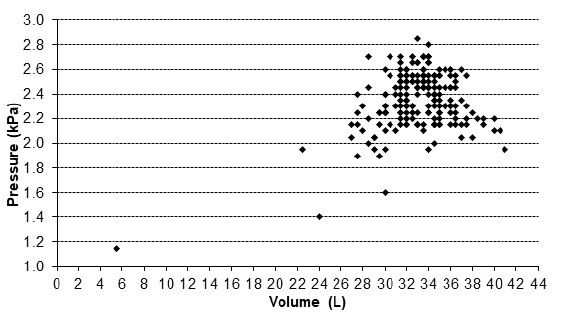
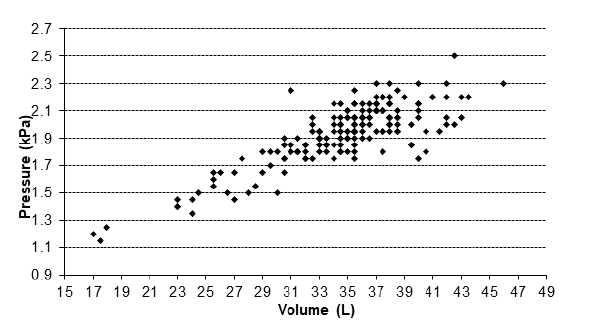
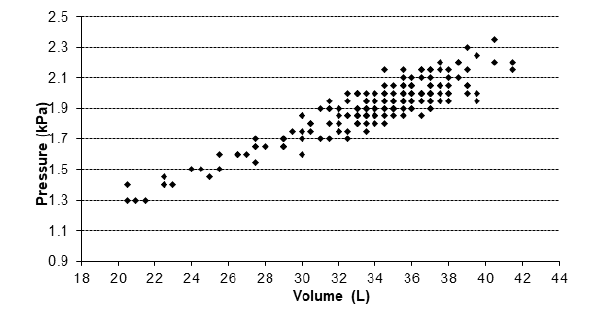
The study of the degradation/aging of natural rubber products in general and condoms in particular, is a major challenge because small modifications to the formulations, often overlooked by manufacturers, can alter the physicochemical properties of the products. (Graphs 1, 2 & 3) represent the different batches of male condoms from the different producers analysed.
Graph 1:Analysis of Volumetric Capacity and Burst Pressure.
Graph 2:Analysis of Volumetric Capacity and Burst Pressure.
Graph 3:Analysis of Volumetric Capacity and Burst Pressure.
Discussions and Conclusion
The results categorically state that different condoms produced by different manufacturers age and exhibit impaired performance over time. The results also indicate that the different products degrade at different rates, with the burst volume appearing to reflect the degradation process most sensitively. However, although the test to determine volumetric capacity and burst pressure is used as an indicator of condom strength by measuring pressure and burst volume, our study demonstrated the need to combine other analytical tests for a greater understanding of the entire degradation process that occurs in the product after its expiration date. It was not possible to perform all analytical tests due to the small number of samples required for a complete study.
References
- Brown RP (2001) Practical guide to the assessment of the useful life rubbers. England: Rapra Technology Ltd, p. 156.
- Brown RP, Forrest MJ, Soulagnet G (2000) Long-term and accelerated ageing tests on rubbers. England: Rapra Technology Ltd. Rapra Review Reports Report 110 (10)2: 1-79.
- Malaika SA (1991) Mechanisms of antioxidant action and stabilization technology-the Aston experience. Polymer Degradation and Stability 34: 1-36.
- Lucas PM, Baba M, Lacoste J, Gardette JL (2002) Crosslinking of dienic elastomers resulting from ageing: Xray diffraction and refractometry measurements. Polymer Degradation and Stability 76(3): 449-453.
- Chapman AV, PORTER M (1990) Sulphur vulcanization chemistry. In: Robert AD (Ed.), Natural Rubber Science Technology. Hertfordshire: Malaysian Rubber Producers’ Research Association 1136: 511-620.
- Coran AY (1994) Vulcanization In: Mark EJ, Erma B, Eirich FR (Eds.), Science and Technology of Rubber. Academic Press, New York, USA, pp. 339-469.
- Amorati R, Lucarini M, Mugnaini V, Pedulli GF (2003) Antioxidant activity of o-bisphenols: The role of intramolecular hydrogen bonding. J Org Chem 68(13): 5198-204.
- International Organization for Standardization (1996) ISO 4074: Rubber Condoms. Part 1: Requirements. Switzerland, p. 8.
- Free MJ, Srisamang V, Vail J, Mercer D, Kotz R, et. al. (1996) Latex rubber condoms: Predicting and extending shelf life. Contraception 53(4): 221-229.
- Bo MC, Silver L, Rodrigues S (1997) Consumer Oriented Assessment of Condoms in the Brazilian Market. 13th International Meeting in the International Society of Technology Assessment in Health. Barcelona.
- Yadesa TM (2014) Permeability and breakage status of male condoms artificially and naturally aged in humid tropical climate, the case of Jimma town, South-western Ethiopia. Journal of Public Health and Epidemiology 6(12): 436-441.
© 2026 Janete Duarte. This is an open access article distributed under the terms of the Creative Commons Attribution License , which permits unrestricted use, distribution, and build upon your work non-commercially.
Editor In Chief







.jpg)































Signup for Newsletter

Quick Links
 Editorial Board Registrations
 Submit your Article
 Best Paper of the Volume
 Reprints
 Refer a Friend
 Advertise With Us
Our Recent Edition

.jpg)


Top Editors




.jpg)

















.bmp)
.jpg)
.png)
.jpg)













.jpg)






.png)

.png)




.png)




Financial Support

Sponsors

Latest e-Books

Latest Video

 a Creative Commons Attribution 4.0 International License. Based on a work at www.crimsonpublishers.com.
Best viewed in
a Creative Commons Attribution 4.0 International License. Based on a work at www.crimsonpublishers.com.
Best viewed in 
 | Above IE 9.0 version