

- About Us
- Information
-

The Author ensures that the research has been conducted responsibly and ethically with adherence to all relevant regulations. read more..
- For Authors
- For Reviewer
- Manuscript Guidelines
- Membership
- Publication Ethics
-
- Journals
- Reprints
- e-Books
- Videos
- Policies
- Contact Us
 COVID-19
- Submissions



Full Text
Psychology and Psychotherapy: Research Study
Cognitive Flexibility and Psychological Well Being Among Students
Paramjit Singh1 and Harneet Billing2*
1 Research Scholar, Department of Education, Sri Guru Granth Sahib World University, India
2 Associate Professor, Department of Education, Sri Guru Granth Sahib World University, India
*Corresponding author: Harneet Billing,, Associate Professor, Department of Education, Sri Guru Granth Sahib World University, Fatehgarh Sahib, Punjab, India
Submission: June 12, 2026; Published: June 26, 2026

ISSN 2639-0612Volume9 Issue 5
Abstract
The present investigation seeks to examine the differential levels of cognitive flexibility and psychological well-being among students from rural and urban contexts. Cognitive flexibility, construed as the capacity to dynamically restructure cognitive frameworks and modulate behavioral responses in alignment with shifting environmental contingencies, constitutes a fundamental determinant of academic competence and emotional regulation. Psychological well-being, encompassing multifaceted dimensions such as selfacceptance, autonomy, environmental mastery, and the cultivation of positive interpersonal relationships, is equally indispensable for fostering comprehensive and adaptive student development. A comparative research design was adopted, incorporating participants drawn from both rural and urban educational milieus. Standardized and psychometrically validated instruments were employed to assess the constructs of cognitive flexibility and psychological well-being. The findings revealed statistically significant intergroup variations. Urban students exhibited relatively elevated levels of cognitive flexibility, a trend that may be attributed to increased exposure to heterogeneous experiences, technological affordances and cognitively stimulating learning environments.
Conversely, rural students demonstrated comparable-and in certain domains, superior-levels of psychological well-being, potentially reflective of cohesive community structures, robust social support systems, and relatively less competitive socio-academic climates. The results accentuate the salience of socio-cultural and environmental determinants in shaping students’ cognitive and affective functioning. The study underscores the imperative for context-sensitive educational interventions aimed at augmenting cognitive flexibility among rural learners, while concurrently strengthening mental health awareness, resilience-building and psychosocial support mechanisms within urban settings. The present findings contribute substantively to the extant corpus of knowledge in educational psychology and offer nuanced implications for educators, policymakers, and curriculum developers in the design and implementation of equitable, inclusive, and developmentally attuned educational frameworks.
Keywords:Cognitive flexibility; Psychological well-being; Rural-urban differences; Comparative analysis; Educational psychology; Student development
Introduction
In the contemporary educational milieu, there is a growing and unequivocal recognition of the imperative to transcend conventional academic metrics and adopt a more holistic and integrative understanding of student development. Education is no longer construed merely as the transmission and acquisition of knowledge; rather, it is increasingly conceptualized as a dynamic, multidimensional process that shapes cognitive capacities, emotional resilience, and adaptive functioning. Within this evolving paradigm, constructs such as cognitive flexibility and psychological well-being have emerged as pivotal determinants of students’ academic achievement, personal fulfilment and overall quality of life. Cognitive flexibility constitutes a critical dimension of executive functioning, encompassing the capacity to adapt to novel and complex situations, shift cognitive perspectives and generate alternative strategies for problem-solving. Its significance is particularly pronounced in the contemporary era, characterized by rapid technological advancements, globalization and continuously evolving socio-cultural dynamics. Students endowed with higher levels of cognitive flexibility are better equipped to navigate academic complexities, engage in innovative and critical thinking and demonstrate resilience in the face of uncertainty and change.
In contrast, psychological well-being represents a comprehensive evaluation of an individual’s mental and emotional state, incorporating dimensions such as self-acceptance, autonomy, environmental mastery, purpose in life and the ability to cultivate meaningful interpersonal relationships. It plays a fundamental role in shaping students’ motivation, engagement and long-term developmental trajectories, thereby underscoring its indispensability within the educational context. The ruralurban dichotomy offers a particularly compelling framework for examining variations in these constructs. Rural and urban environments differ substantially in terms of access to educational resources, technological exposure, socio-economic conditions, and cultural orientations. These contextual disparities are likely to exert a profound influence on both cognitive processes and psychological outcomes among students. Consequently, the present study seeks to undertake a comparative examination of cognitive flexibility and psychological well-being among rural and urban students, thereby contributing to a more nuanced and contextually grounded understanding of student development.
Theoretical Background
The conceptual foundation of cognitive flexibility is situated within the broader domain of executive functions, which encompass a constellation of higher-order cognitive processes, including working memory, inhibitory control and cognitive shifting. Cognitive flexibility, in particular, facilitates the ability to transition seamlessly between mental sets, adapt to changing environmental demands, and integrate novel information into pre-existing cognitive schemas. From a theoretical perspective, Piagetian frameworks underscore the role of cognitive restructuring in developmental progression, emphasizing the dynamic reorganization of cognitive schemas in response to environmental stimuli. Complementing this view, contemporary neuropsychological models highlight the critical involvement of the prefrontal cortex in mediating flexible and adaptive thinking. Furthermore, Vygotsky’s socio-cultural theory posits that cognitive development is fundamentally mediated by social interaction and cultural tools, thereby accentuating the pivotal role of environmental context in shaping cognitive flexibility.
Psychological well-being, as articulated by Ryff [1], is grounded in a eudaimonic tradition that prioritizes the realization of human potential over mere hedonic gratification. Ryff’s multidimensional model delineates six core components: self-acceptance, autonomy, environmental mastery, purpose in life, personal growth and positive relations with others. This framework underscores the intricate interplay between individual dispositions and environmental influences in fostering holistic well-being [2-5]. In addition, Bronfenbrenner’s ecological systems theory offers a comprehensive and multilayered perspective on human development, positing that individuals are embedded within a series of interconnected environmental systems. These range from immediate contexts such as family and school (microsystem) to broader societal and cultural influences (macrosystem), all of which collectively shape developmental outcomes [6].
Rural-urban context and developmental differences
The rural-urban dichotomy encapsulates profound variations in socio-cultural, economic and educational contexts, each of which exerts a distinctive influence on student development. Urban environments are typically characterized by enhanced access to technological resources, diverse educational opportunities and exposure to heterogeneous experiences [7,8]. Such conditions are conducive to the cultivation of cognitive flexibility, as they provide students with opportunities to engage in complex problem-solving, critical inquiry and adaptive thinking. Conversely, rural settings are often distinguished by close-knit community structures, stronger familial bonds, and a relatively slower pace of life. These attributes may significantly contribute to higher levels of psychological wellbeing by fostering emotional support, social cohesion and a strong sense of belonging. However, the relative paucity of educational resources and limited exposure to diverse experiences may pose challenges to the development of advanced cognitive competencies, including cognitive flexibility [9]. It is, however, imperative to acknowledge that these distinctions are not absolute but rather indicative of broader socio-cultural tendencies that necessitate empirical validation.
The Present Study
The primary objective of the present investigation is to undertake a rigorous and systematic comparative analysis of cognitive flexibility and psychological well-being among rural and urban students [10-12]. By examining these constructs in conjunction, the study seeks to elucidate the intricate interplay between cognitive adaptability and emotional functioning in shaping holistic student development. Cognitive flexibility, representing the capacity for adaptive thinking and effective problem-solving and psychological well-being, encompassing emotional stability and life satisfaction, are both integral to fostering well-rounded individuals. By situating these constructs within diverse socio-cultural contexts, the study aims to identify environmental influences that differentially impact cognitive and emotional outcomes. In doing so, it endeavors to generate insights that can inform the design of balanced and context-sensitive educational interventions aimed at promoting both cognitive competence and psychological well-being.
Objectives
a. To assess the levels of cognitive flexibility among rural
and urban students
b. To evaluate the levels of psychological well-being among
rural and urban students
Hypotheses
a. H₁: Urban students will exhibit significantly higher levels of cognitive flexibility than rural students
Methodology
Research design
The present investigation employed a quantitative, crosssectional, and comparative research design to systematically examine differences in cognitive flexibility and psychological well-being among rural and urban students [13]. The comparative design was particularly appropriate, as it enabled the systematic evaluation of variations between two naturally occurring groups defined by their socio-geographical contexts. The adoption of a cross-sectional approach facilitated the collection of data at a single point in time, thereby allowing for the assessment of existing levels of the variables without any experimental manipulation. This design is especially advantageous in educational and psychological research, where ethical and practical constraints often preclude the manipulation of contextual variables such as geographical location [14-16].
Participants
The sample comprised a total of 300 students, with equal representation from rural and urban settings (150 rural and 150 urban participants). The participants were drawn from secondary and senior secondary educational institutions, thereby ensuring representation across critical stages of adolescent development.
A stratified random sampling technique was employed to ensure proportional and unbiased representation of both groups [17]. Initially, schools were categorized based on their geographical location (rural or urban). Subsequently, participants were randomly selected from each stratum, thereby minimizing sampling bias and enhancing the representativeness of the sample. This methodological approach not only strengthens the internal validity of the study but also enhances the generalizability of the findings within the defined population framework.
Instruments
In order to ensure methodological rigor and the accurate assessment of the constructs under investigation, standardized and psychometrically validated instruments were employed.
Cognitive Flexibility Scale (CFS): Cognitive flexibility was assessed using the standardized self-constructed Cognitive Flexibility Scale (CFS), a widely recognized instrument designed to measure an individual’s capacity to adapt to changing situational demands, consider multiple perspectives, and employ flexible and alternative problem-solving strategies [18,19]. The scale comprises a series of items presented in a Likert-type format, wherein respondents indicate their level of agreement with each statement. The instrument captures key dimensions of cognitive adaptability, including awareness of alternatives, willingness to adapt, and confidence in flexible thinking. The CFS has demonstrated satisfactory levels of reliability (0.83) and validity across diverse populations, thereby rendering it suitable for the present study.
Psychological well-being scale (PWBS): Psychological wellbeing was measured using the Psychological Well-Being Scale (PWBS), grounded in Ryff’s multidimensional model of wellbeing. This instrument assesses six core dimensions, namely selfacceptance, autonomy, environmental mastery, purpose in life, personal growth, and positive relations with others. The scale is structured in a Likert-type response format and has been extensively validated across cultural contexts, demonstrating high internal consistency and construct validity [20]. Its comprehensive nature makes it particularly appropriate for capturing the multifaceted aspects of psychological well-being among adolescents.
Procedure
The data collection process was conducted in a systematic, structured and ethically compliant manner. Prior to the commencement of the study, formal permission was obtained from the respective school authorities, ensuring institutional approval for data collection. All ethical guidelines pertinent to psychological research were meticulously adhered to throughout the study. Participants were adequately informed about the purpose, nature, and significance of the research, as well as their rights as participants, including the assurance of confidentiality and the voluntary nature of their participation. Informed consent was obtained from all participants before administering the instruments. The questionnaires were administered in a controlled classroom environment under the direct supervision of the researcher to ensure uniformity in administration conditions. Clear and standardized instructions were provided to minimize ambiguity and ensure that responses were accurate and unbiased. Participants were encouraged to respond honestly and were assured that their responses would be used solely for academic and research purposes [21-24]. The entire data collection process was completed within a period of approximately two to three weeks. Strict measures were taken to maintain the confidentiality and anonymity of the participants, with no identifying information being disclosed at any stage of the research process.
Research Participants
Table 1:Summary of the questionnaire participants.
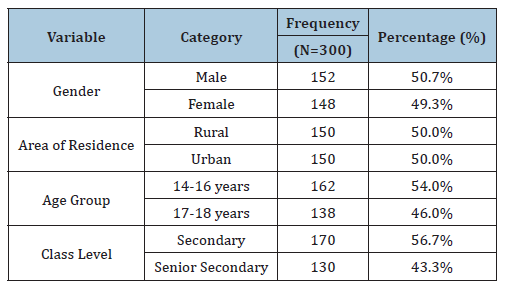
The study utilized random stratified sampling technique to recruit the participants for the study [25]. The selection aimed to ensure diverse representation in terms of gender, area of residence, age group and class level and regional background, allowing for a deeper exploration of possibly diverse pattern identified (Table 1).
Data Analysis
The collected data were systematically coded, tabulated and analyzed using appropriate statistical techniques to ensure the validity and reliability of the findings. Both descriptive and inferential statistical methods were employed. Descriptive statistics, including mean and standard deviation, were used to summarize the central tendency and dispersion of the data for each variable. These measures provided a foundational understanding of the distribution and variability of cognitive flexibility and psychological well-being scores among the participants [26-29]. For inferential analysis, the independent samples t-test was utilized to examine the statistical significance of differences between rural and urban students on the variables under study. This test facilitated the determination of whether observed group differences were statistically meaningful or attributable to chance. Furthermore, Pearson’s product-moment correlation coefficient was computed to assess the nature and strength of the relationship between cognitive flexibility and psychological well-being. This analysis enabled the exploration of the degree to which these constructs are interrelated. All statistical analyses were conducted at appropriate levels of significance, ensuring the robustness and interpretative validity of the results [30-34].
Result
Cognitive flexibility and psychological well-being of the students
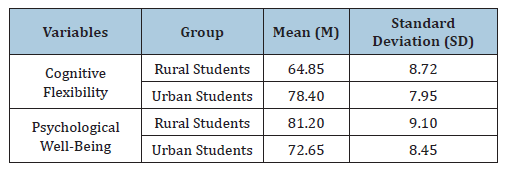
Descriptive statistics were run to show an overall picture of cognitive flexibility and psychological well-being of the students. Higher mean (M 78.40) on cognitive flexibility for urban students than rural students (M 64.85) suggest a greater aptitude for adapting to new information. However, for psychological wellbeing rural students possess higher mean (M 81.20) reporting more positive emotional states than their urban counterparts (M 72.65). The data highlights a distinct inverse relationship between mental adaptability and over all life satisfaction based on geographical location (Table 2).
Table 2:Descriptive Statistics for Study Variables.
Locale based differences in cognitive flexibility and psychological well being
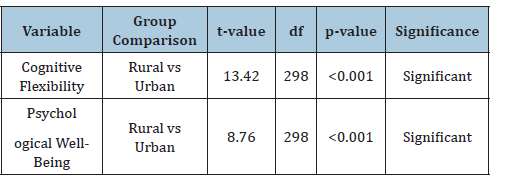
The findings of the present investigation reveal pronounced and statistically significant differences between rural and urban students with respect to cognitive flexibility and psychological well-being. Urban students demonstrated markedly higher mean scores on cognitive flexibility, thereby lending empirical support to the proposition that exposure to diverse, resource-enriched, and cognitively stimulating environments facilitates the development of adaptive thinking, cognitive restructuring, and problem-solving competencies. Such environments appear to cultivate the capacity to navigate complexity, ambiguity, and change with greater efficacy. Conversely, rural students exhibited relatively elevated levels of psychological well-being across multiple dimensions, particularly in domains such as positive interpersonal relationships and environmental mastery. This pattern suggests that the presence of cohesive community structures, robust social support systems, and comparatively lower levels of competitive stress contribute significantly to enhanced emotional stability and life satisfaction (Table 3).
Table 3:Independent Samples t-test for Rural and Urban Students.
Discussion and Implications
The findings of the present study offer compelling and theoretically grounded insights into the differential impact of environmental contexts on students’ cognitive and psychological development. The relatively higher levels of cognitive flexibility observed among urban students may be attributed to their sustained engagement with technologically advanced, pedagogically diverse and intellectually stimulating environments. Such contexts inherently demand higher-order cognitive processing, critical inquiry, and adaptive problem-solving, thereby fostering the development of flexible cognitive schemas and enhanced executive functioning. In contrast, the elevated levels of psychological wellbeing among rural students underscore the profound influence of socio-cultural cohesion and supportive interpersonal ecosystems. Rural settings are often characterized by strong familial bonds, closeknit community networks, and a heightened sense of belonging, all of which serve as protective factors against psychological distress. Additionally, the comparatively reduced intensity of academic competition and performance-related pressures in rural contexts may facilitate a more balanced, less stress-laden developmental trajectory.
These findings are congruent with extant theoretical and empirical literature, which emphasizes the centrality of environmental and socio-cultural determinants in shaping both cognitive and emotional outcomes. The observed positive correlation between cognitive flexibility and psychological wellbeing further reinforces the conceptualization of these constructs as inherently interdependent rather than discrete entities. Students possessing greater cognitive adaptability are more likely to employ effective coping mechanisms, regulate emotional responses, and navigate complex or uncertain situations with resilience and composure. Conversely, individuals with higher psychological well-being are better positioned to engage in flexible thinking and adaptive cognitive processing, owing to the availability of internal emotional resources. Collectively, these findings highlight the necessity of reconceptualizing education as an integrative enterprise that simultaneously nurtures cognitive competencies and psychological well-being. They underscore the importance of fostering environments that support both intellectual growth and emotional resilience, thereby facilitating holistic and sustainable student development.
Conclusion
The findings of the present study underscore the imperative of adopting a holistic, integrative and contextually responsive approach to education-one that explicitly acknowledges the dynamic interplay between cognitive competencies and psychological wellbeing in shaping overall student development. The differential patterns observed in the study suggest that urban environments, characterized by exposure to technological advancements, diverse experiential opportunities and intellectually stimulating academic frameworks, are particularly conducive to the cultivation of cognitive flexibility and adaptive thinking skills.
Conversely, rural contexts, marked by strong social cohesion, supportive interpersonal networks and relatively lower performance pressures, appear to provide a fertile ground for the enhancement of emotional stability, life satisfaction, and psychological well-being. These findings collectively highlight the complementary strengths inherent in both contexts.
In light of these distinctions, it becomes essential for educational policies and pedagogical practices to be contextsensitive, adaptive and responsive to the unique developmental needs of students across diverse environments. Rural educational systems may benefit from the integration of technological resources, experiential learning opportunities, and pedagogical strategies aimed at enhancing critical thinking and cognitive adaptability. Simultaneously, urban educational institutions must prioritize the promotion of mental health awareness, stress management interventions, and the cultivation of supportive social environments to mitigate the psychological challenges associated with highpressure academic settings. Thus, a balanced and comprehensive educational approach that simultaneously fosters cognitive growth and psychological well-being is indispensable. Such an approach not only enhances academic performance but also contributes to the development of resilient, adaptable and psychologically robust individuals capable of effectively navigating the complexities and uncertainties of the contemporary world.
Limitations
Not with standing its contributions, the present study is subject to certain limitations that warrant careful consideration in the interpretation of its findings. Foremost among these is the restricted geographical scope of the sample, which was confined to selected educational institutions within a specific region. This limitation constrains the generalizability of the findings, as variations in cultural, socio-economic, and educational contexts across different regions may yield divergent patterns of results. Additionally, the adoption of a cross-sectional research design inherently limits the capacity to establish causal inferences between cognitive flexibility and psychological well-being. As the data were collected at a single point in time, the study captures only a static representation of the variables, thereby precluding an examination of their developmental trajectories or temporal dynamics. Longitudinal investigations would be more appropriate for elucidating causal relationships and changes over time. Furthermore, the reliance on self-report measures introduces the potential for response biases, including social desirability bias, subjective interpretation, and response distortion. Participants’ self-perceptions may not always accurately reflect their actual cognitive or emotional functioning, thereby potentially affecting the validity and reliability of the data. Despite these limitations, the study provides valuable insights into the complex interplay between environmental context, cognitive flexibility, and psychological well-being, and offers a robust foundation for future research in this domain.
References
- Ryff CD (1989) Happiness is everything, or is it? Explorations on the meaning of psychological well-being. Journal of Personality and Social Psychology 57(6): 1069-1081.
- Ryff CD, Keyes CLM (1995) The structure of psychological well-being revisited. Journal of Personality and Social Psychology 69(4): 719-727.
- Keyes CLM (2002) The mental health continuum: From languishing to flourishing in life. Journal of Health and Social Behavior 43(2): 207-222.
- Diener E (2000) Subjective well-being: The science of happiness and a proposal for a national index. American Psychologist 55(1): 34-43.
- Seligman MEP (2011) Flourish: A visionary new understanding of happiness and well-being. Free Press p. 386.
- Diamond A (2013) Executive functions. Annual Review of Psychology 64: 135-168.
- Miyake A, Friedman NP, Emerson MJ, Witzki AH, Howerter A, et al, (2000) The unity and diversity of executive functions and their contributions to complex "Frontal Lobe" tasks: A latent variable analysis. Cognitive Psychology 41(1): 49-100.
- Scott WA (1962) Cognitive complexity and cognitive flexibility. Sociometry 25(4): 405-414.
- Martin MM, Rubin RB (1995) A new measure of cognitive flexibility. Psychological Reports 76(2): 623-626.
- Dennis JP, Vander WJS (2010) The Cognitive Flexibility Inventory: Instrument development and estimates of reliability and validity. Cognitive Therapy and Research 34(3): 241-253.
- Bronfenbrenner U (1979) The ecology of human development. Harvard University Press, USA.
- Vygotsky LS (1978) Mind in society: The development of higher psychological processes. Harvard University Press, USA.
- Piaget J (1952) The origins of intelligence in children. International Universities Press, USA
- Bandura A (1986) Social foundations of thought and action: A social cognitive theory. Prentice-Hall, USA.
- Singh A, Mukherjee P (2018) Psychological well-being among rural and urban adolescents. Indian Journal of Positive Psychology 9(2): 215-220.
- Kaur S, Kaur R (2015) Comparative study of mental health of rural and urban adolescents. International Journal of Education and Psychological Research 4(1): 43-47.
- Gupta M, Kumar S (2010) Mental health in relation to emotional intelligence among rural and urban adolescents. Journal of the Indian Academy of Applied Psychology 36(1): 33-36.
- Reddy KJ, Chandrashekar CR (1998) Prevalence of mental and behavioural disorders in India: a meta-analysis. Indian Journal of Psychiatry 40(2): 149157.
- Mishra RC (2003) Psychology in India: Trends and developments. Sage Publications, USA.
- Woolfolk A (2016) Educational psychology (13thedn) Pearson Education, UK.
- Santrock JW (2011) Educational psychology (5thedn) McGraw-Hill, USA.
- Hattie JAC (2009) Visible learning: A synthesis of over 800 meta-analyses. Routledge, UK.
- Zimmerman BJ (2002) Becoming a self-regulated learner: An overview. Theory Into Practice 41(2): 64-70.
- WHO (2014) Mental health: A state of well-being. World Health Organization.
- Patel V, Flisher AJ, Hetrick S, McGorry P (2007) Mental health of young people: a global public-health challenge. The Lancet 369(9569): 1302-1313.
- Suldo SM, Huebner ES (2004) The role of life satisfaction in adolescent mental health. School Psychology Quarterly 19(2): 133-149.
- Gilman R, Huebner S (2003) A review of life satisfaction research with children and adolescents. School Psychology Quarterly 18(2): 192-205.
- Dajani DR, Uddin LQ (2015) Demystifying cognitive flexibility: Implications for clinical and developmental neuroscience. Trends in Neurosciences 38(9): 571-578.
- Zabelina DL, Robinson MD (2010) Creativity as flexible cognitive control. Psychology of Aesthetics, Creativity, and the Arts 4(3): 136-143.
- Blair C, Diamond A (2008) Biological processes in prevention and intervention: The promotion of self-regulation as a means of preventing school failure. Development and Psychopathology 20(3): 899-911.
- (2005) National Curriculum Framework. New Delhi: NCERT, India.
- Government of India (2020) National Education Policy. Ministry of Education, India.
- Pratham (2023) Annual Status of Education Report (ASER).
- Kingdon GG (2007) The progress of school education in India. Oxford Review of Economic Policy 23(2): 168-195.
© 2026 Harneet Billing, This is an open access article distributed under the terms of the Creative Commons Attribution License , which permits unrestricted use, distribution, and build upon your work non-commercially.
Editor In Chief






.jpg)





























Signup for Newsletter

Quick Links
 Editorial Board Registrations
 Submit your Article
 Best Paper of the Volume
 Reprints
 Refer a Friend
 Advertise With Us
Our Recent Edition

.jpg)



Top Editors




.jpg)

















.bmp)
.jpg)
.png)
.jpg)












.jpg)





.png)

.png)




.png)




Financial Support

Sponsors

Latest e-Books

Latest Video

 a Creative Commons Attribution 4.0 International License. Based on a work at www.crimsonpublishers.com.
Best viewed in
a Creative Commons Attribution 4.0 International License. Based on a work at www.crimsonpublishers.com.
Best viewed in 
 | Above IE 9.0 version