

- About Us
- Information
-

The Author ensures that the research has been conducted responsibly and ethically with adherence to all relevant regulations. read more..
- For Authors
- For Reviewer
- Manuscript Guidelines
- Membership
- Publication Ethics
-
- Journals
- Reprints
- e-Books
- Videos
- Policies
- Contact Us
 COVID-19
- Submissions



Full Text
Psychology and Psychotherapy: Research Study
A Good Education: A Possible Dialogue Between Waldorf Pedagogy and Radical Behaviorism
Fabrício Emanuel Soares de Oliveira1*, Andrielly Gonçalves Nobre de Oliveira2, Auíri Tiago Nogueira dos Santos³ and Leonardo Tadeu Vieira4
1 Department of Mental Health and Collective Health, State University of Montes Claros (UNIMONTES), Brazil
2Postgraduate Program in Health Sciences, State University of Montes Claros (UNIMONTES), Brazil
3Florida University, USA
4Department of Education, State University of Montes Claros (UNIMONTES), Brazil
*Corresponding author: Fabrício Emanuel Soares de Oliveira, PhD in Health Sciences, State University of Montes Claros, Unimontes, Prof. Darcy Ribeiro University Campus, Prof. Rui Braga Avenue, Vila Mauricéia, Montes Claros, Minas Gerais, Brazil
Submission: January 26, 2026;Published: March 12, 2026

ISSN 2639-0612Volume9 Issue 4
Abstract
In this work the Waldorf Pedagogy was analyzed under an analytical-behavioral perspective applied to education, with the objective of verifying the existence of a similarity between them and the presence of contingencies in this pedagogy as a “model” for cultural planning in terms of education. Data were collected from online video observation, day-to-day observations of a Waldorf kindergarten, interviews with parents and teachers of the school. The data treatment consisted in identifying the contingencies that made the practice of such pedagogy to be effective, through functional analysis of the behaviors, in the school context, of the children and teachers. This work allowed a verification of similarities between the Waldorf Pedagogy and the educational propositions of Behavior Analysis. It is noticeable that some contingencies present in the Waldorf Pedagogy favor the learning process and can offer subsidies for a cultural planning.
Keywords:Education; Behaviorism; Anthroposophy; Teaching; Learning
Introduction
There are numerous theories, methodologies and/or teaching approaches that are often divergent, sometimes complementary and in some cases interrelated [1-3]. Criticism of traditional teaching methodologies and of currently operating educational systems is both common and controversial [4,5]. Some of these difficulties stem from the precarious material conditions of schools, from insufficient teacher training and commitment, from curricula that frequently fall short, from limited available resources, from students who appear disengaged, as well as from family and socioeconomic conditions that often hinder effective parental participation in their children’s school lives [4,6]. There is currently an overvaluation of intelligence within the educational field, neglecting the fact that human beings, in addition to thinking, also act and feel [7]. It is important to clarify what the present work is not. First, this text is not a comparison between two pedagogical proposals; rather, it offers a reading of Waldorf education, proposed by Rudolf Steiner, through the lens of B. F. Skinner’s Radical Behaviorist philosophy. Second, this text is not intended as an epistemological debate concerning the convergences and divergences-both philosophical and applied-between the two approaches discussed here. Such a debate is reserved for future work, possibly entitled Dialogues Between Skinner and Steiner. Radical Behaviorism (RB) is a philosophy of the science of behavior that aims to explain aspects of human behavior, defining behavior as any action of the organism, whether private (e.g., thoughts, feelings, emotions) or public (e.g., walking, speaking, running). To explain behavior, one must seek information in the organism’s genetic and environmental history. Another variable that influences human behavior is culture, upon which individuals depend [8].
RB presents several characteristics that contribute to the understanding of behavior. First, it adopts a monistic and materialist perspective, according to which there is no distinction between body and mind; public and private behaviors are understood through the same laws that describe their functional relations. Second, it embraces determinism, a defining feature of the natural sciences, which seeks to explain present events based on past conditions. Third, behavior is explained through the interaction between the organism and the environment. Fourth, RB adopts a selectionist perspective: Darwin’s theory of natural selection influenced RB at the ontogenetic and cultural levels, and the model of selection by consequences proposes that the probability of a behavior occurring in the future is altered as a function of its consequences [9]. In The Technology of Teaching, Skinner [10] defines the teaching process as the arrangement of reinforcement contingencies under which behavioral change occurs. For Skinner, teaching should facilitate learning and he identifies several factors that explain why teachers fail to teach effectively within the traditional model. First, in classroom settings, students often behave in ways that allow them to escape aversive consequences (e.g., teacher reprimands, low grades); as a result, the reinforcing effect of producing a correct response is overshadowed by the by-products of aversive control, such as anxiety, anger, fear, and counter control. Second, for a behavior to be established, reinforcement must occur immediately after the behavior. In most cases, only the teacher is able to correct students’ responses, which results in a significant delay between the student’s response and the teacher’s correction (i.e., reinforcement). Third, there is a lack of systematic programming of instructional materials that would guide learners toward the desired terminal behavior through successive approximations. Fourth, students are required to follow the same instructional pace; consequently, more advanced students may be forced to wait before progressing through the content, leading to boredom and wasted time, while students with greater difficulties may become lost if the teacher adopts the learning pace of the more advanced students [10]. This final point is strongly criticized by Enkvist [11] who argues that differences in performance may lead high-achieving students to lower their level in response to the difficulties faced by their peers [12].
Prior to Skinner, Rudolf Steiner (1861-1925), also concerned with shortcomings in the educational process, was invited to develop an educational proposal known as Waldorf Education (WE), which was established in 1919 in Stuttgart, Germany. Waldorf education is grounded in Steiner’s philosophical system, Anthroposophy, which is defined as an attempt to unite the spiritual dimension of the human being with the spiritual dimension of the universe, with the aim of expanding consciousness in order to become more fully human. Steiner conceives the human being as constituted by three interrelated components: Body, soul and spirit [13]. According to Waldorf education, teaching should occur in such a way that children learn and, upon reaching adulthood, are able to apply what they have learned in school, thereby becoming genuine scientists or philosophers [14]. The anthroposophical conception of human development takes into account the particularities of children and young people when designing instruction at each developmental stage, always respecting the learner’s capacity for understanding. From the anthroposophical perspective, human life does not unfold in a linear manner, but rather in cycles of approximately seven years, known as septennia, each of which has its own specific characteristics. For educational purposes, particular attention should be given to the first three septennia [15]. During the first septennium (birth to 7 years of age), learning occurs primarily through imitation and the child’s will predominates. At this stage, activities such as children’s songs should engage the senses through their beautiful rhythm. Content itself should not be treated as the central focus; rather, what matters is aesthetic and auditory beauty [16]. The second septennium (7 to 14 years of age) is characterized by formal schooling. The third septennium (14 to 21 years of age) is marked by the absence of a single teacher’s daily presence, as students are supported by a team of subject-matter specialists. Anthroposophy proposes that much of what is learned in early childhood is forgotten and later reemerges in the form of acquired faculties [17].
Waldorf education aims to foster freedom, enthusiasm and a sense of wonder toward learning, while respecting the child and creating an environment that stimulates learning without competition. Anthroposophy proposes the development and balance of the three human soul activities-thinking, feeling, and willing-through education, as these constitute the primary means by which human beings engage with the world [15]. Waldorf education is grounded in values and beliefs derived from Anthroposophy, which assumes that by understanding the human being it is possible to find solutions to human crises. In Waldorf schools, the objective is not merely to teach curricular subjects in isolation, but to consistently connect them to practice, enabling students to develop skills for solving future problems in society [2-15]. RB also presents proposals for an educational model aimed at developing free and creative behaviors. Through the acquisition of new behaviors, individuals expand their behavioral repertoire, improve their capacity to solve problems effectively and increase the likelihood of cultural survival-a core value of behaviorism [18,19].
From a behaviorist perspective, culture is understood as the product of a complex series of events-most often accidental-that determine human behavior. It is therefore possible to understand how culture exerts control over behavior and to propose cultural planning, defined as a way of modifying the social environment so that members of a culture behave more efficiently in maintaining it and confronting challenges [9]. To study culture scientifically is to understand how it emerges, how it is maintained, how it changes, how harmful cultural practices can be eliminated, and how practices that produce more beneficial social outcomes can be [20]. RB views education as an agency of social control that, through planning, seeks to establish behaviors that are useful to both individuals and society, with the ultimate goal of cultural survival. Consequently, teachers play a central role in cultural planning [21]. At first glance, a reading of the works of Skinner and Steiner may lead one to assume that there are no similarities between them, given that Anthroposophy is grounded in a spiritual view of the human being and may be characterized as a mentalistic theory, insofar as it attributes causal status to the “mind” in the explanation of behavior. In contrast, RB holds that explanations of behavior should be sought in the relations between the organism and the environment, without recourse to metaphysical entities as explanatory devices [18]. Nevertheless, a careful and critical examination of these authors reveals that the application of the principles of Waldorf Education (WE) presents notable similarities with the educational propositions advanced by RB. In this sense, the present study aimed to analyze the school environment and educational practices of a Waldorf-oriented kindergarten located in the city of Montes Claros, Minas Gerais, Brazil, in light of the theoretical assumptions of RB. Although Waldorf education remains relatively little known in Brazil, it has increasingly been presented as a possible response to the difficulties observed in so-called “traditional” teaching methods. The crisis in education appears to be a persistent problem, raising the question of whether high-quality education might represent an unattainable ideal. For decades, theorists have offered consistent critiques of curricula, pedagogical goals, and instructional activities grounded in a standardized conception of the typical student, among other issues [4, 22-24]. Several studies have sought to establish connections, comparisons, or analytical dialogues between various theoretical perspectives and Skinner’s work. Goltz [25], for example, analyze the concept of coercion from theoretical and philosophical foundations, bringing together contributions from Skinner and Foucault. Their study addresses coercion as a social and educational phenomenon, highlighting its historical relevance and its impact on these fields. L. Skinner [26], in turn, establishes a dialogue between Skinner’s methodology and theory of verbal behavior and Saussure’s linguistic approach. Similarly, Verhaegh [27] examines how Skinner and Quine each developed their distinct versions of behaviorism, the ways in which they influenced one another and the degree to which their approaches were truly aligned. By drawing on a wide range of new and previously overlooked evidence from their personal and academic archives, that study sheds fresh light on the connection between these two authors. Ogasawara [28] explores a possible dialogue between Skinner and Vygotsky concerning the concept of learning. Another influential work addressing educational conceptions is Skinner vs. Rogers [29], in which the authors compare the theoretical propositions of both thinkers, based on their respective conceptions of the human being and of education. Overskeid [30] proposes a dialogue between Skinner and Freud concerning Civilization and Its Discontents, while Pompermaier [31] examines critiques of causality advanced by Skinner and Merleau-Ponty.
Alam [32] debates on how digital transformation challenges traditional learning theories (behaviorism, cognitivism and constructivism). The review compares these established models with connectivism, which views learning as the process of connecting information across networks. Traditional theories emphasize structured learning and individual knowledge acquisition, while connectivism-proposed by Siemens and Downesfocuses on distributed knowledge and the ability to navigate digital connections. Connectivism supports dynamic, open-ended environments where the teacher acts as a network curator, contrasting with the structured, teacher-centered approach of traditional models, as the author cosider Skinner’s RB applied to education in spite of the broader and deeper environmental approach Skinner brings within his RB. Particularly noteworthy is the work of Melo and Rose [33] who suggest the need for greater dialogue between RB and other anthropological and social theories, an argument echoed by Gusso in his dissertation [34]. However, no research was identified that explicitly relates Waldorf education or Anthroposophy to RB.
Method
Participants
The study included two teachers from a Waldorf-oriented kindergarten located in the city of Montes Claros, Minas Gerais, Brazil, six students enrolled in this kindergarten and six parents or guardians of the students.
Setting
Interviews with parents and teachers, as well as observations of students’ daily routines, were conducted in a Waldorf-oriented kindergarten in the city of Montes Claros, Minas Gerais, Brazil. The institution served children aged 3 to 6 years, with a maximum of 15 children per shift.
Materials
Two interview protocols and two observation protocols were specifically developed for this study. One interview protocol was designed for parents, and the other for teachers. The parent interview protocol consisted of six questions related to the choice of Waldorf education and the developmental progress of their children. The teacher interview protocol comprised eight questions addressing classroom routines and teaching methods, both in loco and through video recordings. The observation protocols focused on aspects related to activity planning and the school environment, teacher-student and student-student interactions, instructional resources, teaching methods, and issues related to cultural planning.
Procedures
This study employed an exploratory design with a qualitative
approach. Data collection was conducted using multiple methods:
A. field research through participant observation, in which
the researchers visited the school and attended a meeting with
the school director and parents to explain the objectives and
procedures of the study.
B. Observation of online videos depicting the application of
Waldorf education, for which the researchers received prior
training to ensure systematic and consistent observation
C. Interviews with teachers and parents concerning Waldorf
educational methods. To ensure anonymity, participants’ names
were replaced with names of characters from children’s stories.
Data analysis was guided by the concepts of contingency and
functional analysis of behavior. Contingency is defined as the
relation among antecedents, behaviors, and the consequences
of those behaviors. Functional analysis involves identifying
the function of a given behavior by considering the context in
which it occurs and the effects it produces for the organism
[35,36]. The following procedures were carried out: 4 video
observations; 20 hours of in loco observation distributed across
five days; interviews with six parents; and interviews with two
teachers. All interviews were conducted at the kindergarten.
Data obtained from the video observations referred to Waldorforiented
kindergartens and elementary schools.
Ethical considerations
The research project was approved by the Research Ethics Committee (Research Ethics Committee (CEP)) of the United Faculties of Northern Minas Gerais (FUNORTE), under approval number 815,589. All ethical procedures required for research involving human participants were strictly followed.
Results
The first aspect analyzed was the physical structure of the schools observed both through video recordings and in loco. Across the 4 schools observed via video and at the Sertão Veredas Waldorf kindergarten, very similar physical structures were identified. All schools were organized in house-like settings, including rooms resembling bedrooms and kitchens, dining areas with tables, and tables decorated with candles and plants. The walls were painted in light colors and displayed numerous artworks produced by the students. In many schools, the floors were made of natural-colored wood. Toys were predominantly made of wood-often left in their natural color-or fabric and were handcrafted. All schools featured a fabric tent resembling a small house, furnished with child-sized household items such as stoves, pots, chairs and tables. Classrooms were equipped with chalkboards, tables, and chairs in natural tones. The outdoor areas included large yards with plants, soil areas where children could play, trees, and outdoor play equipment such as swings, seesaws, and similar structures. It was also observed that most schools did not have solid walls separating them from the street; instead, boundaries were defined by gates, screens, or fences. These schools were considered to present a welcoming and attractive physical environment, one that stimulates students’ interest by offering multiple spaces for play. In the video Waldorf Education Teaching Method [37], a teacher states that Waldorf kindergartens “should be like a second home for students, where they can be surrounded by love, affection, and care.” The activities most frequently observed included painting on blank canvases, aimed at fostering artistic development; watering plants; free play activities such as running, playing with soil, and using slides and swings; singing poems accompanied by choreographed movements; and forming circles for singing and dancing. Children consumed meals prepared at the school using organic foods and recited an ecumenical prayer before meals. Most activities began with a song. In the video Día de los Oficios 2013, Escuela Waldorf Alicante [38] activities related to professions were observed during a “day of work,” including washing clothes, shining shoes, mixing dough for cooking, hammering nails with toy tools, and hanging clothes on a clothesline. In Un día de verano en Nokken [39], older students participated in food preparation, while in Episode 1: Introduction to the Lakota Waldorf School [40], some children washed dishes and cups after meals. A teacher explains that such activities foster responsibility, manual skills, and the learning of practical abilities. Similar participation in daily tasks-such as cleaning the school and preparing meals-was also recorded during in loco observations. In a summer day in Nokken [39], teachers report that children up to seven years of age learn primarily through imitation, a process strongly encouraged in Waldorf schools. Teachers were observed harvesting fruit and preparing the soil without issuing explicit instructions, while children naturally began to imitate these actions.
Regarding teacher-student relationships, interactions were observed to be close and affectionate. Teachers established cordial relationships with all students and frequently engaged in physical expressions of care, such as touching, hugging, and kissing. Teachers remained physically close to the children, even when not directly intervening in activities. According to a teacher from the same school [39], students are free to choose their activities and teachers rarely intervene, doing so only when there is a risk of injury. Teachers sometimes assist younger children with dressing or hold them on their laps. Teachers greet all students and their parents at the beginning and end of the school day, a practice also observed in the school visited in loco.
To become a teacher in a Waldorf school, a specific professional repertoire is required, including broad knowledge of human development. Love is considered the foundation of social behavior, alongside artistic skills that stimulate students’ creativity and imagination. Teachers are also expected to regulate their temperament and language and to demonstrate sensitivity [24]. In interviews, most parents identified this close teacher–student relationship as a crucial element of the learning process. The Brazilian Ministry of Education emphasizes that “education must be understood in its entirety, recognizing care as inseparable from the educational process” [41]. With respect to student-student interactions, observations revealed frequent cooperation during group activities. It was common for children to converse, smile and spontaneously embrace one another, including during songs and choreographed activities. Collaboration among students was essential for the successful completion of tasks. In a summer day in Nokken [39] children were observed taking walks with teachers, during which older students held the hands of younger ones. Older children cared for younger peers by teaching them how to perform activities. One teacher reported that, in this way, students develop caregiving skills, and that helping others may be the most important lesson students can learn at school-namely, the ability to dedicate oneself to others, listen to them, and offer help. In the school observed in loco, teachers actively encouraged students to care for peers who were injured, for example, by helping them stand up, blowing on the injured area, or gently massaging it. Similar practices are described in Walden Two [42,43].
Regarding parental participation in Waldorf education, evidence from a meeting between parents and teachers at the observed kindergarten indicated that parents are highly involved in their children’s educational process, actively discussing activity planning and influencing institutional decisions. Parental and broader school community participation is also encouraged within the framework of RB [44]. In the interviews, several parents emphasized the importance of their involvement in their children’s education, recognizing education as a process that is not exclusive to the school but continues within the home environment. Snow White, the mother of a student, stated: “I think we always need to improve, and I also consider that this applies to us as parents, because I learned that here we participate as parents as well, so I think we have a lot to do for the school.” Such practices may represent important elements for cultural planning, as they involve the participation of all stakeholders in students’ educational development. With regard to the educational environment, Peter Pan, the father of a student, stated: “The environment is very constructivist; children can create and explore, and this is very good for their development.” In an interview, the teacher Rapunzel reported: When it is time for drawing, children are not given a ready-made drawing to color or complete; instead, we always provide a blank sheet so that they can create whatever drawing they wish.
Concerning the use of punishment, the teacher Rapunzel explained
There are several ways to set limits for children; however, it is very important to take into account what the child did, the moment at which the behavior occurred and the child herself. Sometimes you may talk to the child individually or take her to the chair. In other situations, you may shift the focus away from the ‘aggressor’ and place it on the group, because the child may simply be seeking attention and I do not reinforce this type of behavior. You can also redirect the child’s attention to another activity. In short, there are several options available to teachers, and we must be aware of which one to use and when to use it.
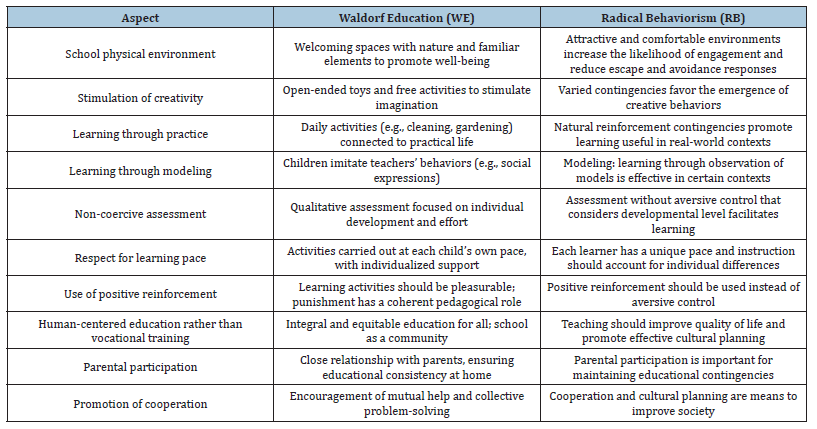
A summary of the common elements observed between Waldorf-oriented schools and the theoretical propositions of RB for education is presented in Table 1.
Table 1:Common characteristics between Waldorf education and Radical Behaviorism in education.
Discussion
The physical structure of Waldorf schools is designed to foster harmony and integration in children’s development, aligning with the pedagogical goal of using architecture and outdoor spaces as integral parts of the learning environment. In line with this, these schools are typically situated in welcoming and serene buildings and include natural outdoor elements such as gardens, trees, and play areas, creating an atmosphere of well-being and familiarity for students. This approach reflects the school’s intention to make the natural environment a living classroom and to promote a sustainable and aesthetically conscious setting for education [45]. Similarly, from the perspective of RB, the physical structure of any environment affects human behavior. An attractive, comfortable, and colorful room reinforces behaviors such as entering and remaining in the space, whereas an uncomfortable and visibly unpleasant environment may elicit emotional responses (e.g., anxiety), leading to avoidance or escape behaviors. Although the physical structure does not directly determine learning, a comfortable and appealing school environment increases the likelihood that students will feel motivated to remain at school [10-46]. Both approaches emphasize the importance of a welcoming environment as a facilitator of learning. Waldorf Pedagogy seeks to stimulate and develop creativity and imagination in students. For example, painting activities are always carried out on blank paper or boards and toys are generally handmade from wood or fabric, often without well-defined contours, in order to stimulate imagination and the emergence of new behaviors [47]. A novel or creative behavior emerges when, in a previously unexperienced situation, the organism emits a new response that may be reinforced and selected by its consequences. Artistic activities are also encouraged in Skinner’s Walden Two [42]. By proposing activities that are more independent and openended, WP provides contexts in which creative behaviors may emerge. In other words, the arrangement of varied contingencies favors the emission of creative behavior. Both approaches value experimentation, albeit from different theoretical foundations-WP emphasizing intrinsic imagination and Applied Behavior Analysis (ABA) focusing on behavioral shaping through reinforcement [19,43-48]. It is common in Waldorf schools for students to engage in daily practical activities, such as those mentioned above. From a behaviorist perspective, this practice benefits learning because it exposes students to natural contingencies of reinforcement-that is, behaviors are directly connected to the natural consequences they are likely to encounter in the future. Experiencing the outcomes of domestic activities, such as cleaning one’s environment, repairing furniture, or observing the growth of garden plants, exemplifies this process [9]. According to WP, during the first developmental stage (the first septennium), children’s speech patterns, gestures, and play behaviors are largely imitative, as they replicate behaviors they observe in their environment. For this reason, preschool teachers educate children primarily through example and environmental arrangement [23]. During in loco observations, it was noted that the teacher consistently used verbal expressions such as “thank you,” “please” and “excuse me,” which were subsequently imitated by the children, among many other behaviors. In alignment with WP, RB refers to learning through imitation as modeling. In certain contexts, organisms may learn more rapidly and efficiently through modeling than through other learning processes [17-34], which can be reached by the occasion of “a collegial basis for teachers working together as an important tool in shaping teachers’ values and beliefs” [48].
In Waldorf schools, students are not subjected to traditional assessment processes that exert coercive control over behavior. Greater emphasis is placed on students’ development than on statistical or standardized evaluation systems. Assessment occurs qualitatively, considering written work, imagination, richness of thought, logical structure, style, spelling, and actual knowledge, while also taking into account the effort invested by the student in achieving results [23]. This approach addresses one of the major problems of traditional education: aversive control in classrooms. Such an evaluative system establishes an environment that facilitates learning, as highlighted by Skinner [10] and Henklain and Carmo [19]. Recent research in both WP and RB indicates that less punitive and more encouraging environments promote better engagement and performance [49,50]. Skinner emphasized that students learn at different rates and that educational methods must account for this variability [10,17,51,52]. Waldorf teachers remain in close contact with students and strive to support them individually. When a student is identified as having difficulty in a particular subject, more intensive assistance is provided [23,53]. In the observed school, children completed activities at their own pace, allowing each student to learn according to their individual rhythm. Emphasis on individualized learning pace constitutes another point of convergence. WP organizes the curriculum into developmental cycles (septennia) and adapts activities according to children’s maturity [23,50], whereas behaviorism advocates for personalized instruction with reinforcement contingent on individual progress [10,54]. Both perspectives criticize rigid systems that disregard individual differences.
Skinner proposed that students should be taught primarily through positive reinforcement, avoiding negative reinforcement or punishment that exerts aversive behavioral control. Similarly, WP argues that students should love their work; from an RB perspective, this implies that studying should function as a reinforcing activity. In WP, punishments that lack a logical connection to the behavior are not applied; instead, disciplinary actions serve a pedagogical function, such as “those who make a mess should clean it” [10,17,23]. According to WP, excessively authoritarian education gives rise to undesirable behaviors such as rebellion, hypocrisy, lying, and other forms of self-defense [23]. Likewise, RB posits that coercive teaching methods generate byproducts of aversive control, including anxiety, anger, fear and counter control [10,17,55]. WP does not direct education toward specific professions; instead, it seeks to provide a shared human formation for all students. Waldorf schools function as an organism or “tribe,” in which work is oriented toward the collective, individual problems are treated as shared concerns, and solutions are discussed collaboratively. Schools strive to maintain close relationships with parents through pedagogical and artistic courses, festivals, presentations, fairs, and other community activities. Parents and teachers jointly manage and financially support the school, and parents are encouraged to maintain functional consistency between home and school environments, extending Waldorf education into family life. Parental participation in students’ educational processes and problemsolving is also considered essential from an RB perspective [17]. WP integrates parents and teachers within a cooperative structure [7], while RB recognizes that consistency between school and home environments enhances learning [17]. Studies in both theoretical frameworks highlight that collaboration between school and family improves educational outcomes [56].
WP directs education toward fostering cooperation and concern for helping others. This orientation may enable effective cultural planning, as encouraging cooperation rather than competitiveness promotes collaboration, reduces conflict, violence, and crime, and enhances collective problem-solving in society. Such outcomes align with Skinner’s goals in proposing RB as a philosophy underpinning a science of behavior, aimed at arranging contingencies to transform the world by improving human living conditions and quality of life [42,54,57-59]. Similarities were observed between the educational practices of the early childhood school where this research was conducted and the educational proposals presented by Skinner in The Technology of Teaching [10]. Both WP and RB share a view of education as a tool for social transformation. WP seeks to cultivate cooperative and socially conscious individuals [23-60], whereas RB proposes the planning of cultural contingencies to promote more harmonious societies [9-57]. Recent research in both approaches reinforces that non-authoritarian, development-centered methods tend to reduce conflict and promote socioemotional skills [48,49]. These similarities suggest that, in pedagogical practice, elements of both approaches may be complementary, particularly in contexts that prioritize holistic development and evidence-based methods [61]. As a limitation of the study, it should be noted that both WP and RB are grounded in distinct, broad, and complex philosophical and theoretical frameworks, and that this study examined only selected points of convergence between them. Additionally, the in-person observation was limited to activities conducted in a single kindergarten, without inclusion of Waldorf schools at other educational levels.
Conclusion
It can be concluded that similarities exist between the propositions examined, without emphasizing their epistemological or practical differences. Based on the identified similarities, the hypothesis that WP arranges contingencies that render it effective, humane and conducive to learning was corroborated. Thus, WP offers meaningful contributions to education from the perspective of RB. Some of these similarities may serve as points of reflection for cultural planning in contemporary educational contexts. According to the results of this study, certain characteristics are essential for effective teaching within both theoretical frameworks: A pleasant environment; minimization of aversive control in teaching processes and teacher-student relationships; closer relationships between teachers and students; student-student interactions that emphasize cooperation rather than competition; and active parental participation in children’s education.
References
- Alomar MJ Strauch CC (2014) Critical analysis of learning theories and ideologies and their impact on learning. The Online Journal of Counseling and Education 3(2): 62-77.
- (2021) European Council for Steiner Waldorf Education [ECSWE]. Media education in Steiner Waldorf schools.
- Alomyan H, Green D (2019) Learning theories: Implications for online learning design. In Proceedings of the 2019 3rd International Conference on E-Society, E-Education and E-Technology (ICSET 2019). Association for Computing Machinery, New York, NY, USA, pp. 126-130.
- Enkvist I (2011) Good and bad education. Goodreads.
- Magee K (2019) Steiner education: An analysis of the waldorf method as it relates to emotional intelligence. Humanities & Cultural Studies, Senior Theses.
- VargaS JS (2013) Behavior analysis for effective teaching (2nd edn), Routledge, p. 400.
- (2019) Aitiara waldorf school basic foundations of aitiara waldorf school Volume 1. Botucatu, SP.
- Skinner BF (1974) About behaviorism. Alfred A Knopf.
- Skinner BF (1953) Science and human behavior. Macmillan, pp. 27-35.
- Skinner BF (1958) The technology of teaching. Appleton-Century-Crofts 128: 969-977.
- Enkvist I (2014) Education: A guide for the perplexed. Ediciones Encuentro, p. 176.
- Fenner P, Rivers MJ (1995) Waldorf education: A family guide. Michael Olaf Company.
- Daskolia M, Koukouzeli V (2023) How sustainable is a waldorf school? exploring the congruence between waldorf education and the sustainable school approach in a Greek school case study. Education Sciences 13(4): 403.
- Hieu TM (2023) Rudolf steiner's viewpoint on the Spirit in the spiritual ground of education. Ra Journal of Applied Research 9(6): 356-360.
- Salchegger S, Wallner Paschon C, Bertsch C (2021) Explaining waldorf students' high motivation but moderate achievement in science: Is inquiry-based science education the key? Large Scale Assess Educ 9(1): 14.
- Neumann R (2024) Media education in Waldorf/Steiner schools. Frontiers in Education 9.
- Steiner R (1996) The foundations of human experience. In: Lathe RF, Whittaker NP (Eds.), Trans. Anthro posophic Press, USA.
- Attfield K (2022) The unique, spiritual and insightful education of waldorf pedagogy. Spiritual and Intellectual Upbringing and Teaching of Youth in the XXI Century (4): 34-38.
- Henklain MHO, Carmo JS (2013) Contributions of behaviour analysis to education: An invitation to dialogue. Cadernos de Pesquisa 4(149): 704-723.
- Goddard M (2023) Creativity and the radical behaviorism of b.f. skinner. creativity 6(2): 89.
- Brunkow F Dittrich A (2021) Cultural survival in b. f. skinner: possibilities for conceptual refinement. Behav Soc Issues 30(1): 774-786.
- Bordin JC, Silva LF, Lemes MJ (2016) The role of the teacher in the school of the future: An analytical-behavioral perspective. Education Culture and Society Journal 6(2): 412-423.
- Boland N (2015) The globalisation of steiner education: Some considerations. Research on Steiner Education 6: 192-202.
- Schlinger HD (2021) The impact of b. f. Skinner’s science of operant learning on early childhood research, theory, treatment, and care. Early Child Development and Care 191(7-8): 1089-1106.
- Attfield Kate (2024) The humane education of Waldorf. Frontiers in Education 9.
- Goltz SM (2020) On power and freedom: Extending the definition of coercion. Perspect Behav Sci 43(1): 137-156.
- Skinner LM, Cautilli JD, Hantula DA (2002) A verbal analysis of nonstandard English. The Behavior Analyst Today 3(1): 12-23.
- Verhaegh S (2019) The behaviorisms of skinner and quine: Genesis, development and mutual influence. Journal of the History of Philosophy 57(4): 707-730.
- Ogasawara JSV (2009) The concept of learning by skinner and vygotsky: A possible dialogue Salvador.
- Milhollan F Forisha BE (1972) From skinner to rogers: Contrasting approaches to education. Professional Educators Publications 127-128.
- Overskeid G (2007) Looking for skinner and finding freud. American Psychologist 62(6): 590-595.
- Mesquita PH (2018) Skinner and merleau-ponty’s criticism of causality. Trends in Psychology 26(1): 111-123.
- Alam MA (2024) Connectivism and traditional learning theories: Implications for contemporary educational and pedagogical practices. Bhartiyam Int J Educ Res 14(1): 11-24.
- Melo CMD, Rose JCCD (2012) Survival of cultures in skinner. Psychology Theory and Research 28(1): 119-128.
- Gusso HL (2008) Behavioral processes in the definitions of culture. Master's thesis, UFSC.
- Catania AC (2013) Learning (5th edn), Cornwall-on-Hudson, Sloan, New York, USA.
- Zhou M, Brown D (2017) Educational learning theories. Education Open Textbooks. Book 1.
- Futura C (2014) Waldorf pedagogy teaching method.
- Alicante EW (2013) Trades Day 2013. Waldorf School of Alicante.
- Compte RF (2013) A Summer Day in Nokken.
- School LW (2012) Episode 1 Introduction to the Lakota Waldorf School.
- Brazil-MEC (2010) National curriculum guidelines for early childhood education. Brasília: MEC.
- Skinner BF (1948) Walden Two. Macmillan.
- Altus DE, Morris EK (2009) B. f. skinner's utopian vision: Behind and beyond walden two. Behav Anal 32(2): 319-335.
- Azima R, Batubara J, Deliani N (2024) Behaviorist learning theory. Tsaqofah 5(1): 364-367.
- Attfield K (2024) The humane education of Waldorf. Frontiers in Education 9.
- Mavrelos E, Daradoumis T (2024) Assessing cognitive and perceptual abilities. Journal of Comparative Education 4(2).
- Bransby K, Rawson M (2020) Waldorf education for the future: A framework for curriculum practice. Steiner Waldorf Schools Fellowship: London, UK.
- Anwar MN, Sultan A, Ali F, Hayat S (2024) Application of behaviorist theory in classroom reforms. Qlantic Journal of Social Sciences and Humanities 5(2): 341-350.
- Bell A (2024) Teaching children to write and read in Waldorf schools. Frontiers in Education 9.
- Twyman JS (2014) Envisioning education 3.0. Mexican Journal of Behavior Analysis 40(2): 20-38.
- Akera A (2017) Bringing radical behaviorism to revolutionary Brazil and back: Fred Keller's Personalized System of Instruction and Cold War engineering education. Journal of the History of the Behavioral Sciences 53(4): 364-382.
- Friedlaender D, Beckham K, Zheng X, Darling-Hammond L (2015) Growing a waldorf-inspired approach in a public school district, USA.
- Bulla A, Wertalik JL, Yakabovits L (2024) Comparing restricted and free operant teaching arrangements. Journal of Behavioral Education.
- Holland JG (2016) Behavior analysis and positive human values. Brazilian Journal of Behavioral and Cognitive Therapy 18: 11-18.
- Li Y (2024) Nurturing tomorrow’s minds. Communications in Humanities Research 32.
- Boland N (2016) A sense of place within the waldorf curriculum. Pacifica Journal 50(2).
- Boland N, Demirbag JR (2017) (Re)inhabiting waldorf education. Educational Journal of Living Theories 10(2): 20-50.
- Goddard M (2017) B. f. skinner’s science and human behavior. Review of General Psychology 21(3): 276-280.
- Boland N (2024) Music as expression of children’s spirituality. International Journal of Children’s Spirituality 30(3): 1-17.
- Hadi K (2024) Psychology of learning theory in science learning Journal of Educational Research IPA 10(12): 920-929.
© 2026 Fabrício Emanuel Soares de Oliveira, This is an open access article distributed under the terms of the Creative Commons Attribution License , which permits unrestricted use, distribution, and build upon your work non-commercially.
Editor In Chief







.jpg)































Signup for Newsletter

Quick Links
 Editorial Board Registrations
 Submit your Article
 Best Paper of the Volume
 Reprints
 Refer a Friend
 Advertise With Us
Our Recent Edition

.jpg)



Top Editors




.jpg)

















.bmp)
.jpg)
.png)
.jpg)













.jpg)






.png)

.png)




.png)




Financial Support

Sponsors

Latest e-Books

Latest Video

 a Creative Commons Attribution 4.0 International License. Based on a work at www.crimsonpublishers.com.
Best viewed in
a Creative Commons Attribution 4.0 International License. Based on a work at www.crimsonpublishers.com.
Best viewed in 
 | Above IE 9.0 version