

- About Us
- Information
-

The Author ensures that the research has been conducted responsibly and ethically with adherence to all relevant regulations. read more..
- For Authors
- For Reviewer
- Manuscript Guidelines
- Membership
- Publication Ethics
-
- Journals
- Reprints
- e-Books
- Videos
- Policies
- Contact Us
 COVID-19
- Submissions



Full Text
Psychology and Psychotherapy: Research Study
Teachers’ Perceptions of Support for Retained Learners in Primary Schools of the Kingdom of Eswatini
Sibongile Nonozi Ndlela1 and Hlabathi Rebecca Maapola-Thobejane2*
1 PhD student, Department of Inclusive Education, University of South Africa, South Africa
2 Department of Inclusive Education, University of South Africa, South Africa
*Corresponding author: Hlabathi Rebecca Maapola-Thobejane, Department of Inclusive Education, University of South Africa, Building 10, Office No. 082, Sunnyside Building, Pretoria, 0001, South Africa
Submission: February 06, 2025;Published: March 03, 2026

ISSN 2639-0612Volume9 Issue 4
Abstract
This phenomenological study examined teachers’ perceptions of support for retained learners in primary schools in the Kingdom of Eswatini. Using a phenomenological research design, eight primary school teachers from four schools (two per school) in the Shiselweni region were purposively sampled. Data was collected through semi-structured interviews and document analysis and analysed thematically. The findings revealed that targeted instruction and peer collaboration were viewed as effective intervention strategies. Academic achievement was identified as the primary indicator of support for retained learners in primary schools. Additionally, teachers’ perceptions of support for these learners were influenced by their belief in the potential for influential learning. The study concludes that teachers share common perceptions regarding effective support for retained learners. These findings have important implications for further research.
Keywords:Grade retention; Learner support; Primary school; Retained learners; Teachers
Introduction
The efficacy of grade retention, also known as grade repetition, as an intervention to improve learners’ academic performance has been a subject of ongoing discussion among educational professionals and policy officials for several decades. In recent trends, grade retention has been perceived as a favourable endeavor to maintain high academic standards and accountability in education [1]. However, Kamin and Lamb AJ et al. [2] contend that grade retention lacks long-term benefits for learner achievement or overall outcomes and may instead have adverse effects on learners and educational districts. Similarly, Jacob B [3] and Kretschmann J et al. [4] posit that there is a global consensus that learner retention is linked to enhancements in standardized test results; however, these gains tend to diminish over time. Moreover, although many countries have adopted grade retention policies and subsequently implemented them in their districts and schools, grade retention has been reported worldwide as a major concern for the education system. Accordingly, teachers, who are pivotal at the primary education stage of learning, are expected to be supportive of learners who, incidentally, fall into this category, often called repeaters. However, literature is scant on how teachers perceive support for these retained learners in schools, which is primarily what the current study sought to explore.
The Salamanca Statement and Framework for Action on Special Needs Education are credited with establishing a broader focus on school inclusion, including learners with retained learning. Normative principles for inclusion are outlined in the Salamanca Statement (UNESCO, 1994). These principles identify institutions that include all learners, value variety as a strength, facilitate learning and attend to individual needs. Research and educational groups, politicians and member states and organizations that signed the Salamanca Declaration have all shown an increased interest in inclusive education (Rapp & Corral-Granados, 2021). However, research on inclusive education is crucial for understanding what inclusion is and how it can be achieved, as different countries have different understandings and definitions of the concept, as well as different approaches to developing inclusive practices (Hernández-Torrano, Somerton, & Helmer, 2020). The Eswatini government intends to achieve the United Nations Sustainable Development Goals (SDGs) by 2030. Among them is Goal 4: ‘Promote opportunities for lifelong learning for all and ensure inclusive and equitable quality education.’ The education of learners with special needs and disabilities seems to be the focus of inclusive education in this setting. To improve education, inclusive practices include working with parents and communities to develop curricula and assessments, as well as an inclusive pedagogy. This includes case management for specific learners who have been identified as having needs. However, it is unclear from the inclusive education policy how retained learners are supported in schools across the country. Thus, it is not surprising that the resources and strategies currently used in the education system have not resolved or mitigated the challenges teachers face in providing inclusive support for retained learners in primary schools [5].
As a result, the prevalence of grade retention in schools is costly for the government, parents and schools [5], detrimental to academic achievement [6] and negatively impacts learners’ mental health [7]. Achieving inclusive and equitable quality education requires exploring the inclusive education strategies teachers use to support retained learners in primary schools in Eswatini.
Grade retention in Eswatini
Grade retention has been a concern for all stakeholders in the education sector in Eswatini. As a result, the Ministry of Education and Training (MoET) in the Kingdom of Eswatini commissioned a sector-wide study on grade repetition in primary schools (MoET, 2018). The report indicates that the average repetition rate exceeds the national benchmark of 10% set by the MoET in 2018, at about 15%. The high retention rate raises concerns about teachers’ perceptions of support for retained learners in primary schools. Similarly, the high retention rate raises questions about the causes of the high repetition rate and the strategies the MoET and schools have put in place to address it. Consequently, recommendations for the promotion of inclusive education throughout the education and training sector have been revised in the National Education and Training Sector Policy ([NESP], 2018). The policy’s goal is to establish a fair and inclusive educational system that provides every learner with access to high-quality, free and compulsory basic and senior secondary education. The strategy lays forth a plan of action to guarantee that all learners have access to highquality education. Ensuring high-quality inclusive education for all learners is the primary objective of the Ministry of Education and Training (MoET), as stated in the Education and Training Sector Policy (2018) and the Eswatini Inclusive Education Standards Report (2019). The policy states that all learners will attend school in an inclusive environment, regardless of whether they have disabilities or belong to a marginalized social group. However, this objective has not been empirically investigated, resulting in persistent interrelated dimensions.
Persistent interrelated dimensions of grade retention
Grade repetition policies have several interrelated dimensions, namely: the economic, pedagogical, psychological, political and social dimensions [5]. From an economic perspective, grade retention is costly, requiring significant expenditures by governments, parents and schools [5]. Stone S [8] contends that the pedagogical dimension of grade repetition shows the harmful effects of grade retention on academic achievement. From a psychological perspective, grade repetition is detrimental to learners because it affects their mental health [7]. Pyne J [9] asserts that the behavioral challenges exhibited by retained learners reflect the emotional turmoil they experience, including low self-esteem and a lack of motivation. On a political level, high-grade retention can result from inefficient education systems, inadequate resources, poor working conditions for teachers and inadequate learning environments [10]. From a social perspective, grade retention is a selective method that may ruin the well-being of learners who feel excluded [11]. Therefore, the challenges posed by learner retention affect every dimension of human existence. Addressing this challenge from the primary school level remains crucial. Furthermore, the focus on teachers’ perspectives on support for retained learners in primary schools in Eswatini is key, as they are the custodians of the support these learners need to succeed. The study is significant because it contributes to the literature on teachers’ perspectives on support for retained learners in primary schools. Establishing teachers’ understanding of support for retained learners in primary schools could be significant in several ways. In Eswatini, most studies on grade repetition have not explored teachers’ in-depth understanding of how to support retained learners; instead, the topic has been mentioned only briefly. To bridge the gap, the current study explored teachers’ perspectives of support for retained learners in primary schools of Eswatini and how the support can be enhanced. The findings of the study may assist the education sector in initiating teacher programmes to support retained learners; prompt education authorities to review policies on learner retention; and enable retained learners to receive the support they need to succeed like their peers.
The constructivist theory of perception
Gregory RL [12] constructivist theory of perception has been adopted as a lens for the current study. The theory’s relevance remains evident in current classrooms. According to the constructivist theory of perception, past knowledge and experience are the most significant factors in comprehending the world around us [13]. Gregory’s theory holds that perception of objects is not solely based on their physical attributes but also on past experiences [14]. Gregory contends that perception involves cognitive processes and that humans do not merely receive information, but also rely on stored knowledge and experiences that influence their perception [12]. The constructivist theory of perception maintains that humans have so much sensory input [15]. This refers to everything that is happening in a person’s immediate environment, that there must be some form of ability to sort it out into meaningful information and the way in which humans do this is by using prior knowledge of a situation or object, their inferences about what will happen, together with their memories [16]. Gregory further argues that individuals base their perceptions on a perceptual set, which holds that their environment and its contents are shaped by what they expect to see. As Gregory RL [12] espoused, perception is an active cognitive process that entails the formation of inferences and interpretations. These mental operations are influenced by an individual’s prior knowledge, personal experiences and the contextual factors in play. In the current study, the theory serves as a wide lens through which the variables could be comprehensively studied. In essence, the theory highlights how teachers’ perspectives are influenced by both their current environment and their prior knowledge and experience. Based on the foregoing, the constructivist theory of perception was suitable because it provided a perspective and a lens for the study under investigation. Throughout history, teachers have viewed retention as a strategy to reduce skill variability in the classroom, thereby better meeting learners’ needs [5].
The implementation of summer school mandates, the provision of rigorous remedial programs during pre- and post-school hours and alterations in teacher and administrative perspectives were considered learner support mechanisms [6]. In their study, Santos NN et al. [11] also analyzed factors warranting attention when devising strategies for providing educational assistance to learners in the early years of primary school. The criteria under consideration were derived from learners’ attributes, the requirements of academic programmes and courses, the geographical context, the technical infrastructure, the programme’s scope and the managerial prerequisites. The scholars concluded that there is no universal blueprint for the design of support services and outlined the need for a comprehensive analysis of support services meant for retained learners. Additionally, Matera C et al. [17] assert that learners who encounter difficulties mastering specific skills and concepts, such as social and emotional learning, require special assistance. To help learners facing difficulties in educational settings, Matera C et al. [17] propose a set of five principles that teachers can employ. These scholars outline how implementing principles can enhance outcomes for retained learners, particularly during the primary years. In addition, these principles encompass strategic planning that aligns with learners’ developmental stages, a comprehensive understanding of individual learners, the use of instructional modeling and subsequent follow-up, ongoing assessment of learners throughout the lesson and the provision of consistent one-on-one or small-group interventions.
Research Methodology
This phenomenological study was conducted with eight (8) teachers from four (4) primary schools in the Shiselweni region of Eswatini. The researchers gained insight into the depth and complexity of the participants’ perspectives on support for retained learners. Phenomenology served as a research design for addressing the research question. The researchers used a qualitative research approach to determine how pertinent data were gathered. We explored participants’ real-life perspectives over time through detailed, in-depth data collection from various sources. In accordance with research ethics, participants were selected using purposive sampling [18]. The demographic information included age, qualifications and teaching experience, as shown in the figure below.
Population and sampling
The study population included teachers who had been teaching at primary schools since 2010, when Free Primary Education (FPE) was introduced in Eswatini. Both male and female primary school teachers were eligible to participate in the study. English and Social Studies teachers of Grade six in the Shiselweni region of the Kingdom of Eswatini participated in the study. In line with the purpose of this study, the researchers selected a more homogeneous group from the entire population with in-depth experience with the phenomenon under investigation. As a result, eight (8) teachers from four (4) schools of Eswatini in Shiselweni region were sampled. The first school was selected for its location in an urban area and for being a pilot school for the National Curriculum Centre (NCC), which designs materials for the primary education curriculum to enhance the implementation of inclusive education. The second school was selected for its location in a semi-urban setting and for piloting NCC. The third school was selected because it is in a rural area of Eswatini and is also a NCC pilot school. Lastly, the fourth school was selected because it is a private school and is in an urban area. As a result, the contexts of different schools were taken into account when selecting schools for this study. Therefore, the purposively sampled school contexts in this study included primary schools in urban, semi-urban and rural areas, as well as private schools in an urban area. The figure below shows participants in detail (Table 1).
Table 1:Teachers’ demographic data.
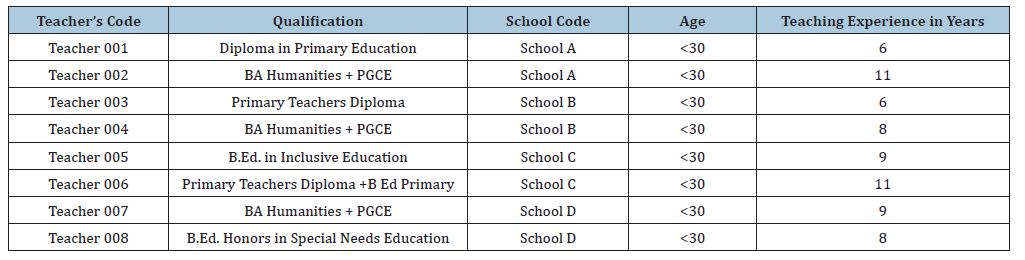
There were eight participants in the study, as shown in Table 1 above. These were professional primary school teachers who had teaching qualifications. Their qualifications ranged from Primary Teachers’ Diploma at the lowest, to B.Ed. Honours in special needs education at the highest level. Their qualifications enhanced the study, as they all held formal teaching qualifications, enabling them to understand what the study entailed. The participants were also experienced teachers. Their teaching experience ranged from six (6) to eleven (11) years. Having experienced participants was feasible because they had sufficient insight into the research’s purpose and could provide rich, relevant data. Findings revealed that all participants from the four primary schools were over 30 years old.
Data collection and analysis
Data was collected using interviews and document analysis. The semi-structured interviews and document analysis provided insight into the support for retained learners that teachers used in primary schools in the Shiselweni region. The interviews were conducted face-to-face and semi-structured questions allowed the researchers to probe further with follow-up and gather more information. Each school was visited twice. During the first visit, the study was introduced to the four schools and the data collection procedure was explained to both the principal and the participants. Participants were given consent forms that explained the purpose of the study and their willingness to participate. They were also informed that their participation in the study was voluntary and that they could withdraw at any time. Both English and siSwati were used to conduct the interviews, depending on each participant’s preference. This was done because, if only English were used, whilst it is their second language, participants would not be able to express their views comfortably. Each participant was given a pseudonym to protect their identity. The eight participants were interviewed individually and each interview lasted about one (1) hour to one (1) hour and 30 minutes. All participants were interviewed using the same set of questions. The researchers took notes and with participants’ permission, used a digital voice recorder to record participants during interviews as a backup for the notes. Thereafter, the interviews were transcribed for analysis. A copy of the transcribed interviews was sent to the participants via email to check if their views were appropriately captured. Document analysis resulted from a thorough scrutiny of documents that were reliable and relevant sources of information in the study. The documents were requested from each participant at the four schools during the first visit, so they may be obtained with the principal’s permission in preparation for the next visit. The sought documents included policy documents on retained learners and inclusive education, monthly test question papers from the past 5 years, examination questions from the past 5 years, progress reports from the past 5 years and gazettes issued by the Ministry of Education on retained learners. These documents were sought from all eight participants in the study. Data was transcribed, sorted and analyzed thematically.
Findings of the study
The following findings emerged from the study:
Finding 1: Targeted instruction and peer collaboration are perceived as intervention strategies to support retained learners
Participants were asked about their understanding of support for retained learners. They explained that they understood support for retained learners to mean classroom intervention strategies. The common thread was the intervention strategies teachers used in the classroom. Each teacher’s responses suggested intervention strategies, indicating that they understood the support for retained learners. Moreover, other participants mentioned schools in their descriptions of support for retained learners. They described the support as intervention strategies adopted by the school, with modifications made by individual teachers to suit the ability of retained learners as outlined below. In summary, participants’ responses explained support for retained learners as intervention strategies by the individual teacher and the school. They described the support needed by retained learners in primary schools in Eswatini. The following table outlines the details of this finding (Table 2).
Table 2:Individual teacher and the school.

As shown in Table 2, the intervention strategies yielded two descriptions, namely: targeted instruction and peer collaboration.
Targeted instruction
Targeted instruction is another intervention strategy to support retained learners, as submitted by the participants. Targeted instruction refers to the process of aligning the specific educational requirements of individual learners with established learning objectives [1]. Participants had this to say:
Teacher 001: “What I understand about support for retained learners is that they get special interventions that are targeted for them as individual learners.”
Furthermore, Teacher 003 submitted that: “My understanding of support of retained learners is that all learners with learning difficulties need to be taught as per learning needs and developmental needs.” The same sentiments were shared by Teacher 006, who stated that: “One of the intervention strategies is targeted instruction.”
This finding revealed that targeted instruction is an intervention strategy teachers use to support retained learners. The present discovery is consistent with Suh’s (2023) research findings. The study demonstrated that teachers transitioned from a predominantly didactic approach, in which physical models were primarily used as demonstration tools, to a more interactive approach that utilized models as problem-solving tools. This approach involved guiding teachers to reflect on their own pedagogical use of models and to devise strategies for integrating specific instructional techniques centered on models into their curriculum.
Similarly, another study by Santos et al. [11] explored effective strategies for developing teachers, their impact on overall learner performance and the benefits of targeted instruction. Findings of the study revealed that targeted instruction should be implemented using the three Cs, that is, be constant, consistent and clear when supporting student learning. Further, Scott TM [5] states that intervention strategies are a plan of action set to assist learners who take longer to pick up in class. The main pointers for effective intervention strategies are identifying learners who need support and their needs and learning gaps.
Likewise, Matera C et al. [17] identify support for retained learners as an integral role for teachers, ensuring that individual learners achieve their learning goals. Redding C et al. [6] posit that teachers of retained learners need to understand them, which is the basis for supporting them in primary schools. The current study revealed that targeted instruction involves identifying learners’ support needs and the type of support needed to improve their academic performance. Primary school teachers should therefore consider identifying retained learners’ support needs as an intervention strategy in their classrooms.
Peer collaboration
Another intervention strategy identified in the current study was peer collaboration. Gullickson A [19] defines peer collaboration as a process that allows a learner to learn from colleagues, transfer knowledge to classroom practice and reflect on what has been learned. In addition, Dickson et al. (2019) defines peer collaboration as an educational method that helps learners solidify their knowledge by teaching one another. Participants had this to say:
Teacher 001: “This small group support system of collaborating with their peers should be implemented on an ongoing and routine basis.”
Teacher 005 also highlighted: “My understanding of support for retained learners is when I use small groups to teach.”
These findings revealed that support for retained learners can best be achieved when teachers use peer collaboration through small groups. As a result, the study found that peer collaboration using small groups allows teachers to support retained learners. This finding is consistent with the results of a research study conducted by Kamin SJ [2] in Boston. The study demonstrated that collaborative efforts among retained learners can lead to a more substantial acquisition of knowledge on the subject matter, surpassing the potential outcomes of individual or competitive learning approaches. Furthermore, research by Kretschmann J et al. [4] indicates that peer collaboration is a crucial tactic for addressing the educational needs of learners with learning difficulties. However, Santos NN et al. [11] cautions that teachers should be thoughtful about group composition and allow retained learners space to reflect on how they benefit from peer collaboration.
Similarly, the current study found that peer collaboration as an intervention strategy encourages retained learners to learn and succeed academically. As a result, primary school teachers should consider peer collaboration when supporting retained learners in the classroom.
Finding 2: Academic achievement is perceived as the main indicator of support for retained learners
Participants were asked to describe indicators of support for retained learners in primary schools. The findings revealed that teachers defined support for retained learners in primary schools in terms of academic achievement. Academic accomplishment pertains to the quantifiable results that indicate the extent to which a learner has effectively achieved predetermined goals that were the central emphasis of educational endeavors within instructional environments [6]. Additionally, Matera C et al. [17] define academic achievement as the extent to which learners have achieved their learning goals. The major pointers link to the attainment of marks or grades that permit the learner to progress from one level to the next based on the standards set by the school (40% or 50%) and guided by the Ministry of Education and Training. Participants had this to say:
Teacher 008 reckoned: “Academic achievement is instrumental in support for the retained learners.”
Teacher 003 disclosed that: “It’s a big challenge for the teacher, but assisting the learner to achieve the academic goals for me is really an achievement.”
Teacher 008 expressed that: “Most of the achievement support should centre on passing to the next grade. That is my understanding.”
Teacher 001 reported: “For me, I understand support to mean that I help the learner to achieve the required skills to progress to the next level.”
Teacher 004 stated: “I’m sure it is when the learners can achieve the expected skills and knowledge after implementing the various learning strategies of support.”
Teacher 006 also presented that: “Retained learners need to attain the required mark to progress to the next level. So, when you work with the learner to achieve the required academic mark to progress, it is support.”
The study revealed that academic achievement for retained learners is best described as helping them achieve a pass mark and progress to the next level of their studies. This finding aligns with Gullickson’s (2022) study, which found that academic achievement is a positive, demonstrable outcome of learners’ academic performance. The study further revealed that, to thrive in a learning environment, academic achievements should be viewed as character traits, knowledge and experience that enable an individual learner to achieve learning goals.
Matera C et al. [17] have proposed that academic achievement serves as a measure of a learner’s successful attainment of specific goals emphasized in each learning environment. This assertion suggests that academic achievement reflects the extent to which learners have met the expectations and requirements of their educational programs. Similarly, Scott TM [5] has found that academic achievement is positively associated with selfefficacy, fewer academic difficulties and learning environments that promote autonomy. This finding highlights the importance of creating supportive learning environments that enable learners to develop the necessary skills and confidence to succeed academically. Support was also defined as assisting the retained learner in achieving a pass mark and progressing to the next level in this study. Teachers should therefore support all retained learners to achieve a pass mark or grade and progress to the next grade level.
Finding 3: Teachers’ perceptions of support for retained learners are driven by the individual teacher’s belief in influential learning.
When asked why teachers perceive the support for retained learners in primary schools the way they do, the findings revealed that teachers’ perceptions were driven by their individual beliefs in influential learning. Influential learning, as defined by Scott TM [5], is the ability to shape learners’ behavior in a particular direction by leveraging key tactics that connect with and inspire them. Participants submitted that individual teachers are key in modeling instruction and following up on retained learners. This involves the teacher thinking aloud and role-playing using teaching aids. Participants had this to say:
Teacher 001 asserted that: “Teachers need to model the right behavior so that retained learners can apply what they see. For example, if a teacher misses classes, learners will not attend class regularly as well.”
Teacher 002 shared that: “As teachers, we influence learners by what we do. To support them, we need to influence them towards positive behavior.”
Teacher 007 clarified that: “My understanding of support for retained learners is that all those around the learner must model good behavior in order to influence the learner to do the same.”
In line with the findings, participants used influential learning to explain their rationale for perceiving the support of the retained learner, which they want the retained learner to provide. The study revealed that influential learning for retained learners is best explained as modeling instruction. The present discovery is consistent with the outcomes of a research investigation carried out by Shinn MR [7], which posits that the acquisition of knowledge is a multifaceted process that amalgamates personal and environmental experiences and influences to facilitate the exploration, enhancement, or alteration of one’s knowledge, skills, values, attitudes, behaviors and worldviews. Fairbanks contends that learning is predicated on a set of routines that instill information into the learner’s memory bank, as well as positive role modeling from educators and educational institutions.
In their study, Redding C [6] assert that influential learning reflects general learning principles and is assumed to have relatively broad applicability. Consequently, incorporating these factors into the design of support for teaching retained learners has the potential to enhance the efficacy and efficiency of the learning process. Additionally, Karwasz GP [14] investigated effective influential learning strategies for retained learners and suggested that effective influential learning can take different forms. In every instance, effective learning ought to elucidate the anticipated requirements of a given task without divulging the solution and should persist as a resource accessible to learners throughout the task. This entails furnishing a comprehensive array of examples, offering explicit direction regarding the assignment’s expectations and demonstrating the sequential execution of the task’s steps. From the study, supporting retained learners requires that teachers have the capacity to influence learning through modeling, inspiring and encouraging the learners to create a common goal and achieve good academic results.
Discussion of the Findings
Findings highlight that teachers have a similar understanding of what constitutes support for a retained learner. The study found that targeted instruction and peer collaboration are crucial intervention strategies to support retained learners; academic achievement is the main indicator of support for retained learners and teachers’ perceptions of support for retained learners are driven by the individual teacher’s belief in influential learning.
The present study’s findings are consistent with those of Neutzling M et al. [16], who posit that among the various important responsibilities of a teacher, support for individual learners is one of the most critical constructs for learner achievement. This form of assistance is particularly important for individuals who face challenges in acquiring specific skills and understanding complex ideas, especially in the realm of social and emotional learning. Pyne J [9] recommends five principles to enhance outcomes when providing support to struggling learners in the primary years. These principles, as outlined by Suh [10], include knowing individual learners, planning instruction based on learners’ developmental levels, modeling instruction and following up with learners, assessing students throughout the lesson and providing consistent one-on-one or small-group interventions. The current study identified these as targeted instruction, peer collaboration, academic achievement and influential learning. The findings of the current study were therefore consistent with those of other researchers.
The study found that teachers’ understanding of support for retained learners in primary schools was relatively similar and was clearly articulated by teachers teaching primary schools in Eswatini in this study. Based on this understanding, it is expected that teachers will support retained learners in their day-to-day duties. Teachers also need to consider the differences between learners who have been retained and those who have not been retained in the classroom. These sentiments are in line with Matera C et al. [17], who state that one of the most critical constructs in student achievement is support for individual learners and that this support is particularly necessary for retained and struggling leaners to achieve good results. Indeed, in Eswatini, primary schools use tests to determine whether a learner will progress to the next grade or repeat the same grade. Given the prevailing emphasis on higher educational standards, an increasing number of students are facing the prospect of being held back because they cannot attain the required test scores for progression. At the same time, teachers must deal with large enrolments due to Free Primary Education (FPE) and provide limited support to learners, thereby perpetuating the cycle of student retention in primary schools [20- 29].
Conclusion
The study concludes that teachers share common perceptions regarding the effective support for retained learners. Research on retained learners has often overlooked teachers’ perceptions of support, treating the topic only briefly. According to Gregory’s constructivist theory of perception discussed earlier, teachers’ perceptions of support for retained learners are seen as active cognitive processes. These processes involve forming inferences and interpretations, which are shaped by the teachers’ prior knowledge, personal experiences and the contextual factors at play. Specifically, the study examined the phenomena of their perceptions of support for retained learners from three angles: teachers’ understanding of support for retained learners, their definitions of retained learners and the reasons behind their perceptions of support in primary schools. As a result, this study’s findings contribute to the existing literature by presenting data from Eswatini, where similar research is lacking. This adds to the limited understanding of teachers’ perspectives on support for retained learners in primary education. Furthermore, the study offers valuable insights from Africa, particularly the sub-Saharan region.
Limitations of the Study
The results of the current study are influenced by several factors. First, the study focused solely on teachers’ perceptions and did not examine teacher attributes, such as attitudes and confidence levels regarding the teaching of retained learners, as these were outside its scope. Since the research was purely qualitative and employed a phenomenological design, it was not possible to establish causal relationships among the variables of interest. Additionally, the study concentrated only on the Shiselweni region, so the results cannot be generalized to the entire country.
Recommendations for Further Study
Based on the conclusions of this study, the researcher recommends conducting further research, particularly using quantitative methods, to gain insight into how teacher attributes influence their perceptions of support for retained learners in primary schools. This aspect was unfortunately beyond the scope of the current study. Additionally, future studies should not only describe indicators of support for retained learners in primary schools but also test their efficacy, which was beyond the scope of the current study. Lastly, further research could examine the same topic in secondary schools and other regions of Eswatini to determine whether location and other demographic factors affect teachers’ perceptions of support for retained learners.
References
- Kyereko DO, Smith WC, Ishmael H, Keney G (2022) Understanding grade repetition from the perspectives of teachers and principals in basic schools in Ghana. International Journal of Educational Development 93(2): 334-338.
- Kamin SJ, Lamb AJ (2021) Grade retention after COVID-19: Evidence-based guidance. International Journal of the Whole Child 8(1): 96-103.
- Jacob B (2016) The wisdom of mandatory grade retention. Brookings.
- Kretschmann J, Vock M, Lüdtke O, Jansen MC, Gronostaj A, et al. (2019) Effects of grade retention on students’ motivation: A longitudinal study over 3 years of secondary school. Journal of Educational Psychology 111(8): 1432-1443.
- Scott TM (2021) Implicit bias, disproportionate discipline and teacher responsibility for instruction as prevention. Preventing School Failure 65(4): 291-300.
- Redding C, Carlo SM (2023) The adoption of test-based grade retention policies: An event history analysis. Educational Policy p. 08959048231174886.
- Shinn MR, Walker HM, Stoner GE (2020) Interventions for academic and behavior problems II: Preventive and remedial approaches. National Association of School Psychologists.
- Stone S (2023) Considering retention in the light of the Covid-19 pandemic. International Journal of the Whole Child 8(1): 96-103.
- Pyne J (2023) Teacher perceptions of past classroom behaviours influence adolescents’ receptivity and responsiveness to a belonging intervention. Educational Evaluation and Policy Analysis 46(1): 01623737231154605.
- Suh D (2023) Understanding teachers’ perceptions of pedagogy in teaching mathematics to English language learners. Doctoral Dissertation, Walden University, USA.
- Santos NN, Pipa J, Monteiro V (2023) Analysing grade retention beliefs within teachers’ psycho-pedagogic beliefs system. Teaching and Teacher Education 121(2): 103939.
- Gregory RL (1970) The intelligent eye. Weidenfeld & Nicolson, London, pp. 181-185.
- Fox R (2001) Constructivism examined. Oxford review of education 27(1): 23-35.
- Karwasz GP, Wyborska K (2023) How constructivist environment changes perception of learning: Physics is fun. Education Sciences 13(2): 195-208.
- Bonner SM, Chen PP (2009) Teacher candidates’ perceptions about grading and constructivist teaching. Educational Assessment 14(2): 57-77.
- Neutzling M, Pratt E, Parke M (2019) Perceptions of learning to teach in a constructivist environment. Physical Educator 76(3): 756-776.
- Matera C, Paradisi M, Boin J, Nerini A (2022) Perceived mattering in the face of COVID-19: links with emotion regulation and psychological well-being. Psychology & Health 37(12): 1471-1491.
- Bhandari P (2023) What is qualitative research? methods & examples. School Effectiveness and school improvement 19(1): 1-19.
- Gullickson A (2023) Differences in the risk of grade retention for biracial and monoracial students in the United States, 2010 to 2019. Sociological Science 10: 403-428.
- Buckmaster JL, Urick A, Ford TG (2023) A quasi-experimental, longitudinal study of grade retention on language outcomes for english language learners. Journal of Education for Students Placed at Risk (JESPAR), pp. 1-30.
- Dickinson DK, Collins MF, Nesbitt K, Toub TS, Hassinger-Das B, et al. (2019) Effects of teacher-delivered book reading and play on vocabulary learning and self-regulation among low-income preschool children. Journal of Cognition and Development 20(2): 136-164.
- Vázquez CG, Postigo A, García-Cueto E, Aller AM, Muñiz J, et al. (2023) Grade retention impact on academic self-concept: A longitudinal perspective. School Mental Health 15(2): 1-11.
- Korstjens I, Moser A (2018) Series: Practical guidance to qualitative research. Part 4: Trustworthiness and publishing. European Journal of General Practice 24(1): 120-124.
- Leedy PD, Ormrod JE (2019) Practical research: Planning and design, global edition. Pearson Education Limited.
- Maree K (2020) First steps in research (3rd edn), Van Schaik Publishers, Pretoria, South Africa.
- Mayan MJ (2023) Essentials of qualitative inquiry. Taylor & Francis, p. 328.
- Ministry of education and training (2018) Grade repetitions and its implications for the primary school’s system in Eswatini.
- Roderick M, Nagaoka J, Bacon J, Easton JQ (2000) Update: Ending social promotion-passing, retention and achievement among promoted and retained students, 1995-1999. Charting Reform in Chicago Series: Data Brief.
- Ferrante GR, Goldin AP, Sigman M, Leone MJ (2023) A better alignment between chronotype and school timing is associated with lower grade retention in adolescents. NPJ Sci Learn 8(1): 21.
© 2026 Hlabathi Rebecca Maapola-Thobejane, This is an open access article distributed under the terms of the Creative Commons Attribution License , which permits unrestricted use, distribution, and build upon your work non-commercially.
Editor In Chief






.jpg)































Signup for Newsletter

Quick Links
 Editorial Board Registrations
 Submit your Article
 Best Paper of the Volume
 Reprints
 Refer a Friend
 Advertise With Us
Our Recent Edition

.jpg)



Top Editors




.jpg)















.bmp)
.jpg)
.png)
.jpg)













.jpg)






.png)

.png)




.png)




Financial Support

Sponsors

Latest e-Books

Latest Video

 a Creative Commons Attribution 4.0 International License. Based on a work at www.crimsonpublishers.com.
Best viewed in
a Creative Commons Attribution 4.0 International License. Based on a work at www.crimsonpublishers.com.
Best viewed in 
 | Above IE 9.0 version