

- About Us
- Information
-

The Author ensures that the research has been conducted responsibly and ethically with adherence to all relevant regulations. read more..
- For Authors
- For Reviewer
- Manuscript Guidelines
- Membership
- Publication Ethics
-
- Journals
- Reprints
- e-Books
- Videos
- Policies
- Contact Us
 COVID-19
- Submissions



Full Text
Psychology and Psychotherapy: Research Study
Skills Recognized by Young Adults in Processes of Social Exclusion Within the Framework of Social-Educational Relationships
Almenta Arantza*
Department of Research Methods and Diagnosis in Education, Faculty of Education, University of Barcelona, Spain
*Corresponding author: Almenta Arantza, Department of Research Methods and Diagnosis in Education, Faculty of Education, Campus Mundet, University of Barcelona, Spain
Submission: February 02, 2026;Published: February 20, 2026

ISSN 2639-0612Volume9 Issue 4
Abstract
The study we present focuses on the results derived from phenomenological research on socioeducational relationships in contexts of social exclusion. The aim is to understand how young adults who are experiencing social exclusion experience these relationships. The research was carried out at the Can Calopa residential center in Barcelona, an environment that promotes professional support, community life and enculturation processes as key elements of socio-educational intervention.
The study addresses the experiences of young people between the ages of 18 and 42 whose life trajectories are marked by institutionalization, the breakdown of family ties and the absence of stable emotional networks. Moral education strategies-based on value clarification, guided autobiography and critical understanding -were used to facilitate reflective narratives through which participants expressed the meanings they attribute to their relationship with educators. A qualitative interpretive design based on phenomenological-hermeneutic methodology was employed. This approach was selected to access the subjective and emotional dimensions of the experience and explore how young adults construct meaning around accompaniment, identity and self-care. Data were collected through written narratives, group dialogues and non-participant observation, allowing for an in-depth analysis of relational and experiential processes.
The results indicate that the socio-educational relationship is perceived as a transformative socioeducational experience. Educators are described as significant figures who provide emotional support, recognition and cultural mediation. This relationship supports the development of social and personal skills that go beyond functional learning, fostering identity reconstruction, emotional regulation and orientation towards life projects. The conclusion suggests that to improve the social situation associated with exclusion, it is necessary to reinforce relational, stable and ethically based accompaniment practices. From a socio-educational perspective, recognizing the socio-educational relationship as a space for recognition and central transformation is essential to promoting inclusion, subjective well-being and meaningful participation in the community.
Keywords:Social education; Educational relationship; Social exclusion; Young people at risk; Social skill
Abbreviations: ASEDES: Asociación Española de Educación Social (Spanish Association of Social Education); PSAPLL: Programa de Suport a la Pròpia llar-in Catalan-(Support Program for Independent Living)
Introduction
Social exclusion represents one of the most profound forms of human vulnerability, as it hinders people not only in their access to material goods, but also in their symbolic belonging to the community. In this context, educators become essential figures, not only because of their technical skills, but also because of their ethical, relational and transformative role. Beyond implementing programs or following protocols, educators are committed, through their work, to the people and communities where social exclusion is most acute [1]. Social education has evolved into an autonomous discipline with a defined professional profile, specifically following the implementation of the European Higher Education Area [2]. This advance has allowed for greater specialization, focusing its mission on addressing processes of social exclusion and guaranteeing the full exercise of citizenship. However, this task is not limited to functional inclusion in the community, but requires a holistic, critical and contextual approach, that is, in, with, from, by and for the individual [3]. It is therefore based on an intersectional perspective.
One of the theoretical pillars underpinning this work is the process of enculturation. This process, developed from anthropology and cultural psychology, refers to the way in which people internalize the values, practices, symbols and norms of their community through a network of vertical (family), horizontal (peers) and oblique (other adult figures) influences [4]. In the field of social education, enculturation is not a spontaneous process, but a deliberate strategy aimed at reinforcing identity, belonging and active participation in the community. When the process of social exclusion fractures these dimensions, the educator acts as a cultural facilitator, creating the conditions for the person to regain their place in the community [5]. Enculturation, understood from this socioeducational perspective, has a dual purpose. Firstly, it focuses on equipping people with social skills that enable them to understand and act within the cultural framework to which they belong. Secondly, it facilitates the construction of an identity that integrates experiences of exclusion without these being determinative. In this sense, the process not only transmits knowledge about norms, languages, customs or rituals, but also facilitates the creation of meaningful social networks, symbolic resources and spaces for participation. This is how enculturation becomes a tool for creating bonds, constructing identity and promoting self-care. This process gives rise to fundamental skills for social educators. These include the ability to design and maintain culturally meaningful learning environments, intercultural mediation skills, ethical sensitivity to recognize and value diversity and relational skills that enable the creation of sustainable bonds [6]. To this we must add the assessment of sociocultural contexts, the implementation of community projects and, above all, the management of the socioeducational relationship as the core of the intervention (ASEDES, 2007).
Socio-educational intervention therefore emerges as a professional action situated and articulated from the socioeducational relationship as a structuring axis [7]. In this way, it allows not only for addressing immediate needs, but also for generating processes of empowerment and emancipation [3]. Socio-educational intervention framed within accompaniment implies a life journey in which bonding, identity construction and self-care are intertwined, giving meaning to socio-educational action from an ethical, affective and critical perspective [8].
In this framework, socio-educational intervention is not about directing the life of another, but about creating a scenario in which they can re-signify their experiences, construct their identity and unfold their own life project [9]. Consequently, it requires educators to have an ethical disposition based on unconditional acceptance [10], active listening, affection [11] and a dialogical practice focused on autonomy [12]. This is why the socio-educational process is so important, not because of what it transforms externally, but because it enables, in terms of subjectivity, a future scenario that is different from the present one. As Appiah KA [13] points out, identity is not a simple social label, but rather the framework that guides decisions and gives meaning to different actions. When a person is in the process of exclusion, they lose resources and also narratives about who they are and who they want and can become. Faced with this situation, the educator does not impose a new story, but rather accompanies the construction of their own narrative. This is a task that requires time, commitment and a deep ethical sensitivity. From this perspective, socio-educational action is framed within models that transcend technocratic logic to situate themselves in intersectional paradigms, where the socioeducational relationship, the interpretation of context and social transformation are central [14]. In short, connection, identity and self-care become three fundamental axes from which the educator approaches the processes of social exclusion, not as a problem to be solved, but as a reality that profoundly challenges their professional practice [7]. In short, social education is a situated, critical and relational profession that, in addition to acting on the present, projects possibilities for the future. Its ultimate purpose is to build spaces where each person, with their history and uniqueness, is recognized as someone who matters and is indispensable [15].
Within this framework, we explore the skills that young adults in processes of social exclusion recognize they have developed through their relationship with educators. Through a qualitative approach, we give voice to the experiences and perceptions of the young people themselves, who identify the educator as a significant agent in their learning processes and in the reinterpretation of their own life trajectories [13]. This study is situated within the intersectional paradigm of socio-educational intervention, understanding the socio-educational relationship not as an instrumental fact, but as a transformative process that allows for the acquisition of social skills linked to knowledge, know-how, self-awareness and social skills within the community. In short, it analyses how the socioeducational relationship, through accompaniment, constitutes a fundamental tool in the development of the skills necessary for social inclusion and community participation, that is, it moves towards full citizenship [2].
Methodology
In this article, we present the second phase of the study, which we frame within a qualitative-interpretative paradigm, aimed at understanding, rather than explaining, the nature of the socioeducational relationship in contexts of exclusion. The first phase was ethnographic, with the aim of describing the moral culture and models of socio-educational relationships. In this case, we opted for a phenomenological-hermeneutic methodology, with the aim of investigating the experience of young adults from their own perspective. This investigative process is characterized by avoiding the imposition of theoretical frameworks or external interpretations. Our methodological choice responds to the need to capture the essence of the bond, identity and self-care as experienced within the socio-educational relationship [16]. From our perspective, hermeneutic phenomenology allows us to delve into the meanings that people attribute to their experiences within a specific context. As van Manen (1997) points out, researching from a phenomenological perspective involves paying attention to the situation, to the lived event that emerges. Thus, we approach the experience of the young people at Can Calopa not from an extractive perspective, but as a shared reality that is revealed through storytelling, reflection and attentive listening.
Participants
We have the participation of young adults residing in Can Calopa, Barcelona, aged between 18 and 42, who have been diagnosed with intellectual disabilities, mental health issues and behavioral disorders. A total of 15 young adults participated in the study, seven women and eight men, as shown in Table 1.
Table 1:Description of participants: name, age, occupation, length of stay at Can Calopa residential facility and living unit.
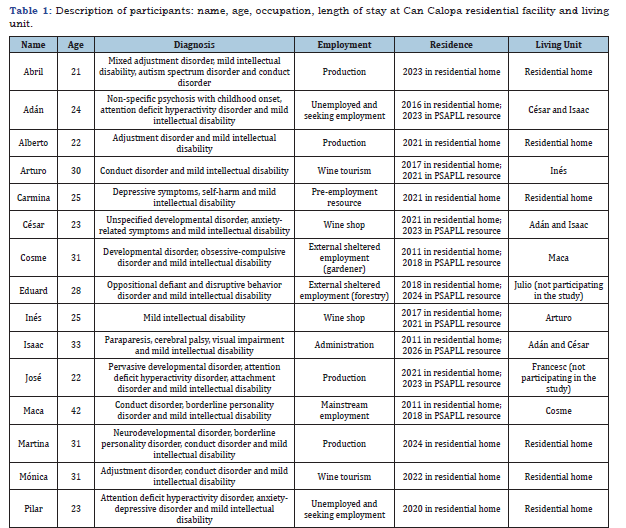
Their lives have been marked by a lack of family and social networks, early institutionalisation and experiences of mistreatment, abandonment, neglect or abuse. The group is immersed in personalized social inclusion and community participation programmes that combine residential living, training and work.
Context
We conducted our research at Can Calopa-l’Olivera, a residential socio-educational resource located in a peri-urban setting in Collserola, Barcelona, which has an interdisciplinary socio-educational team. This space functions as a place of transition and development of autonomy for young people who, for various reasons, are experiencing social exclusion. In this setting, we highlight that the socio-educational relationship is built on a daily basis, on the margins of the formal: during meals, in shared work, in household routines and in those moments of spontaneity that give rise to the emergence of the socio-educational bond.
Information gathering techniques
To access the experiences of young adults and systematize their experiences, we designed a series of moral education activities as strategies to facilitate reflective discourse. These included moral education dynamics such as value clarification, guided autobiographies and critical understanding. All these activities were carried out in an environment of respect, confidentiality and free expression. In addition, non-participant observation, in which we collected data in a phenomenological diary, allowed us to preserve the authenticity of the interactions and capture the subtlest nuances of the socio-educational processes. This seemingly relational and spontaneous space gave us direct access to the meanings attributed by young adults to their accompaniment process, to the figure of the educator as a facilitator of dynamics and to the learnings that emerge in their life trajectories. Table 2 presents a summary of the techniques used for data collection.
Table 2:Information gathering techniques in the phenomenological phase (young adults).

From an ethical standpoint, we requested informed consent and assent from all participants and guaranteed the principles of anonymity, confidentiality and voluntariness. Participation was presented as a free invitation and we ensured an emotionally safe environment in which each young adult could express themselves without fear of being judged or conditioned.
Analysis of the information
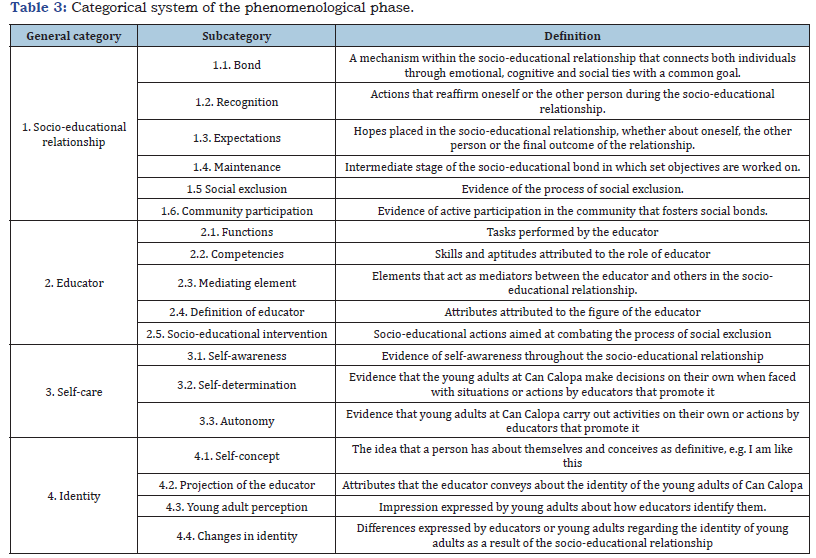
We treated the information collected from a qualitative perspective, i.e., based on content analysis. To do this, we used the NVivo 14.2 program. Content analysis did not allow us to triangulate the voices, dynamics and diary. This approach to the data helped us understand that the narratives provided by the young adults are dependent on the context in which they find themselves [17]. For this reason, the phenomenological diary has been fundamental in understanding and unravelling the elements of interest: the bond, identity and self-care. It is noteworthy that, as a phenomenological process, our interest lay in understanding the experience and, therefore, avoiding inferences from our own worldview. Thus, after an initial analysis based on an initial categorical system, we corroborated the established relationships with the young adults. Finally, we developed a definitive categorical system, (Table 3), which allowed us to carry out the final analysis.
Table 3:Categorical system of the phenomenological phase.
Results and Discussion
The results obtained from the analysis of the testimonies of young adults from Can Calopa reveal the significant role played by educators in their life trajectories. Socio-educational intervention, mediated by the socio-educational relationship, has been perceived as constant accompaniment and a source of emotional, educational and existential support. Far from being isolated or protocol-based actions, young adults identify the interventions as lived experiences that have marked turning points in their personal development.
The intervention of the educator as a reference figure
The presence of the educator is associated with key moments in the process of inclusion and personal growth. From individual meetings, workshops and group dynamics, young people highlight the emotional availability of the professional, their ability to listen, the transmission of confidence and the creation of a safe space. This perception is reflected in statements such as: “They help me to reflect on many issues and the best way to deal with them” (Isaac, autobiography 2024). This highlights the active role of the educator in maintaining the bond and providing emotional support in highly complex situations or when making vital decisions. The narratives highlight unconditional support as a core value in building the bond. From the first contact, the educator is perceived as a welcoming figure who does not judge, who firmly and respectfully upholds rules and who conveys a sense of belonging. This permanent availability not only facilitates the adaptation process, but also allows young adults to feel seen and considered, even in moments of greatest emotional difficulty.
The socio-educational relationship as a mediator of learning
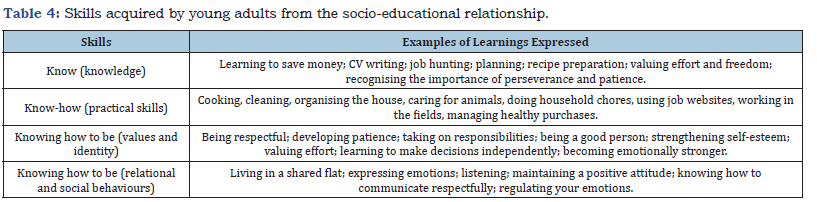
One of the most relevant findings is that learning does not occur in the abstract nor is it limited to the transmission of content, but is closely linked to the figure of the educator. It is in everyday life that young adults recognize that they have acquired skills, values, knowledge and attitudes that enable them to face life’s challenges. A revealing example is José’s statement (autobiography 2024): “I liked him telling me those things... now I cook and I remember him. Sometimes I miss him.” This testimony shows that what leaves a mark is the way in which she was recognized and validated by the educator. In addition, four major dimensions of competencies emerge as a result of the socio-educational relationship: knowledge, know-how, interpersonal skills and social skills. These competencies, detailed in Table 4, provide an understanding of the overall impact of socio-educational intervention. This classification system, in addition to identifying individual competencies, also reveals how the process of enculturation becomes a concrete tool for social inclusion. Young adults, in addition to acquiring functional skills, also highlight cultural codes, modes of relationship, shared norms and ways of interpreting reality that bring them closer to active participation in the community.
Enculturation as the core of socio-educational intervention
Analysis of the data allows us to affirm that the process of enculturation is a cross-cutting process in socio-educational intervention with young adults in contexts of exclusion. Unlike other social relationships, such as those within families or among peers, in which cultural transmission occurs in a non-systematic way, the socio-educational relationship generates intentional, professional and sustained contexts over time, facilitating active and meaningful cultural appropriation. Enculturation appears here as a living process, linked to the creation of bonds, the construction of identity, and the development of self-care. In this context, the figure of the educator acts as a cultural facilitator, someone who accompanies without invading, who offers tools without imposing paths and who, above all, allows the person to feel part of the social fabric.
The research shows how this cultural transmission occurs
through meaningful everyday practices such as cooking workshops.
For example, José recounts:
“I learned to cook with him and to do household chores in the
residence. For example, when I was cooking, he would say to me,
‘That’s good, you’re a star’ and things like that. I liked him saying
those things to me. Now I do them in my flat and I remember
Andrés” (José, autobiography 2024).
This testimony shows how teaching a specific skill-cookingbecomes a validation of identity, where the educator’s recognition leaves a lasting emotional mark. Learning is not limited to technique, but is integrated into emotional memory and becomes part of the young person’s cultural repertoire.
Another significant example is Isaac’s reflection on individual
and group meetings with the educator:
“The individual and flat meetings help me to reflect on many
issues and the best way to deal with them. An example would be
when I meet with my employment advisor to work on my personal
image and we agree that I will buy clothes and look for training
courses” (Isaac, autobiography 2024).
This account reveals how the educator not only provides concrete guidelines-such as seeking training or taking care of personal image- but also places the young adult at the centre of a process of reflection on their role in society and their aspirations.
Enculturation, in this case, is not passive but co-constructed and
responds to an emancipatory logic. Through the systematization of
the learning expressed by young adults, key cultural competencies
are identified that validate the impact of the socio-educational
relationship on the enculturation process. This is reflected in
responses such as:
“to be self-sufficient”, “to know how to live in a flat”, “to calm
down and be a good person”, “that you have to value freedom”, “to
fight for what I want”, “it helped me a lot to keep going”, “to think
positively”, “to be patient”, “to express myself more”, “it has taught
me that I am brave” (Clarification of values, 2024).
These expressions illustrate how young adult’s appropriate essential cultural values: autonomy, effort, coexistence, resilience, emotional expression and appreciation of one’s place in the community, among others. Each of these constitutes a vector of inclusion, belonging, and participation in the community. In other words, through their relationship with the educator, young people not only learn to do or to be, but also reconstruct a cultural narrative that enables them to participate in community life from a new perspective. Furthermore, Table 4 presented above, shows how the knowledge acquired ranges from the functional and technical-such as cooking or looking for work -to the symbolic and relational- such as feeling strong, valuable or capable. In short, the socio-educational process is mediated by interaction and mutual recognition, which reinforces the thesis that the socio-educational relationship is a privileged channel of enculturation. In summary, the results suggest that the process of enculturation is a structural dimension of socio-educational support. It is not enough to learn social norms; rather, the value lies -through socio-educational interaction- in a new way of presenting oneself and participating in the community. This learning, deeply linked to affectivity, security and validation of the other, allows young adults to redefine their trajectories, equip themselves with symbolic and practical tools, and reconstruct their identity in terms of belonging and social inclusion.
Table 4:Skills acquired by young adults from the socio-educational relationship.
Conclusion
The findings of this study confirm that the educator’s intervention in contexts of exclusion is not limited to a set of technical actions, but rather embodies profoundly transformative relational experiences. As stated in the theoretical framework, educators do not act solely as programme implementers, but as facilitators of processes of inclusion, empowerment and autonomy [3].
The data collected show that social skills are not generated in the abstract, but are integrated into the daily life of a socio-educational relationship that offers support, security and recognition. This relationship constitutes an intervention tool in its own right: the context of socio-educational action is the core of the action itself [18]. One of the central elements that emerges from the results is the perception of the educator as an unconditional, approachable and available figure. This quality, identified by young adults from the first contact, constitutes an emotional basis from which learning is solidified and change is facilitated. This connection allows the person to be supported in moments of high complexity and also to activate their personal resources, recognize their abilities and project possible futures [9]. In this sense, enculturation, far from being an abstract concept, is identified in specific learning that young adults recognize they have acquired: from domestic and work skills to personal values such as patience, respect, perseverance and self-care. As Berry JW et al. [4] point out, the process of enculturation involves the progressive incorporation of the codes, values and practices of a given culture, and when this process is intentionally accompanied from a professional perspective, it becomes a key tool for inclusion and community participation. It is important to note that the educator acts as a cultural mediator: they do not impose a hegemonic culture, but rather help young adults to interpret, integrate and, in some cases, redefine it; that is, to conceptualise what culture means to them. Therefore, it requires educators to have specific skills -relational, reflective, ethical and technical- which, as Eslava-Suanes MD et al. [6] point out, shape the professional profile of educators. In this way, the intervention responds to a need and promotes the construction of personal and social identity linked to the community. In this regard, we question the place of social education within the institutional framework. If, as Caride JA et al. [3] indicate, the educator is situated in, with, from, by and for the person and their context, then their role must be recognized as central to the processes of social support. This centrality is reaffirmed when young adults describe the educator as a necessary, though not complacent, agent, valuing their honesty, high standards and ability to generate norms based on recognition.
Likewise, the results invite us to rethink the concept of intervention, not as a specific or corrective action, but as a continuous process of accompaniment. As Planella J [19] states, accompaniment implies time, journey and presence. It is in this temporality that the possibility of transformation lies: the educator does not act on the person, but alongside them. This ethical perspective -supported by affection [7], meaning [20] and recognition [9]-restores dignity to young adults who are experiencing social exclusion and opens up space for new forms of social participation. It is through accompaniment that young adults identify the social skills that facilitate the process of inclusion and, therefore, the achievement of their life projects. In conclusion, this study reaffirms the value of social education as a humanising praxis that articulates technical, ethical and cultural knowledge in the accompaniment of social inclusion processes. The social educator not only offers tools, but also accompanies the construction of narratives, generates links and broadens horizons. Their role, mediated by the socio-educational relationship, becomes an inherent part of the enculturation process that facilitates and promotes community participation and the recovery of an identity damaged by the process of social exclusion. In this sense, the educator does not seek to replace the person, but rather to offer a space, a presence and a reflection that reminds them, every day, of who they are and who they want to be [21-27].
Acknowledgements
The author gratefully acknowledges the L’Olivera Cooperative for their research partnership, which made it possible to conduct socio-educational studies within this context. Special thanks are extended to Dr. Marta Sabariego of the University of Barcelona for her invaluable academic guidance and support throughout the study. The author also sincerely thanks Dr. Fatma Zehra Fidan for her thorough review of the manuscript, which greatly enhanced its quality and clarity.
Conflict of Interest
This study presents no conflicts of interest, as no funding of any kind was received.
References
- Morales M, Puppato DD, Ribó E (2020) Social education: Complementary reflections to the necessary academic training. Hachetepé. Scientific Journal of Education and Communication (20): 79-85.
- Solórzano MR, Armas RD (2019) Social education and social pedagogy in adult education: Their contribution to social development. Revista Estudios del Desarrollo Social: Cuba y América Latina 7(3): 231-245.
- Caride JA, Gradaílle R, Caballo MB (2015) From social pedagogy as education, to social education as pedagogy. Educational Profiles 37(148): 4-11.
- Berry JW, Poortinga YH, Segall MH, Dasen PR (2002) Cross-cultural psychology: Research and applications. (2nd edn), Cambridge University Press, Cambridge, UK.
- Gómez-Redondo C (2014) Diluted frames: Mixtures and suspensions of education and enculturation. Pulso Journal of Education (37): 167-186.
- Eslava-Suanes MD, González-López I, de-León-Huertas C (2018) The professional identity of the social educator through their competency profile. Education in the Knowledge Society 19(1): 53-76.
- Cueto IR (2022) Professional identity and code of ethics in social education. RES Journal of Social Education (35): 192-200.
- Alonso I, Funes J (2009) Social support in socio-educational resources. Social Education Journal of Socio-Educational Intervention (42): 28-46.
- Fryd P, Silva D (2010) Responsibility thought and action: Practicing social education in a fragmented society.
- García-Vita MM, Estefanía M (2013) The prison environment: The care received by female inmates and intramural relationships. Social Pedagogy Interuniversity Journal (22): 43-56.
- Ayala R (2018) The pedagogical relationship: In the sources of educational experience with van Manen. Complutense Journal of Education 29(1): 27-41.
- Viché-González M (2021) On accompaniment change and narrative transformation: Educating for autonomy and self-Management in contexts of solidarity. Quaderns d’Animació i Educació Social (33): 1-14.
- Appiah KA (2005) The ethics of identity 384.
- Mèlich JC (2021) The fragility of the world: Essay on a precarious time. Tusquets Editores.
- Úcar X (2022) Methodology of socio-educational intervention: Some models of socio-educational intervention in Europe. Quaderns d’Animació i Educació Social (35): 1-30.
- Heidegger M (2010) Being and time. In: Trans JS, Schmidt DJ (Eds.), Suny Press.
- Gómez JAC (2002) Building the profession: Social education as an ethical project and civic duty. Social Pedagogy Interuniversity Journal (9): 91-125.
- González CA (2018) Elements for a pedagogy of alterity in the practice of social educators: A narrative study. Theory of Education Interuniversity Journal 30(2): 109-129.
- Planella J (2008) Social education accompaniment and vulnerability: Towards an anthropology of coexistence. Ibero-American Journal of Education 46(5): 1-14.
- Ortega P (2010) Educating is responding to the other's question. Edetania (37): 13-31.
- (2005) National agency for quality assessment and accreditation. White paper Degree in pedagogy and social education.
- Arantza AM (2024) Study on relationships with adults in processes of social exclusion. p. 455.
- (2007) State association of social education & general council of colleges of social professionalizing documents: Definition of social education. Code of ethics for social educators. Catalogue of functions and competencies of social educators.
- Vargas GM, Jesús MLD (2024) Relationships between the perspectives of discursive practices and the production of meanings and the qualitative analysis of thematic categorical content. Latin American Journal of Social Research Methodology: ReLMIS 27(14): 21-24.
- Ruiz M, Santibáñez R (2014) Prison drugs and social education. Social Education Journal of Socio-Educational Intervention (57): 118-134.
- Sennett R (1998) The corrosion of character: The personal consequences of work in the new capitalism. p. 176.
- Manen MV (1997) Researching lived experience: Human science for an action sensitive pedagogy. Open Journal of Nursing (7): 5.
© 2026 Almenta Arantza, This is an open access article distributed under the terms of the Creative Commons Attribution License , which permits unrestricted use, distribution, and build upon your work non-commercially.
Editor In Chief







.jpg)






























Signup for Newsletter

Quick Links
 Editorial Board Registrations
 Submit your Article
 Best Paper of the Volume
 Reprints
 Refer a Friend
 Advertise With Us
Our Recent Edition

.jpg)



Top Editors




.jpg)
















.bmp)
.jpg)
.png)
.jpg)













.jpg)





.png)

.png)




.png)




Financial Support

Sponsors

Latest e-Books

Latest Video

 a Creative Commons Attribution 4.0 International License. Based on a work at www.crimsonpublishers.com.
Best viewed in
a Creative Commons Attribution 4.0 International License. Based on a work at www.crimsonpublishers.com.
Best viewed in 
 | Above IE 9.0 version