

- About Us
- Information
-

The Author ensures that the research has been conducted responsibly and ethically with adherence to all relevant regulations. read more..
- For Authors
- For Reviewer
- Manuscript Guidelines
- Membership
- Publication Ethics
-
- Journals
- Reprints
- e-Books
- Videos
- Policies
- Contact Us
 COVID-19
- Submissions



Full Text
Open Journal of Cardiology & Heart Diseases
Valve Replacement in Pregnancy: Clinical Outcomes and Management Insights-A Case Series
Hina Inam1*, Syed Shamair Ali Rizvi2, Varisha Madni2, Abiha Khurram3, Lumaan Sheikh4 and Saulat Fatimi1
1 Cardiothracic Surgery, Aga khan University Hospital, Pakistan
2 Aga Khan University Hospital, Pakistan
3 Dow University of Health Sciences, Pakistan
4 Gynecology and Obstetrics, Aga khan University Hospital, Pakistan
*Corresponding author: Hina Inam, Cardiothracic Surgery, Aga khan University Hospital, Pakistan
Submission: March 12, 2025;Published: June 01, 2026

ISSN 2578-0204Volume5 Issue 2
Abstract
Background: Cardiac surgery during pregnancy presents unique challenges due to physiological changes,
anticoagulation dilemmas, and fetal risks, especially in Low-and Middle-Income Countries (LMICs) where
delayed referrals and limited resources complicate care.
Objective: To describe maternal and fetal outcomes of pregnant and postpartum women undergoing
cardiac surgery at a tertiary care center in Pakistan, emphasizing management strategies applicable in
resource-limited settings.
Methods: We report a case series of eight women who underwent cardiac surgery during or shortly after
pregnancy at the Aga Khan University Hospital. Clinical presentations, operative details, and postoperative
outcomes were analyzed. Cases included mitral and aortic valve replacements, redo procedures, and
emergency interventions.
Results:
1. A total of 8 patients underwent cardiac surgical interventions during pregnancy or the
postpartum period. The mean age was approximately 32 years (range: 26-38 years).
2. Most patients presented during pregnancy (n=5), at gestational ages ranging from 14 to 28
weeks, while 3 patients were operated in the postpartum period (ranging from 6 days to 2 weeks
post-delivery). One patient had an intrauterine device in situ, and one case involved a twin pregnancy.
3. Mitral Valve Replacement (MVR) was the most commonly performed procedure (n=4 isolated
MVR), while combined procedures included AVR+MVR (n=1), DVR (n=1), VSD closure+AVR (n=1),
and aortic root replacement (n=1). The majority of valves used were bioprosthetic (tissue valves),
with one case requiring a mechanical valve.
4. The mean Cardiopulmonary Bypass (CPB) time ranged from 100 to 235 minutes, and crossclamp
time ranged from 65 to 180 minutes. Minimum intraoperative temperatures varied between
28.3 °C and 35 °C, reflecting tailored hypothermia strategies.
5. Despite the complexity of cases, including redo surgery and combined procedures, surgical
interventions were successfully performed across all patients
Conclusion: Cardiac surgery during or soon after pregnancy can be successfully performed in LMICs through a structured multidisciplinary approach and adherence to evidence-based perioperative principles. This series highlights that high-quality care for critically ill pregnant cardiac patients is not only possible in resource-limited environments, but achievable to a standard of excellence.
Keywords: Pregnancy; Cardiac surgery; Valve replacement; Cardiopulmonary bypass; Maternal Outcomes; LMIC; Multidisciplinary Care
Introduction
Cardiac conditions affect 2-4% of pregnancies, with rheumatic mitral disease as the most common acquired heart ailment [1]. Mitral stenosis is a leading valve-related issue. While maternal mortality rates are comparable to non-pregnant women, fetal mortality remains high due to cardiopulmonary bypass [1]. Pregnant patients undergoing CPB face a non-physiological hemodynamic state with uncertain tolerance, posing risks to both mother and fetus [2]. Cardiac conditions affect 2-4% of pregnancies, with rheumatic mitral disease being the most common in developing countries [1]. Mitral stenosis is a major concern. While maternal mortality is comparable to non-pregnant women, fetal mortality remains high with CPB [1,2]. CPB induces a non-physiological hemodynamic state, posing risks to both mother and fetus [2].
CPB during pregnancy can impact both mother and fetus due to non-pulsatile flow, increased oxygen levels, and heparin use, which may affect the placenta. Pregnancy-related cardiovascular strain is generally tolerable in mild to moderate mitral stenosis, but severe cases risk complications like hemoptysis, atrial fibrillation, and pulmonary edema [3]. Fetal morbidity with CPB is higher at earlier gestational ages and with greater hypothermia. While open-heart surgery is ideal between 24-28 weeks, it can be performed at any stage [3,4].
Maintaining acid-base balance, optimal anesthesia, and drug dosing is crucial in pregnant patients undergoing open-heart surgery. CPB should use high flow rates, high perfusion pressure, and normothermia or mild hypothermia. Minimizing aortic cross-clamp and CPB duration is essential, along with continuous cardiotocographic monitoring [4]. These cases span a period of 13 years and reflect the progression in care and outcomes across over a decade of critical surgeries.
Case Presentations
Case 1
History: A 31-year-old pregnant woman at 28 weeks’ gestation presented at our hospital with the presenting complaint of palpitations, dyspnea, orthopnea and bilateral pedal edema for two months.
Examination: Her physical examination was unremarkable.
Workup: On further diagnostic testing, echocardiography revealed severe mitral stenosis, mild to moderate mitral regurgitation, severe tricuspid regurgitation, mild pulmonary regurgitation, severe pulmonary hypertension and right ventricular dysfunction.
Management: The patient was admitted to cardiology and later to the CCU, where she was managed for heart failure with input from CTS and obstetrics. A mitral valve replacement was planned by the surgical team and she underwent replacement with a 28mm tissue valve. Intraoperatively, the aortic cross-clamp time was 100 minutes and the bypass time was 134 minutes. The patient was kept at a minimum temperature of 34 °C. The surgical procedure was successful.
The patient received inotropic support and was shifted to the CICU. She was extubated the next day, mobilized, and had chest tubes and pacing wires removed. Continuous CTG monitoring remained reactive. Stable pre-discharge labs and a fetal growth scan confirmed a viable fetus at 27 weeks and 4 days. She was discharged in stable condition and delivered a healthy male fetus a few weeks later at a different institute.
Case 2
History and physical examination: A 38-year-old female, in her 23rd week of gestation, presented to the clinic with dyspnea and palpitations. His Examination was unremarkable.
Workup: Further diagnostic testing, including ECG and echocardiography, showed severe aortic stenosis, aortic regurgitation, and mild mitral regurgitation. Moreover, there was a mild echogenic density on the atrial aspect of the anterior mitral leaflet along with a dilated left atrium. Severe calcifications of both the aortic and mitral valves were seen in the excised tissues postoperatively.
Management: After a standard preoperative protocol, the patient underwent Aortic and Mitral Valve replacements with OB/GYN involvement throughout the process. The Mitral Valve was replaced with a 27mm tissue valve, and the Aortic Valve was replaced with a 21mm tissue valve. Intraoperatively, the aortic cross-clamp time was 120 minutes, and the bypass time was 150 minutes. The patient was kept at a minimum temperature of 35 °C.
The surgery was successful. Chest tubes and pacing wires were placed, and postoperatively, the patient was kept on inotropic support and was shifted to the CICU. She was extubated the next day, and chest and cardiac physiotherapy were started, both of which were well tolerated. Immediate postoperative fetal viability was confirmed along with normal fetal cardiac function. The patient was then moved to step-down, where wires were successfully removed, and the stable patient was discharged 6 days after surgery. The patient remained healthy and delivered a live, female fetus.
Case 3
History and physical examination: A 35-year-old woman at 22 weeks’ gestation presented to our hospital with progressive dyspnea, chest tightness and palpitations alongside gestational amenorrhea. Physical examination was unremarkable.
Workup: Further diagnostic testing revealed severe mitral stenosis, moderate to severe mitral and tricuspid regurgitation, severe pulmonary hypertension, and a dilated left atrium with preserved ventricular function (EF 60%). Chest X-ray showed early pulmonary edema and cardiac enlargement.
Management: A surgical procedure was planned immediately. After optimization, she underwent mitral valve replacement with a 27mm tissue valve. Intraoperatively, the aortic cross -clamp time was 65 minutes, the bypass time was 100 minutes, and the patient was kept at a minimum temperature of 33 °C.
The surgery was successful. Postoperatively, she was kept on inotropic support in the CICU, extubated the next day, and transitioned to step-down care. Obstetric reviews were performed daily. Following cardiac and pulmonary rehabilitation, she was discharged five days post-op in a hemodynamically and vitally stable state. The patient delivered a live infant and was healthy postpartum.
Case 4
History and physical examination: A 36-year-old pregnant patient, gravida 3 para 2, presented to the outpatient clinic with progressively increasing shortness of breath and chest pain for 2 months. On physical examination, she was lying in discomfort on the bed and was tachypneic. Her pulse rate was high, and she appeared pale. There was also visible cyanosis, clubbing, and edema. Furthermore, the patient had a history of childhood rheumatic fever, for which she had been admitted to the hospital multiple times with similar symptoms.
Workup: On admission, her echocardiogram revealed a severely dilated left atrium with preserved Left Ventricular Systolic function. Mild aortic regurgitation, moderate mitral stenosis, severe mitral and tricuspid regurgitation were noted. She had severe pulmonary hypertension with an Ejection Fraction of 55-60%.
Management: The patient underwent LSCS and delivered a baby boy on the 4th of January before undergoing Mitral Valve Replacement surgery exactly a week later. Her post-operative care was uneventful and she was discharged on the 18th.
The patient returned to the hospital 12 years later, in December 2023, with complaints of shortness of breath and pulmonary edema. Echocardiography showed vegetations on the bioprosthetic valve alongside moderate mitral regurgitation. There was a severe dilation of both atria, flail bioprosthetic mitral leaflet and ruptured chordae tendineae with severe mitral regurgitation. The patient’s right ventricle was mildly dilated with reduced systolic function. The diagnosis of Infective Endocarditis was made and the patient was counselled on possible surgical interventions that could have been undertaken, but she wanted to go home and so was discharged on request.
Case 5
History and examination: A 27-year-old pregnant female, who was a known case of VSD, presented to the Outpatient Clinic with increasing shortness of breath and fever for 5 days and hemoptysis for 3 days. The patient also presented with acute Rheumatic Fever, pregnancy-induced hypertension, an IUD and Pulmonary Edema. Unfortunately, there was also a preoperative intrauterine loss of the fetus.
Management: After a standard preoperative preparation, the patient underwent peri membranous VSD closure of 6mm with a Dacron patch and AVR with a 23mm bioprosthetic graft. The aortic cross-clamp time was 100 minutes, the bypass time was 110 minutes, and the patient was kept at a minimum temperature of 33 °C.
Postoperatively, the patient remained in CICU where initial monitoring and early management was provided. She stayed there for a few days before being shifted to step -down. There were some post operative complications which included VRE in her urine for which she was managed until she was vitally stable and discharged.
Case 6
History and examination: A 22-year-old patient presented to an outpatient clinic with gradually increasing shortness of breath over 3 months, productive cough and pre -eclampsia at the gestational age of 32 weeks. The patient had preexisting hypertension.
Workup: Her further diagnostic testing, it was revealed that the patient had severe aortic regurgitation, mitral stenosis, mitral regurgitation, tricuspid regurgitation and rheumatic heart disease.
Treatment: Our patient had undergone emergency LSCS 6 days before presenting with these symptoms, and her workup showed a normal ejection fraction with severe dilation of both atria and severe aortic regurgitation. The echo also showed severe mitral stenosis with moderate to severe regurgitation. There was severe tricuspid regurgitation with mild pulmonary regurgitation and severe pulmonary artery hypertension, as well.
After CTS was taken on board, the patient underwent the standard preoperative procedure before being shifted to the OR for a DVR procedure with tissue valves. The DVR procedure consisted of replacement of the aortic and mitral valves with 19mm and 27mm prostheses, respectively. Chest tubes and pacing wires were placed in the patient. The aortic cross-clamp time was around 160 minutes; bypass time was 195 minutes, and the patient was kept at a minimum temperature of 29 °C.
Postoperatively, our patient was kept on inotropic support and shifted to the CICU. She was successfully extubated the next day and was made to do chest physio, which was well tolerated. She was shifted to step-down, pacing wires were removed and Cardiac physio was performed before discharging the stable patient.
Case 7
History: A 30-year-old woman, who had given birth 2 weeks before, presented to the ER department with complaints of shortness of breath and chest pain that radiated to the shoulder for 2 weeks.
Workup: Echocardiography and further testing showed mild to moderately reduced left ventricular systolic function with grade II diastolic dysfunction. There was severe aortic regurgitation, moderate mitral regurgitation, and severe tricuspid regurgitation. The patient also had a patent foramen ovale with a left-to-right shunt and a severely dilated aortic root. The Right Atrium was severely dilated with left atrium and right ventricle moderately dilated.
Treatment: After standard preoperative preparation, she was shifted to the OR where she underwent Aortic Root Replacement with a 28mm graft containing a 25mm metallic valve. Intraoperatively, the aortic clamp time was 110 minutes, the bypass time was 160 minutes, and the patient was kept at a minimum temperature of 28.3 °C. Chest tubes and pacing wires were placed, and she was kept on inotropic support before being shifted to CICU. The patient was started on Warfarin postoperatively with PT monitoring before being discharged when stable.
Case 8
History: This case presents the complex management of a 31-year-old woman with a dichorionic diamniotic twin pregnancy at 14 weeks’ gestation who required redo Aortic Valve Replacement (AVR) due to severe prosthetic valve stenosis from pannus formation. She had a history of mechanical AVR in childhood and had discontinued anticoagulation years prior.
Workup: Following a failed attempt at thrombolysis, she was referred for surgical intervention. Multidisciplinary preoperative planning involved cardiology, obstetrics, cardiothoracic surgery, and anesthesiology teams, with careful assessment of maternal and fetal risks. The surgery was timed in the second trimester to optimize outcomes.
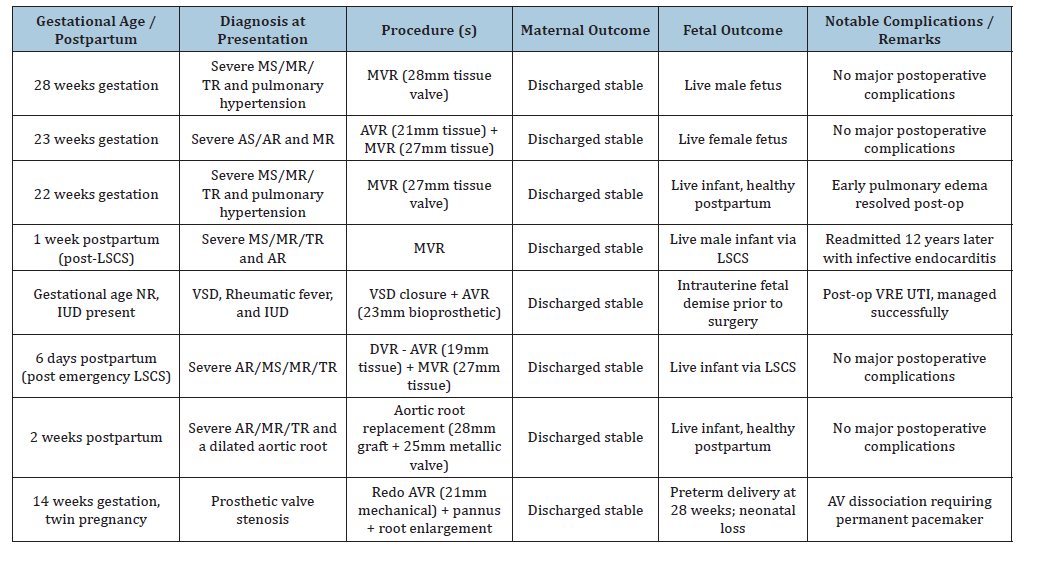
Treatment: The patient underwent full sternotomy, explantation of the old valve, resection of subaortic pannus, and aortic root re-enlargement using a bovine pericardial patch to accommodate a new 21mm bileaflet On-X mechanical valve. The procedure was prolonged due to technical challenges, with total CPB and cross-clamp times of 235 and 180 minutes, respectively. Intraoperative management included high-flow, mild hypothermic CPB, meticulous perfusion pressure control and anesthetic strategies tailored to maintain uteroplacental circulation. Postoperatively, the patient developed AV dissociation requiring permanent pacing. Despite preterm delivery at 28 weeks with neonatal loss, the mother remained hemodynamically stable, highlighting the importance of coordinated multidisciplinary care in managing high-risk cardiac surgery during twin pregnancy (Table 1&2).
Table 1:Patient characteristics and intraoperative details.
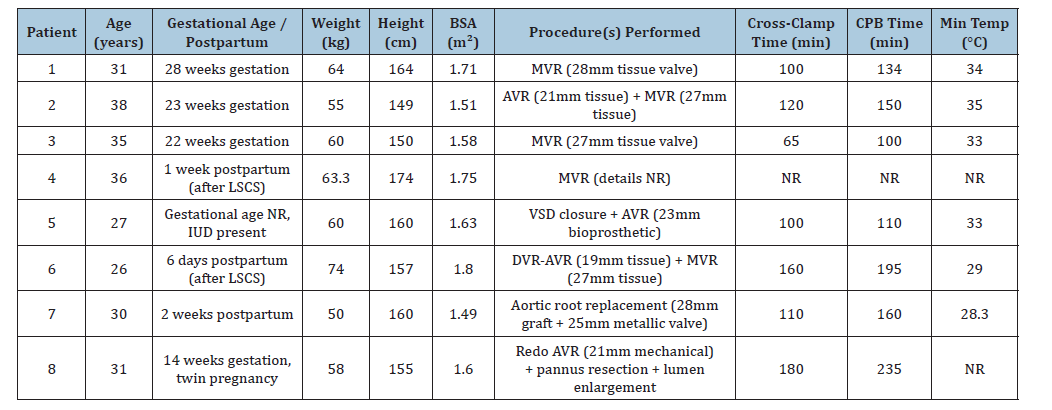
Table 2:
Discussion
Cardiovascular (CV) disease affects approximately 1% to 4% of all pregnancies and is the leading cause of mortality among pregnant and postpartum women in the United States [5]. Valvular heart disease is a frequent contributor to Cardiovascular (CV) disease in women of childbearing age [6]. Most women with valvular heart disease tolerate pregnancy well, but high-risk conditions, such as severe Mitral Stenosis (MS) or Aortic Stenosis (AS), can lead to substantial maternal morbidity and mortality. Additionally, it has been established that maternal CV disease is now the leading cause of non-obstetric mortality in pregnant women with every third pregnancy-related death being associated with CVD worldwide. In women with pre-existing CVD, up to 16% of pregnancies are complicated by CVD [7-10]. Furthermore, in terms of classifications, the updated ACOG and ESC ROPAC registery guidelines for cardiac conditions in pregnancy classifies women with moderate to severe valvular lesion-moderate to severe stenosis- as WHO risk class IIIIV, which requires management at tertiary centers with immediate surgical capability and multidisciplinary oversight [10,11].
Managing anticoagulation in pregnant women with mechanical heart valves poses unique challenges aimed at minimizing maternal and fetal complications [11]. This case series highlights the complexity of managing valvular heart disease and associated complications in pregnant or recently postpartum women, a scenario that poses significant risks to both maternal and fetal outcomes.
Women with Valvular Heart Disease (VHD) experienced a high rate of clinical deterioration and a significant increase in adverse events during pregnancy. These included Congestive Heart Failure (CHF), arrhythmias and the need for either initiation or escalation of cardiovascular drug therapy or hospitalization. The heightened incidence of CHF in VHD patients is expected due to the substantial hemodynamic changes that naturally occur during pregnancy [12]. Our series corroborates this, as most patients presented with dyspnea and decompensated heart failure secondary to advanced valvular pathology. An increased occurrence of cardiac arrhythmias has also been documented in healthy women during pregnancy, which may be attributed to hormonal changes and heightened sensitivity to catecholamines during gestation [13]. Although pregnancy itself can predispose to benign arrythmias, no significant arrythmias were seen in our patients, reflecting upon effective perioperative hemodynamic stabilization and monitoring.
Moreover, the timing and mode of delivery should be determined through a collaborative discussion between the obstetrician, cardiologist, and obstetric anesthesiologist. According to most guidelines, vaginal delivery with appropriate anesthesia and a shortened second stage is considered safe for most patients with Valvular Heart Disease (VHD). Cesarean section, which carries a higher risk of complications, should generally be reserved for obstetric indications or cases of cardiac instability [13]. In our patients, we had a variety of delivery methods, highlighting the challenges where ideal conditions aren’t always controllable, all producing outstanding maternal outcomes. Studies have shown that “women with MCD were more likely to undergo cesarean delivery”, but our patients were well distributed across various delivery methods. Studies also showed that “patients who delivered by cesarean delivery in the setting of maternal cardiac disease had 24.38-fold higher adjusted odds of severe maternal morbidity” but through careful perioperative care, intense intraoperative monitoring, and careful toeing of the line between maternal and fetal care during intense cardiac surgery, our case series had no maternal complications [14]. Hemodynamic monitoring during labor and delivery is recommended for symptomatic patients, as well as those with moderate to severe valvular stenosis, left ventricular dysfunction, or pulmonary hypertension.
Women with valvular heart disease, especially those with leftsided obstructive lesions, have limited cardiac reserve to handle pregnancy-related hemodynamic changes, necessitating close monitoring for decompensation. Increased blood flow may elevate transvalvular gradients, potentially overestimating lesion severity, with valve planimetry offering a more accurate assessment in some cases. Additionally, pregnancy’s hypercoagulable state heightens the risk of thromboembolic events, complicating anticoagulation management, particularly for women with mechanical heart valves [15]. In one of our cases, in order to circumvent the use of anticoagulants during pregnancy, bioprosthetic valves were used, but the use of long-term valve is a potential concern, as seen in case 4, where infective endocarditis complicated the bioprosthetic valve.
The choice between mechanical and bioprosthetic valves in women of reproductive age presents a critical challenge of management between long-term durability and anticoagulationrelated risks. Mechanical valves offer superior long-term durability but necessitate lifelong anticoagulation, exposing both the mother and fetus to risks of bleeding, thromboembolism, and warfarin embryopathy. Bioprosthetic valves, while avoiding the teratogenic risks of warfarin and allowing pregnancy without continuous anticoagulation, carry a higher likelihood of structural valve degeneration, particularly accelerated during pregnancy [16,17]. The shorter life span of bioprosthetic valves is seen in Case 4, where the patient became symptomatic with valve pathologies after just 12 years. According to the ESC and ACOG guidelines, women planning future pregnancies are generally advised to opt for bioprosthetic valves if feasible, especially in the mitral position, whereas mechanical valves may be preferred in those requiring multiple pregnancies to be avoided or with contraindications to reoperation such as redo operations (Case 8). Data from the ROPAC registry and recent meta-analyses underscore that maternal outcomes are comparable between valve types, but fetal loss and hemorrhagic complications are more common with mechanical valves, primarily due to anticoagulation challenges [18]. Thus, valve selection must be individualized, integrating patient preference, surgical expertise, access to anticoagulation monitoring, and longterm reproductive planning [10,11,15].
A systematic review examining pregnancy outcomes in women with heart valve prostheses, focusing on anticoagulation regimens, reported a maternal mortality rate of 2.9% (95% CI 1.9-4.2%) in pregnancies involving mechanical valves. Other complications included major bleeding (2.5%, 95% CI 1.7-3.5%) and thromboembolic events (3.9-33.3%, depending on anticoagulation regimen) [15]. However, a study from New South Wales (NSW) found lower complication rates and no maternal mortality, despite a higher perinatal mortality rate compared to pregnancies without valve prostheses. This improvement likely reflects advances in valve technology, with fewer thrombogenic cage-and-ball valves and increased use of bioprosthetic valves [15]. Our cohort’s absence of maternal mortality contrasts favorably with these statistics, suggesting that structured postoperative care-including early extubation, physiotherapy and hemodynamic optimizationcan offset the intrinsic risks of CPB during pregnancy. However, the variable fetal outcomes observed (ranging from normal growth to neonatal demise) underscore the persistent vulnerability of the fetus despite maternal recovery. These outcomes are consistent with reports in the literature indicating that fetal complications, including preterm delivery, growth restriction and stillbirth, are common in pregnancies complicated by maternal cardiac conditions. This variability also underscores the importance of individualized risk assessment and vigilant monitoring.
Moreover, this case series registers unique challenges in managing valvular heart disease during pregnancy, including the younger age of presentation due to inadequately treated rheumatic heart disease, diverse surgical interventions tailored to complex cases, and the need for long-term follow-up to address complications like bioprosthetic valve degeneration and infective endocarditis. Furthermore, very few cases of mitral valve replacement during pregnancy have been reported in the literature, underscoring the significance of this case series in contributing to existing knowledge. Key management aspects include balancing maternal and fetal risks when deciding on surgery during pregnancy, careful anticoagulation for mechanical valve patients and rigorous postoperative care involving early ambulation, physiotherapy, and vigilant monitoring to ensure optimal recovery.
This case series adds valuable insight to existing literature by highlighting eight diverse presentations of cardiac surgery performed during or shortly after pregnancy, including complex double-valve and redo procedures-cases that are rarely reported from Low-And Middle-Income Countries (LMICs). Although limited by its small sample size and the inherent constraints of a case series design, it reflects real-world challenges faced in LMIC settings, where patients often present late after being misdiagnosed or inadequately managed at smaller centers. Despite these limitations, our experience demonstrates that with multidisciplinary coordination, timely intervention and adherence to evidence-based perioperative principles, high-quality outcomes for critically ill pregnant and postpartum patients are achievable even in resourcelimited environments.
Conclusion
This case series underscores that successful cardiac surgery during or shortly after pregnancy is feasible even in resourcelimited settings when managed through a multidisciplinary approach guided by evidence-based protocols. Despite the logistical and diagnostic challenges common in LMICs, timely surgical intervention and careful perioperative planning can yield outcomes comparable to international standards. Our experience reinforces the need for structured referral pathways, preconception counseling, and regional centers of excellence to optimize care for pregnant patients with critical cardiac disease.
References
- Kikon M, Dutta Choudhury K, Prakash N, Gupta A, Grover V, et al. (2014) Mitral valve replacement in a young pregnant woman: A case report and review of literature. Res Cardiovasc Med 3(2): e17561.
- Bernal JM, Miralles PJ (1986) Cardiac surgery with cardiopulmonary bypass during pregnancy. Obstet Gynecol Surv 41(1): 1-6.
- Arnoni RT, Arnoni AS, Bonini RCA, de Almeida AFS, Neto CA, et al. (2003) Risk factors associated with cardiac surgery during pregnancy. The Annals of Thoracic Surgery 76(5): 1605-1608.
- Strickland RA, Oliver WC Jr, Chantigian RC, Ney JA, Danielson GK (1991) Anesthesia, cardiopulmonary bypass, and the pregnant patient. Mayo Clin Proc 66(4): 411-429.
- Hosain N, Amin F, Rehman S, Koirala B (2017) Know thy neighbors: The status of cardiac surgery in the South Asian countries around India. Indian Heart J 69(6): 790-796.
- Al-Taweel A, Almahmoud MF, Khairandish Y, Ahmad M (2019) Degenerative mitral valve stenosis: Diagnosis and management. Echocardiography 36(10): 1901-1909.
- Creanga AA, Syverson C, Seed K, Callaghan WM (2017) Pregnancy-related mortality in the United States, 2011-2013. Obstetrics and Gynecology 130(2): 366-373.
- Majmundar M, Doshi R, Patel KN, Zala H, Kumar A, et al. (2023) Prevalence, trends, and outcomes of cardiovascular diseases in pregnant patients in the USA: 2010-19. European Heart Journal 44(9): 726-737.
- Susy K, Yacoub M (2021) Cardiovascular adverse events in pregnancy: A global perspective. Global Cardiology Science & Practice 2021(1): e202105.
- Backer JD, Haugaa KH, Hasselberg NE, de Hosson M, Brida M, et al. (2025) 2025 ESC Guidelines for the management of cardiovascular disease and pregnancy. Developed by the task force on the management of cardiovascular disease and pregnancy of the European Society of Cardiology (ESC) Endorsed by the European Society of Gynecology (ESG). European Heart Journal 46(43): 4462-4568.
- Moussa HN, Rajapreyar I (2019) ACOG practice bulletin No. 212: Pregnancy and heart disease. Obstetrics & Gynecology. 134(4): 881-882.
- Roos-Hesselink J, Baris L, Johnson M, Backer JD, Otto C, et al. (2019) Pregnancy outcomes in women with cardiovascular disease: Evolving trends over 10 years in the ESC Registry of Pregnancy and Cardiac disease (ROPAC). Eur Heart J 40(47): 3848-3855.
- Chan WS, Anand S, Ginsberg JS (2000) Anticoagulation of pregnant women with mechanical heart valves: A systematic review of the literature. Arch Intern Med 160(2): 191-196
- E Braunwald (1997) Valvular heart disease. In: E Braunwald (Ed.), Heart Disease. 5th (edn), WB Saunders, Philadelphia, USA, pp: 1007-1076.
- Gavin NR, Federspiel JJ, Boyer T, Carey S, Darwin KC, et al. (2023) Mode of delivery among women with maternal cardiac disease. J Perinatol 43(7): 849-855.
- Kamel H, Navi BB, Sriram N, Hovsepian DA, Devereux RB, et al. (2014) Risk of a thrombotic event after the 6-week postpartum period. New England Journal of Medicine 370(14): 1307-1315.
- Jeejeebhoy FM (2009) Prosthetic heart valves and management during pregnancy. Can Fam Physician 55(2): 155-157.
- Rizvi SS, Safdar MN, Iqbal S, Baloch F, Masheer S, et al. (2025) Redo aortic valve replacement in twin pregnancy: Navigating high-risk cardiac surgery with maternal and fetal success–a case report. International Journal of Surgery Case Reports 137: 112070.
© 2026 Hina Inam. This is an open access article distributed under the terms of the Creative Commons Attribution License , which permits unrestricted use, distribution, and build upon your work non-commercially.
Editor In Chief







.jpg)































Signup for Newsletter

Quick Links
 Editorial Board Registrations
 Submit your Article
 Best Paper of the Volume
 Reprints
 Refer a Friend
 Advertise With Us
Our Recent Edition

.jpg)



Top Editors




.jpg)

















.bmp)
.jpg)
.png)
.jpg)













.jpg)






.png)

.png)




.png)




Financial Support

Sponsors

Latest e-Books

Latest Video

 a Creative Commons Attribution 4.0 International License. Based on a work at www.crimsonpublishers.com.
Best viewed in
a Creative Commons Attribution 4.0 International License. Based on a work at www.crimsonpublishers.com.
Best viewed in 
 | Above IE 9.0 version